Showing posts with label immigration. Show all posts

Friday, 20 January 2012

Video: In US, another gay bi-national couple faces deportation


Via Towleroad

22 years after they first met, Mark and Frédéric, now with four children, faced a hearing at the United States Citizenship and Immigration Services office in Philadelphia to be interviewed in connection with the marriage-based immigration petition they filed last summer.

If the petition is not accepted, the family will be forced to leave the country. They will not separate. All because the federal government does not recognize same-sex married couples under DOMA and outdated immigration laws.

Stop the Deportations has a lengthy, detailed story on the couple's struggle.

And CNN has just done a story on Mark and Frédéric and their family.


Israel refuses citizenship for Israeli man's husband

Maayan Zafrir, an Israeli citizen, and his husband Felipe Javier Episcopo
Source: Dos manzanas via Google translate

Israel has refused to grant citizenship to a Uruguayan citizen married since 2008 with an Israeli. The couple, who have two young children, may be forced to appeal to the country's Supreme Court, which in 2006 accepted the request of five gay couples married to Israeli nationals abroad who asked to see their marriage recognized and forced the administration to register their marriages. What happened once again highlighted the complexity and paradoxical nature of the rules in matrimonial matters in Israel.

Felipe Javier Episcopo and Maayan Zafrir met online in 1999 and have lived together in Israel since 2001, where they are legally recognized as a couple, according to Israeli law. Episcopo legally immigrated to Israel where he was initially granted a visa and work permit in 2005 and obtained a temporary residence permit. In 2008 the couple married in Canada. Initially, there were no problems, the authorities accepted the marriage and updated the status of both. However, when Episcopo applied for citizenship (continued temporary residence permit), the Ministry of Interior refused to fully recognize the marriage, citing as the reason the existence of a regulation that defines marriage as the union of a man and a woman and rejected the request.

The couple is thus confronted with the paradox that the state recognizes marriage only in part. Zafrir denounced the attitude of the Ministry of Interior, stating that what most concerns him are his children (two years old twins) because, as things stand, if he died Felipe could no longer care for them. The couple spoke to New Family, an advocacy group fighting for LGBT rights. The group's founder, Irit Rosenblum, has denounced what he considers "a clear case of discrimination." "It is difficult to understand why the state has to act as discriminatory and humiliating, since the couple are already recognized," he said, noting that they are willing to go to the Supreme Court.

Last September we reported here in dosmanzanas the Israeli Interior Ministry decision to grant Israeli citizenship to Bayardo Alvarez, the non-Jewish spouse of a gay marriage. It was a historic decision, the first time that the 'law of return' was applied to a gay marriage. However, a ministry spokesman stressed that the decision would not necessarily be similar in other cases.

The law on marriage in Israel
 
What happened once again highlighted the need for reform of marriage laws in Israel. This is a situation that does not, of course, apply only to same-sex couples. In December, for example, the Ministry of Interior  refused entry to the country to the Nigerian husband of an Israeli woman, calling him 'just a sperm donor'.

In Israel there is only religious marriage, and most of the population used to join the rabbinate as Jewish orthodoxy (religious marriages may also be held Christians or Muslims). If a heterosexual couple wants to marry Israeli in a non-religious ceremony they must do so abroad, and then apply for registration in Israel. Many, in fact, of those who choose to cross the border to celebrate a secular marriage do it in Cyprus. According to polls, two thirds of the Israeli population supports the adoption of a civil marriage law. However, last year the Knesset (Israeli parliament) again rejected a proposal to that effect.
Enhanced by Zemanta

Tuesday, 17 January 2012

Report: Inadequate legal representation for migrants in New York

Source: New York Times

By Kirk Semple

They are often poorly prepared or make incoherent arguments in court. Some fail to present key evidence or witnesses. Others simply do not show up.

The performance of many lawyers who represent immigrants facing deportation in New York has long been considered mediocre. But in a new report that seeks to measure the extent of the problem, immigration judges themselves step forward and offer a scathing assessment of much of the lawyering they have witnessed in their courtrooms.

Immigrants received “inadequate” legal assistance in 33 percent of the cases between mid-2010 and mid-2011 and “grossly inadequate” assistance in 14 percent of the cases, the judges said. They gave private lawyers the lowest grades, while generally awarding higher marks to pro bono counsel and those from nonprofit organizations and law school clinics.

The study was conducted by a group of lawyers and researchers under the auspices of Robert A. Katzmann, a federal appellate judge in New York City. A year ago, they began sifting through government data and surveying immigration judges in an attempt to measure the quality and availability of legal representation for immigrants facing deportation.

Their report will be published this week in the Cardozo Law Review, a publication of the Benjamin N. Cardozo School of Law at Yeshiva University in Manhattan.
“We began this effort with an intuitive sense of the scale of the problem,” the report says. “The numbers sadly bear out that intuition in the starkest form.”

Wednesday, 11 January 2012

French government 'tighten' asylum and migration policy

Deutsch: Nicolas Sarkozy bei seiner Toulouser ...
Image via Wikipedia
Source: France24

By Ségolène Allemandou

As he presented his party’s campaign platform ahead of next year’s presidential and legislative elections, French Interior Minister Claude Gueant laid down the gauntlet to the far right by hardening the government’s position on immigration.
“It’s easier for immigrants to integrate if there are less of them,” Gueant told Europe 1 radio. “It’s obvious that we need to better manage the flow of immigrants. For immigration to work, we need to be welcoming fewer immigrants each year.”
The statement echoed the priority given to immigration issues during French President Nicolas Sarkozy’s successful 2007 election campaign. But it also rekindled accusations that the UMP, France’s ruling party, is trying to steal a march on France’s far-right National Front (FN) by playing the anti-immigration card.

According to recent opinion polls, the FN’s presidential candidate Marine Le Pen enjoys support ranging between 16% and 20% among French voters. For his part, the current president benefits from marginally less support than his main opponent Socialist Party candidate Francois Hollande, whom pollster LH2 gave 30% (a drop of nine points since he won the Socialist party primaries) in a survey last week.

As a result, Sarkozy - who has yet to officially announce his candidature - has a lot of ground to make up, especially among right wing swing voters.
“The UMP is once more taking up its 2007 strategy of hunting on FN territory”, Jerome Fouquet, co-director of the French pollster IFOP told FRANCE 24.
Among the measures “for better management of the flow of immigrants” announced by Gueant are a toughening of the conditions necessary to obtain French citizenship and of the rules allowing an immigrant living in France to be joined by family members.

Other measures include increasing the number of expulsions of illegal immigrants and increasing the capacity of detention centres.

On November 27, Gueant announced that he wanted to reduce the number of legal immigrants coming to France annually from 200,000 to 180,000, a 10% decrease. (“Legal immigration” includes individuals coming to France on work and study visas and those seeking asylum).

After toughening the conditions on work and study visas, Gueant announced last week reforms to the asylum system in France, including a reduction in the asylum budget and a shortening of the time frame during which asylum applications have to be made. Currently, the asylum budget allows for 21,500 places in reception centres, 20,000 emergency lodgings and temporary social benefits for another 37,000 asylum seekers.

The reforms would also expand the list of “safe” countries, whose citizens would no longer qualify for asylum in France.

Voters’ concerns on economy and immigration

Monday, 9 January 2012

US politicians protest treatment of LGBT immigration detainees

MESA, AZ - DECEMBER 08: An Immigration and Cus...Image by Getty Images via @daylife
Source: Statement by Congressman Mike Quigley and Congressman Jared Polis

LGBT Detainees Specifically Targeted for Sexual Abuse, Denial of Care

WASHINGTON—Following repeated reports of sexual abuse in the immigration detention system by the Heartland Alliance, Congressman Mike Quigley (D-IL) and Congressman Jared Polis (D-CO) requested that the Government Accountability Office (GAO) investigate and offer possible remedies to improve conditions at Immigration Customs Enforcement (ICE) facilities and those with which they contract. According to government documents, nearly 200 allegations of abuse from detainees in detention facilities across the nation have been reported to the Department of Homeland Security (DHS) since 2007. Many of these incidents have involved LGBT immigrants.
“The government has a moral responsibility to ensure the safety of any person under its charge,” said Rep. Quigley. “The pervasive and systematic abuse of detainees held in immigration detention facilities, especially gay and transgender individuals, is unconscionable and should be addressed at the highest level. I am confident that DHS and DOJ will work quickly to review this matter and do everything in the agencies power to prevent further instances of sexual abuse, essentially at the hands of the government.”

“The continued reports of sexual abuse against immigrants in ICE detention facilities are appalling,” said Rep. Polis. “Here we have people who are at their most vulnerable—many without access to any legal assistance—who are being preyed upon and assaulted. LGBT immigrants appear to be special targets for abuse in ICE facilities. I expect that GAO will conduct a thorough investigation and offer up solutions that will end this intolerable situation.”
In a letter to the GAO led by Quigley and Polis and signed by 28 other Members of Congress, it was urged that an investigation include facilities run by ICE, private facilities under contract with ICE to hold immigration detainees, and those public facilities (like county jails) also under contract with ICE. Further, the letter requested GAO identify what steps DHS is taking to rectify the problem and suggest additional actions the Department should consider to ensure that sexual abuse does not continue to plague the immigration detention system.

Members signing the letter included: Zoe Lofgren (D-CA); Yvette Clarke (D-NY); Judy Chu (D-CA); Luis V. Gutierrez (D-IL); Barbara Lee (D-CA); Eleanor Holmes Norton (D-DC); Charles Rangel (D-NY); Jesse Jackson, Jr. (D-IL); Gwen Moore (D-WI); Michael Honda (D-CA); Janice Hahn (D-CA); José Serrano (D-NY); Bob Filner (D-CA); Loretta Sanchez (D-CA); Nydia Velazquez (D-NY); Carolyn Maloney (D-NY); Laura Richardson (D-CA); James Moran (D-VA); John Olver (D-MA); Steve Rothman (D-NJ); John Lewis (D-GA); Robert Brady (D-PA); Alcee Hastings (D-FL); Henry Waxman (D-CA); George Miller (D-CA); Lucille Roybal-Allard (D-CA); Pete Stark (D-CA); and Lynn Woolsey (D-CA).

The full text of the letter can be found below. It is also available here [PDF].


~~~~~~

The Honorable Gene Dodaro

Rare look inside America's immigration jails

Source: Colorlines

By Seth Freed Wessler

Sam Kitching, a soft-spoken, round old man dressed in civilian clothes who works for the Sheriff’s department at the Baker County Jail put his hand on my shoulder and, addressing me as “young man,” said, “It’s very important that you be careful in there. They might have AIDS and might try to grab your hand and push something into it.”
“AIDS?” I ask.

“They could,” he said. “These men can be dangerous.”
A younger man dressed in a tight, dark green Sheriff’s uniform unlatched the door into one of the pods that holds several dozen federal immigration detainees.

Mostly Latino and black and all dressed in orange jump suits, unzipped with the arms tied around waists, the men stood or sat at metal tables in groups of four or five in the three-sided concrete room.

“Zip up,” the guard yelled as the door opened.

The detainees pulled the jumpers up over their shoulders and I followed the guard, Kitching and a young Legal Aid attorney named Karen Winston into the pod. A man stood on a grated walkway in front of one of the two-bed jail cells where the detainees eat, sleep, bathe and go to the bathroom. The rest of the men were below in the concrete room where they pass all their time—there’s only one hour of recreation time in an enclosed gravel yard.

“Hey, Honduras, get down here,” Kitching yelled to the man on the platform, who walked down the grated metal stairs and joined three other Latino men talking in a corner.
“That’s what I do sometimes,” Kitching explained to me. “I call them by their country. For some reason if they’ve been here a while, I can remember their country.”
Winston, a recent law school graduate, works long days in the south Florida jail defending some of the close to 250 immigration detainees held there. On this Friday morning, she’d driven from Jacksonville, the closest city, to conduct a “know your rights” training for as many of the detainees as possible. She noted the training name is misleading, since detainees don’t have many rights to know of.
“I’m here to give a training on your legal rights. He’s here doing research,” she said, pointing at me. “He’ll tell you what it’s about.”

Saturday, 7 January 2012

In Greece, asylum seekers are economic scapegoats in racially motivated attacks

Source: The Guardian

By Hans Lucht 

On the morning of 25 May, Kelly from Ghana was on the bus going to a pickup place at the outskirts of Athens, where African immigrants and asylum seekers go to look for work, when he was attacked by a mob. He saw them from afar, standing at the bus stop – a group of about 10 young men – but thought nothing of it. They were probably going to one of the demonstrations, he supposed. But as they entered the bus, they pulled out bats, iron rods and knives, and attacked him.

As Greece struggles to avoid economic meltdown, dark-skinned immigrants and asylum seekers have become scapegoats in racially motivated attacks that, according to the United Nations high commissioner for refugees, have become an almost daily occurrence in Athens.

Last week, in cases pertaining to asylum seekers caught entering the UK and Ireland, the European court of justice upheld that asylum seekers could not be sent back to Greece because they risk being subjected to "inhuman or degrading treatment".

Ninety per cent of undocumented immigrants enter the EU via Greece. The Greek response has been to announce the construction of a barbed wire wall on the Turkish border, though the EU has made clear that such a wall will receive no funding. The influx of migrants has not been welcomed by some segments of the Greek population. Thus the extreme rightwing party Golden Dawn won its first ever seat on the Athens city council in November 2010 on an anti-immigrant agenda.

On top of the many struggles they face, asylum seekers like Kelly now live in constant fear of attack. I met Kelly while doing anthropological fieldwork in Athens in February of this year. He was a friend of a friend, and he had agreed to show me around the west African immigrant quarters, where he and a group of several hundred young Ghanaian migrants and asylum seekers had settled, looking for a route into Europe.

Friday, 6 January 2012

Deportation reprieve for San Francisco gay couple

Source: Gay Star News

By Greg Hernandez

Bradford Wells and Anthony John Makk, together 19 years and married since 2004, had been living under the threat of Makk's imminent deportation to his native Australia.

But they received at least a two-year reprieve this week from U.S. Citizenship and Immigration Services thanks to intervention from House Minority Leader Nancy Pelosi, U.S. Sen. Dianne Feinstein and state Sen. Mark Leno.
'We’re still dizzy from the news,'  Makk tells the San Francisco Chronicle. 'We are elated.'

Added Wells: 'I’m relieved, really excited and relieved. I am so grateful I don’t have to worry about Anthony being taken out of the country.'
The couple, who live in San Francisco's Castro District, were especially desperate not to be separated because Wells is suffering from illnesses related to AIDS and it is Makk who is his primary caregiver.
Pelosi gave the good news to the couple herself this week and issued the following statement: 'The positive resolution of Anthony’s immigration petition is a personal victory for Bradford and Anthony, and keeps this loving couple together.'

Makk has been in the U.S. legally but had run out of extensions on his visa. The two-year reprieve can be renewed, according to Immigration Equality, the advocacy group that championed the case.

Working in the couple's favor for future reprieves are new federal guidelines in these types of cases that take into account such factors as being a primary caregiver, a lack of criminal record, family ties, and a long period of living in the U.S. legally.

Wells and Makk married in Massachusetts in 2004 and the Australian native applied for a green card based on his marriage to a citizen. But his application was denied due to the Defense of Marriage Act (DOMA) passed in 1996 which bars same-sex couples from all federal marital rights.

The U.S. Justice Department announced last year that it would no longer defend DOMA in court but the law has not been officially repealed.
Enhanced by Zemanta

Sunday, 1 January 2012

Poland announces amnesty for illegal immigrants

Poland: visa and stamps
Image by Sem Paradeiro via Flickr
Source: Reuters

By Joanna Bronowicka

Thousands of illegal immigrants will be allowed to stay and work in Poland under an amnesty unveiled 26 December that highlights the country's transformation into a regional economic powerhouse from communist-era basket case.
Traditionally a country of emigration, Poland has become an increasingly attractive magnet for immigrants, especially from neighboring former Soviet republics such as Ukraine and Belarus, as it notches up high rates of economic growth.

Under the amnesty, economic migrants and unsuccessful asylum seekers will be able from January 1 to receive a resident card for two years that will allow them to work legally in Poland.

"Poland is becoming a more attractive country for foreigners because its growing economic position is leading it to become a destination country and not just a transition country as it has been so far," said Rafal Rogala of the immigration office.

Legalizing the immigrants will benefit the Polish economy by turning them into taxpayers, he said.

The amnesty will apply to undocumented immigrants who arrived in Poland before December 20, 2007, and to asylum seekers who were denied refugee status before January 1, 2010, provided that they have continuously resided in Poland.

The campaign is expected to be more successful than previous amnesties implemented in 2003 and 2007 because there are fewer restrictions, said Rogala.

"The idea is to reach the largest number of foreigners in order to regularize this situation in the widest possible manner," he added.

Friday, 30 December 2011

Fear stalks gay married Tunisian in France

Ashraf and Olivier picture Têtu
By Paul Canning

Têtu is reporting that a Tunisian gay man married to a Frenchman is at risk of being returned and the couple split up.

24 year old Ashraf met Olivier in 2009 and they 'married' last summer - in France there is a civil partnership called Pacs which is also available to opposite-sex couples. France's parliament rejected a gay marriage bill in July.

He arrived on a student visa in 2007 but became undocumented, which appears to be the reason why his residency claim has not yet been accepted.

Ashraf says:
"I wanted to escape Tunisia, land of my childhood. The country where my family, once my homosexuality was revealed, chose to cut all relations with me. To abandon me. The same country where intimidation and violence made my life unbearable. The same country where four bearded men tried one night to make me give up my sexual orientation, holding a knife to my throat."
For a young gay Maghreb (North African) France is a "homo Eldorado" he says, as seen on television and on the Internet: "I just came for a normal life in France ..."

But there is a vast distance between his naive dream and reality. His lawyer points out that even though he is in a recognised relationship with a Frenchmen there is no automatic right for him to stay. But because he is in a Pacs this would put him at risk if returned.

In Tunisia homosexuality is punishable with three years imprisonment. The victory of an Islamist party in Tunisia's elections has left him 'every day, scared', afraid that he will be stopped for an identity check, then forcibly returned to Tunisia.

Writing of the rise of the Islamists, Tarek, Tunisia Editor of the Gay Middle East website, said that the Islamists are telling the international media one thing - we won't touch the gays - but the reality on the ground is very different.
"LGBT people’s suffering in Tunisia started a long time before the election but I fear its results may make things worse," he wrote.
Tarek and others have reported that Tunisian gays have gone even further underground as increasingly confident Islamists strong arm others into their way of life.

Enhanced by Zemanta

Friday, 23 December 2011

2011 round up: Part one: Marriage equality

English: A woman makes her support of her marr...
Image via Wikipedia
By Paul Canning

What stood out on the international LGBT human rights front in 2011? A lot. But lets go out on a limb and pick three things.
  • The repeal of Don't Ask, Don't Tell, the ban on lesbians and gays in the US military, in September.
  • The appearance of LGBT organising, at some level, in most African countries. (See, for example, what's happening in Mozambique in a post from January).
  • The death of the last known gay survivor of the Holocaust, Rudolf Brazda, in France.*
I'll be rounding up the year in a series of posts over the next week - in which no doubt I've missed something, so please let me know what I've missed in the comments!

Marriage equality


In terms of The News, international reporting, this was the year of same-sex marriage.

Same-sex marriage (or 'marriage equality' or 'gay marriage') was a leading international concern - whether in the West or raised as a chimeric threat, particularly in Africa. This year it was legalised in the second most populous US state, home to the UN and intentional media - New York state. American polls also, for the first time, showed clear majority support for marriage equality.

The immigration problems of bi-national, same-sex couples due to the Bill Clinton-era federal Defense of Marriage Act (DOMA) drew national attention in America, but the Obama administration was criticised for being slow to act to use its powers to stop deportations of husbands and wives.

In the UK the Conservative-led government committed itself to marriage equality, there is to be a consultation next year, with Tory Prime Minister David Cameron famously saying he supported it because he was a conservative. The Scottish Nationalist government in Scotland appears likely to legalise same-sex marriage too, although there has been a strong, Catholic Church-led backlash.

In France, although marriage equality failed in the French parliament it is rumored that President Nicholas Sarkozy will announce his support in elections next year, supposedly inspired by Cameron's comments. But in Spain, lesbians and gays fear that a new conservative government may go backwards and convert gay marriages into gay civil unions.

It's been proposed by the Luxembourg government and by the Finnish government, and the Danish government permitted gay marriage in churches. The German parliament is going to vote on marriage equality next year. Civil partnerships are being mooted in Poland and Estonia - a first in a post-Soviet Union state.

Last month the governing Australian Labor Party supported same-sex marriage, though its leader does not and it is likely to fail when it reaches the parliament next year.

In July the Constitutional Court of Colombia ordered the Colombian government to legislate on same-sex relationship recognition - and that if they fail to, same-sex couples will be granted all marriage rights in two years.

Brazil's Supreme Court ruled that same-sex couples are legally entitled to civil unions, and same-sex marriage will be included in the new Nepalese constitution.

In October, in a little noticed but extremely interesting case, a Kenyan court recognised 'traditional' same-sex marriage.

In July, a court in Delhi, India, effectively recognised the marriage of a lesbian couple, whilst ordering that the state must protect them.

* NOTE: Brazda is the last known survivor of the concentration camps. Gad Beck, who managed to escape the camps and helped others survive, is still living.
Enhanced by Zemanta

Thursday, 22 December 2011

Video: Bring exiled couples home for the holidays!

Video source:


Across the globe this year, binational LGBT couples are living in exile or living separated from one another simply because of discriminatory laws in the United States. Despite being U.S. citizens, the American half of these couples is forced to choose between love and country.

But this wrong could be solved tomorrow. Secretary of Homeland Security Janet Napolitano has the power to issue these couples "humanitarian parole," bringing binational couples home for the holidays. Please go to www.getequal.org/gethome to sign our petition asking Secretary Napolitano to bring Jesse, Max, and thousands of other exiled and separated couples home this holiday season!

Enhanced by Zemanta

Wednesday, 21 December 2011

Hunger, cold stalks US immigration detainees

Picture by Carrie Sloan
By Paul Canning

A new report has detailed the shocking conditions in which immigrants and asylum seekers - men, women and children - are being detained in the Midwest of the United States. It offers a snapshot of six facilities but the conditions they found are replicated across the country.
"Over 320,000 immigrants locked up each year not only face tremendous obstacles to challenging wrongful detention or winning their immigration cases, but the conditions in which these civil detainees are held often are as bad as or worse than those faced by imprisoned criminals," says the report.
The report found:
  • Detainees going hungry through lack of food
  • No heating through harsh Mid-Western winters
  • Complaints ignored and those complaining placed in segregation
  • Intimidation by staff
  • Inadequate and dirty uniform clothing provided
  • Inadequate or absent health care, placing lives at risk
  • Poor or absent hygiene
Not Too Late for Reform, authored by Heartland Alliance’s National Immigrant Justice Center (NIJC) and the Midwest Coalition for Human Rights (MCHR), focuses on three county jails — Jefferson County Jail and Tri-County Detention Center in Illinois and Boone County Jail in Kentucky.

In Jefferson, conditions are punitive and inhumane and breach national standards on how immigration detainees are supposed to be treated. Detainees spend the day hungry because they lack food and report getting a hot meal only once every two weeks. Even in the summer, individuals huddle under blankets because of cold temperatures and inadequate clothing. Detainees with medical and mental health issues are told that they need to pay to see a doctor, which indigent individuals cannot afford.

Tara Tidwell-Cullen, director of communications at Heartland Alliance's National Immigrant Justice Center, told International Business Times:
"The important thing to note straight off with the detention standards is they're not law so not enforceable. If the detention facilities ignore them there's not really a legal process by which they can be challenged so it doesn't really provide a whole lot of oversight so we see them consistently violated with few to little consequences."
Often, detainees at Jefferson are required to buy basic hygiene items. They receive jail uniforms and undergarments that are torn, stained, and threadbare. Because laundry service is inconsistent, detainees are forced to wear soiled clothes week after week. Staff is rude and condescending, and detainees are too intimidated to report grievances. In the rare instances when grievances are filed, complaints are ignored or dismissed without merit.

At Boone detainees fear for their safety because they are often intermingled with criminal detainees. Like Jefferson, the jail is kept cold year-round and officials are discriminatory and nonresponsive to requests for
assistance.

A NIJC client said:
 “Within one day of my arrival at Boone, I told the nurse that I am HIV-positive. She said that she would call the clinic to obtain my medical history. I also complained of depression and high blood pressure and informed a second nurse that I am HIV-positive. This nurse also promised to make a doctor’s appointment, but now almost six weeks have passed and I have never received any medication. Nothing has changed since I was moved to Tri-County. I told the nurse right away about my HIV status but still no exam and every day goes by without my pills.”
All of the facilities are remote and their location reinforces the lack of access to justice for those detained in a situation where legal support is not provided and detainees often rely on pro-bono lawyers who are thin on the ground. Isolation from attorneys, social service providers, and immigrant communities means that at-risk people are often deported before they are able to contact their families or seek legal counsel. Compounding this, detainees at one facility, Tri-County Detention Center, report being blocked from access to a law library

NIJC says that many of those they deal with are able to remain legally in the US and should not have been detained.

Around half of those detained have committed no offense and according to government policy are supposed to be a low priority.

In a typical example, 'Alexander' (NIJC client whose name has been changed) was stopped by police for driving over the 30 miles-per-hour speed limit. His family was also in the car and became distressed, particularly his eldest son who suffers from a medical condition. Alexander was taken into Immigration and Customs Enforcement (ICE) custody and his family was left alone on the sidewalk with no way home.

Two years ago, the Department of Homeland Security (DHS) and ICE committed to shift the immigration detention system away from its longtime reliance on jails and jail-like facilities, to facilities with conditions more appropriate for civil immigration law detainees. A 2009 report by National Immigration Law Center warned that the swiftly expanding system was "woefully unregulated."

The government’s commitment followed years of findings from bipartisan groups including the Commission on International Religious Freedom, the Council on Foreign Relations task force on immigration policy, and the Constitution Project’s Liberty and Security Committee – as well as the DHS Special Advisor charged by DHS Secretary Janet Napolitano with reviewing the immigration detention system – that jails and jail-like facilities are inappropriate and unnecessarily costly to hold asylum seekers and other civil immigration detainees. Nationally, around half of detainees are held in such facilities.

The new report criticized the planned construction under an ICE contract of a detention facility in Crete, Illinois by Corrections Corporation of America (CCA), a private company that has a record of "egregious human rights violations," including the death of an immigrant detainee and incidents of sexual abuse, even as its profits have grown in past years. Rather than rely on more costly jails or private contractors, the report's authors urged the use of alternative to detention programs for immigrants who do not pose a flight risk. 

American taxpayers will spend more than $2 billion to maintain this system in FY 2012 – more than 28 times ICE’s budget for more cost-effective Alternatives to Detention, which save more than $110 per detainee per day.

CCA aggressively lobbies Congress and DHS in favor of immigration detention. Between 1999-2009, the major private prison contractors, including CCA, spent more than $20 million on lobbying.
"Instead of pursuing contractual relationships with repeat-offender correctional partners," says the report, "DHS should initiate a movement toward the “case management” model. this model, case workers who have the expertise to address the needs of a civil detention population and have the capacity to foster a non-correctional culture would refer individuals who pose no threat to the community into alternative to detention (ATD) programs, at significant cost-savings to the federal government."
“The administration has plans to create more appropriate conditions for about 14 percent of their immigration detention beds, but the transformation away from the jail model still has a long way to go,” said Human Rights First’s Ruthie Epstein in October.

NIJC-MCHR Not Too Late for Reform Report

Tuesday, 20 December 2011

Video: Human rights crisis at Mex/USA border

The remains of at least 6,000 migrants have been found in U.S. desert land since U.S.-Mexico border policies were implemented in the 1990s. Some groups estimate that for each set of remains recovered, those of 10 more people are lost to the harsh desert elements.

Advocates and authorities attribute the escalating number of deaths not only to rising heat but also to ever-tightening border security forcing migrants into more remote and dangerous terrain. Deserted calls on viewers to recognize these deaths as a humanitarian emergency and human rights crisis.

The video includes chilling images of a morgue in Tucson, Arizona in which row after row of body bags contain human remains that may never be identified, of people whose families may never know what happened to them.

Stand with Breakthrough and recognize this human rights crisis that is taking place at our border. Watch and share this video, and take action against this human rights crisis with No More Deaths (www.nomoredeaths.org) and Coalition de Derechos Humanos (derechoshumanosaz.net).

VIDEO CREDITS: Directed, filmed and edited by Dana Variano with Ishita Srivastava; music by Denver Dalley; post-production audio by Hobo Audio. Produced by Breakthrough.


Enhanced by Zemanta

Wednesday, 14 December 2011

Video: In US, binational same sex couples struggle with deportation


2008 New Jersey civil union ceremony
Source: Pavement Pieces

After fleeing Peru in 2001 because he was persecuted for being gay, Jair Izquierdo settled in New Jersey, met his future husband, and started a life with him. But that life was brought to an abrupt halt last year when Izquierdo was deported for being in the country illegally.

Izquierdo and his partner, American citizen Richard Dennis of Jersey City, N.J., are one of thousands of binational same-sex couples in the United States that struggle with deportation. They were joined together by a civil union, but Izquierdo was an illegal immigrant, and because immigration law is federal, rather than state, Dennis was unable to sponsor him for citizenship.
“Most people don’t even realize how screwed up it is,” Dennis said of the current immigration law and how it applies to gay couples. “There’s so much subjectivity and fear and misinformation.”
The Defense of Marriage Act

The problem for couples like Dennis and Izquierdo is the Defense of Marriage Act, which ruled in 1996 that marriage is a legal union between a man and a woman. Because of DOMA, the federal government and its agencies, including those responsible for immigration benefits, are prohibited from recognizing same-sex marriages and civil unions.

“It’s very hard to explain to the many people who call us every day because it’s so patently unjust,” said Victoria Neilson, the legal director at Immigration Equality, a national organization that advocates for the rights of lesbian, gay, bisexual and transgendered immigrants.

In February, the Obama administration announced that it would no longer continue to defend DOMA in the courts. However, it will be enforced until Congress or the Supreme Court votes to strike it down. In the meantime, the administration claims to be focusing on immigrants with criminal records.

This makes sense, Neilson said, because the backlog of immigration cases in each state would ease up, and many immigrants with clean records and ties to the community would have their cases closed. But whether this theory is being put into practice is a source of contention.

“It doesn’t really seem like the word has reached the field of the actual attorneys and ICE agents who are charged with deciding whether to put people in removal proceedings or not,” Neilson said, referring to the people working for Immigration and Customs Enforcement (ICE).

Dennis echoes Neilson’s concerns.
“They talk tough about secure communities and weeding out criminals, but I think that they just want to deport as many people as possible,” he said. “So the rhetoric doesn’t match the actions and it doesn’t match reality.”

Monday, 12 December 2011

In US, undocumented teen suicide sparks conservative backlash

By Paul Canning

The suicide of an undocumented Texan teen has sparked a backlash from American conservatives.

Last month 18-year-old Joaquin Luna Jr killed himself and left notes. His family says he had indicated that he was in despair at the failure of the DREAM Act, which would have offered him a path to becoming an engineer. They say that the notes explain the reasons for his despair.

Luna Jr rang his siblings before he shot himself. He told his half-brother Carlos Mendoza, 29, who lives across the street:

"My road is finished here. I'm going away."

Mendoza ran to him and broke down a bathroom door, but he was too late.

His mother said he told her:

"I'm never going to be the person I wanted to be. I'm never going to fulfill my dreams."

The notes were left in a bible taken by investigators before the family had seen them.

Following the funeral, Rep. Ruben Hinojosa (D-Texas) told Congress that Luna "took his life because he believed that he would never be able to fulfill his dream of becoming an engineer, earning his citizenship and leading a full and prosperous life in America."

Students at the University of Texas produced teeshirts and posters saying “I am Joaquin.” This echoed a famous Chicano-movement poem of the 1960s.

But the Hidalgo County sheriff, Guadalupe Treviño, said that Mr. Luna’s death had been ruled a suicide, but that investigators had not established a motive.

Sheriff Treviño said:

“I’m very disappointed that some folks, and even some of our elected leaders, have exploited and politicized this young man’s ill decision to take his own life, especially when we have found no evidence that points to any particular motive."

“Nobody knows why he did it. Only he knows for sure why he did what he did.”

Americans for Legal Immigration (ALIPAC), called the family's claim on Luna's motivation "a hoax by desperate and unscrupulous illegal immigrant invasion supporters." One ALIPAC administrator 'Jean' wrote of Luna Jr's death:

"The latest pro-amnesty salvo comes in the form of an act of cowardice ... The boy made a bigger mistake when he chose suicide over hard work."

Right-wing website Newsbusters claimed that 'CNN Helps Politicize Tragic Teen 'Dream Act Suicide''.
ALIPAC cited an investigator who told a local news station before they were released to the family that the bible notes did not mention either the DREAM Act or Luna Jr.'s undocumented status. But half-brother Diyer Mendoza says he was told of the letters contents by the investigation in the days after the suicide and says:

"I know he did it because of his legal status. I lived with him; I shared time with him. I know what I know."

Friday, 25 November 2011

Resource: The Positive Spaces Initiative (videos)

The Positive Spaces Initiative (PSI), now in its third phase, is part of the Creating Safe and Positive Space for LGBTQ Newcomers Initiative. This project is funded by the Government of Canada through Citizenship and Immigration Canada and runs in Ontario.

The main objective of this project is to support the immigrant and refugee serving sector to more effectively serve LGBTQ (Lesbian, gay, bisexual, transgender, queer and/or questioning) newcomers.

Lesbian, gay, bisexual and transgendered (LGBT) individuals are an integral, though often invisible, part of immigrant and refugee communities. Immigrant and refugee-serving organizations have an obligation and responsibility to provide relevant, effective and appropriate services for these immigrants and refugees who are often marginalized within multiple communities.

The project says:

One of the most common misconceptions we heard throughout our provincial consultations was that LGBTQ newcomers do not exist, and there is therefore no need for LGBTQ-inclusive settlement services. From others, we were told there is little understanding about how settlement issues are experienced differently by LGBTQ newcomers. Finally, we heard that queer colleagues working in the settlement sector do not feel safe or fully supported in their workplaces. The invisibility and silencing of LGBTQ peoples daily lived experience was further bolstered by very little formal documentation of LGBTQ newcomers and settlement service providers in Ontario. It was in this context that the need for this research emerged.
Main activities to achieve the project’s objective include:
  • Conduct regional and provincial consultations
  • Provide sector wide training and information sessions
  • Promotion of settlement services to LGBTQ newcomers
  • Enhance the anti-oppression strategies within the sector, in partnership with other organizations
  • To work with community partners and others to collect resources, information and tools to be included on settlement.org and etablissement.org
  • Identification of safe, positive and welcoming spaces for LGBTQ newcomers
The project is now running facilitator lead training that addresses all components of service delivery within the Settlement Services for the  Lesbian, Gay, Bisexual, Trans., Queer/Questioning (LGBTQ) communities. It has also created E-Learning Modules, information and fact sheets.

Videos made by PSI


More videos

Workers face curb on bringing foreign spouses to UK

David Cameron is a British politician, Leader ...Image via Wikipedia
By Paul Canning

The UK is proposing a rule change which would mean half of all workers wouldn’t be able to bring a foreign-born spouse to live with them in Britain.

An advisory committee is proposing the introduction of a minimum gross (i.e. before tax) income threshold of at least £18,600 ($29,388) and perhaps as much as £25,700 ($40,606), which would be required to bring your partner to live with you in the UK.

The committee estimates that 45% of current applicants would not meet the lower income threshold and 64% of current applicants would not meet the higher threshold.  Around 50,000 family visas are granted to immediate relatives of British residents every year.

Prime Minister David Cameron has already expressed support for the idea, saying it is aimed at reducing “a significant burden on the welfare system and the taxpayer.” But the committee which dreamt it up was tasked with finding ways of meeting the British government’s target reduction plan for immigration.

Partly due to the pound losing its value, emigration has fallen to its lowest level in a decade. And according to Oxford University’s Migration Observatory, once you cut out British people coming home, migrants from the EU, student visas and work visas (which are also being cut), you are left with very few immigrants to stop. Hence the focus on people entering via marriage or civil partnership as a means to meeting the pledge to ‘cut immigration.’

The proposal would lead to a significant bias against applicants from Scotland and the north of England, where average incomes are lower. There would therefore be a bias in favor of migration to the London area. It would also make it harder for women to bring in their partners, as they earn less than men.

The figures cited also assume that there are no children or dependents in the household, and the committee proposes a multiplier formula to address this issue, meaning that much higher income thresholds might be introduced for those with children, possibly over £40,000 ($63,000).

There is no evidence that large numbers of migrants entering by the family route are living on welfare, or that current policy is failing to deal adequately with the problem of forced marriages.

Matt Cavanagh, the associate director of the Institute of Public Policy Research, told The Guardian:

“We’re not talking about people who are destitute or living on benefits, we are talking about people who are working and getting an average wage. If the government goes ahead with this policy, it is likely to be challenged in the courts.”
Enhanced by Zemanta

Wednesday, 23 November 2011

Alabama’s immigration law driving businesses away

Which way???Image by Monica Arellano-Ongpin via Flickr
By Paul Canning

If the threat to Alabama’s $5.5 billion agricultural industry from its controversial immigration law wasn’t enough, now it appears it might start scaring away other industries too.

That threat has been highlighted by news of the arrest last week of a Mercedes Benz executive.

The unnamed executive, a manager with the car company, was visiting on business and driving a rental car. He was stopped for not having a tag. He had his German identification with him, but not his driver’s license, so he was arrested and charged with the new offence of ‘driving without a proper ID’. (Previously, drivers who lacked licenses received a ticket and a court summons). He was released after a colleague retrieved his passport and license from his hotel.

Mercedes Benz has their US manufacturing plant in Tuscaloosa, which explains why Republican Governor Robert Bentley called the state’s homeland security director, Spencer Collier, after hearing of the arrest to get details about what had happened.

Collier claimed to the Washington Post that the call was nothing special and certainly nothing to do with the petty arrest of an executive of a major foreign investor in the fifth poorest American state.

“It’s just to make sure they’re using best practises and following the law,” he said.

The chief executive of Alabama’s state pension system, David Bronner, said last week that other states competing with Alabama for foreign-owned industries are using the law to portray Alabama as an unfriendly place.

There are reports that Spanish megabank BBVA Group has cancelled plans for an $80 million tower in Birmingham and that Golden Dragon, a Chinese copper pipe manufacturer, is having second thoughts about a $100 million plant in Thomasville — because of the state’s immigration law.

“Asians, Hispanics, they all have the same feelings you or I have,” Bronner says. “Why would they come here when we treat them differently than Illinois or Kentucky. It’s a huge problem, because people don’t understand how much we rely upon different cultures of the world to maintain our growth here in Alabama. Alabama needs growth, and we need people to maintain growth.”

The most important component in economic development and industry recruitment, Bronner says, is making prospects feel welcomed to Alabama.

If the Hispanic feels he’s not welcome, the Chinese will think the same thing, then the Japanese and the mathematician from India, especially when you can go 50 or 100 miles and not have to put up with it.
We accomplish nothing but hurt ourselves. If we would have passed an immigration law that was softer — we could have done anything less than Arizona — and sent a message to Washington, we could have made the locals happy but we didn’t have to be the poster child.

Not only do we get all the abuse, we lose industry and we get to pay the big legal bills. For what? If you’re just blowing smoke, beating on your chest, what are you accomplishing?

Thomasville Mayor Sheldon Day told Business Week that “up until a few months ago, nobody raised the immigration issue.” But now those considering opening plants in the town are bringing it up regularly because he believes competing states are mentioning it in their negotiations and trying to portray Alabama as unwelcoming to foreigners.

Bronner says anyone who thinks the immigration law won’t have a huge impact on business is in denial.

“Anytime a state screws up, or a governor says something bad, we use it. When we were recruiting Hyundai against Kentucky, anytime we could find something Kentucky did bad, we made sure Hyundai found out about it.”

“That’s the way it works,” he says.

Agriculture is already devastated. Brian Cash, an Alabama tomato farmer, told PBS:

“Tomato production contributes $1.6 billion a year to the state’s economy, but without immigrant labor, that money will disappear. We grow it. Hispanics pick it. That’s just the way it is.”
Enhanced by Zemanta

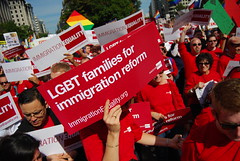
LGBT families not mention in new Obama immigration policy

Immigration Equality's Red-clad ArmyImage by xtopher1974 via Flickr
Source: Washington Blade

By Chris Johnson

The omission of bi-national same-sex couples from recent guidance from the Obama administration is troubling advocates who fear the omission may mean LGBT families won’t be covered under new immigration policy.

The Department of Homeland Security issued guidance on Thursday to attorneys with U.S. Immigration & Customs Enforcement detailing which undocumented immigrants could be deemed a low priority and taken out of the deportation pipeline.

The guidance is the result of the announcement from the Obama administration in August that it will conduct a case-by-case review of about 300,000 undocumented immigrants facing possible deportation. Those who have been convicted of crimes or pose a security risk will be a higher priority for deportation, while those who are deemed lower priority will be taken out of the pipeline.

Administration officials have said they’ll weigh a person’s ties and contributions to the community and family relationships in considering which immigrants are low priority, and these criteria would be inclusive of LGBT families.

According to the New York Times, the process for determining which immigrants could be taken out of the deportation pipeline began on Thursday.

But in the guidance spelling out the details for this review, no mention of immigrants who are in same-sex relationships with U.S. citizens is enumerated among the categories of people who are listed as those who could be considered low priority.

Categories that are identified as low priority include immigrants who had enlisted in the armed forces or those who came to the United States under the age of 16 and are pursuing a college degree. Such immigrants would be eligible for citizenship under passage of the DREAM Act.

Other categories deemed low priority are those who older than age 65 and have lived in the country for more than 10 years and those who have been the victim of domestic violence.

Related Posts with Thumbnails