Showing posts with label el salvador. Show all posts

Thursday, 5 January 2012

Salvadorian trans woman secures US asylum

Source: Washington Post

By Teresa Tomassoni

After a gang member held him at gunpoint inside his home, the 24-year-old gay man knew he had to flee El Salvador to survive. He had been beaten and harassed repeatedly on the streets by gang members. Eventually, they warned, they would kill him.

It took two attempts to get across the U.S.-Mexican border, but in 2006, he was smuggled into Arizona and made his way to Washington, where his brother lived.
“Finally, I can have my real life, exactly how I am,” he thought.
Valerie Villalta, now 30, found that new life as a transgender woman and, in the process, won a kind of protection she didn’t even know was possible for someone like her: asylum.

Asylum, which allows an immigrant to live and work in the country legally, is more commonly associated with immigrants who have been persecuted in their home countries — or who might be in the future — because of their politics, race, religion or ethnicity. But Villalta learned that it also can apply to gay and transgender immigrants who have been tortured because of their sexuality.

Since winning her asylum case in 2009 with the help of the Whitman-Walker Health clinic in the District, Villalta has dedicated much of her life to providing guidance to gay and transgender Latino immigrants who find themselves in a foreign land with little or no knowledge of the language, the culture or the services that can help them find peace with who they really are.

She volunteers with a health education program for gay and transgender youths called Empoderate, or “Empower yourself” — the same program that helped her find her way. The youth center is just a few blocks from its umbrella organization, La Clinica del Pueblo, a bilingual community health center in Columbia Heights.

“When you try to help other people, you feel good,” Villalta said recently, sitting in the center’s coral pink Girls Meeting Room. A drawing of a butterfly emerging from its cocoon hangs above her head. “Soy mujer trans (I’m a transgender woman),” it says.

Monday, 7 November 2011

Raped and tortured in El Salvador, Juan flees abuse and finds angels in America

World MapImage via Wikipedia
By Ken Williams, Editor in Chief, SDGLN

(Editor’s note:  Ken Williams met the Rev. Judith K. Hanlon, pastor of Hadwen Park Church and a founding member of the LGBT Asylum Support Task Force, at the Compass to Compassion consultation in New York. Hanlon, based in Worchester, Mass., shared this compelling story by Juan, as told at a church conference last year in San Diego. Juan’s story puts a human face on LGBT asylum issues. SDGLN is using an alias for the person who is telling his personal story to ensure his confidentiality and to protect family members who live in El Salvador.)

My name is Juan and I was born in 1976 in San Salvador, El Salvador. My life growing up was horrible. I was sexually, physically and verbally abused my entire life due to my sexual orientation.

My mother worked as a maid. She was raped by her employer. When she got pregnant, she had to leave her job and go live with her parents. For that reason, I do not believe that my mother ever loved me.

I finally met my father in 2005. Publically, in his presence, I was called a faggot by neighbor boys. He turned to me with disgust and asked, “Is this true?” I said yes, and he said, “I don’t want a f***ing faggot for a son. Pretend I never met you.”

That was the last time I saw my father.

Enduring endless abuse

My mother was an alcoholic and beat me constantly. She was embarrassed because the neighbor children called me a faggot.

She would beat me with her hands or with her belt. Sometimes she would hit me on the head or on the back. Sometimes she would grab pieces of wood to hit me on the legs with them.

Other times, she would tell me to take off my shoes and socks and make me stand out in the hot sun barefoot. She would tell me that she was going this so I would not walk and behave like a faggot. She told me to walk like a man. I was a child. The pain was unbearable.

Next to my grandparents’ home was my aunt’s home and her three sons. They physically abused me my entire growing up years. Their father told them that I was a faggot and that meant that they could torture me whenever they wanted to. I was so alone. I spent most of the time reading old newspapers.

My grandparents weren’t very tender to me, either. On several occasions my grandmother asked me why I behaved like a faggot. I never answered here because I didn’t know what to say. I didn’t think I was doing anything wrong, just being myself.

Abandoned by his mother

Wednesday, 15 December 2010

In America, a tortured Salvadorian transgender woman released from 2.5 year detention

World MapImage via Wikipedia
Source: Feldman Feldman & Associates

Immigration and Customs Enforcement (ICE) recently released a Salvadorian Transgender Woman known as “Karla” after she was granted Deferral of Removal under the Convention Against Torture (CAT) by a San Diego Immigration Judge (IJ.)

Karla's release and legalized status in the US constitutes the culmination of a two and a half year long struggle with ICE. Most importantly for her, Karla is now able to live openly in a free society without fear of harassment and killings that transgender individuals face in El Salvador.

Deferral under CAT is one of the most difficult and limited forms of relief available to immigrants and requires a showing that the individual would more likely than not be tortured by government officials if returned to her country of origin. Fortunately for Karla, Feldman Feldman & Associates, PC an immigration law firm represented Karla pro bono.

According to one of Feldman Feldman & Associates' Immigration Attorneys, Danielle Rosché who spearheaded Karla's defense:
“The unfortunate reality is that violence is the natural consequence of being transgender in El Salvador. Through independent reports and my client's own personal experiences we were able to clearly show to the IJ the dangerous reality for transgender women there.
In El Salvador, police and society at large routinely target transgender women for violence. My client suffered repeated beatings, and was routinely harassed and assaulted while simply walking down the street. Without the protection of the US, my client would face abuse and death in El Salvador and expresses her appreciation to the US government and the IJ in her case”
Karla is happy to be out, and looking forward to living and working in the real world again after spending 30 months in immigration detention.

More information on asylum, deportation assistance, and other protections the US provides to LGBTQ individuals can be found at http://www.immigrateme.com.

Feldman Feldman & Associates, PC is a full service immigration law firm.
Enhanced by Zemanta

Saturday, 8 May 2010

Blogging behind closed doors

Source: The Guide

By Michael K Lavers

Khalid knows how frightening it can be to live in a country where being gay is taboo.

In 2007, Khalid agreed to appear on the inaugural cover of MK, the first gay magazine in Jordan. But the shirtless photo of the young man caused a stir after the tabloids caught wind of it. The outcry was so fierce the magazine never published.

"I was still in school at the time," Khalid told Guide magazine from his home in Amman, the capital of Jordan. "People were talking about it in my school, and they didn't know it was me at the time. It was very scary because there was no one in the whole Arab world " the Middle East " who was out in the media."

Although Khalid says he never felt his life was in danger, he did face blackmail attempts from those who threatened to out him to his parents. He hid out in neighboring Lebanon until the scandal had passed.

"It's very simple as I'm talking about it, but at the time it was very big because no other media was talking about homosexuality," Khalid said. "But now, everyone in Jordan is talking about it. That's a big step in two years."

The 21-year-old model eventually returned to Jordan, where he launched the monthly webzine My Kali to give Arab gays "a better image to look up to."

"Most of the people here look to English, European and American publications," Khalid said. "Those images don't really apply here. I just wanted to give people a different image to which [they] can relate."

Khalid, who asked that his last name not be used, is one of a growing number of gays around the world who have launched online publications. Their sites serve as virtual community centers and are an increasingly important source of news and information for gays in their own countries and others around the world.

But this online activism is often dangerous, which is why most of the bloggers quoted in this article asked that their full names not be used. Some countries in which gay bloggers work ban homosexuality. Laws designed to curb homosexual activity often carry steep prison sentences --and sometimes the death penalty. Homophobic attitudes can prove equally harmful.

Sunday, 17 May 2009

Gay Immigrants Seek US Asylum

Source: Mission Local

By: Lydia Chavez

As gay activists from the Castro to Lebanon commemorated  International Day Against Homophobia over the weekend , those in Latin America could celebrate recent legal changes in Nicaragua and Panama that end the criminalization of homosexual acts in Central and South America.

Despite such legal progress, however,  many gay Latinos continue to seek political asylum in the United States, gay rights advocates said.

“Homophobia is not something you get over overnight,” said Dusty Araujo of the National Immigrant Justice Center. Talk to political refugees and advocates like Araujo and you learn that despite evolving attitudes in Latin America, homophobic violence is still common, forcing hundreds of sexual minorities to seek asylum in the United States, many in San Francisco.

From his North Beach office cramped with floor-to-ceiling file cabinets containing archives of gay movements around the world, Araujo acts as a one-man resource to those seeking to file for asylum on the grounds of homophobic persecution. The majority of his requests come from Mexico, where same-sex unions were legalized in the capital two years ago. “Movements of people coming out and standing for their rights have helped curb some of the violence,” he said, “but it continues.”

To prove his point, Araujo punches Mexico into his computer. Aside from helping immigrants find an attorney and helping navigate the process of asylum application, his work includes maintaining an online database of anti-gay and anti-transgender violence around the world—documents that can buttress an applicant’s asylum claim.
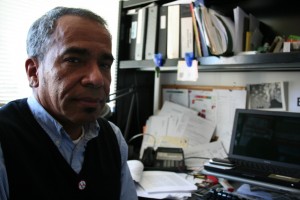
Dusty Araujo of the National Immigrant Justice Center

Dusty Araujo of the National Immigrant Justice Center
Within seconds, he finds a March 13 news report of the killing of a 30-year old gay indigenous man from Oaxaca. Other recent additions include the murder of a transsexual in Chile and the arrest of a group of transvestites in Guyana.

Despite reams of evidence of anti-gay violence in those countries, receiving asylum is no easy process.

Applicants must prove they endured abuse on the part of authorities or that authorities failed to provide safety from abuse. Alternatively if, for instance, an immigrant came out of the closet after they left their native country, they must provide evidence that they legitimately fear for their safety upon returning.

“This is not something you can fake and punk your way through like a walk in the park,” Araujo said. “Many people from a particular country apply, and only a small percentage is granted.

Because the U.S. government does not distinguish between asylum applications for sexual minorities and those for other persecuted groups, no one knows for sure how many LGBT immigrants apply for asylum, and at what rate they are granted.

Araujo’s personal database of the applicants he’s helped from 1990 through 2007 offers a starting point. Of 46 applicants from Guatemala, just six were granted asylum. Of 53 from El Salvador, eight received asylum. Of 249 Mexican applicants, just 36 asylum requests were approved.

And, experts reported, the process may be getting more difficult—an ironic consequence of the recent gay legal victories in Latin America. Because countries are now perceived as more tolerant of homosexuality, they say fighting an asylum case is only getting harder.

“We have a lot of queer clients from Mexico,” said San Francisco attorney Arwen Swink, who specializes in asylum cases for sexual minorities. Nevertheless, since Mexico City approved legal partnerships a year ago, Swink says judges are more resistant to asylum cases.

For applicants, the process can be not only long and costly, but emotionally straining. “You have to put out your life like an open book,” said Claudia Ochoa, 36, who left Guatemala for San Francisco in 2004 after living in fear for her life when she came out of the closet to her conservative family. Shortly after arriving in a new country, the immigrant had to recount the most painful chapters of her life—including childhood incest and domestic violence—to a lawyer, an immigration officer, and a courtroom.

Ochoa, who teaches private Spanish classes in the Mission District, considers herself lucky “to find the right people at the right moment.” It may not have happened, she said, if she had not landed in San Francisco.

“Here [asylum] is something more known, more heard about,” and thus within a month of immigrating here with her girlfriend on a travel visa, local friends told her about the option and the process moved quickly. If an immigrant does not apply for asylum within one year, the process becomes much more difficult.

Honduran Roberto Martinez was not so fortunate, and his experience is probably closer to the typical struggle of a gay fleeing persecution. As a teenager in a violent Honduran city, Martinez, whose name has been changed so as to not impact his case, witnessed his brother murdered by gang members, and a gay friend molested and HIV positive. “I saw these things that were happening to my friend, so I maintained that I wasn’t gay,” Martinez said recently in the office of a Mission District gay youth organization where he volunteers.

At 17 he could no longer endure the repression, and crossed two countries alone, eventually making a home in the cement plaza of San Francisco Civic Center. After four years that included drug dealing, unprotected sex, arrest, rehabilitation, and finally, a determination to help other vulnerable gay youth, promote safe sex, and attend school, Martinez now faces an order of deportation. Only this January did he learn about the option of asylum.

Since the one-year bar long since passed, Martinez has a trickier case to fight. Swink, his attorney, says he has a better chance at winning a Withholding of Removal case—similar to asylum but leaving the immigrant in a kind of legal limbo. If he wins, Swink says, “he could never leave the country, would have no path to a greencard, no path to citizenship.”

But familiar with the violent gangs of his home country and their rampant homophobia, Martinez would prefer to stay no matter the cost than return to Honduras.

“I could not walk like I do here“ Martinez said softly, a colorful scarf wrapped tight over his gray and pink sweater. “I could not have my partner, a job. I could not study. If I was seen as effeminate, it would come to a point where they could attack me, physically, verbally.”

Now living with a partner in the Mision District, Martinez is awaiting his appointment with an immigration officer, and collecting donations at drag shows to help pay his legal fees.

“I am asking the universe that the doors of political asylum open for me,” he said, plastic in his ears hinting at a hearing condition he says will eventually render him deaf. “To be able to study, go to school, to study sign language.”

Dusty Araujo said financial mobility for a Latin American gay man or woman can be very difficult. “They know that in their country, they’re not going to be able to climb the ladder of success,” Araujo said. “That ladder’s not available to them. They’re not going to be able to be important people anywhere because of their sexual orientation. So their fleeing here is partly because of their sex orientation but partly a survival mechanism, hoping that they are going to find a way to succeed in their lives.”

For Martinez, he must weigh that hope against all that he’ll give up if he wins his case. “One of the desires is to stay in this country,” he said. “One of the losses is relinquishing the right to be in your country. So you can lose a lot with your sexual orientation. I could go back into the closet, but that life I had before I don’t want. I want to continue opening wider that door.”

Thursday, 8 May 2008

Terrified to return

Source: Xtra.ca 

By James Burrell

Time is running out for an HIV-positive gay man who's been denied refugee status. Joaquín Ramirez is scheduled for deportation to El Salvador — where he says he'll face torture and death — on Thu, May 15.

Ramirez, who came to Toronto as a delegate for the International AIDS Conference in August 2006, says he's afraid that if he's sent back he'll face violence at the hands of three federal police officers who he claims beat, raped and robbed him in a sugarcane field more than two years ago. Since the alleged attack Ramirez says the three men have visited his family in El Salvador threatening to kill him because, they claim, he infected at least one of them.

"I am sure that I will be put through torture," says Ramirez through an interpreter, "and I am sure that I will be assassinated if I go back. There have been four men who have come to my sister's home in a car and have parked outside her house. They have asked my little niece if I had come back yet and they have also called my sister and told her that they were going to kill me.

"Even my sister, whom I have been getting support from, now has said that if I go back she regrets that she wouldn't be able to help me," says Ramirez. "She is afraid for herself."

Ramirez's application for refugee status was denied in May 2007. In his decision Immigration and Refugee Board of Canada adjudicator Chimbo Mutuma stated he didn't believe Ramirez left El Salvador because of the alleged attack since he had already planned to attend the AIDS conference several months before it took place. Mutuma also asked why Ramirez did not go to police to report the alleged crime.

"I have always told them that I didn't go to report it to the police because in El Salvador you cannot do it," says 39-year-old Ramirez. "I couldn't go to the police to report the police. I have submitted reports of gay people who have been assassinated there. They have been killed in very barbaric ways such as stones being thrown at them. And I believe that would have happened to me."

Ramirez, who volunteered as a safer-sex outreach worker and AIDS educator in his native country, says he was approached by three officers on Jan 13, 2006 in a restaurant in Aguilares. He says he was driven to a sugarcane field, where the officers allegedly beat him and forced him to have sex with them. He says he told them he was HIV-positive and asked them to use the condoms he had with him, but that they accused him of lying to try to stop them from having sex with them.

"When the story broke most of my family said they would have rather I died... than bring shame upon the family as I had done," says Ramirez, tears welling up in his eyes. "Now they say that everyone knows that I am not only gay but also HIV-positive and that it has brought shame to them."

"I think that he's someone who fell through the cracks of the system," says Ramirez's lawyer Leigh Salsberg. A Toronto-based lawyer who specializes in immigration and refugee protection, Salsberg says her client has several judicial reviews of the decision in motion.

"They've rejected his individual story as not credible, the events he says happened to him," says Salsberg, "but they've known all along that he is gay and has HIV. In my view no one has fully assessed the risk of him just being a gay man in El Salvador where the conditions — just that in and of itself — are dangerous. They're supposed to look at the conditions in that country."

Salsberg says one of the judicial reviews argues Ramirez would not be able to continue his course of HIV meds if he's returned to El Salvador.

"Our evidence says that if he returns back there will be an interruption in treatment and that is obviously very dangerous for someone with HIV," she says.

Since coming to Canada Ramirez has volunteered with the Toronto People with AIDS Foundation, the queer Latio group Hola and the Centre for Spanish Speaking People.

"He has a lot of support and has brought in so many letters of support from people that he's worked with, from community organizations both here and in El Salvador," says Salsberg. "It's all really well-documented, and I think it adds so much credibility to his case, to have that many people rallying around him."

But Ramirez says he isn't holding out much hope. "I always had a conviction that Canada would give me protection but now I think that's not the case. I've already fought a lot to be heard and now I'm disappointed. I'm very sad because every day that goes by is one day less I have. I don't know what to do anymore. I have done everything I could to try and make people believe that I deserve to be here, but I have no more strength left."

Thank you to Samuel E Lopez for providing translation services

Related Posts with Thumbnails

