Showing posts with label blogging. Show all posts

Tuesday, 21 June 2011

Video: LGBT immigrants 'come out' at US Netroots Nation conference

Source:


By Paul Canning

At America's annual giant progressive bloggers conference Netroots Nation over last weekend, a pre-conference of LGBT bloggers was told that the voices of LGBT immigrants are missing from their reporting.

Towleroad reported that a panel of queer immigrant activists "offered poignant personal recounts of the struggle they or other undocumented immigrants face in the United States."

Panelists included Tania A. Unzueta (Immigrant Youth Justice League and Association of Latino Men for Action), Reyna Wences (Immigrant Youth Justice League), Juan Rodriguez (Students Working for Equal Rights), and Felipe Matos (Presente.org and Students Working for Equal Rights).

The undocumented migrant Carlos A. Quiroz ('Carlos in DC') posted the above video, of the panelists, and wrote that the event had inspired him to 'come out' as undocumented.

Why telling: I had thought about blogging about my immigration experience for a long time, but fear and timing didn’t allow. One of the things that finally inspired me to do it was the campaign organized by undocumented youth for the Dream Act bill [which would have provided a 'path to citizenship' for those brought to the US as children], which sadly was rejected by the U.S. Senate last year.

Why now: I’m doing this not only because I want to become a productive citizen for this country, but also because this will have a positive impact for many others who are undocumented like myself, and because Immigration Reform should not be put aside even and especially in elections times.
...I cannot live in fear and depression any longer; because I deserve a life of dignity and respect, because I want to face whatever is necessary in order to achieve justice, because I’m unafraid. We can do this.
Here's video of the moment when he says this:

Thursday, 19 May 2011

Video: Brazil: Homophobia, religion and politics

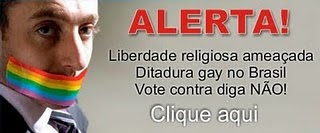
"Caution! Religious freedom threatened - Gay Dictatorship in Brazil - Vote against - Say no!" from the blog Amigo de Cristo (Friend of Christ)
Source: Global Voices

By Raphael Tsavkko Garcia, translated by Sara Moreira

Amidst an increasing wave of homophobic violence in Brazil, which puts the country among the world's worst in terms of crime against the LGBT community federal deputy Jean Wyllys, the first openly homosexual member of the Brazilian parliament, has presented a Constitutional Amendment Proposal (PEC) to legalize marriage for same-sex couples.

Meanwhile, recent statements of hatred and prejudice by some parliamentarians, far right groups and religious representatives, who oppose this and other legislative advancements in LGBT issues, have raised a feeling of indignation in the blogosphere.

An article from Jornal Brasil, republished by O Evangelho (The Gospel) [pt], points out that several religious groups, namely evangelicals and catholics, have been opposing what they call the beginning of a “Gay Dictatorship“ [pt], which includes “homosexual “marriage”, the Ministry of Education's supposed primer against “homophobia” (known as the “Gay Kit”) and PLC 122/2006 (the gay gag law), a bill that intends to criminalize any criticism of or opposition to homosexual behavior or to the intentions of the gay lobby”. In addition, these groups favor the dissemination of ideals which are contrary to the advocacy of LGBT rights [pt].

On this matter, Paulo Cândido, writing for the blog Biscoito Fino e a Massa, criticizes [pt] the “lack of arguments” and the “empty rhetoric”  of the “religious right-wing”:
que mal esconde seu ódio e sua intenção de impor a moral de uma religião à sociedade como um todo.
which barely conceals its hatred and intention to impose the morals of one religion on society as a whole.
Robson Fernando, writing for the blog Acerto de Contas, adds [pt]:

Saturday, 14 May 2011

Recent website issues

Due to an outage at Blogger we have been unable to post since late Wednesday.

We don't think this has affected any posts and believe that everything has been restored this morning, and that we've repaired all issues, but please let us know if you see anything odd on the website. Scheduled posts will be restored from today.

If you've missed us, please consider contributing to our appeal!

Paul Canning, Editor

Saturday, 7 May 2011

Video: New 'safe space' online for MidEast LGBT


Source: InventorSpot

By Jamie Reygle

It's not easy being gay in the Middle East. If you get caught, you could face the death penalty, flogging, or an extended jail sentence - not to mention the probable spurning from your family and friends. It's a lonely, dangerous life for many homosexuals in that part of the world.

But where there is fear, there is also courage. Mideast Youth - an all-volunteer team with representatives from countries like Bahrain, UAE, Saudi Arabia, Egypt, Iran, Syria, and Tunisia - is committed to working "against repression, discrimination and persecution" in the Middle East, and homosexuality is one issue that has recently hit their radar.

The group have created Ahwaa - "A safe space to debate LGBTQ-related issues in the Middle East." It's essentially an anonymous forum that utilizes game mechanics to allow legitimate users to get deeper into the site, while keeping the trolls and the haters at the surface, because the more the Ahwaa community like what you have to say, the better access you get.

They are trying to make it as inclusive as possible, by inviting people of all sexual persuasions to participate, and by making it bilingual (Arabic and English), thereby allowing non-Arabs to offer their perspectives as well.

With all the changes that have been taking place in the Middle East recently, the time is ripe to address issues there that are as controversial as this. And now you can be a part of it all.

What are you waiting for?

~~~~

The project has been created by TED fellow Esra'a Al Shafei.

Al Shafei is the founder and Executive Director of MideastYouth.com, a grassroots, indigenous digital network that leverages the power of new media to facilitate the struggle against oppression in the Middle East and North Africa. She is driven by her passion for civil engagement, freedom of speech, and employing innovative solutions to pervasive and persistent human problems.

Her advocacy on the internet bridges seemingly impenetrable barriers of faith and geography to unite young people committed to fostering constructive discourse in the Middle East. She is also the director of a series of international campaigns for rights for ethnic, religious, and intellectual minorities.

Among those she runs is the global campaign to free an imprisoned Egyptian blogger at FreeKareem.org. She is a recipient of the Berkman Award from Harvard University's Berkman Center for Internet and Society for "outstanding contributions to the internet and its impact on society," and is currently a TED Fellow and an Echoing Green Fellow. Most recently, her project won a ThinkSocial Award for serving as a "powerful model for how social media can be used to address global problems." She servers on the Advisory Board for the Meta-Activism Project and the European Summit for Global Transformation.

Wednesday, 4 May 2011

Lebanese bloggers join International Day Against Homophobia; participate in massive Brazil action against hate crimes


LGBT Lebanese bloggers have launched a joint blog to prepare for and promote Lebanon’s International Day Against Homophobia (IDAHO) events, coming up in a fortnight.

Eight bloggers are contributing at time of writing.

Discussion on Lebanon’s International Day Against Homophobia is also happening on twitter using the hashtags #LebLGBT and #LebIDAHO

IDAHO events internationally are being added to the website www.idahomophobia.org

The organisation has announced that the United Nations will be releasing ahead of IDAHO a first ever brochure highlighting UN official positions on Sexual Orientation and Gender Identity Human Rights. The brochure will be launched by a video adress from Human Rights Commissionner Navanethem Pillay.

Other events or actions announced include that the Transrespect versus Transphobia Worldwide project (TvT) will publish on its website an interactive map documenting over 550 killings of trans people worldwide since 2008.

Dozens of events will be happening throughout the UK. In Japan, 17 cities will host initiatives including an effort by the LGBT community to write letters of support for people impacted by the Tsunami and Earthquake. Eight cities in China will host events. US events will include for the first time ever an event in the State of Idaho.

In Burundi, LGBT groups will inaugurate the first shelter home for LGBT people who have been kicked out of their homes. Organisations Boys of Bangladesh and BANDHU are holding a series of conferences, film screenings and discussions on legal aspects within Universities to increase awareness amongst students. Kenyan LGBT people and sex workers will be marching in Kisumu and Nairobi and holding a one-day training session for police forces, lawyers and health care providers - plus a fashion show.

On 18 May thousands of activists will march on Brazil’s capital in the largest day of action against hate crimes and homophobia in Brazil's history. allout.org say this is a key opportunity to show Brazil's political leaders that people everywhere are demanding urgent action to end the escalating hate and violence. They are asking for supporters around the world to submit photos of themselves by 5 May (tomorrow) holding a sign urging the passage of an anti-hate crimes law to be included in a massive visual projection.


Enhanced by Zemanta

Friday, 29 April 2011

In US, immigration activists fight deportation policy with social media

Image representing Twitter as depicted in Crun...Image via CrunchBase

Source: Mashable

By Juan E. Gastelum

Walter Lara’s first tweet back in 2009 started with the words “I’m being deported.” Two years later, he lives in Miami, works legally, has a driver’s license and pays in-state tuition at Miami Dade College.

He is one of a few dozen young, undocumented immigrants who have avoided deportation and are now enjoying the benefits — even if only temporary — of being in the United States legally as a result of campaigns in which social media played a crucial role.

Social media platforms provide the means by which these youths, who call themselves Dreamers, can find each other without travelling or exposing their status. They appeal to supporters nationwide and petition en masse for extensions on deportation dates. They help garner the attention of politicians, lawyers and advocacy groups. And they get Dreamers’ stories out into the public sphere when the attention of the mass media is elsewhere.

Tuesday, 19 April 2011

Online, international LGBT activism steps up

PhotonQ- The World Neuro Net of Joel de RosnayImage by PhOtOnQuAnTiQuE via Flickr
Source: Campus Progress

By Jessica Mowles

In January the world mourned the death of David Kato, a prominent Ugandan LGBTQ rights activist. Social media deeply shaped Kato’s life and death. His name first became known when Ugandan magazine Rolling Stone, which isn’t the U.S. rock-and-roll magazine, published Facebook photos of him and other Ugandans, labeling them homosexuals and calling for their death. Online petitions sprang up around the world, pushing for the Ugandan government to penalize the publication, as Kato and others were threatened and harassed as a result of the article.

When Kato was beaten to death by an intruder into his home, who police say was Enock Nsubuga, vigils were quickly organized across the United States, Europe, and South Africa via Facebook, Twitter, and other social media outlets.

The United Nations’ High Commissioner for Human Rights, Navi Pillay, addressed the role of the public in decriminalizing homosexuality in her remarks on Kato’s murder. “Today, with the presence of social media and internet-based campaigns, the potential impact of public education is greater than ever,” she said.

Around the world each year, thousands of LGBTQ people are murdered, sentenced to stoning, raped, threatened with deportation, or are otherwise harassed. Exact numbers are impossible to calculate worldwide, but in the United States alone, nearly 1,500 hate crimes against LGBTQ people were reported in 2009. Headlines of LGBTQ people undergoing everything from harassment to murder are far more prevalent than they did ten years ago. That’s the good news.

The bad news is that extreme violence and discrimination against LGBTQ folks still exists in every corner of the globe. Even so, recent increased attention to human rights abuses that target LGBTQ people reflects greater universal acceptance of LGBTQ rights. And the ways human rights organizations are advocating for LGBTQ rights increasingly relies on young people’s use of social media.

Friday, 4 February 2011

Video: Egyptian gays are revolting


Edited: A previous version of this story included references to an individual who has told us that he is not gay, We have deleted and removed any reference to him.

By Paul Canning

Amongst the crowds protesting the 30 year dictatorship of Hosni Mubarek in Egypt are many lesbians and gay men.

They have also been amongst the opposition during the past years.

Bahaa Saber
Another out gay political activist is Bahaa Saber, who last year was arrested, beaten and sexually assaulted by police. Egyptian security forces are frequently accused of sexually abusing suspects; a 2007 video that ended up on the Internet showed police officers assaulting a bus driver with a stick.

Saber, a very brave man whose name deserves to be more widely known outside Egypt, has been arrested, tortured and thrown in jail many times.
"After a while," he told the LA Times last year, "you stop paying attention to the charges they stack against you."
With each jailing, he said, he met activists, laborers, professors, taxi drivers, Islamists, journalists and others arrested by security forces. Saber is not the ideal Arab dissident; his homosexuality has made him a curiosity to opposition groups and an easily vilified target for police and religious conservatives.

He told the LA Times that he was contemplating seeking asylum in another country, but didn't want to betray all those years on the protest line, all those months spent in prison.
His body shook. He wiped his eyes; he said that no matter what, he would never fit in here.

He stepped out, turning the corner toward riot policemen peering through the wire mesh of transport trucks. About 200 protesters were chanting for better wages. He rushed toward them, throwing his fist into the air.
Last Thursday the website GayEgypt issued this call to action:
Egypt's gay and lesbian community has had enough of years of police brutality and torture and GayEgypt.com calls on all lesbians and gays to join their brothers and sisters on the street to peacefully express their demand for immediate change.
It is now carrying news and information about the protests including this photo gallery (nb: download speed is slow due to authorities imposing internet restrictions). There have been reports of many lesbians and gays joining the protesters in Alexandria and Cairo's Tahrir Square.

Last October we published this everyday tale from the Rebel With A Cause blog of police harassment and torture of gay, or in this case 'gay appearing', people in Egypt:
It's not very clear why they decided to be that violent and abusive; although it seems to be basically driven by homophobia as Kareem's appearance looked “different”. Kareem screamed and ran towards police informers nearby but they didn’t bother to help the boy.

Appalled by what they saw, a group of friends sitting at a downtown café decided to intervene and help Kareem from the brutal attack. The one who stepped in first; Mohamed was met by violence and he was slapped and hit too. He was told by the perpetrators “Why do you want to help him? Are you a faggot too?”
Since the fight started to involve more people, the police finally started to take action and step in. They automatically took the side of the perpetrators because the victim seemed to be a homosexual.

The police tortured Kareem and decided to perform a rectal examination to determine if he was a homosexual! This was done using violence and in front of the perpetrator! Mohamed was met by sarcasm and ridicule. Police informers harassed him.
In 2005 Human Rights Watch reported that the Egyptian government arrests and routinely tortures men suspected of consensual homosexual conduct.

Tuesday, 1 February 2011

In Algeria, a gay blog breaks boundaries

Source: IGLHRC

Pioneering Algerian blogger ZIZOU runs and writes ZIZOU’s Magazine, which is one of the most prominent and popular Arabic-language blogs for the LGBT community, focusing on everything from human rights and politics to entertainment (http://zizoumag.blogspot.com/). As part of an ongoing series highlighting creative tools used by sexual rights activists globally, IGLHRC asked ZIZOU about the importance of blogging for LGBT activism.

ZIZOU: The LGBT rights blogging phenomenon has grown extensively and impressively in recent years in parallel with developments in human rights in general and in the field of modern technology, especially the Internet. This has allowed these media channels to develop quickly and to compete with traditional channels of intellectual and cultural information.

A blog for me is an investment in freedom that benefits from the World Wide Web, which is beyond government censorship. Blogging allows me to discuss political, social, and frank personal issues that don’t otherwise reach people through other channels in a simple and funny (sometimes cynical) way.

There are many factors that have helped develop blogging and made it accessible for LGBT activism, including specialized online services with ready-to-use formats that make publishing an easy process. Blogging doesn’t require much time or effort and it does not require a high level of education, permits, capital, employees, or distributors. It is also possible to create a blog under a pseudonym allowing one to discuss issues frankly and without external threat or the pressure that comes just from talking about some issues.

The idea of a blog has itself allowed me to break down the geographical, political and social boundaries between countries. However, there are still various barriers that activist bloggers need to overcome. It is critical to prioritize developing consensus on principles and codes of conduct in the burgeoning field of LGBT blogging in order to ensure the ongoing communication and cooperation of the many diverse LGBT bloggers (whether professionals, researchers, scholars, innovators, or students) who want to capture lost freedom and who desire change.

This work of developing a consensus around human rights requires bloggers to have a lot of courage because they face many pressures when they discuss issues related to the social, political and legal situation in their countries. Some may end up facing restrictions such as having their blogs blocked and may end up being persecuted and even imprisoned for their work. For this reason this work cannot happen individually - support and collective action is required.

Enhanced by Zemanta

Friday, 14 January 2011

Digital Diasporas: how migrant communities are embracing new media

NEW YORK - SEPTEMBER 01:  In this photo illust...Image by Getty Images via @daylife
Source: University of Cambridge

Across the world millions of people live and work huge distances away from their home communities and only rarely get the chance to visit them. In the past, these migrants relied on letters and occasional phone calls to keep in touch. New media has changed that.

Today, even those on modest incomes are able to choose from an expanding range of new media to communicate, often on a daily basis, with family and friends.

A conference taking place at Cambridge University this week will look at how diasporas have increasingly embraced new media, how they make use of communication technologies and how new media play a significant role in shaping their experiences and relationships. Topics discussed will include whether new media isolate communities or help them to integrate within a host country, and whether access to cheap long distance communication is acting as a spur to greater migration.

Digital Diasporas: Migration, ICTs and transnationalism, which will take place at CRASSH (The Centre for Research in the Arts, Social Sciences and Humanities) on Thursday and Friday, will bring together researchers from throughout the UK and overseas to share their research and discuss common themes.

Monday, 3 January 2011

Web attacks target human rights sites

Denial of Service AttackImage by kryptyk via Flickr
Source: BBC

Human rights groups and campaigners are being hit hard by huge web attacks launched by those opposed to their views, finds research.

Many web-based campaigning groups are being knocked offline for weeks by the attacks, it found.

The researchers expect the tempo of attacks to increase as the tools and techniques become more widespread.

It urged human rights groups and independent media groups to beef up their defences to avoid falling victim.

The research by the Berkman Center for Internet and Society at Harvard University tried to get a sense of how often human rights groups and independent media organisations are hit by what is known as Distributed Denial of Service (DDoS) attacks.

DDoS attacks try to knock a site offline by overwhelming it with data.

In the 12 months between August 2009 and September 2010 the research found evidence of 140 attacks against more than 280 different sites. The report acknowledged that these were likely to be the most high profile attacks and that many more had probably gone unreported.

"These attacks do seem to be increasingly common," said Ethan Zuckerman, one of the authors of the report.

While some attacks were triggered by specific incidents such as elections, others had no obvious cause, he said.

The report cites a sustained DDoS attack on Novaya Gazeta, the website of Russia's most liberal independent newspaper.

Deputy executive editor Sergey Sokolov is not certain who attacked his website but suspects government-sponsored Kremlin Youth organisations.

The report finds that DDoS is increasingly being used as a political tool and as a form of protest.

Attacks that recruit participants in so-called volunteer DDoS are proving popular

The report gives the example of the organisation 'Help Israel Win' which recently invited individuals to install a software package, dubbed Patriot DDos, on their computers so the machine could be used to launch attacks, on what the authors assume would be Palestinian targets.

The most recent example of a volunteer DDoS comes from Anonymous, a loose-knit group of activists, who used the method to launch attacks on the websites of firms it perceived to be anti-Wikileaks.

DDoS attacks could hit small media groups and campaigners hard because the organisations have such limited resources, said Mr Zuckerman.

"If you are a human rights organisation or independent media organisation you might be using an account you are paying £20 a month for and its very hard at that level of hosting to fend off DDoS," he told the BBC.

The attacks did not have to be prolonged, he said, to cause real problems for small campaigning groups.

"They just have to do it long enough to annoy their ISP and they will kick them off and then they have to find another place to host," said Mr Zuckerman.

The work of some groups only appears on the web, said Mr Zuckerman, so knocking them offline effectively silences the campaigners. It can take a long time for some to find a new host, upload content and re-build a site.

He said: "We see sites that do not come back online for two to three weeks."

The report also found that DDoS attacks are often only the most visible element of a much broader attack against a site or group.

"There's a very good chance that if you are experiencing DDoS you are being filtered, sent targeted e-mail to get access to your system or to snatch your passwords," he said.

Mr Zuckerman said some DDoS attacks logged in the report used hundreds or thousands of PCs in a botnet - networks of hijacked home computers - but others had just as big an effect with far fewer resources.

"There are certain attacks that seem to work if you have only one or two machines," he said.

What might cause problems in the future, he suggested, would be easy-to-use tools like those employed by Anonymous activists in support of Wikileaks.

"It seems like DDoS has become easier for more people to engage in," he said. "The threats do seem to be increasing."

In response, he said, rights groups needed to work hard to understand the threats and prepare in case they were hit.

"This community needs to get much, much smarter and much more knowledgeable," he said.
Enhanced by Zemanta

Monday, 13 December 2010

First website for Ethiopian LGBT launches

Ethiopian flagImage via Wikipedia
By Paul Canning

'Peace [Selam] seeker' (pseudonym), an Ethiopian gay asylum seeker, has written to us to announce his new website, set up for Ethiopian LGBT around the world.

Homosexuality is illegal in Ethiopia and the country is very homophobic. As elsewhere in Africa, he says, "homosexuality is perceived as being an evil disease or curse brought up on the white man for his wrong doings, hence any appearance of it in Ethiopia would then be attributed to just another shortcoming of globalization."

Ethiolgbt.com carries news, a blog, stories of gay Ethiopians and a forum. It has "been getting very good feedback from the Ethio/Eritrean lgbt community". He says:
My aim is mainly to reach out to Ethiopian gay, lesbian,bisexual and transsexual communities at home and in diaspora, thereby helping to create a closer and stronger community. I strive to reach those with no one to talk to and find themselves in difficult situation due to their sexuality.
I myself have experienced all countless challenges and continue to do so, but after all, I have come to realize that it is up to me to face the facts, accept reality and find the solution to what ever the problem might be.
Main motive for this blog being that I as a gay Ethiopian came to realize that there is literally no means of gaining info, emotional support or general knowledge related to LGBT life as an Ethiopian and also, the only forums engaging in related topics are almost always derogatory and extremely homophobic.
Hence I have set about single-handedly to do my bit by creating this site not only as a let out for my own thoughts and principles, but for all of us, the Ethiopian LGBT community who are starved freedom and acceptance to contribute our share.

Wednesday, 3 November 2010

'Stop the Deportations': a new website for LGBT binational couples

Source: Miami Herald

By Steve Rothaus

Attorney Lavi Soloway, a founder of Immigration Equality, has launched a website, Stop the Deportations, for gay and lesbian binational couples fighting "discrimination caused by The Defense of Marriage Act and U.S. Immigration Law.''

From the website:

STOP THE DEPORTATIONS is a campaign launched in October 2010 by a group of married binational couples working with attorney, Lavi Soloway, a founder of Immigration Equality and a partner in the law firm, Masliah & Soloway. Our purpose is to raise awareness of the cruel impact of the DEFENSE OF MARRIAGE ACT on married gay and lesbian binational couples. Because the federal government denies recognition to these legally married couples, they are deprived of the usual access to immigration laws that allow all other American citizens to petition for a green card for their foreign spouses. 
In most cases, DOMA is the only obstacle preventing married binational couples from achieving resolution of the immigration issue. Because of DOMA, married binational couples are faced with the very real threat of being torn apart because of expiring visas or deportation orders. Other binational couples are exiled to other countries where their relationships are recognized under the law. Still others are kept apart, left to maintain a long-distance relationship on line, by phone calls and visits.
First posting: A Honeymoon for This Gay Binational Couple Means Going to Battle With The U.S. Government
"The final touches are in place for their late October wedding by the sea: the marriage license, the red and orange orchids, and the matching gold rings. But the honeymoon will be different. After they exchange vows, Greg Gould and Aurelio Tiné will immediately go to battle with the US government."
Click here to read the complete posting.
Enhanced by Zemanta

Saturday, 30 October 2010

In Kenya, one transsexual blogs her life

A portal icon for Portal:Transgender, based on... Image via Wikipedia  
Source: Global Voices

By Haute Haiku

Lindsay is a transgendered woman living in Kenya who shares her life and her journey to womanhood on her blog Living Lindsay- My life as a transgender girl in Kenya. She describes herself as “I'm a normal girl with not-so-normal traits. I am transgender, or transsexual if you like.”

This is going to be her sixth month since her surgery and she feels that she is more at ease with her life than before. Her main goal is to educate the public on transgender issues in Kenya by answering questions from the public about her journey on her blog. She has blogged about her surgery orchidectomy, blogging and challenges she has to go through; violent encounters, how she had to move houses and her struggle with her identification documents. Her story has also been highlighted in one of the Kenyan daily newspaper and she hopes that she will make a difference in the Kenyan society.

I recently interviewed Lindsay about her transitional journey, blogging and other issues relating to transgender community in Kenya and Africa.

Question: What inspired you to start a blog?
Answer: At the time, I felt I needed to share out my views, rant, have a place to be free and talk about my thoughts feelings and stuff. It was the perfect place where I could be myself without hiding. I also thought I could reach out to others like me and learn from them.

Saturday, 9 October 2010

Gay Guyanian 'undocumented immigrant' blogs his hidden life in New York

232: Hiding from the Hidden. Salvation via Angst.Image by assbach via Flickr  Source: gakana


Fifteen years ago, I came to the United States, from Guyana as a foreign student. Everything was suppose to change for me. As I stepped off the airplane for the first time upon entering this country on my own, I felt I was stepping out of one room, into another. It wasn't supposed to be just a temporary, symbolic feeling. It had to be the real thing. In truth, behind the well-wishes of success, I was escaping from what I had hoped was my previous life.

I grew up in Guyana. At the age of 8 I was frequently being told I was 'like a girl' by most people who laid eyes on me. Discretion, political correctness and politeness were, and are still television concepts to most Guyanese. At the age of 11 when I had no other option than to recognize that I was sexually attracted to other men, I lived everyday in a state of panic. Even so I vehemently denied that I was homosexual. I was bent on changing the nature of my existence through sheer will. It's no exaggeration. Being tuned into the intolerance, I came to learn that the men being reported as murdered in the newspapers were in fact gay men who had been killed (as have been ongoing, check the newspapers people!). I heard the discussions in my father's store as casual business conversations between his customers, and I heard it in my home. By the time I went to high school, I was already in internal turmoil. The music was filled with lyrics promoting killing homosexuals. What the music did, was stimulate the public's venom for gay men. It also made me acutely aware of the danger I was living in. Classmates threatened to kill me if they found me on the street, and the others pushed, kicked and punched me. Thinking of complaining to the teachers were out of reach.

Sunday, 26 September 2010

Nicaragua: Sexual diversity in the national blogosphere

Rainbow FlagImage by qthomasbower via Flickr  
Source: globalvoicesonline

By Rodrigo Penalba · Translated by Silvia Viñas
 
The recent debate on legalizing same-sex marriage, as seen through traditional media (see poll in newspaper El Nuevo Diario [es]), has brought to light the opinion of those who oppose the measure, including politicians and even some pro-government and pro-sexual diversity movements [es]; however, the opinion of groups that are already organized around these issues is rarely taken into consideration.

Several Nicaraguan blogs are enriching the debate and the information on these issues. This is a selection of blogs that are currently participating in and pushing for sexual diversity:

Monday, 2 August 2010

Collateral Damage: Gay Chinese caught in the political crossfire?

National emblem of the People's Republic of ChinaImage via Wikipedia
Source: Angry Chinese Blogger

Officially speaking, it is perfectly legal to be gay in China.

The Mainland's controversial "Hooliganism" laws - which were used to censure homosexuals - were stripped from the statutes in 1997, and in 2001 laws classifying homosexuality as a mental illness were likewise removed.

China now has a "gay scene". Most large cities have gay bars, some even have entire gay districts.

This isn't to say that there isn't a certain level of intolerance from leaders, or that there aren't homophobic incidents, and China still has a long way to go before gay rights can be said to be on a par with more liberal regions such as Europe (China, for example, does not permit gay marriage).

Things aren't perfect, but for the most part there is a live and let live attitude towards homosexuality from the state. With most officials choosing not to comment on the subject. Offering neither approval nor disapproval under the auspices of there being “no gay Chinese, and no straight Chinese, just Chinese”.

However, while it is now rare for a Chinese homosexual to be persecuted by Beijing for being gay, there have been multiple incidents in China's gay community has been caught up in the crossfire between the state and those who speak out against the state. Causing them to become collateral damage in a war that they are not fighting.

Collateral Damage?

Friday, 2 July 2010

Africa's gay activists use internet to advance homosexual rights

www,domain,internet,web,netImage via Wikipedia
Source: VOA

By Nico Colombant

African gay activists in Africa and in the diaspora are increasingly using the Internet to have their voices heard, while still trying to figure out how to advance homosexual rights on the continent.

One of the most popular blogs advocating gay rights in Africa is called GayUganda. Its author chooses to remain anonymous.

"I am somebody in the heart of Africa who has been lonely without the rest of the Internet, without the rest of the global sphere, talking about what I would like to talk about, with that kind of freedom," he said from Kampala."I cannot do it elsewhere."

While harsher laws are being proposed against homosexuality across the continent, including in Uganda, the author of Gay Uganda says what he is doing helps Africa's homosexual community.

"It started off as a way of venting, but then later I realized that it was a way of putting across to the rest of the world what our lives were more or less," he said. "The things that have been happening around Kampala, in Uganda, and all over the continent – it is strengthening to me personally, that is why I do it."

He says that in Kampala, very few people know he is gay. But online, he has a community of followers who support him. He adds that the types of articles he writes would never be allowed in traditional media.

Thursday, 10 June 2010

Egyptian dissident a double outsider

Source: Los Angeles Times

By Jeffrey Fleishman and Amro Hassan

Bahaa Saber puts himself at risk to fight for human rights and democracy under the authoritarian Mubarak regime. He also is persecuted for being a homosexual, a taboo in the Muslim nation.

Stiff and sore from his latest police beating, Bahaa Saber wiped back the tears of a man trapped in two lives: a homosexual seeking acceptance from Islam, a political activist marching against a state that counters his demands for democracy with truncheons and tear gas.

Saber's voice is hoarse from years of yelling, his eyes weary from watching all that has not changed. His life has become a series of bruises and protests, of thrusting his fists into the air and scanning crowds as black-clad officers in helmets close in on placards calling for better salaries and freedoms denied.

"You start thinking whether it matters," Saber said. "You can't change a police state or force a revolution with a bunch of activists with different agendas. You can't keep shouting slogans into the wind. It's been like this for 30 years. People are working too hard just to get by. They don't have time to make life better. The government put us [in] this box."

Saber sat in a coffee shop the other day, whispering protest strategies into his cellphone, waiting for the scruff of shoes on pavement. Two blocks away, riot police watched government employees chant outside parliament in a daily ritual of sweat and discontent.

Friday, 21 May 2010

A Facebook book on migration

facebookImage by sitmonkeysupreme via Flickr
Source: Computer Weekly

By Mark Kobayashi-Hillary

Migrant Tales is a book project being developed by me, Mark Kobayashi-Hillary, and Angelica Mari from Computer Weekly which will capture real-life stories from the migrant community living in the UK. The aim is to reach out to migrants from all sections of society, wealthy or poor, legal or illegal, successful or struggling.

The media and political parties, with both using populism to gain votes or sales, have simplified the immigration debate. We want to hear the voice, fears, and expectations of the migrant community - along with the experts and policy makers.
The final goal is to paint a picture of how migrants contribute to British life in the twenty-first century, raising awareness of the realities of migration
We are using Facebook to gather real stories from real people. Take a look at the page here. Please also tell your friends and family about this project and the Facebook page.
if you can't post information to the wall or if you would prefer to speak to us, get in touch with us on:
migranttales@gmail.com
The book takes this as a starting point for the debate:
1. The idea of a "job for life" is dead.
2. You are now competing with people from all over the world for your job.
3. Companies are using the Internet to send work to countries where labour is cheaper.
4. Companies can produce more because of better technology. This efficiency means they need fewer people.
5. Across the UK, the rich are getting richer and the poor are getting poorer.
6. But, if you have the skills, you can migrate and find work in any country.
7. The media and the public complain about immigrants. Experts say immigrants are essential for economic growth.
8. Politicians of all parties want to restrict or ban immigration.
9. Immigration was the most controversial and discussed subject during the 2010 UK general election.
10. If you are not British, but living and working in the UK, what is your contribution to the country?
If it sounds interesting then please become a fan of the book page on Facebook and take a look at the questions we are asking there.
Reblog this post [with Zemanta]

Related Posts with Thumbnails