Showing posts with label home office. Show all posts

Tuesday, 10 January 2012

Resource: Country guidance commentary

English: Decisions, decisions. The road on the...
Image via Wikipedia
Source: Fahamu Refugee Legal Aid Newsletter

Mike Kaye is the Advocacy Manager for Still Human Still Here, a coalition of more than 40 organisations that are campaigning to end the destitution of refused asylum seekers in the UK.

Still Human Still Here believes that many asylum seekers who should be granted some form of protection in the UK are being refused and subsequently end up destitute. In 2010, it was estimated that around 70 percent of destitute refused asylum seekers in the UK came from just eight countries, all of which were either in conflict or had serious and widespread human rights violations. These countries were Zimbabwe, Iran, Iraq, Sudan, Afghanistan, Somalia, the Democratic Republic of Congo (DRC) and Eritrea (Still Human Still Here, At the end of the line: Restoring the integrity of the UK’s asylum system, 2010, p. 38).

Still Human Still Here’s contention that the Home Office incorrectly refuses many asylum seekers any form of protection in the UK is supported by a review of the number of decisions which are subsequently overturned on appeal. In 2010, 27 percent of appeals were allowed. That is to say that in more than one in four cases the UKBA got the initial decision wrong.

For some of the nationalities highlighted above, however, the overturn rates on appeal were significantly higher. For example, 50 percent of Somalis won their appeals in 2010 and 36 percent of Eritreans and Zimbabweans were also successful. During 2011, asylum seekers from these and other countries have continued to have an extremely high percentage of their appeals allowed. For example, 57 percent of Eritreans, 53 percent of Somalis, 38 percent of Sri Lankans and 31 percent of Zimbabweans won their appeals in the third quarter of 2011. These cases alone affected 218 individuals, causing them unnecessary anxiety and wasting considerable amounts of taxpayers’ money by forcing them to go to appeal when in many cases they could have been granted refugee status at the initial determination.

While the appeals process works for some refugees, it should be stressed that success at appeal is largely dependent on having good quality legal advice and representation and this is in increasingly short supply, particularly since the closure of both Refugee and Migrant Justice and the Immigration Advisory Service.

One way in which Still Human Still Here believes refugees could be better identified at the initial determination would be through improvements to the Operational Guidance Notes (OGNs). The OGNs outline conditions and risks to particular groups in various countries and are used by case owners as a key resource when deciding on individual asylum applications.

Several OGNs contain country of origin information and references to case law which are outdated. For example, the current OGN on the DRC was issued in December 2008 and relies heavily on the Country of Origin Information Service DRC Country Report from May 2008, which is now more than three-and-a-half years old. Since the beginning of 2009, more than 500 new applications for asylum have been made by individuals from the DRC. Decisions will have been reached on these applications on the basis of information which, at best, was seven months old. In this context, it is not surprising that the percentage of DRC appeals that are successful has risen to 34 percent in 2011 (up to October).

There are currently 30 OGNs published on the countries from which the UK receives the most asylum applications. Those countries from which there are lower numbers of applications tend to be updated with even less frequency. For example, the most recent OGN for Rwanda was issued in March 2009 and generally relies on country of origin information which was published in November 2008.

Even where OGNs are updated regularly, Still Human Still Here considers that many have inconsistencies and omissions between their conclusions and currently available country of origin information and/or case law.

For example, before an update on 15 December this year, the Somalia OGN cited a UKBA fact-finding mission as reporting ‘travel within Al-Shabaab controlled areas of southern and central Somalia was common and considered relatively safe’. It further noted that ‘everyone can move freely in south central’ and that given ‘the relative ease of travel within many areas of Somalia, it will be feasible for many to return to their home areas from Mogadishu airport as most areas are accessible’ (paras. 2.4.3 and 2.4.6).

This assessment appeared to ignore various reputable sources which note that checkpoints operated by armed militias and groups associated with Al-Shabaab inhibit passage and expose civilians to rape, violence, extortion and forced recruitment. Indeed, the United Nations Report of the Secretary-General on Somalia, 30 December 2010, noted that ‘[i]nternally displaced persons and refugees fleeing southern Somalia continued to report abuses by militias manning checkpoints before they reached safe areas, including rape, beatings and looting’ (para.33).

In order to draw attention to these sorts of inconsistencies, Still Human Still Here has published OGN commentaries, including 2011 commentaries on the most recent OGNs for Afghanistan, Sri Lanka, Jamaica, Zimbabwe, Iran, Eritrea and Sudan. These commentaries are intended as tools to assist legal practitioners in preparing appeals; we hope they will help ensure that individuals who may be at risk of persecution or other serious harm in their country of origin have a reasonable chance of getting protection in the UK.
Enhanced by Zemanta

Thursday, 22 December 2011

UK loses Dublin Regulation case at ECJ

English: Courtroom at the European Court of Ju...
Image via Wikipedia
Source: The Guardian

The Home Office has lost a key legal battle over the right to send asylum seekers back to the first European country they enter. The European court of justice ruled on Wednesday that asylum seekers cannot be removed to other EU countries if they risk being treated "inhumanely" there.

The man at the centre of the test case, known only as NS, claimed asylum in the UK in 2009 after travelling through Greece. Under an EU law known as the Dublin regulation, asylum seekers must apply in the first EU country they enter and can be sent back there if they travel to other countries. But removals to Greece have been suspended across much of Europe since January, when the European court of human rights judged that conditions for asylum seekers there were inhumane and degrading.

The Home Office argued it should be able to assume that all EU countries operate an asylum system that protects individuals' rights. But the judgment says no government can make this presumption. It says member states may not transfer asylum seekers when there are "substantial grounds for believing that the asylum seeker would face a real risk of being subjected to inhuman or degrading treatment".

Sonal Ghelani from Islington Law Centre, who has been representing NS, said:
"Around 90% of people trying to get [overland] into the EU came through Greece and they couldn't cope. The UK government knew that there was a massive problem, it can't be said they were unaware. And now we know that once they are aware, they have to apply the EU fundamental charter of human rights."
But asylum seekers would have to show very serious failings in the EU countries to which they were being sent. "They are EU countries so the presumption is strong that they will respect fundamental rights. It would have to be shown that there is a systemic failure, something quite significant."

A Home Office statement said:
"We will consider the detail of this judgment carefully, but we are pleased that the decision supports the operation of the Dublin regulation as a simple way of determining which state is responsible for asylum seekers in Europe."
The case is one of a series of legal challenges to the Dublin system in courts across Europe. A high court decision on the removal of asylum seekers to Italy from the UK was deferred pending Wednesday's verdict.

In October, the Guardian reported that asylum seekers returned to Italy from the UK were sleeping rough on the streets of Rome. The Italian immigration minister, Sonia Viale, said other EU countries were not giving her country enough support. Italy, Greece and Malta have been pushing at the European council for a suspension mechanism in the Dublin law for times when migrant flows increase into particular countries.

Disagreement over reform of the Dublin regulations is holding up progress towards a common European asylum policy, due by the end of 2012. The policy is intended to create minimum standards for processing claims across the EU. The UK has so far opted out of all binding elements of the law.

Cecilia Malmström, the European commissioner for home affairs, told the Guardian that reforming Dublin was proving challenging and that countries had blocked a suspension mechanism.
"It is one of the key elements in the asylum package but it has turned out to be one of the most difficult ones. We have been struggling with it for some time. "The commission proposed a suspension mechanism and we worked for a year to see if we could formulate that, but it has no support in the council."
The UK has been leading resistance to such reforms. The council is now looking at a compromise to send money and technical support to countries that are under pressure. The council is meeting in January to discuss the issue.

Malmström said she still believed a deal could be agreed, but it would be difficult.
"In my business you have to be optimistic, but the challenges are so bad, the issues are emotional and full of controversy," she said.

"We have witnessed dramatic changes in our neighbourhood, with people asking for justice and democracy. We can't say 'it's great you threw out your dictator but stay where you are'. And this clashes with the biggest economic crisis in Europe for a generation. Times are difficult and the mood in member states is focused on other priorities."
Enhanced by Zemanta

Sunday, 6 November 2011

Is the UK's asylum system sexist?

Source: TrustLaw

By Katie Nguyen

It should have been a happy time.

In 2008, Sanaa* (not her real name) left Iraq to join her British husband and start a new life in southeast England. But from the moment she set foot in her new home, she was beaten and verbally abused by her husband, also of Iraqi origin.

He raped her several times and controlled every aspect of her life. Not only was she locked out of the house every time he left their home but she was refused any money.

When she flew back to Iraq to visit family, her husband cancelled the visa on which she had been sponsored and spread rumours among her family in Iraq that she had been unfaithful.

Hunted down by a paternal uncle and her own brothers, Sanaa fled first to an aunt's house and then back to the UK.

Under threat of being killed in Iraq and feeling unsafe living with her husband, Sanaa sought asylum after arriving back in Britain in 2009.

Yet her application was turned down by the Home Office (interior ministry).

The domestic violence she suffered was dismissed, despite evidence from medical and police reports. Her explanation for not returning to Iraq because of the danger she faced at the hands of her family was rejected.

But an immigration judge who heard Sanaa's appeal four months later decided she was telling the truth and overturned the original ruling rejecting her asylum claim.

Sanaa's experience is all too common in the UK, where women seeking refugee status often seem to fare worse than men, activists say. Not only do they face discrimination for being asylum seekers but also because of their gender, campaigners say.

"The UKBA (UK Border Agency) consistently makes the wrong decisions for women seeking asylum, which then have to be corrected by immigration judges," according to London-based Asylum Aid, which provided Sanaa’s case study.

It said her story reflects the wider trend of discriminatory treatment towards women asylum seekers in the UK.

INHERENT UNFAIRNESS?

Women account for about one third of the people applying for asylum in their own right, not as wives or other dependants.

Research published earlier this year by Asylum Aid showed that women in 87 percent of the cases it examined were initially refused asylum by the UKBA, the government agency that controls migration to Britain.

However, 42 percent of those decisions, some involving women who had been raped, trafficked and beaten, were overturned on appeal - far higher than the average of 28 percent for all asylum cases.

The disparity was something Deputy Prime Minister Nick Clegg seized upon in a speech to the UK Refugee Council in May.

" ... why do far more women have their case overturned at appeal?" he said. "Is there an inherent unfairness built into the system?"
It would appear so, according to Debora Singer, policy and research manager at Asylum Aid, a London-based campaigning charity that also offers legal representation to asylum seekers.

She criticised the "institutionalised and systematic" culture of disbelief within the UKBA.
"We identified that the quality of decision-making was woeful. Women simply weren't believed," Singer told TrustLaw. "It is shocking but, unfortunately, the women and the people who work in this sector would say, not unexpected."
Although Asylum Aid's findings related to a small number of cases, they were confirmed by the UKBA's internal data for 2010.

Asylum Aid said UKBA figures -- released in response to Asylum Aid's study -- showed 35 percent of asylum refusals issued to women were overturned on appeal within six months of their application for asylum.

This number rose to 41 percent when the decision took more than six months, whereas the comparable rate for men was 26 percent, irrespective of how long it took for the asylum ruling.

"Many of the UKBA's decisions proved to be, in the words of an immigration judge examining one of the cases included in this research, 'simply unsustainable'," Asylum Aid said in its report.

THE IMAGE OF A REFUGEE

So, why is this happening?

At times, case owners -- officials who deal with every aspect of an asylum application -- failed to understand the nature of the persecution from which women may have been fleeing, and so doubted the accounts they heard, Asylum Aid said.

For example, at one asylum interview, the case owner admitted to never having heard of the term, "female circumcision". Yet female genital mutilation (FGM), marital rape, forced sterilisation, physical and sexual violence are some of the key reasons women seek refuge abroad.

Another problem is how to interpret the U.N. Refugee Convention as it relates to many women's asylum claims.

The Convention defines a refugee as someone with a "well-founded fear of being persecuted for reasons of race, religion, nationality, membership of a particular social group or political opinion", who receives no state protection.

Experts say when the treaty was drawn up in 1951 its architects had in mind the stereotyped image of the male political activist escaping persecution by Soviet-backed regimes of the Cold War era -- and not a woman fleeing persecution in the home.
"There's a number of hoops women have to go through to fit the definition of a refugee," Asylum Aid's Singer said.

"There are many situations which force women to flee persecution abroad, but some women are fleeing because of the harm done to them, not by the state, but by their family or their community. It could be FGM, honour crimes, forced marriages, trafficking."
Although the Convention does not explicitly recognise persecution due to gender as a ground for establishing refugee status, it does refer to persecution due to membership of a "particular social group".

However, case owners either did not consider that argument at all or did not consider it appropriately in cases based solely on gender-related persecution, Singer said.

LESS INTRUSIVE INTERVIEWS

Cases were also weakened by being passed from one case owner to another, a lack of knowledge about an asylum seeker's country of origin and the use in some instances of out-of-date case law, Asylum Aid said.
"One decision-maker relied upon an article from the American gossip website www.gawker.com when refusing an application from a lesbian who feared the death penalty if returned to Uganda," the report said.

"No reference was made to the country of origin report detailing the persecution for gay people in Uganda", it noted.
In recognition that women face a tougher struggle to prove their refugee status, the Home Office, Britain's interior ministry, adopted gender guidelines in 2004 which were then revised in 2007.

Last year, the UKBA appointed a Gender Champion, Matthew Coats, to oversee work on gender as a whole.
"We are reviewing gender sensitivity in the asylum process as part of our overall Asylum Improvement Project," said a UKBA spokesperson, adding that a number of steps had been taken to make asylum interviews for women less "intrusive and invasive".

"We have introduced measures to ensure that female interviewers and interpreters are now available for female applicants. We have also introduced provisions for women to bring a friend or other companion with them to the interview to provide emotional or medical support," the spokesperson told TrustLaw in emailed comments.
In Sanaa's case, the judge who heard her appeal was critical of the fact that although she had mentioned being raped in a statement to officials before her asylum interview no further questions about this were asked at the interview.

* Sanaa asked to use a pseudonym because she was afraid of the consequences of revealing her true identity
Enhanced by Zemanta

Thursday, 13 October 2011

Canada accused over visa denial to Kenyan lesbian activist

Source:

Video of Kate by Freedom In Speech, the Kenyan LGBT website for which she is a contributor.


Picture Kate Kamunde
By Paul Canning

The Canadian government has twice denied a visa to a established Kenyan lesbian activist - despite a detailed appeal from her sponsoring organisation.

Kate Kamunde was invited to join a rights training session organised by the Women’s Human Rights Education Institutes (WHRI) in Toronto. She is a poet and founded Artists For Recognition and Acceptance (AFRA-Kenya) in November, 2008.

LGBT Asylum News understands that denials of visas to activists from the 'global south' invited to conferences, to give speeches or attend training sessions like the one in Canada are becoming increasingly common as Western governments 'tighten' visa regimes.

Denials of visas to artists giving concerts or having exhibitions has become a serious problem in the UK and the US.

In August the British government denied a visa to Kasha Jacqueline Nabagesra, a leading lesbian activist in Uganda and the 2011 winner of the prestigious Martin Ennals award for Human Rights.

She had been invited to open Foyle Pride in Derry, Northern Ireland.

Nabagesra has attended numerous speaking engagements around the world. The British visa was denied on the basis that it was claimed that she had not provided "evidence of financial ties to their home country which would indicate that they intend to return home at the end of their proposed visit." That is, they thought she may become an asylum seeker.

The decision was reversed after intervention behind the scenes.

In 2009 Ugandan activist Victor Mukasa was named International Grand Marshall for Toronto Pride and invited with three other Ugandan LGBTI activists. Despite sponsor appeals and having all the necessary documentation and travel support only one of them secured a visa.

Updated to add: Just after publication of this article I was informed that Naome Ruzindana of Horizon Community Association in Rwanda has been denied a visa by Belgium - despite having previously visited that country numerous times. She had been asked for the first time for a personal bank statement. She wrote:
"Am so worried that I still have to explain my status even to the [embassy] people I think knows me well. Am so confused that we can still solicit for this to our so called partners in our respective countries."
Update, 18 October: Naome has been granted a visa, following political intervention.

Similarly to Nabagesra, Kamunde's visa was denied in part because the Visa Section of the Canada High Commission in Nairobi questioned "whether the applicant would be likely to leave Canada at the end of his/her authorised stay."

Angela Lytle, the WHRI Executive Director said:
“This being Kate’s second attempt, with our support, to procure a visa to Canada for these purposes, we felt certain that the many institutions supporting her attendance should have enabled her to secure a visa. Kate had full funding from a European funding organization and she had the support of the Kenyan National Human Rights Commission in her home country, as well as our invitation for her to participate in this program."

“We cannot fathom why her visa was denied on the standard grounds that the Canadian High Commission asserts for visa denials without ever clarifying or elaborating upon how those decisions are made."

“Kate is the first Kenyan national we have worked with who has been refused her visa twice, and so we are led to wonder deeply about the grounds upon which they made their decision.”

“WHRI have been offering globally renowned training institutes in women’s human rights at the University of Toronto for eight years, with dozens of participants who have come to Toronto from around the world to participate and then subsequently returning to their home communities to share their learning within their home organizations, institutions and communities.”
Wanja Muguongo, Executive Director of the East African Sexual Health and Rights Initiative (UHAI-EASHRI), told Melissa Wainaina for Behind The Mask:
“Foreign missions need to realise that if indeed their governments are true partners in the struggle for human rights then they need to walk the talk.”

“This process seems unduly prejudiced towards sexual minorities or towards the thought that being a minority makes an applicant more risky and this should never be a factor in their appraisals as it is discriminatory in nature.”

“The missions need to come out clearly on what else they require to allow activists to travel.”
In August in relation to Nabagesra's visa denial, I asked the Home Office (who lead on foreign policy implications of visa decisions according to the Foreign and Commonwealth Office):
Is the Home Office concerned on how the denial of this visa will be perceived internationally as undermining the government's expressed support for LGBT rights in countries such as Uganda? Support which was underlined by the Prime Minister in June?
Given that she has traveled to numerous countries and returned to Uganda to continue her work there, why would the UK believe that she would abandon this and remain in the UK as opposed to any of these other countries?
A UK Border Agency spokesperson said:
"The UK’s reputation for supporting those seeking protection on the grounds of sexual orientation is not in doubt ... However, the onus is on the applicant to demonstrate that they meet the immigration rules."
Enhanced by Zemanta

Sunday, 9 October 2011

A gay divorce catches Kenyan attention

By Paul Canning

The London gay wedding of Kenyan men Charles Ngengi and Daniel Chege Gichia sent shock waves throughout Kenya. There was outright and widespread condemnation of their marriage in Kenyan media through October 2009. And the pair were described as "the accidental gay rights trailblazers".
"After the Sunday Nation broke the story of the gay wedding of Kenyans Daniel Chege and Charles Ngengi in London, hardly any other subject could get attention on call-ins into FM stations, the Kenyan blogosphere, and in Nairobi pub conversations," wrote Charles Onyango Obbo.
Now, the couple's divorce is drawing similar attention.

The Nation spoke to Gichia who confirmed it. He had been married before to a British citizen, David Cleave.

The Nation's story, written by London correspondent Joseph Nguigi, claimed that Gichia was seeking a 'decree nisi' - when this is not how civil partnerships, which are the equivalent of marriage, are dissolved in the UK. Nguigi also reported that "Wacera was spirited away from Kenya by Mr Gichia on a marriage visa, issued on the ground that gay marriages would never be allowed to happen in Kenya", something which does not exist. The UK has a 'spouse visa' for those already married and there are no guarantees that it will be granted.

Nguigi quotes Gichia saying that he 'thinks' the British Home Office will investigate whether the marriage was a scam. This cannot be confirmed as they don't comment on individual cases but there have been a number of high profile arrests in so-called 'fake marriage' scams recently in the UK.

Nguigi quotes Gichia saying that that the investigation is into “whether the marriage was indeed a scam, intended only to enable one of the couples gain illegal entry into the UK. As far as I am concerned, I did the right thing to bring Mr Wacera to the UK so that we can marry.” This sounds like words being put into Gichia's mouth.

Gay Kenya points out that The Nation's report quotes Ngengi as 'Wacera' with "mischievous intent ... since Wacera is a female name."

The Nation's report ends with the line:
"Asked whether he had plans to leave the gay life and marry to get children, Wacera said he would never marry a woman, and will never even seek to have children."
Gay Kenya speculates that the divorce resulted from "huge pressure due to too much exposure from the press".
"Ngengi and Gichia were shocked by the amount of interest their civil union received from the Kenyan press. It does appear they never quite recovered from too much exposure and pressure on their families. The press speculated that the couple were not in love but only wanted to secure U.K visa. There are few couples opposite sex or same-sex that would have survived that kind of negative media reporting."

"Listening to many FM radio stations this morning [6 October], one can only empathise with the couple, who now will have to re-live the same media exposure that may have doomed their marriage."
In 2009 the media was condemned for tracking down the couple's elderly parents, in rural Kenya.

Says Gay Kenya:
"We hope this time the media will spare their families. It is not Gichia's and Ngengi's parents who are in a same-sex relationship! Please leave them out of this divorce process."
In April the wedding in the US of Terry Ng’endo and Courtney Nicole led to threats to burn down Ng’endo's sister’s bar and harassment of her mother. The resulting stress forced Terry’s mother to seek hospital treatment .

Since 2009, the Kenyan LGBT community has made huge strides. They are increasingly visible and organised. They are supported by a lot of civil society and have systematically and strategically engaged with religious leaders of all faiths. In June Kenya appointed pro-gay people to its top judicial and public prosecutorial jobs.

Wrote Charles Onyango Obbo in 2009 about the impact of the 'gay wedding' news in Kenya:
"Going forward, discussions of gay issues will probably be less difficult. And, I suspect, the next story of another Kenyan gay couple is unlikely to attract as much attention. The novelty, or shock factor, around gay relationships in Kenya – and indeed people in the know say Kenya has East Africa’s largest gay community – has cracked considerably."

"Chege and Ngengi never intended it that way. After all, they refused to speak to the BBC about their wedding, and their only other comment has been a plea to the media and the public to leave their families alone."

"However, if eventually Kenya comes to hold a more tolerant public attitude toward gay people, history will show that Chege and Ngengi were the ones who opened public minds. They could be the accidental trailblazers for gay rights in Kenya and, who knows, maybe East Africa."
Enhanced by Zemanta

Friday, 7 October 2011

#catgate flap for UK government turning sour for gay couple at centre of it

Pic by @IamHappyToast
By Paul Canning

Since the UK Home Secretary Theresa May uttered those hostage to fortune words on Tuesday 4 October at the Conservative Party Conference ".. and I am not making this up" the British media and both opponents of the government as well as some within her own party have been making hay with her subsequent error - the supposed 'illegal immigrant' who could not be deported because "he had a pet cat".

Her claim, that a foreigner had been allowed to stay in the UK because of the human rights issues involved with owning a cat, was literally laughed at by one of her colleagues - the Justice Secretary Ken Clarke - and led to endless pussy-related headline and pictures like the one above, which a Labour MP happily retweeted. Prime Minister Cameron even made a joke about it in his speech winding up the conference.

The claim in a speech was, May admitted, sourced solely from newspaper headlines, which formed a nice circle coming back to bite the Home Office in the proverbial as the Home Office's PR people are well known for producing tabloid headline friendly stories showing them 'cracking down' on 'illegal immigrants'.

#catgate dates back to a Sunday Telegraph article from 17 October 2009 which had the headline 'Immigrant allowed to stay because of pet cat'. The following day, the Mail, Express, Sun and Star all ran the story, the Express going with the headline 'Got a cat? OK, you can stay'.

The story was then repeated by columnists including Richard Littlejohn, Amanda Platell, Sue Carroll and Eamonn Holmes.

But despite the comprehensive debunking, the Judicial Communications Office issued a statement literally minutes after May's speech, those tabloids are refusing to give up and on Thursday 6 October one leading producer of stories about 'benefits claiming illegal immigrants' The Daily Mail hit back with a front page claim that - yes - this 'illegal' Bolivian was staying for precisely the reason May claimed he was. And, for no particular reason, they 'out' the couple involved as gay.

They quoted at length from the judgment of an Immigration judge to try and prove their point but, of course, they were still getting it wrong and twisting quotes to fit their narrative.

Barrister Adam Wagner comprehensively debunks the Mail on the UK Human Rights Blog.

Wagner writes that "on any reading, the judgment [the Mail cites] does not support the proposition the Home Secretary made in her speech." And he points out the the cited judgment is irrelevant anyway as it was superseded. In that final judgment the Home Office's case was thrown out:
"For entirely separate (to the human rights claim) reasons relating to the UK Border Agency’s failure to follow its own policy, means that the cat issue did not have to be considered and was therefore rendered wholly irrelevant to the final decision not to deport the man."
The Bolivian man could not be deported because it was UK policy to allow someone in a four-year relationship, as he was, to stay. The Home Office had, er, forgotten that policy. The judge did not. The cat came up in a minor role as evidence introduced by a witness for the relationship and the judge made a couple of jokes about it, including one about the cat not having to adapt to Bolivian mice.

The judge said:
"I do not consider that it would be reasonable for the appellant’s partner to move to Bolivia to live with him. There are several considerations that justify this conclusion. The appellant’s counsel addressed these matters in his submissions. The most important perhaps is the condition of the appellant’s partner’s father. The evidence of this appellant’s partner and his siblings is that their father is in a condition that he is not expected to recover from. They stated that a family decision has been taken to give their father collective support as a family and that the support as a family and that the support that the appellant’s partner would give is an integral part of that effort. It would be distressing to the appellant’s partner’s [sic] if he were to have to leave the United Kingdom having regard to his father’s condition."

"I find however that the evidence of the appellant’s friends and of his partner’s siblings is persuasive and telling. In my view it attests to the strong quality of the relationship between the appellant and his partner."
The lawyer involved, Barry O'Leary, also issued a statement pointing out that:
"Their ownership of a cat was just one detail amongst many given to demonstrate the genuine nature of their relationship."
O'Leary also pointed out that:
"It was, in fact, the official acting on behalf of the Home Secretary who, when writing the letter of refusal, stated that the cat could relocate to Bolivia and cope with the quality of life there. This statement was not in response to any argument put forward by this firm or my client (and was, frankly, rather mischievous on behalf of the official)."
The Mail would appear to have none of this though. Facts mean nothing. Ad hominem is their business model.

At the end of their article is an appeal for information on the couple and a phone number. They'll pay some 'friend' of the couple to give them dirt.


Update: The Daily Torygraph has named the Bolivian, and repeated the falsehood about the centrality of the cat to him staying in the UK.
Enhanced by Zemanta

Monday, 19 September 2011

Diplomatic leak shows 'cold' French opposition to LGBT asylum rights

Philippe Étienne
By Paul Canning

Leaked diplomatic cables obtained by the French news website Rue89.com show 'clinical' French government opposition to EU standards development for LGBT asylum seekers.

The Foreign Ministry cables classified as "RESTRICTED", are from the French representation to the European Union in Brussels, to the Quai d'Orsay, Paris Ministry offices, between June 22 and July 13, 2011. Written by various diplomats, they are all signed by Philippe Étienne, the permanent representative to the EU of France.

In April the European Parliament narrowly voted on including various LGBT asylum measures in a resolution on harmonising asylum procedures across the EU. This included expanding the definition of groups of asylum-seekers 'with special needs' to include people fleeing persecution based on their sexual orientation or gender identity.

The harmonisation proposal is now being negotiated amongst EU governments with a decision due next year.

According to a 5 July cable, "a large number of delegations" (including France) "expressed reservations" during these negotiations about LGBT being included in the 'special needs' definition.

It listed thirteen countries - France, Slovenia, Czech Republic, Austria, Portugal, Netherlands, Spain, Bulgaria, Romania, Greece, Luxembourg, Slovakia, and Sweden - as opposing inclusion in the definition. A fourteenth, Italy, criticised it while welcoming "the consideration of sexual orientation."

Gérard Sadik, coordinator of the National Commission for asylum, La Cimade, told Rue89.com that the Foreign Ministry's approach to the inter-government negotiations was "very homophobic."

Reviewing the cables, Rue89 described seeing a "clinical coldness with which French diplomats asked to remove some basic rights, or to prevent advances that seem obvious under international instruments."

Rue89 says France is not alone in its opposition to another provision, "which seems obvious, however, with regard to human rights", to not allow the detention of vulnerable people where it is established that their health and well-being will deteriorate.

The largest conservative grouping in the European Parliament, the EPP, which includes French President Nicholas Sarkozy's Union pour un Mouvement Populaire (UMP), has previously stated opposition to the harmonisation resolution. However the EPP have also said that there is agreement "amongst all groups" in the parliament on "the careful treatment of people with specific needs."

Thursday, 1 September 2011

How the Home Office is misusing law in gay Ugandan asylum seeker case

BBC report on Segwanyi republished in Uganda's Monitor newspaper. Click for full scan of page.

By Paul Canning

The British Home Office in judging the claim of gay Ugandan asylum seeker Robert Segwanyi is misapplying the law, according to its latest refusal of his case.

Segwanyi was jailed for homosexuality and tortured but escaped and fled to the UK and claimed asylum. His case was rejected by an immigration judge last November and, on the basis of the judge's decision, by the UK Border Agency (UKBA).

A campaign for Segwanyi which has included a 3000 strong petition has prevented several attempts to remove him. Evidence that Segwanyi is "obviously gay" as well as a statement by Ugandan Anglican Archbishop Christopher Senyonjo on the risk of removal is amongst the new evidence submitted to support Robert's case, however this new evidence does not appear to have been considered by the agency as it is not referred to in his last rejection letter dated 25 August.

Using the wrong precedent

In both Immigration Judge Hembrough's decision last November and the UKBA's latest rejection of Segwanyi 's case (citing the judge's decision) reference is made to case law precedent on gay Ugandan asylum seekers - but the wrong case law is cited. And this is not the first time this 'mistake' has been made in rejecting the claim of a gay Ugandan asylum seeker.

In another Ugandan case we reported in February Home Office lawyers argued that a 2008 ruling ('JM') applied. This said that LGBT could be safely returned to Uganda if they relocated and lived 'discreetly' and that Uganda's sodomy law was not used to jail homosexuals. In January 2011 Home Office lawyers on the Home Secretary's behalf were still arguing that in Uganda:
"while there may be disapproval of homosexuality, instances of violence and discrimination, there is no persecution."
The correct legal precedent is 'SB 2010', which overturns 'JM' on how gay Ugandan cases should be considered. In this case a judge accepted a mountain of evidence from NGOs and other experts of gay men - and crucially in this case also of lesbians - being arrested in Uganda just because of their sexual identity. This rejected Home Office lawyers arguments of an absence of persecution, particularly of lesbians. 
Refusing the Home Office and allowing the judicial review, [Immigration Judge] Hickinbottom wryly noted that the presentation of the previous judgment [JM] once again by [then Home Secretary] Alan Johnston's representative as an argument for deportation - despite all the subsequently available evidence of persecution of lesbians in Uganda - could not be used as "a trump card for the Secretary of State".
In SB, Hickinbottom dismissed Home Office lawyers resorting to JM 2008 precedent writing that:
"The 'climate has changed' [in Uganda], as has the government stance: homosexuals are suffering beyond intimidation and harassment to the point of persecution and the new ['kill the gays'] law will worsen their position."
In rejecting Segwanyi's case again, the Home Office quotes Judge Hembrough's use of JM precedent - he said:
"Even if I am wrong as regards the Apellant's homosexuality I see no reason to depart from the country guidance in JM which states: "Although there is legislation in Uganda which criminalises homosexual behaviour there is little, if any, objective evidence that such is in fact enforced. Notwithstanding a prevailing traditions [sic] and cultural disapproval of homosexuality, the evidence does not establish that in general there is persecution of homosexuality in Uganda"."
but the Home Office omits the inherent legal error ('SB' is the precedent) and says:

"It is not considered that the treatment of homosexuals in Uganda has significantly worsened since the date of the Immigration Judge's determination" (my emphasis).
This bizarre twist in logic ignores that the judge's decision was based on incorrect precedent relating to 2008 - not to November 2010 - never mind that it ignored the great mass of evidence of increased persecution since 2008

No evidence of 'penetrative sexual acts'

In February this year, lawyer Mohammed Ayub of Chambers Solicitors in Bradford, who represented a Ugandan lesbian in a case where Home Office lawyers quoted 'JB' and argued that she would be safe because there is no repression of lesbians in Uganda, told me that if an asylum claimant doesn't have a competent lawyer a judge will often adopt the view of the Home Office. We've previously reported that it's been shown the judges can ignore or even be ignorant of legal precedent.
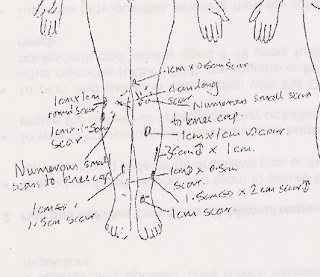
Roberts+scars.png
Segwanyi's torture scars, including from burning plastic
In Segwanyi's case, the Home Office lawyer before Hembrough last November argued that even if Robert was gay, gay people are not at risk in Uganda. Hembrough's determination follows the Home Office lawyer's arguments.

The question of why Home Office lawyers are still using 'JB' precedent and why they are still arguing that there is no repression of LGBT in Uganda is one likely to be followed up as it has yet to be satisfactorily answered.

There are numerous other reasons for concern at Judge Hembrough's determination, such as his treatment of the evidence of a leading psychologist, Professor Cornelius Katona, particularly the judge's claim that the psychologist had said Segwanyi was not gay which was not the case, as the psychologist has repeatedly and loudly insisted, and his rejecting of Katona's finding that Segwanyi suffered Post Traumatic Stress Disorder, something Katona said could not be faked.

Another might be the judge rejecting the November appeal in part on the basis of a lack of medical evidence "which might show that the Appellant had engaged in penetrative sexual acts" - a comment which is reminiscent of the ‘virginity’ tests given to South Asian brides by the British authorities in the 1970s or the use of phallometry, a method used by the Czech authorities to judge gay asylum seekers that involves attaching electrodes to the penis to measure sexual arousal.

The new rules

Last July's ruling of the Supreme Court took 'SB' and overthrew the Home Office's 'discretion' and relocation argument at the highest level, for every country.

Barrister S. Chelvan explains:
"The Court expressed in clear language, that the correct test .. involves firstly making a finding that an individual is gay, lesbian or bisexual, or will be perceived to be. This importantly recognises the risk to those who do not live what I term a ‘heterosexual narrative’, ie living, or being perceived to live, a straight life, by engaging in a socially expected heterosexual gender sex role. Secondly, an assessment will be required of what would occur to a gay, lesbian, or bisexual person, if they lived ‘openly and freely’ in the country of origin. If, as a result of living openly, there would be persecution, then the fear is well-founded. Thirdly, if it is found that they will live ‘openly’ and consequently be subjected to a real risk of serious harm, then they are entitled to refugee status. Nevertheless, if, on the other hand, they are discrete, due to this fear of persecution, then they are also a refugee."
The Supreme Court laid down new rules, which were subsequently codified by the Home Office in a new Asylum Policy Instruction (API) published in October 2010 on sexuality-based asylum claims and which UKBA officers are supposed to be trained to follow.

This guidance says that consideration should be made of the traumatised state in which someone may be telling their story. This is especially relevant as the rejection of Robert's account of his relationships in the UK and in Uganda as inconsistent and 'not credible' was because of language issues and Professor Katona said that

"Mr Segwani's Post-Traumatic Stress Disorder [means that] there is a strong possibility that his high levels of fear and stress may have led to his assenting to be interviewed in English without taking fully into account the disadvantages of doing so."
That July 2010 interview which is picked apart for inconsistency and on which basis Segwanyi's case is still being rejected was conducted mere weeks after he escaped from prison and fled with the Ugandan police looking for him and putting up 'wanted' notices. Judge Hembrough explicitly rejected the idea that he should be re-interviewed.

In his letter to UKBA, Segwanyi's MP, Mike Hancock, writes that Hembrough's findings about Segwanyi being interviewed in English, about his Post-Traumatic Stress Disorder and his homosexuality:

"Are at best based on somewhat prejudiced views and not in line with the evidence. Indeed if Mr Segwanyi had wanted to mislead the immigration authorities he would surely have acted in a different way."
The UKBA API says that officers are supposed to ascertain why someone claiming asylum on grounds of persecution because of sexuality will be 'discrete'. The Supreme court rules include four tests, three concerning why someone gay would be 'discrete'. If it is not their own choice, if they are saying they'd be 'discrete' because of societal or state pressure, they are a refugee the rules say.

In rejecting Segwanyi's claim reference is made to a supposed comment in his interview in July 2010 that he would be discrete because his family would want him to be. As noted, there are serious questions regarding the translation of his answer as English is not his first language and the interview was conducted in English, but if current guidance was being followed this claim on how he would behave would be directly asked, rather than being extracted out of context from other testimony, as it has been.

Different department, different Uganda policy
 
As well as the instructions and rules having changed, the UKBA's own 'country information' on Uganda changed in February this year, after much criticism of the slowness by which such information was updated. This now recognises the persecution of LGBT in Uganda, in particular it points decision makers at an Amnesty International report from last year.
"Amnesty’s 2010 Report 'I Can’t Afford Justice' published on 6 April 2010 commented “…section 145 of the Penal Code Act has been and continues to be used by the police and other law enforcement officials to subject lesbian, gay, bisexual and transgender (LGBT) people in Uganda to arbitrary arrest and detention often resulting in torture or other cruel, inhuman and degrading treatment.” [10b] This comment is contrary to that made by UHRC at 19.04 and should be considered accordingly. [This means that this information should be prioritised over prior information.]"
Any claim that the sodomy law is not enforced and that LGBT are not persecuted in Uganda, such as by Home Office lawyers representing the Home Secretary, actually mirrors the argument of those pushing for the so-called 'Kill gays' bill. Its advocates say that a new law is needed in Uganda precisely because LGBT are not now persecuted and new law is therefore needed to persecute them.

Other parts of the British government are heavily engaged with critiquing the same growing persecution of Ugandan lesbians and gays that is detailed in evidence presented in 'SB', the February case and Bishop Senyonjo's evidence regarding Segwanyi.

UK Ministers have made statements against the 'Kill gays' bill and state-sanctioned persecution. The Foreign Office is "concerned" and is reportedly privately lobbying Ugandan politicians. The previous Prime Minister even pulled aside the Ugandan president at an international conference and told him to stop the bill.

But another part of the government, in August 2011, thinks differently if it is still using the same argument on the lack of persecution of Ugandan LGBT advanced in 'JM', and supported by Judge Hembrough in Segwanyi's case before him last November, as it appears to be in its latest argument rejecting Segwanyi.

Robert's case has now been reported (picking up from the BBC report) in the respected Ugandan newspaper The Monitor (see scan of their report at the beginning of this article). It is cited in a section covering mentions of Uganda in foreign media, as often occurs in media in other countries which picks up on mention of them elsewhere - see Australia's media for other examples of this.

The Home Office (and immigration judges) routinely discount media coverage on the basis that it is sought "for the sole purpose of of attempting to increase any perceived risk he may face on return" as the latest rejection letter for Segwanyi puts it. BBC reports and other coverage is not considered part and parcel of normal civil society investigation of how the Home Office works. Any journalistic or campaigning challenging of Home Office decisions which results in media coverage must be 'manipulation' personally orchestrated by the asylum seeker - according to their own words there cannot be any other reason for it.

Another argument used is that such coverage, usually African coverage, has been bought and deliberately placed. It remains to be seen if this will be used regarding the Monitor coverage, given that the Monitor is Uganda's equivalent of The Guardian or The New York Times

Mike Hancock MP will be protesting his treatment regarding his interventions on behalf of Segwanyi. He was written to by UKBA asking for further information and then the next day written to again to be told that they'd already made a decision.

Hancock's office say that he is currently considering putting down an Early Day Motion in the House of Commons concerning Segwanyi's treatment.

Segwanyi's lawyer is submitting an appeal today.

Enhanced by Zemanta

Thursday, 25 August 2011

In UK, immigration detention 'legal but unfair'

Statue of JusticeImage by Ann Althouse via Flickr
Source: Compas

By: Stephanie Silverman, DPhil Politics and International Relations

The UK immigration detention system is always attracting attention, most of it negative.  There are protests organised monthly – if not weekly – outside of detention centres and in the centre of London.  MPs ask Parliamentary Questions about the statistics and treatment of detainees; the United Nations intervenes in UK domestic politics to express its disapproval; the Immigration Law Practitioners Association publicly calls foul on the lack of bail options for detainees; and, during the 2010 General Election campaign, Nick Clegg makes ending child immigration detention a key manifesto promise.

So, why all the fuss? Why are activists, barristers, mental health professionals, students, pensioners, and politicians all working towards improving conditions for UK immigration detainees, if not ending the practice altogether? Because, while it may be legal, the UK immigration detention system is far from fair.

To better understand why the stakes are so high, here is a potted list of some of the current issues, and why they might provoke anxiety and outcry.


The size and cost of the system

The UK immigration detention system expands virtually every year.  As of 2011, the UK boasts one of the largest networks of immigration detention facilities in Europe.  According to Home Office statistics, approximately 30,000 non-citizens entered detention under Immigration Act powers in 2009.  Put another way, nearly 3,000 non-citizens in the UK are being detained under Immigration Act powers on any given day. This compares to 1,950 total immigration detainees on 25 December 2004 and 780 on 30 December 1998.

After the re-purposing of the Morton Hall prison as an immigration removal centre (IRC) in June 2011, UK detention capacity expanded to approximately 3,500 places.  As a snapshot example, 2,525 non-citizens were detained in UK facilities on 31 December 2010.

The detention system is extremely expensive to run.  In 2010, the average overall cost of one bed per day in the immigration detention estate was £120.  This means that, to take our example of 31 December 2010, the detention system cost taxpayers approximately £303,000 for that one day only.  Further, since the UK Home Office outsources the operations of the majority of its detention facilities, much of this money is being pocketed by private firms and this in turn raises issues of accuracy and transparency.

Sunday, 14 August 2011

In UK, protest against deaths in detention centres

Source: Indymedia London

Anti-detention campaigners 5 August held a small, but noisy, protest at Colnbrook immigration prison, near Heathrow airport, where two migrant prisoners apparently killed themselves in less than a month. With a megaphone, whistles, a vuvuzela and pots and pans, they made themselves heard to the migrants locked up in Colnbrook, as well as in the adjacent Harmondsworth. Detainees shouted back 'freedom, freedom' and other angry, desperate slogans.

On 31st July, a 25-year-old man in Colnbrook reportedly killed himself. No details or hard facts are known yet. The Home Office is claiming that he died of 'natural causes' but fellow detainees told campaigners he committed suicide after becoming “very distressed.”

Less than a month before, on 2nd July, another Colnbrook detainee, Muhammed Shuket from Pakistan, died on the way to hospital after he apparently tried to hang himself. Again, the Home Office refused to reveal any details and promised “an inquest in due course.”

Earlier this week, on 2nd August, a 35-year-old man locked up in Campsfield immigration prison in Oxfordshire was also found dead. According to other detainees, the Moldovian national was about to be deported and hanged himself in the toilet.

The three deaths bring the number of people who have died in UK immigration prisons over the last few years to 16. These crimes should stop and the only way to do that is to close down all immigration prisons and stop forcibly deporting people who have come here to seek refuge and safety.
Enhanced by Zemanta

Thursday, 28 July 2011

Report: In six EU countries refugee protection "significantly divergent"

yellow umbrellaImage by solidether via Flickr
Source: UNHCR

"Safe at Last? Law and Practice in Selected EU Member States with Respect to Asylum-Seekers Fleeing Indiscriminate Violence" examines the application in particular of Article 15(c) of the EU's Qualification Directive (QD), under which Member States are required to grant subsidiary protection to persons fleeing ''serious and individual threat to a civilian’s life or person by reason of indiscriminate violence in situations of internal or international armed conflict."

The research has focused on the practice of six EU Member States who received together 75% of EU asylum claims in 2010: Belgium, France, Germany, the Netherlands, Sweden and the UK. The study looked in particular at the assessment of claims for protection by Afghans, Iraqis and Somalis.

The study found, among other things, that the approaches to application of Article 15(c) of the Qualification Directive are significantly divergent between the six Member States examined. In some cases, it would appear to be applied in such a narrow manner that protection is denied to many persons which Article 15(c) was originally intended to cover. In some States, it is applied to an extremely small percentage of people fleeing situations of violence and armed conflict overall.

In addition, it appeared that States are not granting refugee status under the 1951 Refugee Convention to some people fleeing indiscriminate violence who, in UNHCR's view, would be entitled to it. It is found moreover that the added value of Article 15(c ) QD compared to Article 3 of the European Convention on Human Rights (ECHR) is not clear; that approaches to assessing the level of violence required to trigger
application of the provision vary widely; and that the concept of a "real risk" is interpreted in a way that imposes a heavy burden on applicants to show they are exposed to individual risks.

Based on these findings, UNHCR puts forward nine recommendations to Member States and the EU in order to ensure that protection is granted to persons fleeing indiscriminate violence.

Safe at Last? Law and Practice in Selected EU Member States with Respect to Asylum-Seekers Fleeing Indiscri...

Wednesday, 20 July 2011

Breakthrough: UK to record sexuality-based asylum claims

By Paul Canning

LGBT Asylum News has learned that information on sexuality-based asylum claims have been imputed into the Central Information Database of the UK Border Agency (UKBA) since 1 July.

The UK joins only five other countries which record data on the number of LGBT persons benefiting from
asylum/subsidiary protection due to persecution on the ground of sexual orientation: Austria, Belgium, Cyprus, Latvia and Estonia.


Correction: This information from the EU Fundamental Rights Agency is incorrect, according to research currently being conducted on LGBT asylum in Europe. Researchers say that only Belgium and Norway records sexuality-based asylum claims.

The Home Office say as well that:
"We are also reviewing all first asylum decisions in these cases taken between 1 April and 30 June to evaluate the success of our new guidance and training."
After the Supreme Court decision one year ago that ended 'go home and be discrete', the UKBA said they would collect data on LGBT asylum but Immigration Minister Damien Green said earlier this year that this wouldn't happen because of "disproportionate cost".

UKBA has made no official announcement but we understand that retiring manager Bill Brandon (Deputy Director, NAM+ Quality and Learning; Refugee Integration and Resettlement) told a event organised by the law firm Mischon de Reja last month about the developments on data and auditing.

UK Lesbian and Gay Immigration Group (UKLGIG) Group Manager Erin Power said:
"I don't know why UKBA didn't say publicly that they were trying to find an accurate way to do this."
LibDem peer Lord Avebury has pressed the Home Office on the issue of recording data and auditing.

UKLGIG, which works with LGBT asylum seekers, have been lobbying on the issue for some time and in the last 12 months has held discussions with the Home Office on several occasions.

Power said that following the announcement last year that UKBA would record data attempts were made but failed because of IT problems and "because different areas of the country collated different stats."
"We were aware of the initial attempt to record LGBT claims that did not work well and of subsequent work on ensuring that recording was practicable and consistent.  We were also aware of the audit and will, like many others, be interested in the outcome."

"Of course we are delighted that UKBA is looking at the quality of decision making on LGBT asylum claims and we are hoping that it will reveal an improvement in initial decisions."
Anecdotal evidence is of increasing disbelief that applicants are lesbian or gay and this website has documented poor decision making in a number of cases. Power has acknowledged that this is a concern for UKLGIG, telling The Guardian: "It has always been difficult to prove but more frequently now, people are not being believed."

Last October, as a result of the Supreme Court decision, the UKBA introduced new Asylum Instruction guidance and at the beginning of this year ran a one-day 'case owner training' session for UKBA staff. The training was run by UKBA which consulted with UKLGIG, Stonewall and UNHCR

The Home Office say that:
"The government has made it clear that it is committed to stopping the removal of asylum seekers who have genuinely had to leave particular countries because of their sexual orientation or gender identification."
However data recording and the completed audit will only look at new claims and concerns have been raised about the treatment of cases already in the system. As well, there are serious concerns about a decreasing availability of specialised legal advice due to legal aid cuts and the collapse (due to those cuts, it is claimed) of the two biggest providers of legal services to asylum seekers.

The Immigration Law Practitioners Association told The Guardian that:
"The sensible thing to do would be to review cases of removal. When you get to a point where you have to put someone on a plane for removal, you should get their file out and make sure there's nothing of concern. They should check they have not claimed on the grounds of being gay, because they know that there was an important decision in the court which may be relevant."
Says Power:
"Obviously there is no point in collecting the stats if they don't look at them and see if there has been any change in decisions - hence the audit."

"There are still some concerns which we can look at when we see the results of the audit."
The government has specifically ruled out other measures which would help LGBT asylum seekers. It will not exclude sexuality-based claims from 'fast track' decision making - as some other categories of claim are - despite Damien Green in a letter to Dr Hywel Francis MP, the Chair of the House of Commons Joint Committee on Human Rights, accepting that they "can raise complex and specific issues based on cultural differences and the possible trauma of the individual concerned."

'Fast track' claims are far harder to win because legal options are dramatically reduced and people - often traumatised from torture and other bad treatment, as Green acknowledges - are invariably detained.

In the letter to Francis, Green refers to Stonewall's report 'No Going Back' - however that report made 21 recommendations, which went far beyond training of staff. For example, the report discusses the effect of the dispersal system on LGBT asylum seekers who are sent to towns where it is impossible to access appropriate and safe support. They are often forced to live with people who do not accept them and several reports have found that they can be at risk of violence. We are aware of  cases where UKBA has been asked to move LGBT asylum seekers closer to sources of support but has refused.

Green does acknowledge criticism of the crucial 'country information' on which many case decisions hang. In particular, he acknowledges the criticism made by the Shadow Foreign Secretary in the 'BN' Ugandan case that that country's information was two years old and made no reference to LGBT. In the letter he notes that at the time of writing only three country reports made any reference (since he wrote new Uganda guidance has been published which does include LGBT issues, however problems remain with its contents).

Green says in the letter that other work is "in hand" to address the (wide ranging) issues raised in Stonewall's report - but it is not in any of the plans published by the Home Office (and the department's business plan covers the entire life of this parliament).
Enhanced by Zemanta

Monday, 11 July 2011

UK's removal of gay tortured, imprisoned Ugandan stopped at last moment

Robert Segwanyi
By Paul Canning
The removal of Ugandan gay asylum seeker Robert Segwanyi was tonight "deferred" at the last minute. He had been moved today to a Heathrow 'removal centre' for an early morning 11 July flight to Kampala.

The deferment comes after the last minute intervention of Segwanyi's MP, Mike Hancock, as well as the MEP Michael Cashman. Many concerned people also wrote the British Home Secretary Theresa May over the past few days.

A new lawyer had been found today for Robert - who has been badly represented previously - but he did not have enough time in which to submit a judicial review application.

Robert was imprisoned and tortured for homosexuality. On escaping prison in June 2010 he fled to the UK and applied for asylum a fortnight later. The UK Border Agency (UKBA) does not accept he is gay and a judge rejected his appeal claiming that there is no risk to gay people in Uganda.

Hancock's letter demanded that Robert be given enough time to put in for judicial review - because, he explained in some detail, previous judicial dismissal of Robert's case appeared to be unsafe.

In particular he pointed to immigration judge Hembrough's treatment of the evidence of Professor Cornelius Katona, a Fellow of the Royal College of Psychiatrists, Emeritus professor of Psychiatry in the University of Kent, Honorary Professor in the Department of Mental Health Sciences at University College London and author of over 300 expert medical reports. (Katona's evidence wasn't available on Friday when we detailed other problems with both judge Hembrough's as well as the UKBA's treatment of Robert.)

Hancock pointed to the judge's statement in his ruling that Prof. Katona did not consider Mr Segwani to be gay - yet Prof. Katona has said that this is "with respect, incorrect".

Hembrough said he had “considerable doubts as to whether” Segwanyi was suffering from post-traumatic stress disorder (PSTD) – despite Prof. Katona saying that it would not even be possible for professional actors to fake PTSD symptoms in a way that Segwanyi did.

The treatment of Katona's evidence demands judicial review, Hancock says.

Further, he points out that Theresa May has said that "cases involving LGBT will be reviewed before final deportation." And Hancock wants an answer to his suggestion:
"That this case shows that the UKBA and the Home Office are institutionally homophobic and there should be better consideration of this case so that it can demonstrate that it is not."
Mike Hancock MP
Hancock notes that the judge's determination in November was:
"Even if I am wrong regarding the Appellant's homosexuality I see no reason to depart from the [then] current country guidance" - this guidance being that "the evidence does not establish that in general there is persecution of homosexuality (sic) in Uganda".
When, Hancock says, the situation for LGBT in Uganda was widely reported as worsening.

He notes that Professor Katona says that
"Mr Segwani's Post-Traumatic Stress Disorder [means that] there is a strong possibility that his high levels of fear and stress may have led to his assenting to be interviewed in English without taking fully into account the disadvantages of doing so." 
Robert's prior argument was that the 'credibility' issues raised by UKBA were due to the interviewer mixing up his statements about his past relationships - and Prof. Katona says that Robert's understanding of English was poor and his spoken English also "very limited". The judge dismissed this evidence.

When Robert's case was last dismissed by UKBA 21 January reiterating the judge's ruling, Prof. Katona said:
"This assessment appears however to have ignored my expert clinical assessment."
Commenting on the judge's decision, Hancock quotes the Public Law Project:
"Public bodies must correctly understand and apply the law that regulates their decision making powers. An action or decision may be unlawful if the decision maker had no power to make it or exceeded the powers given to him/her. Four kinds of illegal activity may be identified:...[including] taking irrelevant factors into account or failing to take account of all relevant factors."
Hancock writes that Hembrough's findings about Segwanyi being interviewed in English, his PSTD and his homosexuality:
"Are at best based on somewhat prejudiced views and not in line with the evidence. Indeed if Mr Segwanyi had wanted to mislead the immigration authorities he would surely have acted in a different way."
Hancock quotes from Stonewall's Report 'No Going Back' that "some appeal judges' attitudes to LGBT are "old-fashioned"." And he highlights a quote from the report from another Ugandan asylum seeker who said:
"My lawyer asked whether I could change my case and claim on political grounds instead. She said it's hard to represent me properly with the case of being gay."

Enhanced by Zemanta

Related Posts with Thumbnails

