Showing posts with label sudan. Show all posts

Monday, 28 November 2011

Migrants in Egypt targeted for body parts

By Paul Canning

People fleeing persecution in countries like Eritrea are being killed in Egypt for their body parts.

According to a doctor in a town on the Sudan-Egypt border quoted by South Africa's Weekend Argus newspaper, a number of “disemboweled bodies” have been discovered. Organs, especially kidneys, were missing.

A recent car crash in Sinai provided evidence. The doctor who was driving the car was killed and, inside the vehicle, officials discovered a small refrigerator containing several human organs. There is other evidence including photographs from a morgue in the Egyptian port town of al-Arish showing scars in the abdomens of refugees who did not make it.

At least 27 refugees have alleged that Egyptian Bedouin people-smugglers have threatened to steal their organs unless they or their families paid money, Physicians for Human Rights (PHR) Israel says.

The Egyptian authorities are known for ignoring the treatment of migrants by traffickers and others, or, in the case of those trying for the Israeli border, actually shooting to kill. They deny the evidence of any trade in body parts.

Italian-based Eritrean agency Agenzia Habeshia provided evidence of some 300 Eritreans and Ethiopians who are being held in police stations in Aswan in Southern Egypt and in the military camp of Shelal in “inhuman and degrading conditions”.

The inter-governmental organisation International Organisation for Migrants (IOM) has listed the situation in Aswan as “very serious”.

Beatings are a regular feature of detention and political and religious refugees in particular are subjected to torture to make them sign “voluntary repatriation requests”.

IOM say that last week more than 100 Christian Eritreans who suffer religious persecution and fear for their lives in Eritrea, were beaten repeatedly until they signed.

“Refugees and asylum-seekers returned to Eritrea have been detained incommunicado and tortured upon return,” Amnesty International said. They have accused the Egyptians of denying refugees access to UNHCR.

The situation in camps run by traffickers is worse, with slavery well documented aside from the alleged, lucrative body parts trade. In the Sinai, criminals hold hostage, kill, torture, and rape migrants.

PHR Israel earlier this year published a survey based on interviews with 284 asylum seekers who made it to Israel. Some 44 per cent said they witnessed violence and/or fatalities of other asylum seekers while they were in the Sinai and the vast majority (88 per cent) stated they experienced severe hunger and food deprivation.

Many women have asked for abortions after being raped.

A leader from the largest Bedouin tribe told CNN said he was aware that rogue elements of his tribe are engaged in people trafficking, bonded labor and torture.

Several hundred Eritreans were recently released from hostage by local Bedouin police working with an NGO coalition. But authorities have been slow to act, if at all, despite being given details about individual criminals.
Enhanced by Zemanta

Wednesday, 19 October 2011

LGBT Muslims in Europe organise conference

CALEM, the Confederation of Associations LGBTQI European and Muslim, is organising a conference in December in Brussels, "to enable inclusive Muslims, and particularly those who happen to be LGBTQIA individuals, to express their sexuality in peace, while defending their civic rights and human dignity through ideas and dialogue. "

The conference also aims to 'actively contribute to a reformed and genuinely inclusive representation of Islam' and a 'positive and constructive dialogue about Islam, within the Muslim world'

CALEM brings together four LGBT Muslim organisations, from Belgium, South Africa, France, Sudan and Egypt.

Speakers at the conference include Amina Wadud, a university professor "struggling for an Islamic feminism", Islamic Scholar Muhsin Hendricks, who is a human rights activist focusing on gender and sexual diversity in Islam, Ludovic Lotfi Mohamed Zahed, founder of the French LGBT Muslim collective HM2F, and Abdennur Prado, President of the Catalan ligue for Islamic reform  -

The conference will be attended by CALEM sister organizations from Europe, the Arabic world, Asia and Africa.

CALEM say that their network is "at the avant-garde of the reflection about Islam and sexual or gender diversity." In early 2011 they were involved in creating an International Network of Inclusive Muslims (INIMuslim).

INIMuslim (“I am Muslim” in Arabic) is a collaborative initiative of official organizations and associations worldwide, and selected experts, working internationally for the inclusivity of Muslims marginalized on the basis of their sexual or gender orientation, advocating both against “homophobia” and “islamophobia”, to defend their human rights.

The conference will include much discussion but will also include an "inclusive Muslim marriage religious celebration, thanks to our inclusive imams."

Saturday, 24 September 2011

The Guardian tells stories of LGBT from Africa, Middle East

Rick & Steve: The Happiest Gay Couple in All t...Image via Wikipedia
Source: The Guardian

Bisi Alimi, from Nigeria

In 2002, I was at university in Nigeria and standing for election. A magazine wrote about me and exposed me as being gay. This led the university to set up a disciplinary committee. I was very nearly dismissed. When I did graduate, people wanted to refuse me my certificate on the grounds that I did not have good enough morals to be an alumnus of the university. While this was going on, the then-president, Olusegun Obasanjo, declared that there were no homosexuals in Nigeria, and that such a thing would not be allowed in the country.

I talked with a friend of mine, who is a famous Nigerian talkshow host, about challenging this opinion. Nobody had come out publicly before. So, in October 2004, I appeared on her breakfast show, New Dawn with Funmi Iyanda". I talked about my sexuality, the burden of the HIV epidemic in the gay community.

The reaction was immediate and violent. I was subjected to brutality from the police and the community. I was disowned by my family and lost many friends, including in the gay community. They were afraid to know me. I was isolated, with no support and no job. The TV show was taken off the air by the government. It led to the introduction of the Same Sex Prohibition bill of 2006. All I had done was say who I was. Three years later I appeared on the BBC World Service. I repeated what I had said on television in Nigeria and suggested my government was using attacks on homosexuality to help cover up its own corruption.

On my arrival back to Nigeria, I was arrested, detained and beaten by the police. For a month, until I fled back to the UK in April 2007, my life was in constant danger.

Nassr, from Iraq

I was working for the Americans as a translator. When I got back to Iraq, I found that my house had been confiscated by the Mahdi militia. They are Shia, I am Christian. When I knocked on the door, I said: "This is my house." They said: "This is not your house. Either you go or we kill you." They beat me. They hit me on my head with their guns. I ran away, so they went after my sons instead. I heard they had asked my neighbours about me, and the neighbours had told them I am gay. I was now in real danger.

Friday, 23 September 2011

Gay Africans react to Obama's UN comments

By Paul Canning

Gay African activists have reacted positively to President Obama's inclusion of LGBT human rights in his annual address to the United Nations General Assembly - a first for an American President.

Obama said:
"No country should deny people their rights, the freedom of speech and freedom of religion, but also no country should deny people their rights because of who they love, which is why we must stand up for the rights of gays and lesbians everywhere."
According to Mark Bromley of The Council for Global Equality, a coalition of organisations working to promote human rights and LGBT equality in the United States and overseas, the inclusion of LGBT human rights is very significant as it reflects the Obama administration’s foreign policy priorities and "there is always intense competition to get issues included in the speech. It’s definitely considered prized placement."

Bromley noted that President George Bush had refused to join a UN statement calling on countries to decriminalise homosexual relations.
"President Obama, in contrast, stood before that same institution to pledge U.S. support for LGBT rights globally," he said.
The United States has, under Obama, led efforts for LGBT at The United Nations and in other international bodies. Obama personally spoke out against Uganda's 'Kill gays' Anti-Homosexuality bill - comments which drew significant attention in Africa. The Archbishop of the Church of Uganda, His Grace Henry Luke Orombi, said:
“It is distressing that Barack Obama a fellow African would promote racial civil rights as morally equivalent to immoral civil behaviour. We are Africans and know the difference between moral behaviour and responsibility as opposed to civil rights being compared to homosexuality. Will Barack Obama represent our interests in this matter?”
In January Obama said he was "deeply saddened" by the murder of Ugandan gay rights activist David Kato.

In June Obama called the passage of the first LGBT human rights resolution at the United Nations "a significant milestone in the long struggle for equality, and the beginning of a universal recognition that LGBT persons are endowed with the same inalienable rights - and entitled to the same protections - as all human beings."

He said that the United States "stands proudly with those nations that are standing up to intolerance, discrimination, and homophobia."
"LGBT persons are entitled to equal treatment, equal protection, and the dignity that comes with being full members of our diverse societies. As the United Nations begins to codify and enshrine the promise of equality for LGBT persons, the world becomes a safer, more respectful, and more humane place for all people." 
Ugandan lesbian activist Jacqueline Kasha Nabagesera yesterday told the Global Summit Against Discrimination and Persecution, held to coincide with the UN General Assembly, that "not every war is fought with guns" and that "statements and resolutions from the US help. We need American support against the LGBT hate bill in Uganda." (Video of her speech below, she says Ugandan diplomats told her she should be arrested for treason).

African gay leaders we spoke to saw Obama's latest comments as extremely important for their struggle in a continent where the LGBT movement is growing but faces stiff and organised resistance.

Ali Sudan, President of the underground LGBT group Freedom Sudan, said that the comments "gave me hope".
"LGBT individuals suffer or are killed everyday by the hand of their countrymen especially here in Africa and the Middle East," he said. "We need to stand together and keep fighting to gain our rightful rights as humans. I hope his message will inspire many other people to stand with us in this fight."
Stéphane Koche of Cameroon's Association Camerounaise pour la défense de l'homosexualité (ADEFHO) described Obama's UN comments as "very inspiring for the world, including Africans."
"It means a lot. It highlights common values, common hopes, common aspirations and it's very simple to understand."
Braam Hanekom, coordinator of South Africa's PASSOP (People Against Suffering, Oppression and Poverty), also found the comments "inspiring". He said:
"Despite the immense political challenges we believe he is facing, President Obama was unafraid to address the rights of the LGBTI community. He used a powerful platform and addressed many of our leaders."
"His inclusion should be seen as a clear message and we hope that pressure will be increased on all countries that have failed to protect and/or who have even actively demonized the LGBTI community."
"We should warn him that many of our African leaders are, what I call "chameleons", they tend to "care" for the LGBTI community where it is popular and it benefits them, while in their countries and communities (even in AU meetings), they tend to be homophobic (where and when it benefits them politically). We hope that he will show them that the USA will not support leaders who have failed to recognize the rights of the LGBTI community."
"The USA should also start challenging those who fail to make their position clear, as well as hold accountable those who "claim" to respect LGBTI rights. It is also important to state clearly that many Africans are part of our local LGBTI communities and thus there is no substance to nonsensical claims from certain "right-wing populist" leaders that "it is Un-African", instead it is "Un-African" to disown our brothers and sisters for who they love or what they believe."
David Kuria, a Kenyan gay leader and politician, "read the statement with delight."
"When a President such as Obama with African roots talks in favour of gay rights, at the very least it shows that not everyone is homophobic and that in fact African leaders are in a class of thinning minority."
Kuria said that there are now some African politicians who are prepared to stand up for LGBT "albeit not too loudly." He suggested that they may be "emboldened to be more vocal" if US embassies follow up the comments with "tangible action".
"We are trying as activists," Kuria said, "to build a narrative that shows LGBTI rights as the next cycle of or frontier of Human Rights development in Africa. First we had decolonization, then  women's rights and now the last frontier is LGBTI rights."
"The same arguments, including religious, against LGBTI rights had been used against women's rights so it's not a hard narrative to generate. President Obama's words falls quite in place in this story because his predecessors had prophetically spoken in similar terms of the previous cycle of rights."
Some commentators were more critical. Writing on death + taxes, US gay activist Andrew Belonsky said:
"The real test, however, will be whether the Obama Administration actually works said rights into their policy, especially in Arab nations undergoing Democratic transformations."

"The States have failed to normalize homosexuality in places like Afghanistan and Iraq. If Obama wants to be seen as a man of his word, he and the State Department will make clear that new governments like those in Egypt and Tunisia in need of American support and money have no choice but to accept and celebrate their LGBT citizens. If they don’t, they will be failing the democratic dreams that fueled their uprisings in the first place."
Video of Obama's speech

Tuesday, 30 August 2011

In Sudan, for LGBT, more clouds on the horizon

Mosque of Uqba image via Wikipedia
By Ghareeb

This is part two of a two part series; read part one

The preparation of this article started 8 July, the eve of the secession of southern Sudan from the Republic of Sudan to become an independent country. Southerners were very excited, obviously, but both northerners and southerners were wondering about what the future might hold for them. Homosexuals on both sides have more than their fair share of concerns.

In December 2010 president Omar Albashir stated in a public speech which preceded Southern Sudanese referendum in January this year:
“If Southern Sudan chose the secession  the constitution will be then modified and there will be no place to talk about racial and cultural diversity and Islam and Shari’a* will be the main resources for legislation.”
This statement was made in the context of the “carrot and stick” policy attempted back then by the Northern government in order to persuade southerners who were living in the north to vote for unity in the 9 January referendum, however its echo stirred the fears of liberals, human right activists and, of course, LGBT community which had already suffered a great deal even during the transitional period between 2005 and 2011 in the name of Shari’a.

During this period, in concordance with the “Republic of Sudan Transitional Constitution for Year 2005”, shari’a remained the main resource of legislations on the national level and it has been actively implemented in the Northern states whereas the South was excluded.

Before the National Islamic Front came into power by the military coup d'état (National Salvation Revolution) which held up the logo of “Islamic State” and rejected the principle of  “Secular State” in 1989, before that, there were no laws that criminalised same sex between adults. However, only two years after that in the 1991 Penal Code man to man sex was criminalised under the name of “Sodomy” with the “guilty” being lashed and maybe imprisoned for the first and second convictions and subjected to death penalty for the third and last conviction. (The funny thing about this article is that anal sex between a man and a woman is included also as crime in the same article!)

As for “Acts of Obscenity” (public or private display of affection or a sexual behavior that does not reach the point of sexual intercourse) lashes, a year of imprisonment and a fine are all options. However, there is no clear mention in that law for same sex between women.

Shari’a: designed and prejudiced, the Sudanese way

Monday, 15 August 2011

Breaking News: LGBT has hit Sudan!

By Ghareeb

Part one of a two-part series. Read Part Two.

There is a Sudanese website called Rumat Alhadag which posted in 2009 an article about the establishment of the Sudanese LGBT Association Freedom Sudan and its goal to improve the rights of LGBT individuals in Sudan, a quick analysis of the replies to this article reveals the following:
  1. There were 39 replies (repetitions were not counted).
  2. While only 4 replies reflected positive attitude toward homosexuality and homosexuals, 33 replies displayed a negative (many times very aggressive) attitude toward the issue. However, 1 reply acknowledged its existence without showing a clear attitude and another one only displayed a surprise feeling.
  3. Words used to describe homosexuals included: “dregs”, “decadents”, “immoral”, “animals alike” and “salacious” with calls to “be expelled to an empty jungle”, “buried alive” and “pursuit by authorities”.
Before the establishment of the LGBT association in Sudan (Freedom Sudan) in 2006, homosexuality was a taboo subject and not many people dared to talk about it publicly and if they did so they would then have to face fierce and sometimes personal attacks from the society members. Even if they displayed a judgmental negative attitude toward the issue they would probably be labeled with descriptions like “profligate” and  “excitement seekers” and accused with “attempting to distort the image of Sudan”.

Sexual behavior in Sudanese culture is strongly linked to honor (the honor of the individual and the honor of the group are inseparable) and the concept of “honor” is a great and dangerous deal here in Sudan, it pushes many people to lie even to themselves if it was necessary in order to protect it. That is why these attempts to talk freely about homosexuality were met by such enormous denial and aggressive attack. Even until now after it has started to become less and less a forbidden subject, many people still think that this issue shouldn’t be discussed openly and should be dealt with secretly by security measures only, after all (according to these voices) these “deviants” represent only a very small and closed group in Sudan and no one supports them.

Homophobia in Sudan: a “ping pong” game!

In the highly charged political climate of Sudan, many political and religious movements seized the opportunity of the already existent negative public attitude toward LGBT people and the shock caused by the formation of an association for LGBT individuals and also the appearance of LGBT groups on Facebook (i.e. “gay story in sudan”, “SUDAN NEXT TOP GAY”, “Sudanese Gays” ... and others) they seized all this and used it as an argument against other opponent groups.

Those who consider themselves to be moderate or even liberals or progressive thinkers blame the hypocrisy of  the NCP* government and its supporters which, as they like to prescribe, while raising the logo of the “civilized Islamic project” have created a proper atmosphere for “extraneous and deviant phenomena” like the “spreading” of homosexuality by forcing in a puritanical form of Shari’a** (was prominent during the 90s then started to weaken afterwards) that inhibit the mixing of males and females in public and academic life which caused the elevation of sexual oppression among both sexes and pushed them to search for the “alternative” (by which they mean homosexuality)!.

Many of them like to adopt the opinions of some journalists and social thinkers like Mariam Othman and Hanan Aljak who prescribed Homosexuality and Bisexuality as psychological ailments and attributed them to many factors like:
  • sexual assaults during childhood; 
  • physical or emotional absence of the parent from the same gender and; 
  • other socio-economic factors like poverty, ignorance and the rising costs of traditional heterosexual marriage.
Ironically, extremists and fundamentalist Islamist groups like Ansar Alsunna (which has close ties with Saudi Arabia and the thinkers of the strict Hanbali School of Islam which prevails there) also blame the NCP government for its failure to implement the Shari’a sufficiently strong enough. They also don’t forget to aim their arrows at their natural enemies (the liberals) for calling for more freedom in the society and separation of religion from politics.

Lubna Hussein (in green)
Meanwhile, the NCP seems to be using the issue tactically against its opponents like in the famous case of the journalist Lubna Hussein who was arrested in August 2009 among other women from a restaurant in Khartoum for wearing “indecent dress” in a public place - and thus breaking the notorious article 152 in the Sudanese low “Indecent Acts” (she was wearing trousers in that incident).

The other women were flogged by law with 40 lashes each, but Lubna was excluded from the sentence. Her immunity was due to her working for the United Nations Mission in Sudan, however she challenged the authorities by refusing to pay a fine and called for the abolition of article 152. Her case caused great embarrassment to the NCP government which was faced with not only international calls from human rights organization to release Lubna and remove the above mentioned article but also with demonstrations inside Sudan which supported Lubna and her cause.

When the preparations of these demonstrations were taking place, an article was published in Alwifaq newspaper (known to be a pro-government newspaper) under the title “And with the aid of western embassies, demonstration by prostitutes and homosexuals for the abolishing of the public order law” in which the writer mentioned that a demonstration was going to be organised by prostitutes and homosexuals benefiting from the case of the journalist Lubna with the aim to reach the headquarter of UN in Khartoum and to hand in a petition requesting pressure on the government to remove the public order law.

The article was largely condemned and the government was accused with attempting to abort the demonstrations that supported Lubna and prevent supporters from gathering by sending a message via this article that whoever goes out in this demonstration is either homosexual or a prostitute. In other words using public homophobia as a weapon against opponents’ demonstrations.

In the middle of all this political exchange, public opinion becomes more congested and homophobia exacerbate. So it wouldn’t be a surprise to find a group on Facebook named (as it is translated to English) “fighting homosexuals and those who call for sex in Sudan on Facebook” which incites the visitors to help in closing Sudanese homosexual groups by clicking 'report/block this person' on their page.

Even many individuals who are supposed to be objective considering their position display obvious prejudiced non-professional opinions which could be sometimes completely wrong. For example, in the forum of the Sudanese universities of public health graduates and public health officers (suphof) some members put homosexuality side-by-side with increasing cases of AIDS in Sudan. Additional  homophobic statements were made by some members of the National Program for the Prevention of AIDS, of whom some prescribed homosexuality as a “negative mutation” in sexual practices in Sudan and that it also contributed to the high increase in AIDS in Khartoum state.

Although they mentioned concurrently that whereas the known HIV to them reached around 10,000 cases (the estimate is 88,000 cases), the number of Homosexuals known to them was only 715 and the estimate prevalence of HIV virus among them was 7.8% - which means, according to their figures, that there are only around 56 homosexuals infected with HIV. This contradicts their argument about homosexuality and AIDS spreading. The danger with these statements is that it came from a health program that is supposed to be objective and shouldn’t discriminate against any group in order to promote early voluntary examination amongst the community.

Shadows from the Past

For me, fundamental Islamic teachings wasn’t enough to explain all that hatred and the discrimination practiced at both official and popular levels against homosexuals, so I have searched for the missing part in the past and only then the picture started to became clearer to me.

Shawghi Badri
Mr.Shawgi Badri is a popular Sudanese writer and historian well known for his bold style in writing. Although he displays a frankly negative attitude toward homosexuality and considers it as a problem, yet (the opposite to the public mainstream) he acknowledges both its presence and its historic existence in the Sudanese community. This attitude has brought him many accusation of being “non loyal to the country” and “a non modest man who passed the seventh decade”  The reader can only imagine if this is what a man who himself disapproves of homosexuality had to face, because he spoke freely about it, if this is the case, what do homosexuals have to face on daily basis?!

In a post on the sudaneseonline.com website, Badri wrote a brief glance at the history of homosexuality since the Fonj Sultanate in Sinnar until the 80s passing through the era of “Almahadia” in the late 19th century and the years of British colonisation and the period after independence. He referred to global historical figures who many people tend to believe were gay like Alexander the Great, Richard the Lionheart, the First Earl Kitchener and Leonardo da Vinci. He compared them to homosexuals in Sudan using the following statement which I think is the key statement in his article:
“For those people there were choices, however what is practiced in Sudan is a process of enforcement and humiliation”
He gave the following examples:
  • His schoolmaster used to force some of his classmates to have sex with him before he was caught. 
  • In many areas in the capital Khartoum were not safe for boys and young men to walk in after dark fall and even in the daytime some kids were harassed or even raped 
  • Badri wrote that he himself was subjected to harassment and many attempts but his strong physical structure and his aggressive behavior during adolescence protected him from these attempts.
  • Some of this harassment took a “class hatred” nature being carried out by some men of low socio-economic status against kids from families of high socio-economic status just to break their spirits and be “well remembered by them when they grow up”. 
Another very alarming statement made by him which is relevant to the status quo was
“Sudanese youth in high schools and universities who were harassed or forced under fear, stimulation or threatening to have sex they found a shelter in the Islamic Brotherhood Organization which embraced them and offered them protection. Some of those were filled with hatred against the society and the others because they did not perform these acts by their own will and that might explain their dark behaviors when they reach power”. 
Badri once heard the mother of one of his classmates complaining to their neighborhood grocery man:
“What shall we do if the Minister of the Interior parks his car beside our house, climbs it and cries out for our kid from behind the wall”!
It is obvious from what is mentioned above that homosexual acts in the minds of many Sudanese are linked to sexual harassment, child abuse, class hatred and marital infidelity as Badri summarised it at the beginning as a “process of enforcement and humiliation”.

I failed to find one known example of a man to man or a woman to woman relationship described as being based on mutual love and respect between the two partners. If this is the case, no wonder from where all this anger came from.

Who knows, perhaps the men who are today eagerly chasing LGBT  individuals are the children of yesterday whose innocence was brutally taken from them by past monsters. It made me ask myself the following question: To what extent is the reality today different from the past? Well, I am still in the process of finding out the answer.

Definitions:
  • *(National Conference Party), the ruling party in Sudan since 1989. Previously called the National Popular Party before the split of the Dr. Hasan Alturabi (the mastermind behind the 1989 coup d’état) and his supporters in 2000
  • ** Shari’a or Sharia: is the code of conduct or religious law of Islam. Most Muslims believe Sharia is derived from two primary sources of Islamic law: the precepts set forth in the Qur'an, and the example set by the Islamic Prophet Muhammad in the Sunnah. Fiqh jurisprudence interprets and extends the application of Sharia to questions not directly addressed in the primary sources by including secondary sources. These secondary sources usually include the consensus of the religious scholars embodied in ijma, and analogy from the Qur'an and Sunnah through qiyas. Shia jurists prefer to apply reasoning ('aql) rather than analogy in order to address difficult questions.
 (Definition taken from wikipedia.org)

Ghareeb is a member of Freedom Sudan

Enhanced by Zemanta

Tuesday, 19 July 2011

Video: Sudanese LGBT produce first video

Freedom Sudan, the Sudanese LGBT Association, has produced its first video. They describe it as "something to start putting LGBT Sudanese issues out there".


Freedom Sudan is the lesbian, gay, bisexual, and transgender (LGBT) organisation in Sudan. The organisation was formed in December 2006. Their status is illegal. Homosexual behavior is illegal in Sudan and homosexuals face the death penalty.

They say:

"That's why our organization was formed in secret and all our activities are carried out secretly, hoping that one day we will get accepted in our communities and even in our families, and hope that we can be FREE to be the way we are. Freedom Sudan is an organization run by volunteers only."
Their website includes forums, opinions and stories.
Enhanced by Zemanta

Thursday, 14 July 2011

World's newest country off to bad start on LGBT rights

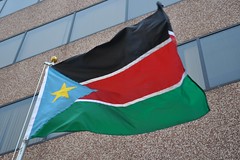
South Sudan flag raising ceremony, Washington DCImage by martha_jean via Flickr
By Paul Canning

South Sudan, the world's newest country, was proclaimed 11 July and its President, Salva Kiir Mayardit has declared that his promise of equality would not be extended to lesbians and gays.

South Sudan was formerly subject to the Sudanese interpretation of Sharia law, under which homosexual activity was illegal, with punishments ranging from lashes to the death penalty. In 2003 the government of what was then called "New Sudan" adopted its own penal code, and in 2008 the autonomous Government of Southern Sudan adopted a replacement penal code. Both codes prohibited sodomy.

In May 2010 Mayardit spoke of a New Sudan where "all citizens" enjoy "equal rights" in a country based on "democracy, equality and justice". But Mayardit said that LGBT recognition was "not in our character."
"It is not even something that anybody can talk about here in southern Sudan in particular. It is not there and if anybody wants to import or to export it to Sudan, I will not get the support and it will always be condemned by everybody."
Mayardit is wrong that "it" is not "there". In an article for the expat Bor Globe Network last October, Majur Deng Nhial wrote:
"There are people out there who congenitally conceal their true sexes for fear of being considered abnormal and not to be regard with extreme hatred and hostility. They also remain impassive not to distort families’ histories that can bring inerasable shame to the kinships. Another reason is that, there are no potential mates interesting in anal intercourse. Presumably, the mentioned suggestions could be why there was silence in their sexual behavior in the Sudan."
Two ancient cultures present in South Sudan, Nubian and Cushite, have had homosexuality as "an intricate part of the society."

Nhial relates the story of a South Sudanese gay man living in Kakuma Refugee Camp, Kenya:
"Kuma (not a real name) was a fashionable gentleman who loved to hangout with girls quite often. His voice box and walking style was of a female, but everybody else was sucking a thumb saying “Oh! he got all of them, all the girls” because he had a physical grace and beauty that attracted girls; that was a moment he wrestled with his true gender identity, but nobody paid attention until his arrival to the United State where he found liberty."
John Mathenge of HOYMAS, a Kenyan support group for MSM and gay men living with HIV, told the Kenyan website Freedom in Speech last month:
"We have cases of Somalis and Sudanese who are MSM or gay in our records. Many flee their countries because of political instability but when you get to learn their story you realize they ran away for a completely different reason. The ones I have met are gay or MSM and many end up engaging in sex work here in Nairobi to earn a living."
Activities addressing HIV/Aids in South Sudan do not include the needs of LGBT or men-who-have-sex-with-men (MSM), and a need for research has been identified. A World Bank report from April said:
"Hardly anything is known about two important high-risk populations that probably exist in Southern Sudan – men who have sex with men (MSM) and injection drug users (IDU) – both of these populations (including male sex workers) have been identified in neighbouring countries, and there is no reason to assume that they do not also exist in Southern Sudan. Even if their numbers are small, their behaviours mean that their HIV incidence rates can be very high."
Despite western media reports that the country is mainly Christian, most South Sudanese maintain traditional indigenous (sometimes referred to as Animist) beliefs and the government has supported freedom of religion. But the Christian church is very influential and in 2006 the Archbishop of the Anglican Church of South Sudan, Rt. Rev most Archbishop Abraham Mayom Athiaan told the Sudan Tribune:
"We, the bishops together with our congregation of the Anglican church of the Sudan (ACS) strongly condemn the practice of homosexuality, abortion which is being practiced in Episcopal Church of Sudan (ECS) leaderships."
Enhanced by Zemanta

Monday, 21 February 2011

Egypt is no safe haven for refugees: will things improve? Or worsen


Source: Huffington Post

By Lindsey Parietti

Ghada El-Khafagy fled Iraq four years ago with her two young children, in a journey that took her to Jordan, back to Baghdad and then finally to Egypt, but after two weeks of an often violent uprising, this second homeland is no longer a refuge.

“Please do not ask me about how I spent the past week. It was really terrible. I spent most of the time crying at home,” the 31-year-old single mother said. “I’m afraid to go out, to see anyone. I don’t know what might happen.”

Her decision to leave underscores the desperate condition of many of the roughly 100,000 refugees and asylum-seekers living in Cairo. Facing shortages of food and fuel, marauding street gangs and tanks in the streets, many have decided to flee.

For years, Egypt has provided a new home for hundreds of thousands of African and Middle Eastern refugees, a safe haven in the middle of a tumultuous region.

Wednesday, 12 January 2011

Video: Holocaust Memorial Day 2011 film trailer


Watch the making of the HMD 2011 online film: 'Untold Stories' and discover the stories behind the trailer.

Ali is a Iraqi LGBT activist who has experienced discrimination and persecution. His name has been changed and his face obscured to protect his identity as he still faces persecution today in London.

Apolinaire Kageruka is a survivor of the 1994 genocide in Rwanda. He has never recorded his testimony before.

Astrid Aghajanian survived the Ottoman Empire’s destruction of its Armenian population. For more information on the events of 1915-18, please visit the USHMM site.

Hawa is a survivor of the genocide in Darfur. She has covered her face for filming in order to protect her identity. Hawa is not her real name.

Margret is a German Jewish Refugee. She and her family fled Nazi persecution and settled in the UK.

Michel is a photographer living in the UK. In 2010, he was a victim of hate crime when his home was vandalised and a swastika was painted on his door.

Mukesh Kapila was working as Head of the UN in Sudan in 2004 and brought the genocide in Darfur to the attention of the international community.

Safet Vukalic survived the genocide in Bosnia. He now lives and works in the UK.

Simon Winston survived the Holocaust in hiding. He is filmed at The Holocaust Centre.

Sokphal Din survived the genocide in Cambodia (1975-1979).

Vicky Botton lives in the East Midlands and is a Traveller. She speaks about the Untold Stories of the persecution of Gypsy and Travellers in the UK today. Vicky refers to the ‘gadje’ in her film. This is a Romani term meaning ‘non-gypsy.’

Thursday, 16 December 2010

Sudan fashion models guilty of 'indecency'

The twins Keyontyli (left) and Taleon (right) ...Image via Wikipedia  
Source: al-bab

By Brian Whittaker

Readers of this blog may recall an incident last June when Sudan's Public Order Police, whose role includes enforcing "morality", arrested a couple of dozen people at a fashion show in Khartoum.

Yesterday, seven of the male models were convicted of "indecency" – for wearing make-up at the event – and each fined 200 Sudanese pounds (about $80). Under Sudanese law they could also have been sentenced to 40 lashes, but were spared that.

A woman was also convicted. The nature of her offence is unclear, though from the Reuters report it appears that she may have been the person who applied the make-up. Their lawyer is quoted as saying:
"The court thought that they were indecently dressed ... The judge thought that wearing makeup could be offensive for men and allowing a woman to put makeup on men was against the law."
This follows a much-publicised case last year when a group of 13 women were arrested for wearing trousers in public. Ten pleaded guilty and were subsequently flogged. One of them, journalist Lubna Hussein, contested the charge amid a welter of international publicity. She was eventually fined and was jailed when she refused to pay. She was released after one night in jail when the journalists' union paid the fine on her behalf.

Arrests of this kind have become common in northern Sudan – police statistics show that 43,000 women were arrested in Khartoum province in 2008 for clothing offences. >
Enhanced by Zemanta

Thursday, 25 November 2010

In Israel, a border wall to stop African refugees

Source: IRIN

Israel is building a 60km-long barrier on its southern border with Egypt aimed at physically keeping out African asylum-seekers amid a rising tide of intolerance towards people widely referred to as “illegal workers".

The barrier will be built at two locations which witness the most crossings - near the Gaza strip and near Eilat. The estimated US$1.35 billion project is due to be completed at the end of 2013.

Prime Minister Benjamin Netanyahu was quoted in July as saying that the "flood of illegal workers infiltrating from Africa" into Israel was "a concrete threat to the Jewish and democratic character of the country".

Local news channel Ynet recently reported that Netanyahu was also considering paying African countries willing to take in Israel’s asylum-seekers.

Israel immigration authorities estimate 10,000 asylum-seekers have crossed the border so far this year, bringing the total number in the country to some 30,000. This represents a sharp rise on the 1,100 estimated to have crossed in 2006, despite the perils of the journey, which include Egyptian border guards that shoot on sight.

Tuesday, 16 November 2010

Israeli policy on refugees comes under scrutiny in award-winning documentary

Source: Haaretz

By Riva Gold

“The issue of refugees is not foreign to us; not to Jews, and not to the State of Israel,” says award-winning filmmaker Shai Carmeli-Polak. Shai’s documentary, “Ha'plitim,” (The refugees) seeks to expose the moral and legal questions underlying refugee status in Israel.

The film follows African asylum-seekers as they cross the Egypt-Israel border to escape life-threatening conditions, and won the Bronze Olive Award at the Montenegro International TV Festival in 2009. Shai captures their arrival and detention in Israel, interspersed with scenes of parliamentary debates surrounding Israel's policies on refugees.

The film's release started with a few 2009 screenings in other countries, but is now on a tour across Israel, accompanied by talks from Carmeli-Polak. The film recently had a screening party in its honor at the African Refugee Development Center in Tel Aviv.

While Israel is party to the 1951 Convention relating to the Status of Refugees, the government has not yet adopted asylum legislation. An approximate 17,000 asylum-seekers have fled to Israel from Sudan, Eritrea, Democratic Republic of Congo, and the Ivory Coast. Many have been detained in prison camps and over 270 have been returned to Egypt.

“It’s a humanitarian crisis,” says Carmeli-Polak, who became an activist for the refugee community in 2007. “People are arriving from war-torn countries, and the government wants to just give them food and send them back.”

Tuesday, 5 October 2010

In South Sudan, an invisible LGBT community

Source: Borglobe Network

By Majur Deng Nhial

For the first five years when Sudanese flocked to developed nations, what they told their counterparts in the West either at dinner tables or in class-room presentations was that “We don’t have gays in Africa and particularly in Sudan.” Ouch! It was simply said so because something was covert and abyss according to the Sudanese community standards altogether with its norms.

The people who came from Kenya through immigration status are almost ten years from now. Their lifestyles have drastically changed in people’s thoughts and deportment. This is the latest microevolution in the Sudanese Americans community. A few number of boys wanted to be girls and the reverse is true for girls who have features of being boys.

Some analysts put forth reasons for gender alteration that a decimal of the Sudanese populations suffer attitudes of uncertainty and conflicting emotions toward their genders. There are people out there who congenitally conceal their true sexes for fear of being considered abnormal and not to be regard with extreme hatred and hostility. They also remain impassive not to distort families’ histories that can bring inerasable shame to the kinships. Another reason is that, there are no potential mates interesting in anal intercourse.
Presumably, the mentioned suggestions could be why there was silence in their sexual behavior in the Sudan.

Monday, 6 September 2010

Why Israel needs a refugee status determination process

Israel flagImage via Wikipedia

Source: Jerusalem Post

By Mollie Gerver

The lack of a working, objective policy to absorb asylum seekers has led to the mistaken overuse of ‘migrant worker’ to classify those who flee persecution in their countries.

Three thousand years ago the Jewish people introduced a revolutionary idea: provide refuge to those escaping slavery and give the former slaves almost full residency rights in the land of Israel (Deuteronomy 23:16-17).

“Infiltrators” and “migrant workers” are terms used today by government officials, policy-makers and the media to describe former slaves and victims of genocide who are crossing our border. These terms are the reason that hundreds have been forcibly returned by the IDF to the Egyptian border patrol that kills or imprisons them. Out of the approximately 25,000 African asylum seekers who have made it here alive since 2007, only around 600 have been granted temporary residency, and far fewer received refugee status, which would protect them from arbitrary deportation and allow them to apply for resettlement in other countries.

How do we know if the Africans who cross our borders are genuine refugees who have fled persecution? First, refugees are willing to knowingly risk their lives to make it here, suggesting their lives are at risk in the countries they are fleeing. Based on different AP reports of African asylum seekers killed by the Egyptian border patrol, at least one out every 200 who attempts to cross the border is killed. This statistic ignores the hundreds more who AP doesn’t find out about. Women are told they may be raped by the Beduins who help them make the journey, but are still willing to risk it. They take birth control pills to, at the very least, avoid forced impregnation – evidence that whatever they face at home is worse than the prospect of likely rape.

Thursday, 2 September 2010

Egypt has become a human prison for African migrants.

Source: Ethiopian Journal

By solomon

They are hung from trees by metal chains attached to their arms and provided with plastic bags to collect their urine to drink when they are thirsty. They are gang raped, tortured with electricity and held prisoner in desert camps. When they escape they are shot, either by their Beduin captors or by Egyptian police. These savage and disturbing details, published piecemeal over the years, are just a part of the picture of what is being done in Egypt’s Sinai desert to African migrants.

The story probably begins with the end of the Ethiopia-Eritrea War in 2000, the beginning of the Darfur genocide in 2003 and the end of the war in South Sudan in 2005, each of which in its own way created numerous refugees. In December 2005, Egypt began cracking down on African migrants, in one infamous incident many (between 10 and 60) were massacred by police attempting to clear a park of their encampments.

This helped provide incentive to travel further afield, with Europe a tough destination, they trickled into Sinai and thence to Israel. Eritreans, who now make up the majority of refugees (10,000+), have been arriving in Israel since 2007. In that year it was reported that 48 African refugees deported to Egypt by Israel had been abused and then disappeared. One migrant claimed Egyptians imprisoned him and “poured boiling water on his body.”

Friday, 20 August 2010

Cross-dressing men flogged in Sudan for being 'womanly'

Coat of arms of Politics of SudanImage via WikipediaSource: BBC

A group of young Muslim men have been publicly flogged in Sudan after they were convicted of wearing women's clothes and make-up.

The court said the 19 men had broken Sudan's strict public morality codes.

Police arrested them at a party where they were found dancing "in a womanly fashion", the judge said.

The men were not represented in court and said nothing in their defence, some hid their faces from the hundreds of people who watched as they were lashed.

The sentence of 30 lashes was carried out as soon as the court in Omdurman, near Khartoum, gave its ruling.

They must also pay fines of as much as 1,000 Sudanese pounds ($400, £252).

One lawyer, who did not want to be named, told Reuters news agency the men had not received a fair trial.

"These people did not get a chance for justice, public opinion and the media prejudged them and lawyers were too scared to come and defend them," he said.

Newspapers had called the party a "same sex wedding".

Northern Sudan is governed by Sharia law, under which homosexuality is illegal.

Laws governing "indecent clothing" were highlighted by a case last year in which a female journalist was sentenced to be flogged for wearing trousers.

The sentence was commuted to a fine.

Homosexuality is not tolerated in Southern Sudan either, where most people are Christian or follow traditional beliefs, the BBC's James Copnall says.

South Sudan President Salva Kiir recently told a radio station that homosexuality was an "imported" idea.

"It [homosexuality] is not in our character. It is not there and if anybody wants to import it to Sudan it will always be condemned by everybody," he said.

Enhanced by Zemanta

Wednesday, 28 April 2010

During an election 'usually, however, there is only silence'

Phil WoolasImage via Wikipedia
Source: OurKingdom
By Clare Sambrook 
When terrified men, women and children are being shunted off to countries where they face real and imminent risk of rape, torture, genital mutilation or death, an MP’s urgent appeal to government may tip the balance, stalling removal directions, making time to get legal advice.

But not during a general election campaign, when MPs lose their right to represent constituents' grievances. ‘We will not be able to respond to former MPs, or prospective parliamentary candidates on individual cases,’ says the UK Border Agency, ‘unless there is a signed letter of authority from the individual they are representing.’

For an asylum seeker banged up unexpectedly in a detention centre, isolated from help and support, with little English, no legal advice, restricted access to a fax machine, and facing a dawn deportation flight, the effect until May 6th is likely to be: no representation.

‘The family is Sudanese — a mother with three girls, aged 14, 10 and three,’ Conservative MP Alistair Burt told the House of Commons one evening last summer. ‘They have been in this country for a couple of years . . . The father disappeared in Darfur and the family applied for asylum, but the application was turned down.’
Burt, whose Bedfordshire constituency contains Yarl’s Wood detention centre (pictured) , where the family had been held for nine weeks, went on: ‘The three girls face the inevitable prospect of female genital mutilation when they return — the 14-year-old faces it almost immediately on her return. It is impossible to describe to the House the horror and apprehension that the family feel about their imminent return.’

He said: ‘I was contacted suddenly before their anticipated removal, and I asked whether the minister would be good enough in the circumstances . . . to put the removal directions on hold and allow the family more time to see a new solicitor and present another case. On the afternoon in question, the family . . . were in a van on their way to the airport when news came through from the minister’s office that he had been kind enough to grant a stay of removal directions.’

Despite receiving minister Phil Woolas’s cancellation orders, the private contractors, G4S, drove the family onto the tarmac, had their bags loaded onto the plane, then split them up so they could force the girls onto the plane first. The mother managed to get word to Burt on her mobile phone.

‘The mother became extremely distressed and was restrained in the elastic cuffs that are used,’ Burt told the House. ‘The mother resisted, not unnaturally, and there was further to-ing and fro-ing. She was placed in the aircraft, where she continued to resist, and then the escort said that further confirmation had been received that the removal directions had been cancelled. That followed a further intervention on my part to the minister’s office, asking what on earth was going on when removal directions had been cancelled but, contrary to the minister’s express wishes, were being carried out.’

That wasn’t the end of it.

Wednesday, 24 March 2010

Is the US helping or hindering internet freedom?

Icon for censorshipImage via Wikipedia

One of the more significant changes since the Obama administration came it power is that the US is beginning to recognise the importance of the internet in struggles for freedom in many parts of the world.

This is highlighted in the State Department's latest annual report on human rights which describes 2009 as ...

"... a year in which more people gained greater access than ever before to more information about human rights through the internet, cell phones, and other forms of connective technologies. Yet at the same time it was a year in which governments spent more time, money, and attention finding regulatory and technical means to curtail freedom of expression on the internet and the flow of critical information and to infringe on the personal privacy rights of those who used these rapidly evolving technologies."

The US Treasury has now modified its sanctions against Iran, Cuba and Sudan "to ensure that individuals in those countries can exercise their right to free speech and information to the greatest extent possible". Voice of America explains:

"US companies will now be able to legally export certain free services and software related to the exchange of personal communications over the internet, including web browsing, blogging, email, and social networking.

"US Deputy Treasury Secretary Neal Wolin said, 'As recent events in Iran have shown, personal internet-based communications ... are powerful tools. This software will foster and support the free flow of information – a basic human right – for all Iranians'."

So far, so good. But American companies are also complicit in curtailing freedom on the internet. Just a few years ago, for example, they were queing up – along with others from Europe – to sell filtering software to the Saudis. ''This would be a terrific deal to win," one of them said. ''Once we sell them the product, we can't enforce how they use it,'' another said, shrugging off any responsibility for the consequences.

Now, Microsoft seems to be getting in on the censorship act too, with its Bing search engine. Research by the OpenNet Initiative (ONI) has found that "users in the Arab countries – or, as termed by Microsoft, 'Arabian countries' – are prevented from conducting certain search queries in both English and Arabic."

Testing of Bing using the "Arabian countries" setting showed that various sex-related keywords, in both Arabic and English, are filtered out. Searching for these terms produces no results but a short message from Bing saying "Your country or region requires a strict Bing SafeSearch setting, which filters out results that might return adult content."

ONI wonders whether that is actually true. It says:

"It is unclear ... whether Bing’s keyword filtering in the Arab countries is an initiative from Microsoft, or whether any or all of the Arab states have asked Microsoft to comply with local censorship practices or laws.

"It is interesting that Microsoft’s implementation of this type of wholesale social content censorship for the entire 'Arabian countries' region is in fact not being practised by many of the Arab government censors themselves. That is, although political filtering is widespread in the MENA [Middle East and North Africa] region, social filtering, including keyword filtering, is not practised by all countries in MENA. ONI 2007-2008 and 2008-2009 testing and research found no evidence of social content filtering (eg, sex, nudity, and homosexuality) at the national level in countries such as Algeria, Egypt, Iraq, Jordan, Lebanon, and Libya."

The problems with this kind of "keyword" filtering are widely recognised and Microsoft really ought to know better. ONI explains:

"Microsoft’s declared aim from this type of censorship is to filter out 'results that might return adult content'. However, filtering at the keyword level results in overblocking, as banning the use of certain keywords to search for websites, not just images, prevents users from accessing – based on Microsoft’s definition of objectionable content – legitimate content such as sex education and encyclopedic information about homosexuality."
Reblog this post [with Zemanta]

Tuesday, 16 March 2010

Audio: Interview with gay man from Khartoum, Sudan

Source: Sudan Radio Project


Related Posts with Thumbnails