Showing posts with label brazil. Show all posts

Friday, 23 December 2011

2011 round up: Part one: Marriage equality

English: A woman makes her support of her marr...
Image via Wikipedia
By Paul Canning

What stood out on the international LGBT human rights front in 2011? A lot. But lets go out on a limb and pick three things.
  • The repeal of Don't Ask, Don't Tell, the ban on lesbians and gays in the US military, in September.
  • The appearance of LGBT organising, at some level, in most African countries. (See, for example, what's happening in Mozambique in a post from January).
  • The death of the last known gay survivor of the Holocaust, Rudolf Brazda, in France.*
I'll be rounding up the year in a series of posts over the next week - in which no doubt I've missed something, so please let me know what I've missed in the comments!

Marriage equality


In terms of The News, international reporting, this was the year of same-sex marriage.

Same-sex marriage (or 'marriage equality' or 'gay marriage') was a leading international concern - whether in the West or raised as a chimeric threat, particularly in Africa. This year it was legalised in the second most populous US state, home to the UN and intentional media - New York state. American polls also, for the first time, showed clear majority support for marriage equality.

The immigration problems of bi-national, same-sex couples due to the Bill Clinton-era federal Defense of Marriage Act (DOMA) drew national attention in America, but the Obama administration was criticised for being slow to act to use its powers to stop deportations of husbands and wives.

In the UK the Conservative-led government committed itself to marriage equality, there is to be a consultation next year, with Tory Prime Minister David Cameron famously saying he supported it because he was a conservative. The Scottish Nationalist government in Scotland appears likely to legalise same-sex marriage too, although there has been a strong, Catholic Church-led backlash.

In France, although marriage equality failed in the French parliament it is rumored that President Nicholas Sarkozy will announce his support in elections next year, supposedly inspired by Cameron's comments. But in Spain, lesbians and gays fear that a new conservative government may go backwards and convert gay marriages into gay civil unions.

It's been proposed by the Luxembourg government and by the Finnish government, and the Danish government permitted gay marriage in churches. The German parliament is going to vote on marriage equality next year. Civil partnerships are being mooted in Poland and Estonia - a first in a post-Soviet Union state.

Last month the governing Australian Labor Party supported same-sex marriage, though its leader does not and it is likely to fail when it reaches the parliament next year.

In July the Constitutional Court of Colombia ordered the Colombian government to legislate on same-sex relationship recognition - and that if they fail to, same-sex couples will be granted all marriage rights in two years.

Brazil's Supreme Court ruled that same-sex couples are legally entitled to civil unions, and same-sex marriage will be included in the new Nepalese constitution.

In October, in a little noticed but extremely interesting case, a Kenyan court recognised 'traditional' same-sex marriage.

In July, a court in Delhi, India, effectively recognised the marriage of a lesbian couple, whilst ordering that the state must protect them.

* NOTE: Brazda is the last known survivor of the concentration camps. Gad Beck, who managed to escape the camps and helped others survive, is still living.
Enhanced by Zemanta

Saturday, 17 December 2011

What preceded Hillary Clinton's UN speech?

By Douglas Sanders

Hillary Clinton’s fine speech in Geneva on LGBT rights saw the US playing catch-up to initiatives of a dozen other Western countries. As activists, we welcome the US to the process. But dawn is not yet breaking everywhere.  There are many time zones.

In the years since the Second World War lesbians and gay men have gradually been recognized as legitimate minorities in the West. Soon half of Western Europe will have legal same-sex marriage (and most of the rest will have registered partnerships in parallel with heterosexual marriage). Latin America has begun to follow the same path, with marriage in two key states (Argentina and Mexico) and equal rights in other places (including strong leadership by Brazil). 

The combination of Western European and Latin America support has turned the tide at the United Nations, allowing (a) the accreditation of LGBT NGOs for lobbying purposes, (b) support from UN human rights experts, and (c) the first resolution by a UN political body in June, 2011, supporting LGBT rights (in the Human Rights Council). 

There is now some jockeying for applause by leading states. Which country has taken the lead and should get special praise? Is it the Netherlands? Is it Brazil? Is it France? Is it Argentina? Is it the UK? Is it the US? We have become fashionable! Hillary Clinton was photographed with a clutch of LGBT leaders from around the world after her speech.

Who is on the other side? Russia. States in the Organization of the Islamic Conference. Most of Black Africa. Who says nothing? India. China (which has stopped simply siding with opposing states on the issues).

The Netherlands must get the ‘lifetime career’ Oscar. It had the first post-war gay organization, and led in funding both for local and international LGBT organizations. Its domestic policy was termed gay and lesbian ‘emancipation.’ In 2001 it was the first country to open marriage. HIVOS, a humanist foundation, administers a part of Dutch foreign aid, and its name is inevitably on the supporters list for international events.  Sweden also gets credit now for supporting the International Lesbian and Gay Association.

The 1993 UN World Conference on Human Rights in Vienna was the first ‘coming out’ party for governments. Five stepped forward to state their support for gay and lesbian equality rights: Australia, Austria, Canada, Germany and the Netherlands. Singapore also stepped forward – the only government to state their hostility to homosexual rights (and skepticism about human rights in general). 

Thursday, 17 November 2011

In first, husband of Brazilian man gets permanent residency

MarriageImage by jcoterhals via Flickr

Source: Associated Press

By Juliana Barbassa

Brazil's government for the first time has granted a foreign citizen the right to live permanently in the country based on a same-sex relationship with a Brazilian citizen, according to a notice published Monday in the country's Federal Register.

Spanish man, Antonio Vega Herrera, and his Brazilian partner live in the town of Aracatuba in Sao Paulo state.

The action grows out of an October ruling by country's Supreme Court that recognized same-sex marriage, giving gay couples the rights such as the ability to jointly file taxes and to jointly adopt a child.

Gay rights activists lauded the new announcement as an important victory.
"We're advancing our rights as part of a conversation about democracy in this country," said Julio Moreira, president of the Rio de Janeiro gay rights group Arco Iris, which means rainbow in Portuguese. "Our constitution says no one should be discriminated against, so we see this in the same terms as the fight against racism and sexism."
The next step is to push Congress to pass legislation guaranteeing those rights, Moreira said, so that each case doesn't have to be petitioned separately to the courts.

"The legal system is closing these gaps in rights, but Congress has to legislate to tie it all together," he said.
Enhanced by Zemanta

Saturday, 8 October 2011

Video: Beating up gays has become favorite sport of bullies in São Paulo

Source: Jornal da Band


Bruno Chiarioni Thomé
Source: BrazzilMag

By Edison Bernardo DeSouza

Another incident involving an attack to homosexuals has occurred at the famous business district of Paulista Avenue, in São Paulo, Brazil, which is also one of the major tourist points of the city. According to Bandeirantes TV news, the couple was kicked and punched several times.

The aggression occurred around 4 am this past Sunday. The two gay men had just left a night club along with a female friend.

Two men attempted to flirt with the gay couple's female friend, however as she did not show any interest towards them, they followed the three of to a local convenience store and,  upon making   homophobic remarks, initiated a series of brutal attacks. One of the victims, a gay man, had bruises and a broken foot.
"They said we were crazy faggots and that we should die before spreading diseases around," said Marcos Paulo Villa, one of the victims.
It is not the first time that gays are attacked in this busy district  of São Paulo. Paulista avenue is well known for several attacks against blacks and gays in the past and very little has been done to prevent such violence.

Around Augusta Street, which crosses Paulista, Neo-Nazi groups usually are able to bully and attack minorities and walk around freely without police surveillance.

The attacked couple has been together for four years.  They have now filed a report at the 78th police district. According to them, local police made no attempt  to go after the criminals: "The police officers did not even care. According to them, this was probably a punk or skinhead related crime, and they just left it at that."

Paulista Avenue has become a center of Neo-Nazi attacks. About 50% of the cases involving violence against homosexuals occur in that area.

According to the Secretariat of Human Rights, which works in tandem with the Federal Government, in 83% of the cases the victims are homosexuals, 10% bisexuals and 4.2% heterosexuals. In 22% of these cases the aggressors  are not identified and 10% are actually friends with the victims.

Last August the Architect Bruno Chiarioni Thomé, 32, and Rafael Ramos, 30, were also attacked by a group of six men. The aggressors utilized stones and an iron lamp to attack the victims.

These incidents seem far from being resolved, and security hasn't improved in the area despite the fact that Paulista avenue is considered a major business and entertainment center in São Paulo city.

Edison Bernardo DeSouza is a journalist, having graduated in Social Communication Studies at Pontifical Catholic University in São Paulo, Brazil . He lived in the US and Canada for close to 12 years and participated in volunteering activities in social works agencies.
Enhanced by Zemanta

Friday, 23 September 2011

In Brazil, rising Christian evangelism behind LGBT rights pushback

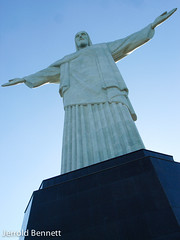
Brazil-0013292Image by Jerrold via Flickr
Source: publico.es

Walking through the streets of Jardim São Luís, or many other neighborhoods on the outskirts of São Paulo, a Sunday afternoon is an experience. At every turn, succeed evangelical ceremonies, music and shouting. There is no denying the explosive rise of evangelical churches, especially in poor neighborhoods, who have managed to win with an attention to social problems that the Catholic Church in Brazil had neglected.

This year, the Assembly of God, the largest Pentecostal evangelical church in the country, is celebrating its centenary, and has much to celebrate. While Brazil remains the largest Catholic country in the world by number of faithful, devout evangelicals are growing every year and now total around 24 million and some estimates are that by 2045 they will be half of the population.

In recent years this influence has moved into the Congress of Deputies. In elections last October, the evangelical candidate, belonging to a dozen parties but grouped in the so-called evangelical caucus, got three senators and 73 deputies elected, not far from the Workers' Party (PT) of President Dilma Rousseff and allied Brazilian Democratic Movement Party (PMDB). They include bishops, pastors and worshipers with policies framed in different centuries. Of those, 19 are deputies to the Assembly of God, to which also belongs Senator Marina Silva, former presidential candidate for the Green Party which had 20 million votes.

The Evangelical Parliamentary Front got 22 of the 30 pastors and evangelical leaders who were on their lists elected, a proportion higher than the PT, which won the election of 88 of its 334 candidates.

The evangelists are recovering well from their position in the 2006 elections, when they were punished by the voters for their involvement in scandals such as the famous mensalão (vote-buying scheme in Congress) and fraud in the purchase of ambulance cars.

Their priority is to fight against gay marriage and abortion

Evangelical parliamentarians belong to 14 different parties with different economic policy orientations, but vote as a block when it comes to moral issues. They are particularly active in rejection of gay marriage and legalised abortion. A few months ago their pressure made it impossible to introduce, as proposed by the Government, an "anti-homophobia kit" to schools - in a country that carries the sad honor of having the highest rate of violence against homosexuals in the world .

The Evangelical Parliamentary Front blog makes it clear that their priority is to fight "projects such as the legalisation of abortion, marriage between same sex, the concept of family change, the National Human Rights Plan and projects that criminalise pastors and others who dare to protest against the sin of homosexuality. "

Its force was felt already in the election campaign. Many analysts believe that it was the strong opposition to the legalisation of abortion of the Evangelists, while campaigning for the presidential elections of 2010, which prevented the first-round victory of Dilma Rousseff. At the time, Rousseff saw her popularity tumble and she summoned the bishops to an emergency meeting in which she won some support. And found the power the Evangelical Church has accumulated, which has a number of television broadcasting licenses.

The Universal Church of the Kingdom of God is the best proof of that. It is, along with the Assembly of God, the most influential church in the streets and in Parliament. Its founder Edir Macedo owns Rede Record, the second most watched television station in the country with a 16% market share, second only to Il Globe. It also controls 30 radio stations, two newspapers and a magazine.

Present in 40 countries

The enormous power of the media that Macedo holds probably explains why he has survived numerous scandals and accusations in the past two decades. Since the early nineties, he has been investigated for fraud and embezzlement, but was acquitted. At the end of that decade came the claim that The Universal Church of the Kingdom of God's network of 2,000 churches in Brazil had helped launder money from the Cali cartel, one of the most powerful drug trafficking groups in Colombia.

And there is still Macedo, watching his empire grows, its four million members, its 10,000 pastors. Some estimates suggest revenues of up to one billion dollars annually. The Universal Church stands with pride and magnanimity on the Avenida João Dias, in the south of São Paulo, the 'Casa de la Moneda' as more skeptical paulistanos sarcastically refer to it. The truth is that the church founded by Macedo in 1977 in Rio de Janeiro is now present in over 40 countries. And scattered, always, by controversy.

They say the secret to Macedo's success was to convince the faithful that both spiritual and material improvement will not come in the afterlife but on earth. It's called prosperity theology. But to achieve this, the faithful will continue to disburse the, almost mandatory, and expensive, tithes. A mixture between the commercial and the divine.

[Via Google translate]

HT: ILGA
Enhanced by Zemanta

Saturday, 20 August 2011

Dutch launch massive, world-first HIV/Aids program aimed at world's marginalised

Estimated HIV/AIDS prevalence among young adul...Image via Wikipedia
Source: GNP+

The Ministry of Foreign Affairs of the Netherlands has reserved € 35 million so that gay men, people who use drugs and sex workers in 16 countries can get easier access to information, condoms, antiretroviral treatment and care.

Never before has a country launched such a large HIV program aimed at these vulnerable groups. It could mean a huge turnaround in reducing the number of HIV infections in the 16 countries.

The program will start in September 2011 and be implemented by seven Netherlands based organizations  including GNP+. As well as the grant from the Ministry of Foreign Affairs, the program has been made possible by € 11.7 million from other sources.

The 4.5-year program has been judged the best by the ministry.

Earlier this year there was a call for proposals for development cooperation projects aimed at vulnerable groups. The Dutch government’s decision to reserve funds for this project is highly important. It means a continuation of the ‘Dutch approach’ within international AIDS relief where access to prevention and care in combination with the decriminalization of drug use, homosexuality and sex work is central. This is the only way gay men, people who use drugs and prostitutes can get the care they need.

A good example of this care is the integrated needle exchange program for injecting drug users. Many HIV infections are prevented as a result. The great success of the Dutch approach is recognized internationally.

Vulnerable groups are 10 to 20 times more likely to become infected with HIV than the general population. Only 8% has access to prevention, care, HIV treatment and support.

Many countries have legislation that makes access to care difficult or impossible. Examples include laws that make homosexuality a criminal offence or ones that are used to prosecute sex workers.

Offering HIV/AIDS care developed for and by these vulnerable groups must therefore go hand in hand with political pressure to change such legislation. This is precisely the aim of this program. It is also aimed at partners of gay men, drug users and sex workers. Because of the taboo related to homosexuality, in many countries men also have a relationship with a woman or are married.

The program will be run in 16 countries: Georgia, Kirghizstan, Tadzhikistan, Ukraine, Botswana, Uganda, Kenya, Zimbabwe, South Africa, Nepal, Pakistan, Vietnam, Indonesia, Brazil, Costa Rica and Ecuador.

The program builds on work carried out in recent years. This work can now be continued and expanded. This new program will involve a lot more collaboration in order to be as effective and efficient as possible.

Gaps in existing projects will also be tackled. For example, most prevention programs along ‘truck routes’ in Africa are aimed at drivers. Until now, they have not benefited sex workers. This has meant that a great many infections still take place along these routes.

The Dutch program will be carried out by seven organizations: Aids Fonds/STI AIDS Netherlands, Aids Foundation East-West, COC, Global Network of People living with HIV, Health Connections International, Mainline and Schorer.

Together with 102 partner organizations in the 16 countries listed, they will ensure that in the coming years 400,000 gay and bisexual men, transsexuals, people who use drugs and sex workers get access to HIV prevention, treatment, care and other support.

New Report Shows Major AIDS Funders Fail to Track Investments for Gay Men and Transgender People

Source: MSMGF

Sunday, 7 August 2011

Photo essay: A Kazakhstan-born gay couple in Rio

Source: English Russia

Max and Roman, are citizens of Kazakhstan who have been staying in Brazil for more than eight years. They met nine years ago in a gay club and never separated since then.

Roman was born in 1978, graduated from the Altai State University and got a degree in journalism. He is very popular in Kazakhstan due to his work on the radio and as a deputy chief editor of ‘TimeOut Almaty’.

Max was born in 1976 and graduated from the Almaty Polytechnic University. He has a degree in oil and gas field development and operation. He is an oil worker in an international company.  Eight years ago Max was shifted from Kazakhstan to Brazil and Roman followed him.

In Rio de Janeiro the two have a company of their own with a famous logo.

Enhanced by Zemanta

Monday, 23 May 2011

In Brazil, thousands protest for new LGBT hate crimes law


(All photos by Alexandra Martins, see photoset)
As part of the "Seminário LGBT" at the Brazilian Parliament on May 17, activists presented the All Out / Avaaz petition signed by 100,000+ in support of passing the Anti-Homophobia law, that would finally give ALL Brazilians equal protection under the law.


(All photos by Alexandra Martins, see photoset)
On May 17, All Out organized a massive outdoor photo projection in Brasília, the Brazilian capital, in support of the proposed Anti-Homophobia law (PLC 122). All Out's photo petition drew hundreds of submissions from around the world, some which were projected against the wall of the National Library in downtown Brasília. Brazil has one of the higest rates of attacks and murders of LGBT people in the world, and the projection accompanied a vigil in memory of the over 260 LGBT Brazilians who lost their lives to homophobic or transphobic violence in 2010.

Thousands of gays and supporters marched 18 May in the Brazilian capital to demand that Congress pass a bill criminalising hate crimes against LGBT.

The march covered the central Esplanade of the Ministries up to the Congress building with rainbow flags and banners with slogans like "For a world without racism, without sexism, without homophobia."

Thursday, 19 May 2011

Video: Brazil: Homophobia, religion and politics

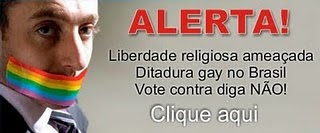
"Caution! Religious freedom threatened - Gay Dictatorship in Brazil - Vote against - Say no!" from the blog Amigo de Cristo (Friend of Christ)
Source: Global Voices

By Raphael Tsavkko Garcia, translated by Sara Moreira

Amidst an increasing wave of homophobic violence in Brazil, which puts the country among the world's worst in terms of crime against the LGBT community federal deputy Jean Wyllys, the first openly homosexual member of the Brazilian parliament, has presented a Constitutional Amendment Proposal (PEC) to legalize marriage for same-sex couples.

Meanwhile, recent statements of hatred and prejudice by some parliamentarians, far right groups and religious representatives, who oppose this and other legislative advancements in LGBT issues, have raised a feeling of indignation in the blogosphere.

An article from Jornal Brasil, republished by O Evangelho (The Gospel) [pt], points out that several religious groups, namely evangelicals and catholics, have been opposing what they call the beginning of a “Gay Dictatorship“ [pt], which includes “homosexual “marriage”, the Ministry of Education's supposed primer against “homophobia” (known as the “Gay Kit”) and PLC 122/2006 (the gay gag law), a bill that intends to criminalize any criticism of or opposition to homosexual behavior or to the intentions of the gay lobby”. In addition, these groups favor the dissemination of ideals which are contrary to the advocacy of LGBT rights [pt].

On this matter, Paulo Cândido, writing for the blog Biscoito Fino e a Massa, criticizes [pt] the “lack of arguments” and the “empty rhetoric”  of the “religious right-wing”:
que mal esconde seu ódio e sua intenção de impor a moral de uma religião à sociedade como um todo.
which barely conceals its hatred and intention to impose the morals of one religion on society as a whole.
Robson Fernando, writing for the blog Acerto de Contas, adds [pt]:

Wednesday, 6 April 2011

Brazilian government offers protection to threatened gay MP

Minister Maria do Rosário and MP Jean Wyllys
Source: Gay

[Google translation]

The minister of the Special Secretariat for Human Rights , Maria do Rosario, offered on the afternoon of Monday, 28/03, a whole security structure and parliamentary investigation into Mr Jean Wyllys (PSOL-RJ), who said he suffered threats Death of social networks.
 
Maria del Rosario assured the Member that will take science to the Federal Police and make every effort to ensure the protection not only of Jean Wyllys, but all those who suffer from homophobia in Brazil. "This situation is very worrying. As Rep. Jean Wyllys, how many Brazilians are being threatened and even murdered today at the exits of subways, buses, streets in general? "Asked Maria do Rosário.
 
Jean, who took the fight in the House of Representatives for the rights of minorities, has received increasing threats in the Twitter profiles of homophobic neo-Nazi, racist and reactionary wing religious fundamentalists. In February, his Facebook profile has been the target of an avalanche of false accusations, which eventually resulted in its temporary ban until the support team verify the precedence of the complaints.
 
According to the deputy, "I have enormous respect for Catholics and evangelical Christians, but I will not tolerate crime virtual fundamentalist racist and homophobic. More than a homosexual is brutally murdered per day in this country because of speeches like these that sometimes threaten and offend me. We can not face the homophobic speech and incitement to violence as harmless, especially when it comes to religious leaders. These men who call themselves "God" should be more responsible (and humans!) In time to lead the minds of the faithful. "
Enhanced by Zemanta

Sunday, 27 March 2011

Death threats against gay Brazilian MP


Source: dosmanzanas

[Google translation]

Jean Wyllys is, since February, the first openly gay Brazil MP, representing the Party for Socialism and Liberdade (PSOL), a small left force. One of his first initiatives was to relaunch the Mixed Parliamentary Front for LGBT Citizenship, comprising representatives from different parties and proposed measures include a proposed constitutional amendment to legalize marriage between same sex. Something that has not been too fond of certain sectors, according to the threats he is receiving.

Wyllys, in addition to having been elected a writer and university professor (and winner of the Brazilian edition of Big Brother in 2005, he became particularly known in Brazil ...) has complained that, since it published its draft forward in the direction of equal marriage has not stopped receiving homophobic abuse and even death threats via social networks like Twitter, not only from their own country but also from the United Kingdom or United States and other countries. Wyllys has already been made ​​in understanding the threats of the Brazilian Congress, and although he claims to feel some concern at the moment has not sought police protection, since in his opinion a "dog that barks does not bite."

Friday, 11 February 2011

In US, gay asylum seekers gaining ground?

Immigration Equality at the National Equality ...Image by Matt Algren via Flickr
Source: WGLB

By Kilian Melloy

An American organization that assists GLBT asylum seekers reports that it helped a record number of gays from hostile home countries secure safe haven in 2010.

Immigration Equality, working together with legal volunteers, successfully assisted 101 GLBT asylum seekers last year, according to a press release issued by the organization on Feb. 7. The largest number from a single country was 28; those refugees came from Jamaica, one of the most violently homophobic nations in the world.

Gays in Jamaica are reportedly subject to mob violence, sometimes beaten and even murdered in their own homes. Homophobia is deeply rooted in Jamaican culture, with anti-gay songs played at dance halls. Homophobia is further inculcated into the society by anti-gay religious leaders.

A further 10 gay asylum seekers came from other Caribbean nations, the press release noted.

Other sexual minorities who won the right to stay in the United States and not be shipped back to face anti-gay persecution--which can often be life-threatening--came from Russia (seven of the 101 individuals), Uzbekistan (four asylum seekers), and Ghana (three individuals), among other nations.

Monday, 31 January 2011

In US, 'gay it up' if you want asylum

drag queensImage by mauri212 via Flickr
Source: New York Times

By Dan Bilefsky

NB: This article has been the subject of a letter labeling it as misleading.

Romulo Castro considered attending his asylum interview in Rosedale, Queens, dressed as Fidela Castro, a towering drag queen in six-inch stilettos, a bright green poodle skirt and a mane of strawberry blond hair. In the end, Mr. Castro, 34, opted for what he described as understatement: pink eye shadow, a bright pink V-neck shirt and intermittent outbursts of tears.

After years of trying to conceal his sexual orientation back home in Brazil (where Fidela never made an appearance), Mr. Castro had been advised by his immigration lawyer that flaunting it was now his best weapon against deportation.

“I was persecuted for being fruity, a boy-girl, a fatso, a faggot — I felt like a monster,” said Mr. Castro, who reported being raped by an uncle at age 12, sexually abused by two police officers, and hounded and beaten by his peers before fleeing to the United States in 2000. “Here, being gay was my salvation. So I knew I had to put on the performance of my life.”

Amid international outcry over news of the Czech Republic’s testing the veracity of claims of purportedly gay asylum seekers by attaching genital cuffs to monitor their arousal while they watched pornography, some gay refugees and their advocates in New York are complaining that they can be penalized for not outwardly expressing their sexuality. While asylum-seekers and rights groups here expressed relief that use of the so-called erotic lie detector is impossible to imagine in the United States, some lamented in recent interviews that here too, homosexuals seeking asylum may risk being dismissed as not being gay enough.

Wednesday, 12 January 2011

In Brazil, in one year, 250 LGBT murdered: a "homocausto"

Posters, flowers and candles left at a 21 November demonstration against homophobic attacks in Sao Paulo

By Paul Canning

A Brazilian LGBT organisation which has been documenting homophobic murders of LGBT people in that country says they have now hit a record number: one every day and a half.

Grupo Gay da Bahia (GGB), the oldest Brazilian gay group, documented 250 cases in 2010. The figure is part of their annual report - still being completed - that will be officially unveiled in March.

In an interview with Terra Magazine, founder of the GGB and 'dean of the homosexual movement in Brazil' ('decano do movimento homossexual brasileiro'), Luiz Mott, said that in 2009 there were 198, about 50 less than reported last year.

Speaking on Brazilian TV, Mott described what's happening as a "homocausto".

In the previous decade an LGBT person was killed, on average, every three days. In recent years, that average rose to a murder every day and a half.

Monday, 13 December 2010

Cuba to legalise same-sex marriage?

Dr. Alberto Roque
Source: ILGA

[Google translation]

The Cuban Parliament would see the legalization of same-sex unmarried partners in July next year. This was stated by Dr. Alberto Roque, representing the National Center for Sexual Education (CENESEX) during his speech at the XXV International Conference ILGA going on in Sao Paulo (Brazil) in the public policy panel on sexual diversity of which members of the Ministry of Health of Brazil, and Germany and Cuba.
Roque spoke about the advancement of LGBT rights in Cuba during the last decade, as opposed "to what he believes the collective imagination." This progress comes from the implementation of an Education Strategy for Self-Respect Sexual Orientation and Gender Identity, led by governmental CENESEX and other institutions on sexual diversity.

In this context, highlighted the performance of the Cuban Conference Against Homophobia for three years, the creation of networks for the health of lesbians throughout the country, and transgender sex reassignment.

Roque said that in the legislative framework, is still pending discussion by the Cuban parliament's new Family Code, which recognises domestic partnerships between same sex and respect for transgender people under family. Despite resistance from some policymakers, it is reported that this debate is scheduled to be tried in July 2011.

Finally, the activist said that after the Cuban vote in favor of the amendment that eliminated sexual orientation within the items listed in the resolution condemning extrajudicial killings, the authorities regretted being the only Latin American country in taking this position, noting that thus joined countries that legally condemn homosexuality.

In an unprecedented move, the Cuban Foreign Minister Bruno Rodriguez Parrilla, met with LGBT representatives where they said that this vote does not mean a change in policy on these issues and the Cuban position was due to a fact "cyclical and unexpected"! In what was at stake solidarity with African countries. As a result, activists succeeded in an official statement to the Permanent Mission of Cuba to the United Nations where the Cuban Government expresses its rejection of extrajudicial killings, including those committed on the grounds of sexual orientation.
Enhanced by Zemanta

Sunday, 12 December 2010

ILGA world conference sends key message: activists should forge alliances

Source: ILGA

More than 300 activists from 76 countries attended the 25th World Conference of the International Lesbian, Gay, Bisexual, Trans and Intersex Association in Sao Paulo, Brazil, and called on collaboration with civil society to fight homophobia and trans-phobia. (LBT) issues and on issues of transgender people.

One of the spearpoints of the International LGBTI Rights movement should be the forging of strong alliances with other people and institutions in civil society, who support the principles of equality and freedom for sexually diverse people and communities (LGBTI) all over the world. This was a principle conclusion of the 25th World Conference of ILGA, the International Lesbian, Gay, Bisexual, Trans and Intersex Association, which came to an end last Thursday in Sao Paulo, Brazil.

"This conference has given the mandate to look for more allies in the struggle for equality and freedom for LGBTI people around the world, particularly in civil society. We hope that this will be relatively easy, as by stating clearly in our vision that we believe in human rights for all, irrespective of their sexual orientation, gender identity or expression", said re-elected ILGA Co-Secretary General Renato Sabbadini (Italy), at the end of the conference.

According to Sabbadini ILGA will also demand its rightful recognition by the United Nations in the upcoming period, stressing that "ILGA will renew its efforts to see its right to engaging with the UN system like any other legitimate NGO recognized.”

Tuesday, 23 November 2010

Video: In Brazil, debate on murders of LGBT and hate crimes law sparks homophobic backlash

Posters, flowers and candles left at a 21 November demonstration against homophobic attacks in Sao Paulo
By Paul Canning

By many counts Brazil is one of, if not the, most dangerous countries in the world to be LGB or T. But a proposed law to tackle this has provoked a massive backlash on social media, including direct incitements to violence

According to Senator Fatima Cleide one person dies every two days, as a victim of a homophobic attack. The Brazilian gay rights group Grupo Gay da Bahia (GGB), which is funded by the World Bank and the United Nations Educational, Scientific and Cultural Organization (UNESCO), estimates that between 1980 and 2009 at least 3,100 homosexuals were killed by hate crimes in the country.

Recently two Brazilian soldiers were arrested following the shooting of a 19-year-old gay man on the day of the Gay Pride celebration in Rio de Janeiro. Sao Paulo's Gay Pride attracts 3.3 million - the biggest in the world - but a group of upper middle-class teenagers went on an attacking spree, beating several men and yelling homophobic epithets after the parade. Four of them were minors, and were sent to a juvenile detention center, but they have already been released, since a judge determined that they "were not a danger to society." Though the victims' lawyers will hopefully pursue criminal charges against the aggressors, the Sao Paulo government has only threatened fines (though they could potentially be quite high).

Alongside the massive displays of Gay Pride, Brazil is a country where hundreds of people are dying every year because on hate crimes.

Vagner de Almeida and Richard Parker, the directors of the first documentary film about the violence, 'Sexuality and Hate Crimes', found that the hate crimes come from different segments of society, and are often motivated by the anti-gay output of the Catholic Church and radical evangelical groups.


The film notes that many of the afflicted are unrecognizable after death due to mutilation.

Past President Lula's government launched 'Brazil Against Homophobia', including television advertisement and billboards, in 2006. Last year he launched a National Plan of Promotion of the Citizenship and Human Rights of LGBT. Brazil recognises same-sex relationships for immigration purposes. Yet the Brazilian Congress has struggled to approve legislation categorizing homophobic violence as hate crimes. A bill is again currently under debate.

Religious and conservative interests have proven to be strong and effective opponents of this hate crimes legal change, claiming it would offend their 'religious rights'. These interests have previously proposed two federal laws, one that makes illegal the act of kissing between persons of the same sex in public, another that creates an aid and assistance program for 'sexual reorientation'.

The hate crimes proposal, amid the publicity surrounding the shooting in Rio, has provoked a backlash from anti-gay forces - including on Twitter, and mainly from young people. MundoMais reports that thousands of Twitterers are supporting homophobic attacks on gay and say: "Homophobia? Yes!" (#homofobiasim, see English translation of tweets, some of which are explicitly pro-violence, pro-'corrective rape' of lesbians) in reaction to the proposed hate crimes law (yes=#PL122Sim, No=#PL122Nao).


Said commentator Diego after viewing MundoMais's video of the #homofobiasim tweets:
I find it strange to be in the 21st century and have the feeling that I'm in the 15th century. There is a setback in the mentality of the population that is breathtaking. And I do not wonder that people with their opinions, but because of encouraging violence. No one is obligated to anything, not to "worship" homosexuals. All this hatred and disrespect for the differences is caused by an empty society, no morals, ethics and basic values. A country that does not take care of education of its people and has no decent and fair laws begat bad seeds, which can contaminate the whole. We achieved much in recent decades and we can not and must never lower our heads. Respect and dignity is a right for everyone.


Enhanced by Zemanta

Africans and Asians attracted to Latin America as a migration route

SVG file, it's recommended nominally 550×550 i...Image via Wikipedia   
Source: UNHCR

By Mariana Echandi


Yakpaoro is part of a new trend in South America. The refugee from Guinea is one of a growing number of Africans and Asians, many of them refugees, making their way to the continent before joining mixed migration routes from the south to the north.

UNHCR statistics show that so far this year between five and 40 per cent of total asylum applications submitted in various Latin American countries were lodged by nationals from Asia and Africa. In the past, these countries were almost exclusively hosting refugees from regional states, especially Colombia.

This new trend in the region as well, as the risks that people in migration flows face – kidnapping, extortion, rape and other serious human rights violations – will be discussed at an important meeting Thursday in Brasilia on refugee protection, statelessness and mixed migratory movements in the Americas. Senior UNHCR officials will join representatives from 20 countries at the gathering, to be hosted by Brazil’s Justice Ministry.

Saturday, 13 November 2010

Gay Brazilian married in US may face deportation

Source: Associated Press

By Russell Contreras
A Brazilian man who was recently reunited with his Massachusetts husband when federal officials temporarily allowed him into the U.S. said he could face deportation because the attorney general won't reverse the immigration ruling that initially separated the couple.

Genesio Oliveira, 31, said Monday that he could be forced to return to Brazil in six months because of Eric Holder's decision.

"I was very depressed," Oliveira said in a telephone interview. "I'm terrified. I thought this would be over by now."

Three years ago, Oliveira and husband Tim Coco, 49, of Haverhill, were forced to live apart when Oliveira was denied asylum over claims he was raped as a teenager. A judge found Oliveira's fear of returning to Brazil "genuine," but ruled he was never physically harmed by the rape.

The Associated Press does not typically name rape victims, but Oliveira speaks openly about his case and allows his name to be used.

Tuesday, 19 October 2010

In Brazil, murders of LGBT soar by 60% in two years

Source: Sapa-AFP

Murders of gays in Brazil have jumped 62 percent between 2007 and 2009, making the country one of the most perilous in the world for homosexuals, a gay rights association said.

The Gay Group of Bahia told the newspaper O Globo the shocking statistic should be a key issue in second-round presidential elections taking place on October 31, alongside abortion and gay marriages.

It said 198 gay murders were recorded in 2009, 187 in 2008, and 121 in 2007.

By comparison, there were just 35 gay murders registered in Mexico last year, the |group added.

Between 1980 and 2009, the association counted 3 196 murders of homosexuals in Brazil, or an average of 110 per year.

The activists criticised opposition by church groups to a draft law that would criminalise homophobia.

"Unfortunately, homophobia is one of the aspects of Brazilian society that pushes homosexuals into hiding," the group's head, Marcelo Cerqueira, told O Globo.

"Gays, lesbians and transvestites are murdered in cruel ways, generally with faces disfigured, and they end up being considered the guilty parties," Marcelo said.

Related Posts with Thumbnails