Showing posts with label Anglicans. Show all posts

Sunday, 4 April 2010

Is Christianity the Key to Gay Liberation in Africa?

Source: African Activist

A progressive Christian pastor in the United States recently sent out a letter advocating that progressive Christians begin missionary outreach in Africa and build alliances with struggling progressive congregations in Africa. This idea originated from two African activists from Zambia and Uganda touring the United States.
Kapya Kaoma, an Anglican priest originally from Zambia, has been doing research on this for the Political Research Associates, a watchdog group observing right-wing political movements and concentrating on the movements of the "Christian" right. Frank Mugisha is executive director of a Ugandan liberation group called Sexual Minorities Uganda (or SMUG). Together they have laid out the picture of the central African situation: large, rich conservative churches which have received lavish support from right-wing American "Christians," who are there spreading a gospel of hate and building schools where their bigotry is being promulgated.

Meantime, progressive Christians, who do not believe that non-Christians will go to hell and who are sensitive about imposing our culture on others, have avoided missionary activity, leaving small, poor, progressive churches and their pastors in Africa to fend for themselves.

Kapya and Frank say that Africans are spiritual. It would not help for secular rights groups to go to Africa with an eye toward supporting the liberation movement. The support and the language must be Godly in order to be effective. Moreover, since Uganda is about to pass even harsher legislation making it illegal to harbor or support anyone who is GLBTI, the safest and best approach is to go and preach a gospel of love, and give money and support to those who are there already doing it. People need to hear that there is no room for hate in our Christian faith.

Gordon-Conwell Theological Seminary's Center for the Study of Global Christianity recently published the Atlas of Global Christianity. The Africa Map (pdf) is available online. In introducing the Africa Map, the Atlas of Global Christianity reports:
Over the past 100 years Africa has experienced the most dramatic demographic religious transformation of any continent. In 1910 Africa was largely animistic in the south and Muslim in the north. There were 11.7 million Christians. By 2010 Christians have mushroomed by 40 times to more than 490 million. Ethnoreligionists dropped precipitously from 58% in 1910 to about 10% by 2010. Yet today’s presence of even a small percentage of ethnoreligionists is an unexpected development, for many in the early twentieth century predicted the complete disappearance of these traditional religions in a generation.

Christianity does not have a monolithic presence in Africa. Christians in Africa now number almost 50% of the population.

Over the past 100 years, Christianity has grown at nearly twice the population rate of Africa.

The claim that only 50% of Africa is Christian is misleading because there are many parts of Africa where 100% of the population is Christian. Here is a clip from the Atlas:

Wednesday, 31 March 2010

Leading African clergy and civil society groups call on Uganda to stop the Anti-Homosexuality Bill

Desmond Tutu 2007 at the Deutscher Evangelisch...Image via Wikipedia
Source: Civil Society Coalition on Human Rights and Constitutional Law, Kampala

Press statement

Leading African clergy and prominent individuals, as well as more than 60 civil society and human rights groups from 10 sub-Saharan African countries have endorsed a statement calling on the President, Government and Parliament of Uganda to reject the Anti-Homosexuality Bill in its entirety.

The Anti-Homosexuality Bill provides for severe punishment, inclusive imprisonment, for those engaging in same sex relations, as well as for members of the public who fail to report such activities to the authorities.  The original draft also provides for the death penalty and life imprisonment.  The Bill has already gone through the first reading in Parliament and is now before the Legal and Parliamentary Affairs Committee. "We are very concerned that it could become law within a few weeks or months", said Adrian Jjuuko, Coordinator of Uganda's Civil Society Coalition on Human Rights and Constitutional Law.    

The statement has been endorsed by leading African clergy such as Archbishop Emeritus Desmond Tutu, the current Archbishop of Cape Town, the Most Reverend Dr. Thabo Cecil Makgoba and Canon Gideon Byamugisha of Uganda. Others endorsing the statement include Pius Langa, the former Chief Justice of South Africa, and other jurists, academics, truth commissioners and human rights activists.

In the declaration, the endorsing individuals and organizations reaffirm their commitment to the universality of the human rights of all persons.  They note that "all forms of discrimination, in particular against vulnerable groups, undermine the human dignity of all in Africa".  The statement declares that the Bill "promotes prejudice and hate and encourages harmful and violent action against marginalized groups in Africa".

"Civil society organisations throughout Africa are mobilizing to persuade Ugandan Parliamentarians to block this pernicious Bill", said Phumi Mtetwa, executive director of the Lesbian and Gay Equality Project in South Africa. Godwin Buwa, a lawyer with the Refugee Law Project in Kampala said that "if the Bill is passed, even in diluted form, it would constitute a massive setback for human rights in Africa".

The statement calls on African governments and the African Union to call on the President and Government of Uganda to withdraw the Bill and to respect the human rights of all in Uganda, without exception.

The list of individuals and organizations continues to grow and will be updated regularly.  The full list can be viewed at www.alp.org.za and www.ugandans4rights.org


CALL BY AFRICAN CIVIL SOCIETY: REJECT THE ANTI-HOMOSEXUALITY BILL   

Thursday, 25 March 2010

Jamaica’s gay underground Christians

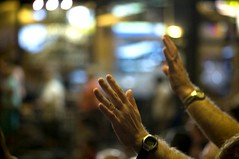
Hands raised in worshipImage by D G Butcher via Flickr

Source: Bay Windows


By Rev. Irene Monroe

Sometime in the late hours of Saturday night the call will come in. Philbert (not his real name,) like many of his Christian lesbian, gay, bisexual, transgender, and queer (LGBTQ) buddies, waits anxiously for the call in order to know the time and place of the van pickup, and where it’ll drop them off to a safe and secluded place for Sunday worship. Last week’s worship service was in Montego Bay, just 50 miles from Negril’s Grand Lido, one of the flagship resorts in Jamaica, where Philbert works the night shift at the bar. This week Philbert hopes for a closer worshipping space, perhaps a safe space in Gales Valley, just 40 miles from work.

Every Sunday Philbert and his friends have to worship in a different space. The risk is too high if it’s discovered that they’re queer.

"My experience as a gay man living in Jamaica is one which is marked by periodic incidences of abuse, both verbal and physical. I have lost count of the number of times I have been verbally abused, called ’battyman’ [Jamaican slang for ’homosexual,’] ’chi-chi,’ ’sodomite,’ ’dirty battybwoy,’" an unnamed gay man shared on the Jamaican Forum of Lesbians, All-Sexuals, and Gays (J-Flag) in 2003.

When Jamaica’s leading gay rights activist, Brian Williamson, was murdered in his home in June 2004, multiple knife wounds savagely mutilated his body. A Human Rights Watch researcher witnessed the crime, reporting a crowd gathered after the killing, rejoicing and saying, "Battyman, he get killed!" Others celebrated Williamson’s murder, laughing and calling out, "Let’s get them one at a time," "That’s what you get for sin," and "Let’s kill all of them." Some sang, "Boom bye bye," a line from renowned Jamaican reggae artist Buju Banton’s then popular anti-gay song about killing and burning gay men. (Banton has a long history of advocating the killing of LGBTQ people in his lyrics, yet he was nominated for a Grammy in 2009 for his album "Rasta Got Soul.")

In 2005 a gay man was harassed at the beach, and a mob pursued him. To avoid the wrath of the homophobic mob he ran into the sea and drowned.

In 2007 a pastor’s church was attacked by an angry mob on Easter Sunday because of the presence of people accused of being homosexuals were at a funeral service he performed earlier in the week.

And in November 2008, Rev. Richard Johnson, one of the leading Anglican priests on the island, was found nude and stabbed 25 times, in the rectory of St. Jude’s Anglican Church in Kingston, because he was thought to be gay.

Homophobia is so intense in Jamaica and so consistently goes unchallenged that people who speculate about who’s LGBTQ can easily plot to kill them, and unabashedly announce their intent with impunity, because the police won’t protect Jamaica’s LGBTQ citizens from mob led murders and violence; they instead incite the country’s homophobic frenzy by either being present and inactive during these assaults, or by following and watching them all the time.

Wednesday, 10 March 2010

Continuing threats to gays on Kenya's coast

By Paul Canning

A Christian Radio Station in Mombasa, Kenya, is continuing to broadcast threats against local LGBT. Baraka FM, along with others, has been implicated in inciting the attempted pogrom February 11-13 in Mtwapa, near Mombasa.

Blogger GayUganda reports receiving an email stating that the station read out the following threat:
"Homosexuals are not human beings and should be treated as such..... The KEMRI-UW research centre has been given 7 Days to close or we shall attack it on Friday next week [12 Feb]"
The Kenya Medical Research Institute (KEMRI) clinic in Mtwapa was the centre of the mob attacks, due to it providing HIV/AIDS services to men who have sex with men (MSM).

The author of the email said:
Considering that this is how it started last time, if you remember we raised an alarm a day earlier and the attacks happened the following day, I advise that we take precaution and consider informing all our contacts in Mombasa about the Lurking Danger.

There is negative talk that the Muslims in Mtwapa want to make an example of someone, they are vowing not to take anyone to the police this time. Keep us in your hearts and as earlier requested, anyone who can assist especially in the area of reaching out to the Muslim community or the security apparatus will be highly appreciated.
Police rescued a number of gay men from mob attacks, fueled by rumours of a 'gay wedding' and believed to have been organised, and released them without charge. Human rights activist Muthoni Wanyeki, a executive member of the Kenyan Human Rights Commission, has praised the actions of the police.

Attempts at dialogue

Following the mob attacks, Sheikh Ali Hussein, Council of Imams and Preachers of Kenya (CIPK) Kikambala coordinator, and the National Council of Churches of Kenya (NCCK)'s Kilifi District representative, Bishop Laurence Chai, had continued to threaten the KEMRI clinic and rejected government attempts to calm the situation by joining a committee which aims to educate wananchi (the public) on the operations of the clinic.

Kenyan LGBT Christian organisation Other Sheep supported by the East African Sexual Health and Rights Initiative (EASHRI) reached out, facilitating three seminars for Christian religious leaders, LGBTI and Muslim religious leaders in the Mombasa region to address religious homophobia and transphobia.

Leader Michael Kimindu said:
The association had decided to use the two major religions to create awareness on issues of human sexuality and religion. We went to Mtwapa and talked to Christians and they asked for more time and education to discuss issues of sexual orientation and the bible.
They held a seminar for 32 Christian pastors drawn from various denominational backgrounds 5 March in Mtwapa. The chairman of the Mtwapa Pastors’ interdenominational Fellowship, secretary and treasurer participated in the workshop.

They aim to organise further workshops aiming to reach out to about 350 clergy in Mtwapa.

These will provide:
  • more resource materials on LGBTI and Christianity for further reference and study
  • seminars on the bible and sexuality.
The pastors said that 95% of religious leaders in Mtwapa have no college education and that negative reactions to homosexuality come from ignorance. They pledged to nurture the spirit of tolerance and acceptance of people of different sexual orientation without resorting to violence, and follow the model of Jesus.

They were trained in the areas of sexual orientation, religious homophobia and transphobia, culture and LGBTI, counseling of LGBTI and PFLAG (parents and friends of lesbians and gays) and MSM HIV/AIDS initiatives.

The following day the group met with 30 top Muslim religious leaders in a Mombasa hotel. They included the leader of Muslim men in Kenya, the leader of Muslim women in Kenya and the leader of Muslim youth in Kenya, Chairman of Kenya Muslims Advisory and director of NACADA, which deals with substance abuse.

Similar to the outcome of the meeting with the Christian pastors the leaders wanted more dialogue on religious interpretations of dealings with homosexuality: "counseling of LGBTI instead of stoning to death of homosexuals".

One Muslim observation was:
Sodom and Gomorrah were destroyed killing everybody in these cities but strange enough homosexuality is still in existence, so by stoning homosexuals to death isn’t the solution, but understanding them.
Women at the meeting complained that Sheikhs and Imams ask for anal sex from their wives and sleep with young boys in the community/mosques. This puts them at risk of contracting HIV/AIDS.

Other Sheep Kenya also met with local LGBT in Mombasa who reported great ignorance on HIV/AIDS as well as discrimination based on skin colour, with darker skinned gays being more harassed than lighter skinned ones. One outcome was to do outreach to the local media.

As well KEMRI took part in a media clinic at a Mombasa hotel 4 March. They told journalists that 15.2 per cent of all new HIV infections in Kenya were through men having sex with men.

Dr Mary Mwang’ombe, KEMRI researcher based at Mtwapa, said that it was difficult for researchers to gain access to homosexuals and investigate their HIV risk behaviour and prevalence rates.
Most of these men live a secluded lifestyle to avoid being discriminated against by the police and the health care personnel.
In addition to the clinic, a gay-friendly Mombasa bar, Club California, is facing closure following the imposition of 'impossible demands' by local authorities. The Department of Public Health visited the club 12 February, the day of the riot, and issued a notice demanding undefined improvements to the club's "sanitary conditions".

The victims speak out

South African LGBT website Behind the Mask has interviewed some of the men caught up in the February mob attacks. All preferred to use only their first names.

Ali, speaking through Javine Ochieng of Gay Kenya, said:
There was no wedding planned at all. I heard the news from the mosque as a sermon was being passed that there was a wedding to take place.
The Imam said that they can not condone a homosexual marriage to take place by any chance since the person to be married is a Muslim and that we have to protect the Islamic norms and shed blood to stop the wedding.
After the sermon at the Mosque Ali says he went to a barber and was questioned about the rumours of a gay wedding, supposed to take place 12 February. The barber accused Ali of being one of those getting married and told him to get ready for "a hunt" that day for "those getting married and that they will be killed". On Ali's departure the barber told him never to set foot in his barber shop again.


Ali was beaten up by a mob and taken to Mtwapa Police Station where he was rescued by activists from Kenyan Human Rights Commission, then immediately taken to hospital since he relies on an inhaler for his asthmatic condition.

George was also attacked by the mob and taken to the cells while Nicholas was arrested from the KEMRI research centre where he works.

Lameck was arrested from his home, Yvonne from KEMRI, where he works, and Hanza was rescued by activists and taken to a place of safety before the mob could confront him.

All are now in a place of safety coordinated by the Gay and Lesbian Coalition of Kenya (GALCK) but they say they now live in fear, not knowing what will happen next.

Said Yvonne:
People can still recognise us even in our hiding place and there are rumours of demonstrations that will be held against homosexuality to strategise on how to search for the remaining gay people in Mtwapa and Mombasa.
Nicholas warned:
If the society does not accept this [existence of homosexuals], people will continue practicing unsafe sex, due to lack of information and hence the spread of HIV and AIDS.

Some of the people in the mob who were beating us are always gay in the dark and very heterosexual in light.
Kenyan press debate

Tuesday, 2 March 2010

Ugandan activists call for withdrawal of anti-gay bill


L-R: Bishop Christopher Ssenyonjo, Canon Rev. Gideon Byamugisha, Frank Mugisha and Maj. (rtd) Rubaramira Ruranga presented the petition to parliament

Source: RFI

Report: Correspondent Patricia Okoed in Kampala


Hundreds of religious leaders and Aids activists petitioned the parliament of Uganda on Monday for the withdrawal of a proposed anti-homosexuality bill. The group, led by a self-declared HIV-positive Anglican priest, called on legislators to reject the bill that would criminalise homosexuality, saying it is in violation of the freedoms set out in Uganda's constitution.

Around 450 activists presented parliament speaker Edward Ssekandi with a petition.

"The bill is not about protecting Ugandan culture and traditions as it purports. On the contrary it is violating our cultures, traditions and religious values that teach against intolerance, injustice, hatred and violence," said the leader of the movement, Reverend Canon Gideon Byamugisha.

Campaigners say that the proposed law violates the Ugandan constitution, which supposedly guarantees freedom from discrimination on the grounds of race, sex or beliefs.

It could even criminalise those such as pastors or aid workers who work with HIV-positive homosexuals, Byamugisha claims.

"This is a bill that requires various members of the community, family members, service providers and spiritual mentors to spy on one another," he said. "This would obstruct religious leaders, doctors, counsellors and other service providers in their essential roles, and would facilitate political and religious witch hunts and false accusations against real and perceived enemies."

But other Christian groups in Uganda, for instance the fast-growing Pentecostal church, accuse Byamugisha of misleading his flock according to his own political agenda, according to RFI's correspondent in Kampala, Patricia Okeod.

The parliament speaker accepted the petition, but said that the bill could not be blocked and would have to undergo due process.

This process will include a public consultation, Ssekandi added, assuring that "a lot of time" will be devoted to collecting Ugandans' views.

The bill would introduce the death penalty for "aggravated homosexuality", in cases of rape of a minor by a person of the same sex, or where one partner carries the HIV virus.

It has attracted widespread international condemnation, with United States President Barack Obama describing the bill as "odious". A global petition against the bill by rights group Avaaz currently has more than 450,000 signatures.

Homosexuality is already illegal in Uganda, with a maximum penalty of life imprisonment.

NTV Uganda report


Reblog this post [with Zemanta]

Sunday, 21 February 2010

Kenya: Mtwapa clerics want to 'eradicate gays', but human rights defenders are many


By Paul Canning

In the aftermath of the attempted anti-gay pogrom in Mtwapa, a small town near Mombasa, Kenya, the Daily Nation reports that the government's attempts to calm the situation are being rebuffed by clerics.

The government has set up a committee which aims to educate wananchi (the public) on the operations of the Kenya Medical Research Institute (Kemri) centre - the focus of organised anti-gay rioting.

But Sheikh Ali Hussein, Council of Imams and Preachers of Kenya (CIPK) Kikambala coordinator, and the National Council of Churches of Kenya (NCCK)'s Kilifi District representative, Bishop Laurence Chai, separately told the newspaper that they accepted to join the committee for the sole purpose of 'eradicating gay activities in Mtwapa'.

"We did not join to drum up support for Kemri, which is one of the factors behind this menace," said Sheikh Hussein. They threatened that some of the clinic's researchers must be removed.

Bishop Chai said the committee was also formed to ensure that residents have access to HIV/Aids and TB treatment offered at the Kemri station.

"Anything short of that is a clear indication that our concerns were ignored by the government and we shall pull out of the committee," he warned.

Media incitement

Muthoni Wanyeki, Kenya correspondent for The East African, and a executive member of the Kenyan Human Rights Commission, speaking in a report on media coverage of homosexuality in Kenya, Malawi and Uganda for Radio France Internationale (RFI), says that the Mtwapa events were provoked by media reports that were completely unverified.
The reporter who broke the story never bothered to mention 'how could a wedding be taking place?' It's not possible under civil law, it's not possible under any of the religious or customary laws. He took a joke completely out of context leading to the situation, without any concern for facts.
The media has not corrected their reporting, she says.

Muthoni says gay men were not arrested (as widely reported), the police intervened "to their credit" to protect the people from a mob organised by the Muslim and Christian leadership.
The state has no interest in these cases until it's forced to appear to be doing something because of religious and popular sentiment of the kind that's stoked, unnecessarily, by bad media coverage.
Muthoni's comments are backed up by statements from local police to The Star. Coast deputy provincial police boss Henry Barmao said: "We are not holding any homosexual suspects. Police did not arrest anyone. They only rescued them from angry mobs. I do not know where they are now but I am certain they are not being held at any police station."

This angered Sheikh Mohamed Khalifa who said: "The police should say why they let the suspects go free. They should have taken them to court and let the courts make its decision based on the evidence produced and witness accounts."

Discussion: media coverage of homosexuality in Kenya, Malawi and Uganda

Hope for gays in Kenya

Daily Nation columnist Cabral Pinto, however, points out that: "What is comforting is that the voices of Mtwapa are not the only voices being heard on this issue in Kenya."


Pinto find those voices in thriving civil society organisations and the media. He cites Professor Makau Mutua of the non-governmental organisation Kenyan Human Rights Commission (KHRC) who gave a public lecture entitled 'Sexual Orientation and Human Rights: Homophobia on Trial' organised by Akiba Uhaki, a social justice organization, February 16 in Nairobi.
Prof Mutua made many persuasive arguments on the issue of gay rights. I point out the ones that are foundational.

He argued that the Kenyan Constitution and, indeed, the constitutional draft now being debated, protect the sexual orientation of heterosexuality and refuse to extend this protection to other sexual orientations.

Human rights activists, he suggested, should be bound by the normative obligation not to be selective in their protection and promotion of rights of all people.

Prof Mutua found the origins of homophobia from various sources, significant among them religious dogma.

He dismissed the often repeated notion that homosexuality is not African and urged the Committee of Experts [who are writing the new Kenyan constitution] not listen to what is popular, but defend the powerless from the powerful and the majority.
In a public debate on Nairobi following the lecture he was supported by Reverend Michael Keminchi, who has been an Anglican minister in Kenya for the past 30 years, and anthropologist Jasper Imungi of the University of Nairobi. Imungi said:
Nobody has a monopoly of knowledge, ideas and speech. Some people abrogate themselves to be the mouthpieces of others and constantly use words like Kenyans have, Kenyans don’t, Kenyans do. As an anthropologist, who gives you the moral authority to set the moral prefix?
Mutua has previously written that 'It is nonsense to assert that being gay is un-African'. In Uganda, speaking at a February 18 human rights forum, Mutua denounced a Ugandan Member of Parliament who said he would kill his son if he discovered he was gay.
"I am baffled by the kind of hatred you spew against gay people," Mutua said, "including your desire to be a hangman. Would you apply to be a hangman if the person to be hanged were your son?"

When [MP Otto] Odonga nodded yes, Mutua said, "There is something deeply wrong with you."

"It's important that we all try to expose ourselves to knowledge, to keep on growing. People who express extremist views are, in my view, always the ones who have read the least."
Mutua compared the MPs' arguments against human rights to comments made by slave owners in the American Civil War.
"The kind of speech you made against gay people was the kind of speech that white segregationists were making all over America. Those arguments are classic. They have been reproduced in every era by every segment of society. You didn't invent them."
He backed threats by some countries to withhold foreign aid if Uganda passed its 'kill-the-gays' bill. "There are consequences to being a member of the international community," he said.

During his Kenyan visit (Mutua is a Professor at Buffalo university) he spoke with Kenyan TV channel K24.

He reminds the interviewer that he is a Kenyan and says that he did not come easily to his support for gay rights, it was an "intellectual exercise, I began to ask questions about why I was homophobic."


Pinto cites Kenya's Citizen TV who have been running programmes on sexuality and human rights. Discussions on gay rights, he says are polarised but their presence shows the press' freedom in Kenya and that the issue is neither a taboo nor controversial.

In this latest report, Citizen TV includes the press conference by Mutua and comments by Dr. Nicholas Otieno, a program specialist for the World Council of Churches, who explains the research on the genetic basis of sexuality.


Many other Kenyan media outlets have produced reports. In this one from last June GhettoRadio visited the Umoja area of Nairobi and found many people in favour of gay rights including gay marriage.


Muthoni Wanyeki says that more and more Kenyan mainstream human rights and women's organisations are seeing the protection of gays as "part of their normative obligations".

She sees the main threats to gays coming from the evangelical Christian and "more radicalised" Muslim leadership.

Speaking in the RFI hosted discussion, both Timothy Kalyegira, editor of the Uganda Record, and Kondwani Munthali, a Malawi reporter at The Nation spoke out against the perception of the African debate on gays, as portrayed in the Western media.

Munthali said that increasing democracy, literacy and civil society in developing Africa meant that the debate was not happening in the same context as the West - but it was happening.


Reblog this post [with Zemanta]

Saturday, 20 February 2010

Christian hypocrisy over Uganda 'kill-the-gays' bill

Christians believe that Jesus is the mediator ...Image via Wikipedia
Source: Religion Dispatches

By Candace Chellew-Hodge 

Christianity Today has put its two cents in on the “Kill the Gays” bill in Uganda, telling gays and lesbians to unwad their knickers over the law and instead exercise “patience as Ugandan leaders sort out among themselves the best way to preserve their culture’s sexual mores.” Instead of strongly condemning this legislation, which President Barack Obama has called “odious,” CT tells us we need to understand the culture and give the Ugandans a fair hearing on their homophobia, reasoned arguments against gays and lesbians:
For American Christian leaders, both silence and open condemnation end up violating important missional and human-rights principles. There is no escaping this dilemma, but several points are worth reflection.

First, when American media reported on the proposed legislation, they assumed an inordinate amount of American influence. Media outlets tried to “expose” the power of American evangelicals who had spoken about gay issues in Uganda. Such assumptions were racist, said Scott Lively, one of the speakers. If anything, Ugandan legislators did not follow his advice: He had urged them to favor rehabilitation rather than imprisonment in crafting a new law on homosexuality.

There is American and European influence in Uganda, Anglican bishop David Zac Niringiye told Christianity Today. The liberationist sexual politics exported from the West are the true cultural imperialism. Indeed, the member of Parliament who introduced the bill hopes that Uganda will lead the world in fighting moral decadence.

So, working to block this bill is both racist and imperialist, as Western gays and lesbians attempt to point out the worth of every human life, even if the large majority of the population finds those lives offensive.

Let’s put the shoe on the other foot, though, shall we? If this were a law threatening Christians with death or imprisonment for exercising what they believe is their God-given right to proselytize without restrictions, they’d be loudly condemning the bill and not counseling “patience as Ugandan leaders sort out among themselves the best way to preserve their culture’s” religious mores. No, they would be trying to quash or change this pending law. How are their current efforts to change laws in other countries that discriminate against Christians any less racist or imperialist than gays and lesbians working to save the lives of other gays and lesbians in another country?

In Kazakhstan, for instance, individuals and religious groups who practice “missionary activity” without registering with the country are punished with fines and deportation.

A Baptist jailed there told one news outfit: “What we want is simple: to be left alone to pray to God and speak to others of God without any obstruction. We don’t want any privileges or any discrimination in our favor.”

The gays and lesbians of Uganda could say the same thing. They simply want to be left alone to form the adult, consensual relationships that they seek, and to speak of their lives and live their lives without any obstruction. They seek no privileges or discrimination in their favor – they seek simply to be allowed to live openly and with dignity.

Open Doors’ Web site lists the top countries where Christians are persecuted like North Korea, Iran, Saudi Arabia, and Somalia. Everywhere they are persecuted, Christians are working to change the system, through prayer, protest, or other actions. Yet, they would deny this kind of action to gay and lesbian people simply because we should take our time and stop and “listen” to why the people in Uganda want to kill or imprison us? Believe me, we’ve heard their reasons and they smack of misunderstanding, hatred, and downright meanness.

When conservative Christians don’t have any skin in the game, they counsel “patience” and cultural understanding, but let a conservative Christian get locked up in a foreign country for passing out Bibles or talking about Jesus, and their tune changes pretty quickly. Then, they want to be “left alone” to do what they want.

There’s a word I’m looking for here – ah, yes, a familiar one when conservative Christians speak: hypocrisy.
Reblog this post [with Zemanta]

Friday, 19 February 2010

Uganda : 200 courageous LGBT activists showed up for a LGBT conference


Ugandan gay activist Val Kalende at the Feb 14 conference

Source: IDAHO Committe - Feb 18

Press release

Summary: In spite of the anti-gay law prepared by the government of Museveni President, 200 courageous LGBT activists attended the conference recently organised by the IDAHO Committee correspondent in Uganda, which turned out to be a great success.

« All these Uganda activists who challenged the threats of the government are a strong response to President Museveni, and this is even a heroic attitude », commented on Louis-Georges Tin, President of the IDAHO Committee, who attended the event.

The Ugandan government is preparing what could soon become one of the most homophobic laws in the world. It reinforces the laws already existing, includes death penalty for homosexual people who are “guilty” of being HIV infected, and according to one of these articles, outing of gay and lesbian people would become a legal obligation.

In that dreadful context was organised on february 14th a conference the title of which was: « standing on the side of Love. Reimagining Saint Valentine’s day ». More than 200 people attended this extraordinary event in order to protest against the laws that could be voted in a few weeks, if not in a few days.

Among the participants were members of IDAHO-Uganda, Spectrum Uganda, Queer Youth Uganda, Integrity Uganda Chapter, and several other local organisations, giving evidence of their incredible courage. These organisations work in different areas, among students, among inhabitants of slums, among people infected by HIV, but all of them were inspired on this day by the same and unique hope: homosexuality should be decriminalised in Uganda. Freedom for all! This was the message.

Among the keynote speakers were the retired bishop Christopher Senyonjo, a remarkable man of the Uganda Anglican church, the correspondent of the IDAHO Committee, a pastor himself, the president and founder of the IDAHO Committee, Louis-Georges Tin, Patricia Ackerman and Marlin Lavanhar, American pastors. This strong focus on religions during the meeting was aimed to show that religious arguments, so often used by homophobic people against LGBT citizens, can be defeated, including by religious arguments. It is not because one is a believer that he or she is forced to be homophobic. To put it other words, religion can’t be used to break and violate human rights in any way.

Thus, this conference was definitely part of the IDAHO campaign for 2010-2011 on « Religions, homophobia and transphobia ». It took place on February because of the situation in Uganda, but it is a first step before other similar conferences on the same issue that will take place around may 17th in other countries like Ivory Coast, Cameroon, Brazil, France, United Kingdom, Netherlands, Malta, Russia, Belorussia, etc. Or course, in Uganda, given the dreadful context, this conference was very special…

The CNN and BBC journalists did not fail to feel the importance of the event, and gave the conference a very large media coverage. For the organiser of the conference, whose name cannot be mentioned for safety reasons, “this conference shows that gays and lesbians from Uganda will not yield to this unacceptable pressure.” “We will fight until the end”, he added.

Louis-Georges Tin, president of the IDAHO Committee who came to attend this event, also met the representatives of the French embassy to ask “France in particular, and the European Union in general to keep pressure on the Ugandan government. The economical sanctions should be considered by President Museveni as a serious threat. The European financial help devoted to develop the economy of Uganda, and paid by European citizens, cannot be a help for the development of hatred and homophobia.”

~~~~~~

Xtra reports from Uganda: Gay Ugandans gather to pray, plan
Ugandan gay activist Abdallah Wambere (aka Long Jones) at the Feb 14 conference. He consented to having his photo used in this report.

Source: Xtra - Feb 15

By Kaj Hasselriis

More than 100 gay and lesbian Ugandans packed a hotel conference room in Kampala on Valentine's Day to talk about anti-gay legislation that threatens all of them.

But the main message of the day, repeated over and over again, was a Christian one: Jesus loves you.

"Being gay or lesbian does not make you fall short of God's glory," the emcee of the conference, Abdallah Wambere, told the crowd. The main opposition to homosexuality in Christian-dominated Uganda comes from Christian conservatives, yet most gay and lesbian Ugandans are themselves Christian and fear that the homophobic preachings of anti-gay pastors are true.

"The Bible's message and the story of God's unconditional love can also be inspirational to the LGBT community," assured Sam Ganaafa, president of Spectrum Uganda, a local lesbian, gay, bi and trans organization. Spectrum Uganda co-sponsored the event along with the Unitarian Universalist Association of Uganda.

Many of the speakers at the one-day event were pastors, including an Anglican bishop from Uganda and two Unitarian ministers from the United States. The biggest cheer of the afternoon came when Rev Marlin Lavanhar, a Unitarian preacher from Oklahoma, said, "You can be a good person and be a gay or lesbian person. Please know you will reach the promised land. God bless Uganda!"

Conferences like the one held yesterday — called "Standing on the side of love: Re-imagining Valentine's Day" — are rare in Uganda. Organizers feared that anti-gay outsiders might learn about the event and try to infiltrate or disrupt it, so the time and location were only announced at the last minute, by word of mouth.

Since gays in Uganda are often accused of trying to seduce minors, organizers also tried to keep out anyone under the age of 18. Most of the people in attendance were gay men in their 20s, though there were also about 20 young women. Everyone who came was offered a red T-shirt with a rainbow heart on the front, and rainbow flags were displayed prominently around the room. Attendance was free; the biggest financial sponsor was the Austria Foundation.

"Let's resist bad laws being propagated," Ganaafa told the crowd. He referred, of course, to a bill before Uganda's Parliament that calls for the execution of gays and lesbians, the imprisonment of heteros who fail to report homos and the abolition of organizations that support queer rights.

"If it passes," Ganaafa said, "our lives will never be the same again. I encourage you all to talk, raise issues and be courageous." A petition was passed around the room for people to sign.

But participants had other concerns on their minds, too. During a question and answer session, the crowd's queries included:
  • "Why weren't politicians and cabinet ministers invited to the conference?"
  • "Everyone in my neighbourhood knows I'm gay. Am I safe?"
  • "What are we doing to educate people in the villages?"
  • "Why aren't we gathering research and statistics about Uganda's gay population to counter the anti-gay side's homophobic claims?"
  • "Where can I get reliable condoms and lube?"
  • "How can we end the culture of dependence that causes us to depend on Western agencies for help in our struggle?"
  • "How can we get together as a community to help each other find jobs?"
After the six-hour event was over, participants were offered free lunch and beer. Most of the people in attendance seemed satisfied with the day.

"I learned about so many things," said a young woman named Kevin Simbwa, "like what the Bible says about my being lesbian. Before, I thought it was saying evil things about me. Now I don't think that anymore. Now I'm confident to go to church and face my pastor."

"There were many people I didn't know here," said another lesbian, Warry Ssenfuka, "many people I've never seen. It takes time to collect all these people together like this, and it encourages unity."

A young man who only wanted one of his names — Titus — used, expressed concern that there was too much talk and not enough plans for action. "Though there are plans to do many things, there are no strategies," he said.

"Before we help ourselves," he added, "we need to help others understand what the bill is all about."

Friday, 12 February 2010

Protest about Continual Harassment of Nigerian Human Rights Activist

Source: Pink Triangle Trust

Kenilworth, 14 January 2010 — The UK gay humanist charity the Pink Triangle Trust (PTT) has expressed its grave concern about the continual harassment of the Nigerian humanist and human rights activist Leo Igwe who has made a staunch public defence of LGBT rights in his country.

Mr Igwe and members of his family have been subjected to a sustained campaign of harassment by police involving multiple arrests on unsubstantiated charges since 2007.

Mr Igwe is the Executive Secretary of the Nigerian Humanist Movement. In 2006 he made an impassioned appeal to members of the Nigerian National Assembly not to pass a Bill that would not only criminalise gay marriage but also impose a five-year jail sentence on anyone who has a gay relationship or anyone who aids or supports a gay marriage or relationship. The Bill had the blessing of the Nigerian Anglican Church and its leader, Archbishop Peter Akinola, as well as the then Nigerian President, Olusegun Obasanjo, who declared that homosexual practice “is clearly unbiblical, unnatural and definitely unAfrican”.

In 2008 Mr Igwe and his humanist colleagues were awarded the Rainbow Humanist Award by Nordic Rainbow Humanists “for their courageous defence of LGBT rights and dignity in the face of ferocious attacks from homophobic Nigerian politicians, parliamentarians and religious leaders calling for the imprisonment of those having homosexual relations and those who dare to support such relations, and for reminding fellow countrymen and women in Nigeria of the need to safeguard the spirit of the United Nations Declaration of Human Rights and the need for reason, common sense, thoughtfulness, knowledge, love, tolerance, solidarity and empathy, instead of hate and homophobia”.

Pink Triangle Trust secretary George Broadhead commented: “We are very concerned about Mr Igwe. He is fearless and selfless in fighting for justice for LGBT people. Like the UK’s Peter Tatchell, he is never afraid to challenge the powerful even when he is a lone voice and knows that the powerful may hurt him. It is up to his fellow humanists and others concerned with human rights to show that he does not stand alone, and work together to ensure justice for him.”

The PTT has sent a letter of protest to the Nigerian High Commissioner in the UK, Dr Dalhatu Sarki Tafida, and asked the European Parliament’s Intergroup on LGBT Rights to issue a public condemnation.

Sunday, 24 January 2010

Ugandan’s Plea to US Congressional Hearing: ‘Gay Hate’ Bill Undermines Very Basic Human Rights


Source: UK Gay News - January 21

WASHINGTON, January 21  –  The Ugandan Anti Homosexuality Bill (2009) undermines very basic human rights, the Tom Lantos Human Rights Commission of Congress heard this afternoon.

Julius Kaggwa of the Civil Society Coalition on Human Rights and Constitutional Law, who had flown-in from Uganda for today’s hearing, said that his group had been approached by many in his country who had received death threat.

And there was total silence in the hearing room at the US Congress when he told law-makers that he was himself a “personal victim” to both verbal and physical assault as were gays who often suffered daily.

“Our rights as human are universal,” he told the hearing, adding that the character of Uganda and the rights of its citizens were at stake.

Mr Kaggwa pointed out that sexual minorities in Uganda were already excluded in HIV programmes – and the Bill makes the situation unimaginably worse.

“All in Uganda are affected,” he said.

Mr Kaggwa added that the Bill was not just a foreign policy issue.  “It’s national issue affecting all Ugandans.”

Cary Alan Johnson, executive director if the International Gay and Lesbian Human Rights Commission, told the hearing that the lack of unequivocal condemnation by the Ugandan Government had already caused grave damage.

The United States must maintain the pressure on Uganda, he insisted.

Deputy Assistant Secretary Karl Wycoff, who was representing the U.S. Department of State, told the hearing that the Bill not only constitutes serious threats to human rights in Uganda and the internationall reputation of country, but also compromises Aids work.

Rev. Kapya Kaoma, a Zambian Anglican priest was is currently project director at the progressive Boston ‘think tank’ Political Research Associates, said that Ugandans were fighting for their rights – and needed the support of the United States.

He reminded the Commission member of the deep US conservative evangelical influcene and support for the Bill.

Rev. Kaoma pointed out that since the anti gay seminar in Uganda last March, at which three American evangelicals, including Scott Lively, attendend, 14 known cases of arrest had occurred, including one death, on grounds of suspected homosexuality

Christine Lubinski of the HIV Medicine Association at the Infectious Diseases Society of America said that 1500 doctors were outraged by Bill and its threat to combat HIV.

“Silence equals death,” she said.  “We have a responsibility to ensure billions of USPEPFAR money is reaching those in need.

Representative Tammy Baldwin, who chaired the hearing, said that through their involvement in the Bill religious leaders were attempting to restrict human rights and that the Bill would put USPEPFAR  in serious jeopardy.

“No modification of the Bill would make it palatable to those committed to social justice,” Ms Lubinski insisted.

And she went on to say that Uganda already had regressive laws affecting the LGBT community in the country.

Representative James McGovern said that the Bill, which would seriously limit HIV work, turns people into “sex spies”.

And he had a warning to the Ugandan authorities: “US Congress stands behind Mr. Kaggwa”.  He added that he would be “watching for his security very closely”.

This report was compiled courtesy of Jirair Ratevosian, Deputy Director, Public Policy at The Foundation for AIDS Research, who was “tweeting” from the hearing.

For full report, see DC Agenda: U.S. Commission Considers Ways to Stop Anti-Gay Uganda Bill. By Chris Johnson (January 23, 2010).

~~~~~~

Rep. Tammy Baldwin (WI-02) chairs a January 2010 Congressional hearing in strong opposition to pending legislation in Uganda that would outlaw homosexuality and make any form of sexual relations between persons of the same sex punishable by prison or even death.


Baldwin, Polis, Frank Lead Opposition to Ugandan Anti-Homosexuality Bill
Send Letters to Presidents Obama and Museveni

Source: Rep Tammy Baldwin - January 21, 2010

In strong opposition to pending legislation in Uganda that would outlaw homosexuality and make any form of sexual relations between persons of the same sex punishable by prison or even death, Congresswoman Tammy Baldwin, and Congressmen Jared Polis and Barney Frank, Co-Chairs of the Congressional Lesbian, Gay, Bisexual, Transgender (LGBT) Equality Caucus, joined by more than ninety of their colleagues, have sent letters to President Obama and Ugandan President Yoweri Kaguta Museveni.

In the letters, the Members of Congress call the Ugandan Anti-Homosexuality Act of 2009 “the most extreme and hateful attempt by an African country to criminalize their LGBT community.” The Members asked President Obama to use his “personal leadership, and that of our country, in seeking to deter these legislative proposals,” and warned President Museveni that, “Should the bill be passed, any range of bilateral programs important to relations between our countries and, indeed, to the Ugandan people inevitably would be called under review.”

The Ugandan legislation would increase the penalty for same-sex sexual acts to life in prison, limit the distribution of information on HIV by criminalizing the “promotion of homosexuality,” and establish the crime of “aggravated homosexuality” punishable by death for anyone in Uganda who is HIV positive and has consensual same-sex relations. Further, the bill includes a provision that could lead to the imprisonment for up to three years of anyone who fails to report to the government within 24 hours the identities of everyone they know who is lesbian, gay, bisexual, or transgender, or who supports human rights for people who are.

“The pending Anti-Homosexuality Bill in Uganda is an appalling violation of human rights and it behooves us, as Americans and Members of Congress, to do all we can to prevent its passage,” said Congresswoman Baldwin. “We fervently hope that President Obama will use the full force of his office to oppose this hateful and life-threatening legislation in Uganda and send a clear message to other countries that such discrimination must not be tolerated. And, we hope that Ugandan President Museveni recognizes that this legislation is morally untenable and politically harmful to his nation,” Baldwin said.

“This is nothing more than the institutionalization of hatred and bigotry and it must be stopped,” said Congressman Polis. “Governments should promote peace within their people, not instill unconscionable discrimination, which will undoubtedly lead to human rights violations. I strongly encourage Presidents Obama and Museveni to do everything in their powers to prevent it from becoming law,” Polis said.

“Having accepted debt relief from the international community only a few years ago, Uganda has an obligation to show some respect for basic human rights,” said Congressman Frank. “Vicious unleashing of persecution of gay, lesbian, bisexual and transgender people should and will be an obstacle to any future Congressional initiative to provide aid to that country,” Frank added.

The letter to President Obama expresses the Members’ serious concerns about the grave injustice occurring in Uganda and other countries that are taking steps to criminalize or otherwise severely discriminate against the LGBT communities and asks the President to speak out publicly against this proposed legislation to bring further attention to the issue.

The letter to Ugandan President Museveni urges him to use every means possible to convey to leaders in Parliament that this draconian legislation is reckless in both intent and potential impact and should be withdrawn immediately.
Reblog this post [with Zemanta]

Thursday, 21 January 2010

Senegal police probe 24 men for 'homosexual activities'

Source: AFP

DAKAR — A group of 24 men in Senegal are under a criminal investigation for alleged "homosexual activities", a police source said Monday in the west African country, where homosexuality remains illegal.

Officers arrested the men on December 24 at a house in the seaside resort of Saly, 80 kilometres (50 miles) south of Dakar, for allegedly engaging in homosexual acts and holding an unauthorised party, the police source said.

They were released the next day but police are continuing their investigations, the source added.

"They can be called in again at any time. The two organisers were questioned today to see if there is anything to follow up with in this case," the source said.

The source said officers found condoms, lubricants, wigs and makeup when they raided the house in Saly where the party is said to have taken place.

Homosexuality is a crime in largely Muslim Senegal and carries a jail sentence of up to five years.

Human rights groups want that law scrapped but the government insists that is has no plans to do so.

Senegalese Foreign Minister Madicke Niang on December 10 said there is "no question that homosexuality will be decriminalised in Senegal."

Almost a year ago, judges there convicted nine Senegalese men of "indecent acts against nature" and membership of a criminal organisation after they were arrested at a private apartment in Dakar.

The Senegalese court of appeal overturned the ruling last April and ordered that the nine men be released.

~~~~~~~


Homosexuality in Senegal: religious leaders speak
Moral depravity, loss of social order, an act against nature: in Senegal, homosexuality arouses disapproval, fear and sometimes violence.

Source: Radio Netherlands Worldwide

By Bineta Diagne

Assane Seck is the imam (leader) at the mosque of the unit 17 in the suburbs of Dakar. He often preaches against homosexuals "to raise awareness" about this phenomenon. Holder of an MA in Islamic law, this imam strongly condemns homosexuality in Senegalese society, composed of 95% of Muslims living in a secular state: I regard homosexuality in Senegal very much contrary to the faith, the religion and the morals of over 95% of the population," says Seck.

"This phenomenon (homosexuality) is strongly opposed to in our society. It arouses the most complete condemnation since Islam, as he says, has quite a strict view on homosexuality. According to this religious leader, homosexuality threatens the Senegalese "social order".

European influence

Similar thoughts are held by the Islamic NGO Jamra. Its president, Bamar Gueye, denounces the homosexual lobbies from Europe, who would be behind the Senegalese homosexuals: He says that some people from other countries want to impose something that is not consistent with their religion or tradition, while he recognises that faith is a sensitive matter.

This Muslim says that he confidentially advises the few homosexuals who come to his organisation: "We tell them to comply with the rules of our sublime religion,” says Gueye. He emphasises that  they encourage them and do not force them.

More radical, Imam Assane Seck follows strictly what is in the Quran, which according to him, dictates to kill homosexuals to purify society.

Victims of evil

Another voice against homosexuals: the Church of Senegal. “The Christian faith rejects homosexuality,” says Father Léon Diouf, vicar at the Episcopal Cathedral of Dakar. Yet this Father preaches tolerance because he considers gays as victims of evil that should be protected from the movement of the crowd. (...) “It is the crowd that rejects this community,” he denounces.

A Senegalese activist at the African Meeting on Human Rights warns against the excesses of homophobia. “Opposing oneself against MSM (men who have sex with other men) does not warrant that we go dig up a homosexual, as was the case in Thiès last year. If you go this far, it means there is a problem in society,” he warns.

In February 2008, photos showing a gay ceremony published in local newspapers provoked an outcry and started a real man-hunt against homosexuals. “Since then, we are forced to hide,” says the executive secretary of a gay organisation, on condition of anonymity: “In the beginning, when our association was formed, we had difficulty in mobilizing the MSM because they had to leave their hiding.”

~~~~~~

Meanwhile, in Senegal

Source: Pambazuka News - 19 February

By Cary Alan Johnson and Ryan Thoreson

The global outcry against Uganda's 'Anti-Homosexuality Bill' could not be more deafening. Opponents of the legislation have condemned the effort not just to put gays in prison, which is already the law in Uganda, but to further criminalise the 'promotion of homosexuality', require that suspected gays and lesbians be turned in to authorities, and to punish some individuals - including those who are HIV positive or those euphemistically called 'repeat offenders' - with death.

The governments of Canada, France and Sweden have branded the bill wrongheaded. From Secretary of State Hillary Clinton to President Barack Obama himself, the US, a major foreign donor to Uganda, has made its disapproval of the legislation clear. Usually silent religious leaders, from Anglican and Catholic church leadership to Saddleback church's Rick Warren and other evangelical Christians, have condemned the bill's promotion of the death penalty, imprisonment for gays and lesbians, and the threat its provisions pose to pastoral confidentiality.

Arrests on charges related to homosexuality in Senegal continue largely unnoticed
The Joint United Nations Programme on HIV/AIDS (UNAIDS) executive director Michel Sidibe has expressed deep concern with the bill's potential impact on Uganda's heretofore successful HIV-prevention efforts. And while both the African Union and the government of South Africa have characteristically failed to condemn the bill, several important African leaders, including former president of Botswana Festus Mogae and UN special envoy for HIV/AIDS in Africa Elizabeth Mataka, have spoken out firmly and forcefully. If the bill passes in this firestorm of criticism, it certainly won't be for lack of unified, unequivocal condemnation.

This vehement response was absent less than a year ago and fewer than a hundred miles away, when the parliament of Burundi amended its penal code to criminalise consensual same-sex relationships for the first time in its history. Nor was it conspicuous when Nigeria considered criminalising attendance at gay-rights meetings or support groups in 2006. Now, horror at the cruelty of these new laws and growing evidence of direct involvement by the US religious right is leading to a subtle, but significant, sea change. Local LGBT (Lesbian, gay, bisexual, and transgender) and civil-rights movements are finding the voice to condemn these horrible new pieces of legislation and the international community is standing its ground. Last month, the government of Rwanda dropped a proposal to criminalise homosexuality in the face of pressure from rights activists and HIV-service providers inside and outside of the country.

But while condemning new oppressive laws is important, it is just as important - and perhaps more pressing - to take measures to hold governments accountable for the daily violence and lifetimes of discrimination that LGBT people face in the more than 80 countries around the world that continue to criminalise homosexuality and the many more that impose penalties for those who challenge gender norms.

Take Senegal, for instance, where homosexuality has been illegal since 1965. The last two years have seen a dramatic escalation in homophobic persecution and violence, largely unnoticed by the international community and the world media. The country has experienced waves of arrests, detentions, and attacks on individuals by anti-gay mobs, fuelled by media sensationalism and a harsh brand of religious fundamentalism. Police have rounded up men and women on charges of homosexuality, detained them under inhumane conditions, and sentenced them with or without proof of having committed any offence.

Families and communities have turned on those suspected of being gay or lesbian. In cities throughout the county, the corpses of men presumed to have been gay have been disinterred and unceremoniously abandoned. As the international community has laudably warned Uganda on the progress of its nonsensical law, arrests on charges related to homosexuality in Senegal - five men in Darou Mousty in June, a man in Touba in November, and 24 men celebrating at a party in Saly Niax Niaxal on Christmas Eve - continue largely unnoticed.

Responding to the homophobic extremism in the Ugandan legislation is hugely important, but it is no substitute for a broad and unequivocal condemnation of sodomy laws and anti-LGBT violence wherever it occurs. When just such a statement condemning grave violations of human rights on the basis of sexual orientation and gender identity and calling for the end of criminalisation was brought to the UN General Assembly just one year ago, only 66 of 192 countries voted for it. At the time, the US was not one of them.

Even if the campaign against the anti-homosexuality bill succeeds, homosexuality will continue to be illegal in Uganda - just as it is in Senegal, where the lives of LGBT people are virtually unliveable. The test of our commitment to rights for all members of the human family, including LGBT people, is not whether we respond when the media turns its hot spotlight on a new, extreme piece of legislation. It is whether we are willing to commit our attention, resources, and political will in places like Senegal, where there are no cameras or reporters chronicling the impact of a decades-old law to hold us accountable. While the global sense of outrage at Uganda's bill is inspiring, it will be a missed opportunity if this spirited condemnation of homophobic violence fails to become standard operating procedure.

Cary Alan Johnson is the executive director of the International Gay and Lesbian Human Rights Commission (IGLHRC). Ryan Thoreson is a research fellow at IGLHRC and co-author of 'Words of Hate, Climate of Fear: Human Rights Violations and Challenges to the LGBT Movement in Senegal'. The opinions expressed here are the authors' and not necessarily those of the organisation.

Tuesday, 12 January 2010

Why Ugandans Embrace U.S. Christian Right’s Anti-Gay Agenda

Emmanuel churchImage by D G Butcher via Flickr
Source: New America Media - Jan 12

By Edwin Okong'o

There is a joke among Africans about how colonialism began. A Christian missionary came with a Bible in hand, told our ancestors to bow their heads for a prayer, and when they opened their eyes their land was gone. Today, the same can be said about African constitutions.

American religious right-wingers are flocking to Africa and are having more success in passing new legislation criminalizing homosexuality there than they are having in Alabama, Mississippi and Georgia.

The most vicious of those laws is in Uganda, where Parliament is now considering a bill that would make some homosexual acts punishable by death. Although they have denied it, evidence suggests that American right-wingers are in the forefront of this war on homosexuality.

Among them is the Fellowship Foundation, better known as the Family, a secretive but powerful evangelical club that includes U.S. senators and congressmen. Republican senators Jim Inhofe, Tom Coburn, John Ensign, Jim DeMint and Sam Brownback belong to the group. The group includes members like Mike McIntyre, a conservative Democratic congressman, who believes that the Ten Commandments are "the fundamental legal code for the laws of the United States.”

Publicly, the Family’s most prominent event is a National Prayer Breakfast held in Washington, D.C., which has been attended by congressmen, senators, and even presidents. In his book, “The Family: The Secret Fundamentalism at the Heart of American Power,” New York University scholar Jeff Sharlet writes that of the Family’s $14 million budget, “the bulk of it, $12 million, goes to ‘mentoring, counseling, and partnering with friends around the world.’”

In other words, having failed to turn the United States into a true “Nation under God,” American evangelicals are going to Africa to satisfy that calling. Is there a better place to create Christian nations than in a continent with nearly 500 million impoverished believers, and easily corruptible governments? Similar laws have been proposed, or exist, in Nigeria, Burundi, Rwanda and Malawi.

“You develop a relationship with the [African] presidents in the spirit of Jesus,” Sen. Inhofe said in a February 2009 interview posted on the website of Faith and Action, an evangelical Christian group, whose “mission is to awaken the conscience of our nation by proclaiming Truth to those in positions of power.”

In his book, Sharlet writes that Uganda’s president Yoweri Museveni is the organization’s “key man” in Africa. Museveni’s relationship with the Family goes as far back as 1986, when he came to power following a bloody civil war. David Bahati, the Ugandan lawmaker who introduced the anti-gay bill, is also a member of the Family.

U.S. evangelical groups have gotten so close to African religious and political leaders that they openly conduct their hateful crusades. In early March 2009, for example, U.S. religious extremists played a central role in the “Seminar on Exposing the Homosexuals' Agenda” held in Kampala, Uganda. Among speakers was Scott Lively, a California evangelical pastor who heads Abiding Truth Ministry.

Rev. Kapya Kaoma, a Zambian priest who went undercover to the “viciously homophobic” conference, quoted one Ugandan attendee as saying, “The man of God (Scott Lively) told us about…a movement behind the promotion of homosexuality. … I got to know that there is a force behind homosexuality, which we need to tackle with force. He also told us that these people who are behind this…evil, they have all resources that they need…to spread this evil. We need to stand firm to fight homosexuality.”

Evangelicals have managed to succeed in promoting homophobia by taking advantage of Africans’ lack of adequate information. They have presented homosexuality as a new “culture,” rather than something that has existed all along.

Kaoma quotes yet another Ugandan from the anti-gay conference: “Dr. Scott told us about Brazil where, 10 years ago, homosexuality was unheard of. Today, it is the capital. There are people that have been against homosexuality that are having to leave because of the pressure and the threats that they are putting on them. That is how serious it is.”

Africans take such filth without questions because they suffer from a severe case of inferiority complex. Even worse, they staunchly believe in the supremacy of the white man. Ill-informed Christians like the ones Rev. Kaoma quotes above, place the white man immediately below the Holy Trinity, a belief with its roots in the colonial era.

Growing up in Kenya, I heard stories about how supernatural the white man was. When we did well in school, our parents and teachers said we were as intelligent as white men. When you went to take a bath, Ma told you to come out as clean as a white man. If the white doctor at the hospital failed to diagnose your disease, death was imminent.

Even among the "educated," this plague runs deep. In 2006, I mentioned to my younger brother – a graduate of a Kenyan university – that I had co-taught a writing class at the University of California, Berkeley, where I was studying journalism.

"Come on! Stop playing," he brushed me off and laughed.

When he was finally convinced that I was telling the truth, he asked, "Were there white students in the class?"

Having gone through schools reading moistly textbooks written by white men, Africans are programmed to accept any Western literature. Add the word of God to that and the white man’s message becomes gospel truth. That’s why when a white religious fanatic like Scott Lively writes in his book, “The Pink Swastika,” that Nazis committed the Holocaust because they were gay, without hesitation Africans promise “to stand firm to fight homosexuality.”

As I ponder over this issue I’m reminded of the 1980s, when Reinhard Bonnke, a German evangelist who claimed to have healing powers, visited Kenya. Business came to a halt, as people with all kinds of ailments traveled to Nairobi to seek his miracles. Kenyans flocked Bonnke’s sermons because they believed that as a white man, he was closer to Jesus Christ than were black evangelists.

If Archbishop Manassas Kuria, who at the time was the Anglican primate of the Church of Kenya, had called a press conference to announce that he had healing powers, they would have laughed at him, and perhaps accuse him of blasphemy. Black clergymen do not perform miracles.

The belief that black people can only speak to God through white men is illustrated in the same interview Sen. Inhofe gave to Faith and Action. Inhofe describes the Family’s work in a “miserable” village in Benin. The hamlet’s name translates to “Village of Darkness,” he says, and children “drink mud and die of dysentery.” The evangelicals rescue the village by providing sanitary water.

When residents ask why the evangelicals have decided to shine light on the village, the Americans say, “Because we love you.” And when they ask, “Why do you love us?” they answer, “Because Jesus loves us.”

No one asks why Jesus didn’t send love directly to Africa without going through middlemen. Inhofe says today the village has changed its name to “The Village of Jesus”, thanks to the Savior’s “miracles.”

Now imagine telling such people that the “force behind homosexuality” threatens to corrupt their children and anger Jesus. They will “stand firm to fight” this “evil.” Enacting laws allows them to hide the blood on their hands.
Reblog this post [with Zemanta]

Monday, 11 January 2010

The U.S. Christian Right and the Attack on Gays in Africa

This summary is not available. Please click here to view the post.

Related Posts with Thumbnails