Wednesday, 31 August 2011

In Austria, support group forms for LGBT refugees

Negar Roubani at Vienna GayPride
Source: Die Standard

By Sandra Ernst Kaiser

[Via Google Translate]

"If I would live my homosexuality in Iran, there would be no second when I would not fear for my life," says Pedram Bashooki.
"Every meeting with another man, and especially any physical exchange with him, it could mean my death sentence." 
Bashooki's parents fled three years before the Iranian revolution in 1979. Gays are persecuted in Iran by the state, often ending their lives through a public execution. According to Amnesty International more than 4,000 gay men have been killed in Iran since 1979. Lesbian women are rejected by their families and society, losing their jobs or university places and often have to flee even before the violence in their families.

Iran is not the only country where homosexuality means persecution, torture and condemnation. Mauritania, [Northern] Nigeria, Sudan and Saudi Arabia has the death penalty for homosexuality enshrined in law, imprisonment in Angola or Malawi and different lengths of prison sentences in Oman, the United Arab Emirates, Libya, Indonesia, Pakistan - to name just a few countries in which they are named as "perverts", "sick" or "sinners". Worldwide there are 85 countries where homosexuals are persecuted by law. So people go on the run, and there starts the next gauntlet.

Many Iranians and Iraqis flee to Turkey. After the first interview with UNHCR they receive, unless they are not believed, the LGBTIQ refugee status. As of now it is usual to wait up to two years in Turkey for an entry visa to Austria. The problems for the refugees include violence from police and civilians. Because work is prohibited in Turkey LGBTIQ refugees often end up in prostitution because of the UN monthly hand out (converted) 70 € is not enough to live on.

As the Austro-Iranian Negar Roubani explained, her reason for flight was that her sexual orientation could not be concealed. In Turkey the refugees cannot stay in big cities, only in small towns where they are again exposed to homophobia and resentment. "They are like lepers, who nobody wants to touch. Their martyrdom unfortunately continues."

Last year the Oriental Queer Organisation Austria (ORQOA) was founded.

Originally it aimed to support the LGBTIQ migrant community in Austria, to reduce and combat discrimination. However, the organisation has become a focal point for people who are persecuted because of their sexual orientation in their home country, Roubani says.
"The group's existence has spread quickly. Via Facebook, email or by telephone contact, we get asked for help from their home countries  and especially from those when they land in Turkey."

Zimbabwe 'disappears' refugees

Source: The Zimbabwean

by John Chimunhu

Eighty three refugees who were detained by the Zimbabwean government in February have vanished, amid fears that they have been deported to their countries of origin in violation of United Nations rules.

United Nations High Commissioner for Refugees (UNHCR) representative for Zimbabwe, Marcellin Hepie, told The Zimbabwean that he did not know what had happened to the asylum seekers.
"As far as the people you are talking about are concerned, I really don't have any information. But they are not at Tongogara refugee camp," Hepie said.
UNHCR documents in our possession show that 83 foreign refugees, including some who had made the arduous journey from Somalia and Ethiopia, were detained by the Harare authorities for illegal entry into the country.

"In February, approximately 83 asylum seekers were detained (including 21 under the age of 21)," the documents say.

The UNHCR expressed concern that most of the refugees granted asylum in Zimbabwe fled the country.
"At the beginning of 2011, Tongogara refugee camp experienced appropriately 70 to 90 new arrivals each month. It was reported in March that approximately 300 Somalis and Ethiopians transit through Zimbabwe every month. Of these individuals eventually reaching the camp, only 30 to 35 percent remain in the camp," UNHCR said.
Moira Gombingo, a senior refugee official in the Department of Social Welfare, confirmed to The Zimbabwean that asylum seekers entering Zimbabwe were routinely handed over to the CIO [Central Intelligence Organization] for interrogation.
"From a security point of view, we have to find out who these so-called asylum seekers are. We call in the security agencies to deal with these state spies," Gombingo said.
She confirmed that after being grilled by the CIO, the asylum seekers were then handed to the security services of their countries of origin without being allowed access to the UNHCR.
"We have to consider bilateral relations. For example, because we are in good books with the Zambians, if any of their nationals come, we let Zambian security deal with the issue," Gombingo said.
She confirmed that during the DRC civil war, Rwandan refugees had been "dealt with" because the country was at war with Zimbabwe's ally.

Enhanced by Zemanta

Video: Music: Mista Majah P: Gay Bullying is Wrong

Source:


Mista Majah P "Gay Bullying is Wrong" telling bullies world wide bullying is wrong. PLEASE STOP.

By Peter Tatchell

Jamaican reggae singer Mista Majah P has released the world’s first pro-gay reggae album. Called Tolerance and featuring rainbow stripes on the cover, the album includes 11 songs, variously in support of same-sex marriage and adoption by gay couples, as well as attacks on homophobic bullying and the US military policy, Don’t Ask Don’t Tell.

The tracks also feature swipes at the anti-gay prejudices of ‘murder music’ reggae singer Beenie Man and of the Jamaican Prime Minister Bruce Golding.

The Stop Murder Music campaign, of which I am the international coordinator, since 2004 has protested against eight reggae singers who have put out songs encouraging and glorifying the murder of lesbian, gay, bisexual and transgender (LGBT) people.

Although Mista Majah P is not gay, he supports the LGBT communities and gay equality. Explaining why he created the album, Mista Majah P said:
“I want to counter the myths that all Jamaicans are homophobic and that all reggae music is violent and anti-gay. I’m seeking to challenge ignorance and reach out to gay people.”
“My hope is that this cd, Tolerance, will break down the homophobic stance that certain reggae artists and heads of government have taken towards the LGBTQ community. Because of the hateful songs that some performers have been singing, gay people have been threatened and harmed."
"Some foolish people act upon what these artists are preaching because they worship these artists like gods. My music is about tolerance. It shows that reggae music can respect gay and lesbian people. Reggae music used to be about love, peace and unity. Now it is too often about bigotry and violence. I want to bring the music back to its progressive roots,” said Mista Majah P
Since releasing the album, Mista Majah P has received numerous death threats and has been warned to not return to Jamaica (he currently resides in California). He’s undeterred and defiant, stating that ‘murder music’ has given reggae a negative image, which is bad for the music industry and for all reggae artists.

Mista Majah P - Love and Tolerance

Tuesday, 30 August 2011

Ugandan activist inspires in Northern Ireland

Kasha Jacqueline Nabagesera opening Foyle Pride, Derry, Northern Ireland

By Michael Carchrie Campbell

You are facing arrest at any time, there are death threats published in newspapers concerning you, you are forced to move home frequently as it is unsafe not to do so, and all because of those that you love.

This is the sad, unfortunate, and unacceptable life that 25 August’s speaker at the Amnesty International Belfast Pride Lecture 2011 faces every day of her life in her own country. She says:
"I love my country, I want to live in it. There is nowhere else I want to live."
But it seems that many in the Parliament of her country do not want her there. We were shown many photographs of protests across her country against ‘same-sex marriage’ and ‘sodomy’. We, here in Belfast, could almost hear the ‘Save Ulster from Sodomy‘ campaign of the now Lord Bannside resounding back at us through another medium.

Kasha Jacqueline Nabagesera was inspirational when she talked of the struggle for freedoms that we in Northern Ireland and across Europe tend to take for granted.

She talked about how it is important for her security and of all the gay community to be ensured:
"We need to be careful – we’re better activists alive than dead."

Audio: In New Zealand, gay Pakistani couple's marriage dream shattered by threats


Source: GayNZ.com

A gay Auckland couple has given up on its dream of being married in New York, after threats were apparently made against family members in Pakistan.

Emad Khan and Haseeb Meta were about to be announced as winners of radio station ZM's Same Sex in the City competition when Khan called in to reveal he and his partner could no longer take part.
"Haseeb and I and our loved ones have been put in a very awkward and bizarre situation and I think we're just going to stay put and just get married in New York another time probably."
A shocked breakfast host Polly Gillespie questioned him further and he explained his family was unsafe and did not want to elaborate further for their sake.
"We have felt amazing, like, throughout this journey and it has been really awesome and we've really loved people who have voted for us and everything, it's been really amazing. But we've had a difficult night."
Grant Kereama expressed absolute disbelief, but both hosts expressed understanding at the situation.

The couple has already overcome meeting and falling in love in a country where homosexuality is illegal, living apart as Meta cared for his terminally ill mother and moving to New Zealand together.

The runners-up Hayles Sherry and Tashie Mills from Wainuiomata will now be married in New York instead.

Friends of Khan and Meta are shocked and devastated at the situation after rallying to help them get enough public votes to live their dream. There has also been an outpouring of concern from ZM listeners.

In Sudan, for LGBT, more clouds on the horizon

Mosque of Uqba image via Wikipedia
By Ghareeb

This is part two of a two part series; read part one

The preparation of this article started 8 July, the eve of the secession of southern Sudan from the Republic of Sudan to become an independent country. Southerners were very excited, obviously, but both northerners and southerners were wondering about what the future might hold for them. Homosexuals on both sides have more than their fair share of concerns.

In December 2010 president Omar Albashir stated in a public speech which preceded Southern Sudanese referendum in January this year:
“If Southern Sudan chose the secession  the constitution will be then modified and there will be no place to talk about racial and cultural diversity and Islam and Shari’a* will be the main resources for legislation.”
This statement was made in the context of the “carrot and stick” policy attempted back then by the Northern government in order to persuade southerners who were living in the north to vote for unity in the 9 January referendum, however its echo stirred the fears of liberals, human right activists and, of course, LGBT community which had already suffered a great deal even during the transitional period between 2005 and 2011 in the name of Shari’a.

During this period, in concordance with the “Republic of Sudan Transitional Constitution for Year 2005”, shari’a remained the main resource of legislations on the national level and it has been actively implemented in the Northern states whereas the South was excluded.

Before the National Islamic Front came into power by the military coup d'état (National Salvation Revolution) which held up the logo of “Islamic State” and rejected the principle of  “Secular State” in 1989, before that, there were no laws that criminalised same sex between adults. However, only two years after that in the 1991 Penal Code man to man sex was criminalised under the name of “Sodomy” with the “guilty” being lashed and maybe imprisoned for the first and second convictions and subjected to death penalty for the third and last conviction. (The funny thing about this article is that anal sex between a man and a woman is included also as crime in the same article!)

As for “Acts of Obscenity” (public or private display of affection or a sexual behavior that does not reach the point of sexual intercourse) lashes, a year of imprisonment and a fine are all options. However, there is no clear mention in that law for same sex between women.

Shari’a: designed and prejudiced, the Sudanese way

Monday, 29 August 2011

Video: In Mexico, first national march against anti-gay hate crime


Marcha contra la homofobia from elhorizontal.com on Vimeo.

By Paul Canning

Mexicans gay and straight marched 13 August from the office of the Attorney General (PGR), Marisela Morales, to Mexico City's main square (the Zocolo) to demand justice for Christian Sánchez and over 700 people killed in the country in 2011 so far for their sexual orientation.

Mexico reportedly has the second highest rate of homophobic crimes in Latin America. The national march follows protests elsewhere in Mexico, such as a July march in Guerrero the capital city of the southern state of Chilpancingo, following the possible stoning murder of activist Leija Herrera.

The contingent, led by the Sánchez family, activists and local legislators, demanded that the federal agency to implement a national plan to combat homophobia. Protesters called on the authorities to reaffirm the status of the murder of Sánchez as a homophobic hate crime and punished "in exemplary fashion" those responsible. They also requested that the case be transferred to the agency specialised in crimes against the sexual diversity community.

Christian Sánchez
Daniel Sánchez Juarez, the victim's brother, read a statement on behalf of the organising committee of the march, to demand that all hate crimes in Mexico "are clarified with the rigor and the definition of hate crime homophobic, lesfobia, biphobia and transphobia." They demanded a federal law to "prevent and punish conduct homophobic antidiversas, anti-progressive and intolerant that generates an environment conducive to hate crimes."

They requested strongly that the National Council to Prevent Discrimination (CONAPRED) "launch in full force a national campaign against violence against LGBTTTI community, it has become urgent that all states have in the their penal codes hate crime law."

The march was attended by representatives of Amnesty International, the National Association of Democratic Lawyers, Agenda LGBT Fundar, Project 21, the Gay and Lesbian Business Association and Mexican ProDiana Association, among other groups.

Sánchez, a well respected activist in the largest left-wing party, the Democratic Revolution Party (PRD), and a member of la Coordinación de Diversidad Sexual del PRD-DF (the Coordination of Diversity Sexual PRD-DF party, the party's LGBT group), was found dead in his apartment in the neighborhood of Tlatelolco on 23 July, with nearly 100 stab wounds.

Sánchez family at 5 August memorial event
5 August the president of the PRD in the Federal District (Mexico City PRD), Manuel Oropeza Morales, unveiled a plaque in Sánchez's honor in Tlatelolco to highlighted his work to extend and defend the rights of sexual diversity in the country and in Mexico City.

According to Daniel Sánchez Juarez this is the first time a national march of this nature has been organised.

Following the march, a contingent met the Attorney General of Mexico City, Gabriel Hernandez, to request a hearing with Attorney Miguel Ángel Mancera and require a report on the progress of an investigation into the murder of Christian Sánchez.

The march's demands included an end to impunity and to require the murder of gays, lesbians and transsexuals are not considered any more as "crimes of passion". Another of the demands was a campaign to raise the awareness of public servants and police forces on issues of sexual diversity and the creation of a Special Prosecutor.

Most murders go unreported outside of Mexico. Activists in Puebla State just reported on at least 10 hate crime murders of LGBTTTI from 2005 to date. In July we reported the shooting of five trans women in Chihuahua.

Enhanced by Zemanta

Places limited for events on National Human Rights Tour in UK

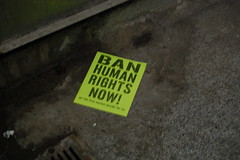
Ban Human Rights Now!Image by driusan via Flickr
Source: The British Institute of Human Rights

What’s the role of human rights in a period of cut backs to public services? What is the role of human rights in protecting the vulnerable? Do human rights offer an effective tool for people wishing to challenge the impact of service cuts or changes? How do we make sure we balance one person’s rights against the interests of society as a whole?

These are the questions at the heart of a National Human Rights Tour by the British Institute of Human Rights.  There will be 16 free-to-attend events taking place across the UK between September and December 2011. The full list of destinations is:
Belfast, Birmingham, Brighton, Bristol, Cardiff, Derby, London, Manchester, Mold (North Wales), Newcastle, Norwich, Oxford, Plymouth, Scotland (2 events TBC), Sheffield.
Full information about dates, locations, and booking is available at the end of this message. Places are limited so book early to avoid disappointment and please forward this information to your colleagues, friends and networks.

Background

In Australia, Lebanese gay man wins asylum appeal

Source: Herald Sun

By Padraic Murphy

A man whose marriage to an Australian woman fell apart after he began frequenting gay clubs has been recommended for asylum because she outed him to his family in Lebanon.

The Lebanese Muslim man came to Australia in 2008 after being sponsored by his Australian wife, whom he met at a barbecue.

A Refugee Review Tribunal decision said the woman became suspicious of her husband after he had difficulty consummating the marriage. He also began having sex with men.

The tribunal said he began frequenting Prahran gay clubs, including the Love Machine, before the marriage finally fell apart.

The man's original application for asylum failed and he took his case to the review tribunal.

This month the tribunal overturned the original decision, describing the man as a "courageous witness". It found he genuinely faced persecution because his wife had told relatives in Lebanon about his sexuality.
"Despite the popular view that Lebanon is the gay-friendliest country in the Arab world, some activists say that behind closed doors, sexual minorities often suffer physical and psychological abuse," the tribunal found.
The tribunal also rejected suggestions the man could return to Lebanon if he suppressed his homosexuality.
"Consequently, the tribunal accepts that to require the applicant to modify his behaviour in the event that he returns to Lebanon by concealing or suppressing his homosexuality, including the nature of his relationship with the witness, would amount to a persecutory curtailment of his sexual identity," the tribunal found.

"The tribunal therefore finds that there is more than a remote chance that the applicant will encounter serious harm ... in  the reasonably foreseeable future, should he return to Lebanon."
The man's case will now be reconsidered by the Immigration Minister before a final asylum decision is made.
Enhanced by Zemanta

Sunday, 28 August 2011

Video: In Russia, activists look forward to 'gay century'

Source: Russia Today


Russian gay rights activists have planned their demonstrations for the next hundred years and have sent applications to the city authorities. They say the aim is to expose what they call the “absurdity” of the laws which the authorities use to deny them the right to conduct their events.

The legal loophole the activists are trying to exploit stipulates that applications to hold a demonstration should be filed to local authorities no less than 45 days before the event. The law does not prohibit filing requests earlier.

The gay community, thus, had every right to submit their requests “to help mass cultural and educational activities from 2012 to 2112.” All the events are to take place on Bolotnaya Square in central Moscow, right next to the Kremlin.

The dates chosen for Gay Pride parades in 2012 are March 4, coinciding with the first round of presidential elections, and May 27, the anniversary of the ban on criminal prosecution against homosexuals in Russia. Up to 2112, the gay community is planning to hold demonstrations every Saturday around May 27.

According to Russian law, the authorities’ answer can be expected to follow in two weeks. So far, no official comments on the issue have been released.

“I think they will try to look for ways to ban it without looking stupid,” LGBT activist and lawyer Nikolay Alekseev told RT. “But in this situation it would be really hard not to look stupid."
"I’m really looking forward to such headlines as ‘Moscow authorities ban Gay Pride parades for 100 years.’ The entire world will be laughing at this, including the judges from the European Court. The Council of Europe will have to take steps to pressurize the Moscow authorities into allowing such an event to take place.”
The last attempted gay pride effort was dispersed by police in Moscow on May 28. More than 60 people, both supporters of LGBT rights and their opponents, were detained.

Russian gay rights activists have been applying for permission to hold a parade in Moscow for several years without success. Former mayor Yury Luzhkov was an outspoken critic of gay marches, branding them on one occasion “satanic.”

With Luzhkov replaced by Sergey Sobyanin, the LGBT community said they hoped for change. The new mayor, however, deemed such events in the capital “unnecessary.”

The bans have always been warmly supported by the Russian Orthodox Church. The authorities are entitled to ban any propaganda based on its potential moral damage to the people, church officials say.

In July 2011, Russia has paid 30,000 euros in compensation to gay activists over Moscow's decision to ban so-called pride marches.

The fine was issued by the European Court of Human Rights, which ruled that the decision to repeatedly ban gay pride parades in 2006, 2007 and 2008 was unlawful.
Enhanced by Zemanta

UK LGBT asylum activists react strongly to Ugandan activist comments

Robert Segwanyi
By Paul Canning

The publication by South African based news website Behind The Mask of an article on UK LGBT asylum issues has drawn adverse comment by British activists.

The article followed extensive publicity surrounding the case of the Ugandan gay refugee Robert Segwanyi and quotes Ugandan activists. Segwanyi's case was rejected by the British authorities, however their attempts to remove him were 'deferred' following an campaign which included a petition of almost 4,000 people. [Disclosure: the petition was started by the author.]

The article contain claims about asylum seekers which UK supporters of LGBT asylum seekers have strongly reacted against.

Dr Paul Semugooma, a Ugandan physician and an activist on HIV and LGBT issues, is quoted as saying:
“For quite some time, there has been a tendency for everyone [claiming asylum] to claim that they are gay.”
The article's unnamed author wrote that "some people pretend to be at risk gays to enter Britain and other western countries."

It quotes Frank Mugisha, of Sexual Minorities Uganda (SMUG) saying that:
“So they (Britain and other Western countries) should work with us (local activists).”
Mr Mugisha was quick to add that his comments were general and not specific to Segwanyi’s case.
Mugisha said: “Immigration (British) should carry out good analysis, work with us and grant genuine cases asylum. But because of the situation here, it is not correct to come up with guidelines and just reject every one who applies.”
Jide Macaulay, speaking for London-based Justice for Gay Africans, which has supported a number of gay Africans claiming asylum in the UK, said:

"I believe that the article published in MASK is misleading and [could] prejudice future cases."
"We have to be mindful of journalistic jibes that can taint credible years of hard work."

In Egypt, LGBT 'increasingly visible'

The Queen Boat – floating nightclub which was ...Queen Boat image via Wikipedia
Source: Washington Post

By Ernesto Londono

Pop star Katy Perry’s “I Kissed a Girl” was playing on speakers set around the dimly lit dance floor. Kholoud Bidak, a 33-year-old lesbian, leaned against an old piano, scanning the entrance warily as guests paid $6 to get into one of Cairo’s increasingly common underground gay parties.

Just months ago, a raid by Egypt’s vice police would have been a concern at gatherings such as this fete for a man in red shorts who was turning 26. But on the recent sweltering Thursday night, as men in pastel-colored, V-neck T-shirts streamed in, a crackdown was the last thing on Bidak’s mind. She worried whether a certain woman might walk through the door.

Bidak doesn’t have a girlfriend. “I have drama,” she said.

Egypt’s gays emerged buoyed from the uprising that toppled President Hosni Mubarak in February. Increasingly visible and willing to speak up, they show how upheavals across the Arab world could prove to be social and cultural revolutions, albeit with uncertain outcomes.

Could Egyptian gays emerge as the pioneers of social liberalization in a region where a wave of revolts has forced out autocrats and raised the prospect that largely youth-led movements could upend dogmatic mores? Or in the months ahead, might gays and other liberal groups lose out against a rise of fundamental Islamists  — another long-oppressed segment of society empowered by revolution?

Here in Egypt, gays and lesbians have turned a handful of public venues into spaces where it’s safe for men to dance with men and where women sit on each other’s laps. And activists are quietly putting together campaigns they hope will enable gays and lesbians to live openly in a country where sexual minorities have long been ostracized.

Web sites used to meet gay men are once again wildly popular because police appear to have ceased using them to conduct sting operations. Some people have gone as far as creating an anonymous Facebook page with a provocative goal: “A Gay Pride March for Egypt in 2020.”

Most of the revelers at this second-story venue, tucked behind the courtyard of a decaying downtown building, were in their 20s and 30s. They tossed back bottles of $3 Egyptian Stella beer and glasses of lukewarm red wine. A DJ alternated between pop hits — lots of Lady Gaga — and songs in Arabic.

Scott Long, an American human rights researcher who has studied Egypt’s gay community for years, watched in amazement as hips swung on the wooden dance floor.
“For me, it’s an astonishing thing to come here and find that there is a community,” said Long, 48.

Saturday, 27 August 2011

In Cameroon, proposed law change equates homosexuality with pedophilia

Me Alice NkomAlice Nkom Image via Wikipedia
By Paul Canning

A revision to Cameroon's criminal code will equate homosexuality with pedophilia, according to activists.

Two proposed new by-laws punish homosexual acts on minors between 16 and 21 years of age to eight years in jail with 10-15 year terms available for acts committed on minors younger than 16, activist Stéphane Koche told AFP.

The new law thus equates acts committed on both age groups as paedophilia, Koche said.

The proposed law change "will allow judges to condemn more people more easily," Alice Nkom, lawyer and president of ADEFHO (Association pour la Défense des Homosexuels, Association for the Defense of Homosexuals) said.

Homosexual acts in general remain punishable by between six months to five years imprisonment in the new criminal code, Koche said.

In an interview with Jeaune Afrique [text via Google translate] Nkom said that the situation for LGBT in Cameroon has got worse over the past ten years:
"Homosexuals lived much better before than now. 10 years ago they arrested fewer people for their homosexuality. This is the result of a combination of two situations: the Catholic Church in a homily in 2005 accused homosexuals of being the cause of moral depravity and of youth unemployment. Subsequently, almost all the newspapers at that time have included this message."

"Some have gone further by publishing (in 2006) a list of homosexuals with their names and their functions. This has created drama in the family. Children suffered the evil of their classmates at school, it was terrible."

"In a country where things are done normally, one would have expected the intervention of the Head of State, to a circular addressed to the prosecutors, judicial police officers, about this savage repression, so they stop. But nothing was done, homosexuals are still treated as abominable."
Nkom and others defending LGBT have come under sustained attack, including threats by state officials of possible arrest and with violence from segments of civil society.

Roger Jean Claude Mbede was arrested and sentenced in March to 36 months of prison after sending an text message in which he declared his love to a friend he had met on the internet. Amnesty International is running an international campaign demanding his release.

LGBT rights group Alternatives-Cameroun recently saw him in Yaoundé Central Prison (Kondengui). They said:
"We found Mr. Mbede in a state of moral health and nutritional deplorable. Suffering at the time  with his  left eye and without treatment or medications. He told us he slept on the ground since his imprisonment, and abandoned  by most of his family members who regard  him as a wizard."
The 2011 US State Department report on human rights in Cameroon says that individuals incarcerated in Douala's New Bell Prison for homosexual acts suffered discrimination and violence from other inmates. A report by IGLHRC last year said that police and prison officers routinely abuse detainees they suspect of same-sex sexual relationships.

Today, four men were arrested in what a lawyer described to AFP as "obviously a set up."

This month two young gay men arrested, according to Nkom, because they were effeminate "confessed" to homosexuality after being tortured

In June a violent attack on a suspected gay couple was reported.

In late January, a young gay man, Serges T., was nearly burned alive by a mob in Douala .

Despite this situation Nkom spoke hopefully with Jeaune Afrique about change:
"Cameroon does not want to occupy a prominent place in the international community and not respect all the conventions that enshrine the rights of man. The country adopted the Universal Declaration of Human Rights as a preamble to its constitution. It is provided for in Article 45 that the international conventions and treaties signed and ratified are above the law. Cameroon is a member of the United Nations but does not respect the values ​​promoted by the organization including respect for human rights.

"A [LGBT human rights] resolution was passed at the UN in June. It now sees minority rights as part of human rights. While Cameroon had voted against the majority, the resolution was adopted. It will be obliged to submit one day and legalise homosexuality. You can not swim against the current."
Enhanced by Zemanta

In the Philippines, anti-gay murder 'rising'

Source: Dragon Castle

The Philippines has always had a sizable and unique LGBT population thanks to a less binary definition of gender (the effeminite bakla are often considered a third gender). But though more than 10% of Filipinos say they’ve had at least one homosexual encounter, and drag culture thrives in various regions, LGBT rights are still limited thanks in part to the influence of Western missionaries and rising Muslim fundamentalism.

The Philippine Lesbian, Gay, Bisexual, and Transgendered Hate Watch has released a study calling out Mindanao as the deadliest place in the country for lesbians. Since 1996, half of all fatal hate crimes against queer women have occurred in the easternmost island, the nation’s second-largest. That’s 6 out of 12 deaths, so we’re talking small numbers to begin with, but LGBT hate crimes, fatal or otherwise, are often under-reported.

For the GBT parts of the LGBT rainbow, the National Capital Region —w hich incorporates Manila, Quezon and Luzon, among other cities—is singled out as a death trap:
Of 61 hate crimes against gays recorded by the researchers, 28 were reported in NCR. Quezon City had the most, with 12, followed by nine in Manila.

There have also been more transgendered and bisexual Filipinos killed in NCR since 1996, many of them found with multiple stab wounds.

By June this year, 28 LGBT Filipinos were killed compared to 29 murdered in 2010. The LGBT Hate Crime Watch research records 103 hate crimes that resulted in death since 1996.
The grizzliness of these attacks is particularly disturbing:
“The brutalities done to the murdered LGBT Filipinos are also suggestive that they were victims of hate crime. Thirty-six of the victims were stabbed multiple times. Twenty of them died of gunshots. Six were tortured before they were killed. Others were raped, or killed with a blunt object, or suffocated, or dismembered, or burned alive,” The group said.

Ilagan said Winton Lou Ynion, an openly gay professor at the University of the East, was stabbed 40 times by an unknown assailant in 2009.

She also cited the case of a trial judge in Laoag City who was “found lying in a pool of his own blood with his head almost decapitated and semen found in his anus.”
While the numbers, again, are still low, they are rising: From an average of 10 anti-gay murders between 1996 and 2008, the killings rose to 12 in 2009, 26 in 2010 and 27 just in the first six months of 2011. Gabriela Party Representatives Luzviminda Ilagan and Emmi De Jesus have petitioned for an investigation into anti-LGBT hate crimes and appropriate legislation to stem their growth.

Enhanced by Zemanta

Friday, 26 August 2011

Expat Ugandans organise to fight 'Kill gays' bill

By Paul Canning

A group of expat-Ugandans living and working in the United States have launched a new lobbying group against the Anti-Homosexuality (aka 'Kill gays') bill (AHB) called OneFamilyOneVoice (1F1V).

The group, who mostly work for international organisations and, according to blogger and activist Rick Rosendall include Ugandan human rights activists and anti-Museveni ex-pats, say they met originally in a Washington DC coffee bar and discussed the dangers of the AHB. This includes the danger to heterosexuals who refused to oppose LGBT human rights. The bill has a clause which says that:
"Anyone failing to report to the authorities a person they knew to be homosexual would also be prosecuted."
They say:
"This bill forces the entire Ugandan population - regardless of their sexual orientation - to be Gestapo agents snooping on their fellow citizens on behalf of the regime."
The group's aims are to:
  • Expose secret strategies underway to pass the UAHB without the knowledge of the international community.
  • Work in partnership with other groups to not only kill but completely take the bill out of picture and to ensure that such a bill is never considered by any other African country.
  • Start a unified voice with a movement to educate and empower leaders to accept diversity and inclusion.
According to Rosendall:
"The danger the Ugandan activists and insiders face is grave, so names are not being bandied about."
Enhanced by Zemanta

Video: US religious right target international bodies, ally with Iran, support anti-gay Africans

Source: Stand for the Family

Sharon Slater discusses the work of Family Watch International. the importance of protecting the institution of the family in order to maintain our fundamental freedoms, the International Planned Parenthood booklet, Healthy, Happy, and Hot that she picked up at the Girl Scout meeting at the UN that promotes sexual rights and sexual pleasure for youth, and she describes her new book, Stand for the Family which was designed to equip citizens with the talking points, facts, and research they need to defend marriage, life religious freedom and parental rights and much more.


Source: Religion Dispatches

By Warren Throckmorton

Sharon Slater, American anti-gay activist and president of Family Watch International, recently encouraged delegates attending a law conference in Lagos, Nigeria to resist the United Nations’ calls to decriminalize homosexuality.

Keynoting the Nigerian Bar Association Conference, Slater told delegates that they would lose their religious and parental rights if they supported “fictitious sexual rights.” One such “fictitious right” is the right to engage in same-sex sexual relationships without going to jail.

According to an email from the organization, Slater’s efforts are already getting results. A week after Slater’s speech, husband Greg Slater, FWI’s legal adviser, told supporters in an email:

As the most populous and one of the wealthiest African counties, Nigeria can serve as a strong role model for other governments in the region to follow on how to hold on to their family values despite intense international pressure. In fact, several days after the conference, the head of the Anglican Church called upon the Nigerian government to withdraw from the United Nations because of its push to further the cause of homosexuality.
In Nigeria, homosexual behavior is illegal and punishable by up to 14 years in prison. In the Islamic North, where Sharia law is enforced, gays can be sentenced to death by stoning.

According to Family Watch International, Nigeria is a role model.

“Aggravated Homosexuality”

A nonprofit organization, Arizona-based FWI is affiliated with the World Congress of Families, an Illinois think tank which conducts international conferences to promote their vision for “the natural family”—“the fundamental social unit, inscribed in human nature, and centered around the voluntary union of a man and a woman in a lifelong covenant of marriage.”

Most of the conferences are outside the United States and have focused on developing nations where their conservative message resonates well. Like FWI, the World Congress of Families opposes decriminalization of homosexuality. For instance, WCF opposed the 2009 UN resolution calling for decriminalization of homosexuality and downplayed the harshness of the Uganda Anti-Homosexuality Bill in a 2009 newsletter. For FWI and WCF, supporting the natural family means resisting the right of GLBT people to live without threat of jail for private conduct.

FWI once considered Uganda’s notorious anti-gay pastor, Martin Ssempa, a volunteer coordinator for Africa. However, according to its website, FWI broke with Ssempa about the same time Ssempa’s support for Uganda’s Anti-Homosexuality bill became public. Although Ssempa’s name is still listed as a volunteer, there is a new description accompanying it:
Martin Ssempa, FWI African Coordinator (volunteer) — Martin Ssempa was associated with Family Watch International because of his extensive work with youth promoting abstinence-based HIV education in Uganda. This association ended when Family Watch became aware of Mr. Ssempa’a support of the proposed law in Uganda calling for the execution of homosexuals who engaged in “aggravated homosexuality” (defined as homosexual sex between an adult and a minor or when a person infected with HIV knowingly has sex with another person putting them at risk for contracting HIV).
Slater: “It’s Complicated”

One step back in lawsuit against Botswana sodomy law

BotswanaImage via Wikipedia
Source: Botswana Gazette

By Isaac Pheko

The controversial case in which Caine Youngman is suing the government over anti-sodomy laws has been withdrawn to strategise and consult with stakeholders.

Youngman and the Lesbians, Gays and Bisexuals of Botswana (LeGaBibo) want to collect additional evidence in their challenge of Section 164 of the Botswana Penal Code which criminalizes sexual conduct between adults of the same gender.

Youngman with the support of LeGaBibo wants Section 164 declared unconstitutional, and repealed on the grounds that it discriminates against persons on the basis of their sexual orientation.

An attorney representing Youngman, Monica Tabengwa, said that the law is a legacy of British colonialism and has since been de-criminalized in Britain. She was speaking at a press briefing in Gaborone on Monday to announce the withdrawal of the case.

“This case has attracted a lot of publicity and interest locally and internationally. Good things have emerged from this goodwill, “she said. Tabengwa explained that there were people willing to offer legal assistance and supporting the case by deposing affidavits to show that Batswana are ready.
“We are proud to announce that our lead counsel in this matter going forward is Advocate Marcus Gilbert, a SA advocate with years of experience in public interest in litigation,” she said.
Tabengwa explained that Gilbert was lead counsel in the case of the South African Coalition of Gays and Lesbians seeking to enforce constitutionally guaranteed rights over a statute that was clearly in contradiction, “she said.

She stressed that countries like Lesotho and Swaziland are observing Botswana to see the outcome of the case.
“We know Malawi is violating people’s rights based on their sexual orientation. If we lose, they will go ahead with their violations,” she said
One of the lawyers representing Youngman, Uyapo Ndadi, said that it is important to get support from Batswana; even some parliamentarians and opinion leaders have wished them well with the case.
“We are not giving up on the case. We are only retreating to bounce back in a more solid way,” he said.
Past newspaper reports have stated that in 2005 LeGaBibo attempted to register their association with the registrar of companies but their application was turned down, on the grounds that the Republican constitution does not recognize homosexuals.
Enhanced by Zemanta

Paper: Homophobia and the governance of sexuality in Uganda: The concomitant implications for forced migration

By Stephen Kaduuli, York University; Africa Leadership Institute

Abstract:    
Uganda resurfaced in the global headlines at the tail end of 2009, when the Anti-Homosexuality Bill 2009, which appears to be supported by most Ugandans, was tabled before Parliament. This paper probes homophobia in Uganda and addresses the theme of "sexuality", justice and the concomitant implications for forced migration. It looks at the analysis of the bill in relation to the issue of human rights. Methodologically, it briefly focuses on addressing the socio-cultural aspects in respect of Afro-societal aversion to homosexuality and legislative change.

Homophobia and the Governance of Sexuality in Uganda_ the Concomitant Implications for Forced Migration

Enhanced by Zemanta

Audio: Interview with an Ugandan asylum seeker

An interview with Usman, a Ugandan asylum seeker in the UK.

"They will try to twist you, ask you questions. Once you make a small mistake they use that against you, and then you die."

"I don't think being an asylum seeker is a good thing and people should remember that. We don't come here just because we want to, it's because we're fleeing persecution."


Enhanced by Zemanta

Thursday, 25 August 2011

In Pakistan, police act to protect trans women

Source: Express Tribune

By Manzoor Ali

In Peshawar, the City police took seven persons into custody after transvestites complained of being sexually harassed and physically tortured by them, police said.
SHO Khazana Police Station Raz Mohammad Khan told The Express Tribune that they took seven persons into custody after transvestites approached the police with a written complaint detailing their ordeal, saying that they shaved the heads of five transvestites and subjected them to physical abuse.

Raz Mohammad said that the issue was settled as another application of reconciliation was submitted to the police station after the initial application.

However, he added that the accused were still in police custody.

Transvestites have traditionally been paid to help celebrate the birth of a son or to dance at weddings, but today, many end up living on the streets, begging or prostituting themselves. Additionally, in a country where sexual relations outside marriage are taboo and homosexuality is illegal, transvestites are also treated as sex objects and often become the victims of violent assault.

Earlier in the day, transvestites from around the city protested outside Peshawar Press Club (PPC) to call attention to the abuse.

Khyber-Pakhtunkhwa Shemale Association President Farzana told the Express Tribune that such incidents have been taking place over the last few months and the same group of people is responsible for shaving the heads of transvestites and subjecting them to other forms of physical and mental abuse.

Earlier, five transvestites approached with a complaint that they were taken to a party in the Bakhshi Pul area on Charsadda Road, where a group of men shaved their heads and then began torturing them.

She identified the transvestites as Marghay, Lambay, Nazoo, Guria and Saeeda, adding that the same kind of treatment has been meted out to at least 20 transvestites during the past few months, with some of them leaving the city in fear.

Farzana claimed that the same group had previously sexually abused some transvestites and filmed the incident, which was later uploaded to the internet. She claimed that she was also being threatened for speaking out.

Another transvestite who was subjected to physical abuse some 20 days back corroborated Farzana’s story, telling The Express Tribune that a group of 15-20 men subjected them to physical abuse and that the attackers filmed part of the incident. She felt sure that the attackers were from the same group that shaved the heads of transvestites last night.
Enhanced by Zemanta

Are asylum seekers lying when their testimony is inconsistent? A personal story

Source: Refugee Media Project

By Ben Achtenberg

I’ve just been re-reading Judy Eidelson’s PsySR post, Traumatic Memories, Well-Founded Fears, and Credibility. The article is based on Judy’s experiences in documenting the psychological impact of torture trauma for clients who are seeking political asylum in the United States.

As she points out, torture survivors’ requests for asylum are often turned down because asylum officers and immigration judges:
“assess the credibility of a refugee’s testimony by scrutinizing it for inconsistencies. Many asylum claims are denied because the case record includes conflicting accounts of details in the asylum seeker’s story, or because aspects of the story deemed important by officials only emerge late in the proceedings. But these kinds of inconsistencies are a hallmark of PTSD.”
Judy’s observations have been overwhelmingly borne out in the interviews I’ve done for our film, Refuge: Caring for Survivors of Torture.

Folks have repeatedly told us about torture survivors who were turned down for asylum because of slight discrepancies between their affidavits and their verbal testimonies, or their statements on different dates – different recollections of the number of people inflicting the torture, for example, or not remembering the exact dates they were imprisoned. Several people mentioned cases in which the asylum applicant failed to mention some particularly degrading element of their torture on first testifying – rape or other sexual torture, for example – but added it later, and were disbelieved.

Eidelson notes:
“Part of the problem is that many of us cling to the idea that no matter what people have been through – including rape, mutilation, and the slaughter of loved ones – they will act in just the way we like to think we would have acted. We would remember exactly what happened. We would know what parts of our long trails of misery are most relevant to immigration authorities. We would report exactly the same details each time we were asked. We would have no trouble talking about it, even in front of strangers who accuse us of lying. We would look appropriately upset while telling the story – crying at the sad parts and making eye contact throughout.”

Would we, indeed?

Resource: The Iranian Queer Organization

Saghi Ghahraman
Source: Shahrvand

By Sima Sahar Zerehi

The Iranian Queer Organization better known as IRQO is likely the name that most people remember when it comes to organizing the lesbian, gay, bisexual, transgendered, and transsexual Iranians in Toronto. The group was formed in the summer of 2006 by Niaz Salimi, Arsham Parsi, Sam Kusha, Roshan Borhan, and Saghi Ghahraman. Since its genesis IRQO has spearheaded an aggressive agenda of educating, mobilizing and advocating on behalf of LGBTQ Iranians.

Today, although short one of its founding members, IRQO continues to be an active queer rights group working on multiple fronts.

Niaz Salimi and Saghi Ghahraman continue to lead the organization with the assistance of a team of dedicated volunteers including Hamid Parnian, Yegane Dudi, Parastoo Rahmani, Mahiar Fatemi, and Ramin Jafari,
“We work to combat discrimination against homosexuality within the penal code of Iran,” begins Saghi Ghahraman.
Ghahraman a slight almost girlish figure with shocking silver hair is a well-known personality in the Toronto Iranian community.  She’s the kind of trailblazer that creates controversy wherever she goes, a true iconoclast. You can even say that she has a talent for provoking people and making them question the very things they take for granted as essential truths. In short, she’s exactly the kind of person you want standing next to you when you’re fighting a battle to create change.

While today she is known by most people as a queer rights advocate, she is remembered by the founders of 'Tehranto' as a poet and writer with three published books of poetry and a collection of short stories; literary achievements that helped to give a voice to a generation’s experience with migration to Canada.

Ghahraman continues by noting that “Raising awareness about LGBT human and civil rights” is another key goal for the group.

While IRQO is based in Toronto, the organization also advocates for LGBTQs who fled Iran to claim refugee status in Turkey or other transit and or host countries.
“We provide assistance via legal and financial support until they’re granted refugee status and are resettled in a safe country,” Ghahraman explains.

In UK, immigration detention 'legal but unfair'

Statue of JusticeImage by Ann Althouse via Flickr
Source: Compas

By: Stephanie Silverman, DPhil Politics and International Relations

The UK immigration detention system is always attracting attention, most of it negative.  There are protests organised monthly – if not weekly – outside of detention centres and in the centre of London.  MPs ask Parliamentary Questions about the statistics and treatment of detainees; the United Nations intervenes in UK domestic politics to express its disapproval; the Immigration Law Practitioners Association publicly calls foul on the lack of bail options for detainees; and, during the 2010 General Election campaign, Nick Clegg makes ending child immigration detention a key manifesto promise.

So, why all the fuss? Why are activists, barristers, mental health professionals, students, pensioners, and politicians all working towards improving conditions for UK immigration detainees, if not ending the practice altogether? Because, while it may be legal, the UK immigration detention system is far from fair.

To better understand why the stakes are so high, here is a potted list of some of the current issues, and why they might provoke anxiety and outcry.


The size and cost of the system

The UK immigration detention system expands virtually every year.  As of 2011, the UK boasts one of the largest networks of immigration detention facilities in Europe.  According to Home Office statistics, approximately 30,000 non-citizens entered detention under Immigration Act powers in 2009.  Put another way, nearly 3,000 non-citizens in the UK are being detained under Immigration Act powers on any given day. This compares to 1,950 total immigration detainees on 25 December 2004 and 780 on 30 December 1998.

After the re-purposing of the Morton Hall prison as an immigration removal centre (IRC) in June 2011, UK detention capacity expanded to approximately 3,500 places.  As a snapshot example, 2,525 non-citizens were detained in UK facilities on 31 December 2010.

The detention system is extremely expensive to run.  In 2010, the average overall cost of one bed per day in the immigration detention estate was £120.  This means that, to take our example of 31 December 2010, the detention system cost taxpayers approximately £303,000 for that one day only.  Further, since the UK Home Office outsources the operations of the majority of its detention facilities, much of this money is being pocketed by private firms and this in turn raises issues of accuracy and transparency.

Wednesday, 24 August 2011

In Serbia, politicians accused of inciting violence against LGBT

Dragan Marković Palma
Source: B92

United Serbia (JS) leader Dragan Marković Palma says his party has never called for violence and bloodshed but that they will never support gay Pride Parade.

He has announced that he will ask the Serbian government not to allow holding of the parade because “Serbia has more important things to do”.

This was Marković’s response to Gay-Straight Alliance NGO’s announcement that they will file a lawsuit against him “for homophobia, discrimination and violation of equality”.

In a written statement, the JS leader said that his party would never support something unnatural and something that was not even accepted by the Serbian Orthodox Church (SPC) and other religious organizations in Serbia”.

He stressed that “homosexuality was considered a disease 20 years ago, not according to Dragan Marković Palma, but according to the World Health Organization, but it was taken off the disease list under pressure from powerful lobbies”.

Marković repeated that his party was advocating a healthy family that included children being born in a marriage between a man and a woman and not to be children in “surrogate families” in which “two persons of the same sex would play mom and dad and only have different hair color. They will wear the same clothes and shave beard and mustache”.
“The JS is fighting against the birth rate decline, helping families and children with various activities because all of us are family people who advocate marriages in which children will not be deprived of possibility to have different-sex parents,” he pointed out, adding that “only this can be a healthy future of Serbia, instead of homosexuality”.
The Jagodina mayor said that the difference between the JS and others was “that we are not ‘hypocrites’ who think one thing and say the other and that we will never say we support the Pride Parade, as gay population calls it, or ‘Shame Parade’ as we call it.”

Bearing in mind that Serbia has better things to do and that now is not the time to shift the entire public’s attention to the “shame parade”, the JS “calls on the government not to allow it to be held in Belgrade”, Marković said in the written statement.

“The Serbian Progressive Party (SNS) believes that taking part in the gay Pride Parade is a personal choice of every individual,“ said SNS Presidency member Zorana Mihajlović.
“Everybody has the right to take part in it or not. That's a personal thing of every citizen of this country,“ she stressed.
The SNS official added that the SNS believed that there were much more serious problems that should be dealt with than the issue of the Pride Parade.

Mihajlović said that it was police’s responsibility to worry about security, including security at the Pride Parade, adding that this was the case in every country.
Enhanced by Zemanta

Video: Protection barriers faced by LGBTI refugees

Presentation by Rachel Levitan of Oram at the 'LGBT Identities, Governance, and Asylum' session at the 13th conference of the International Association for Studies in Forced Migration (IASFM) held in Kampala, Uganda, July 3-6.


Enhanced by Zemanta

Related Posts with Thumbnails