Showing posts with label azerbaijan. Show all posts

Tuesday, 15 November 2011

Interview with Azerbaijani gay activist

Location map of Azerbaijan within EuropeImage via Wikipedia
By Paul Canning

Interview with Ruslan Balukhin, co-founder gay.az, a website for LGBT people in Azerbaijan:

Q: What is the purpose of your website?

A: This informative-entertainment resource is for LGBT community of the capital, Baku.

After news about the site appeared on the local news outlets, I started to receive SMS messages from supporters but also from people with negative views about this site. I often receive e-mails and calls with threats. Channel One and Euronews also sent me message and asked to give interviews.

Then I received similar message from Euronews where BBC and CNN were mentioned. I think, this interest is associated with the victory on Eurovision 2011 and with the calls from LGBT communities worldwide to boycott the show in Baku in 2012.

As far as I can remember, an organization, official representatives of LGBT community in Azerbaijan, exists from 2006 – 2007 [this was 'Azeri Gay Community']. During its existence it has done nothing to solve problems of sexual minorities. What to talk about, if even the site lgbt.az, which is the site of the organization, doesn't work anymore.

Q: What methods do you use in the struggle for your rights?

A: We do not yet have any defined methods. Today, our main goal is to offer psychological help to sexual minorities, and we also try to establish communication. Our site is not associated with politics and therefore we do not put any aims in the struggle for our rights on the government level.

Q: Although homosexuality is legal in Azerbaijan, I understand that it is not tolerated?

A: It's very serious problem, because there may be many backgrounds of negative attitude and aggression: conservatism, religion, education and people's views. But the main reason of different people not being accepted in our society is ignorance.

People do not know about biological and genetic causes of homosexuality. It is not easy to replace negative attitude with tolerance. In the first place, educational work must be done, it is necessary to tell people who LGBT people are and why they are different.

Q: How do gay couples survive, is everyone closeted?

A: If you mean living together, there are many homosexual couples in Azerbaijan. Of course, most of them keep their relations hidden from others, but it is not hidden from sexual minorities.

In most of our families, the attitude towards gays is that they shouldn't be in their families.

Sooner or late, families accept it. Sometimes much time is needed for the family of a transsexual to understand that nothing has changed with the person after they discovered a hidden part of his biography.

Q: What do you think about the future of the LGBT gay movement in Azerbaijan? Will change happen?

A: I'm sure that there will be equality among people, independent of their sexual orientation. It's hard to tell, how much time will be needed for it – tens or hundreds of years, but that depends on us.

Some Azerbaijani journalists call homosexuality “disgusting”, reports on these are left without reply. Gays encounter insults in everyday life – in universities, streets. Struggle against discrimination should be accompanied with educational work. We would like to have discussions about homosexuality in an adequate, delicate and informed way in universities and schools and mass media on the required level.

Enhanced by Zemanta

Monday, 26 September 2011

Human rights defenders need solidarity from all parts of Europe when repressed by their governments

Destroyed Azeri human rights group office
By Thomas Hammarberg

The clampdown on human rights defenders in Belarus continues unabated. In early August, Ales Bialiatski, the chair of the Human Rights Centre Viasna and vice-President of the International Federation for Human Rights (FIDH), was arrested. He is still being held in pre-trial detention. Activists who have demonstrated for his release have been summoned by the police and one of them is awaiting trial.

Viasna has been at the forefront of human rights defence in Belarus for years. The detention of Ales Bialiatski and the current criminal investigation process are seriously jeopardising the organisation’s activities to the detriment of victims of human rights violations, who have come to depend on the assistance provided by Viasna.

Another sad example has been reported from Azerbaijan. In mid-August, bulldozers demolished a building in Baku where several human rights organisations were located, including the Office of the Institute for Peace and Democracy led by Leyla Yunus. This demolition took place in the evening, despite a court decision temporarily prohibiting the destruction of the building.

As the house was torn down without any prior notification the persons who worked there were unable to salvage any papers, computers or other working materials. It is generally believed that the action was directed towards Leyla Yunus, who has been vocal in denouncing corruption and forced evictions in Azerbaijan.

Rights that protect and enable the work 

The importance of the work of human rights defenders is recognised in international conventions. The UN Declaration on Human Rights Defenders lists several fundamental rights necessary for the work of human rights defenders, such as freedom of association, peaceful assembly, expression and opinion, the right to be protected and the right to effective remedy. Many of these rights are also enshrined in other binding human rights treaties of the UN, in the European Convention on Human Rights and in the OSCE commitments.
Yet reports about breaches of these standards continue to reach me. Authorities can obstruct the work of human rights defenders by making it difficult to register organisations or by creating burdensome reporting and financial requirements. Hindering access to funding through excessively cumbersome procedures is another method which is frequently employed.

Viasna, for example, was dissolved in 2003 and has since then been denied the possibility to re-register. Belarusian legislation outlaws the operation of unregistered organisations and criminalises the activities of their individual members – a clear breach of international standards. In 2007, the UN Human Rights Committee concluded that Viasna’s dissolution was a violation of the International Covenant on Civil and Political Rights (article 22).

Denial of right to receive funding 

The Belarusian authorities are now accusing Ales Bialiatski of “concealment of profits on an especially large scale”. They are using information provided by official institutions in Vilnius and Warsaw about bank accounts established in the name of Bialiatski, to which foreign donors have been able to send contributions.

The right to access funding is protected in international and regional human rights treaties. The UN Declaration on Human Rights Defenders states that everyone has the right “to solicit, receive and utilize resources for the express purpose of promoting and protecting human rights and fundamental freedoms through peaceful means”.

I know that the governments in Vilnius and Warsaw regret that the protection of human rights defenders’ integrity and work was not taken into account when information was provided to the Belarusian authorities and that they are now trying to limit the damage.

Sadly, this unintended mistake is being used in the case against Ales Bialiatski who is threatened with a long prison sentence. And he is not the only victim of policies to prevent voluntary solidarity efforts for those who suffer human rights violations.

Governments have a primary responsibility 

It is therefore particularly important that the protection of the safety of human rights defenders be reaffirmed as a crucial standard. Whenever this universally agreed undertaking is abrogated in one state, governments in other countries – including Council of Europe member states – must react.

Thomas Hammarberg is the Council of Europe Commissioner for Human Rights

Enhanced by Zemanta

Wednesday, 21 September 2011

Azerbaijan's Eurovision welcome for gays questioned again

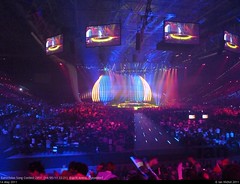
Eurovision Song Contest 2011Eurovision 2011 image by ianxn via Flickr
By Paul Canning

Azeri officials have again reassured journalists that gays will be welcome at the 2012 Eurovision song contest to be held in Azerbaijan's capital Baku.

And Alekper Aliyev, a writer and an author of a controversial book about a gay relationship between an Azeri and a man from Armenia, the country's historic enemy, which was removed by the police from a big bookstore in Baku, told the BBC:
"During Eurovision, no-one will bother gay foreigners in Baku. People here don't mind, as long as it's not in their family."

"There are several openly gay celebrities in Baku who have money and bodyguards, and they are safe. But nothing will change [because of Eurovision] for the majority of gays, particularly in the provinces. This society will never accept them."
Azeri refugee Babi Badalov told the BBC:
"Eurovision will be held in the five-star Hotel Europa. Everyone knows that after midnight not far from this hotel you can get gay sex with a transvestite prostitute. Married men go there for fun. And yet homosexuality to them is disgusting."
Yadigyar Sadykov, a human rights activist from Mr Badalov's native region, said:
"Homosexuality here is seen as worse than prostitution. If a family decided to kill a gay relative, most people would approve. I have heard of many suicides of suspected homosexuals - I have never met an openly gay person around here."
Elnur Aslanov, a senior official from the Azeri presidential administration, told the BBC that these comments were expatriates issuing "ill-informed speculation" about the treatment of LGBT in Azerbaijan .
"We consider all this nothing more than an unsuccessful attempt by those naysayers to gain a better reputation in their respective countries in the light of the upcoming Eurovision song contest in Azerbaijan," she said.
According to a Council of Europe report published in June, during 2009 police raided gay bars and arrested almost 50 people. Police reportedly held the individuals and threatened to expose their sexual orientation publicly unless they paid a bribe. A film documentary from Azerbaijan in which several people testify about their experiences also points to such incidents of blackmail.

The US State Department 2010 Human Rights Report on Azerbaijan said:
"During the year, members of the lesbian, gay, bisexual, and transgender (LGBT) community continued to refuse to lodge formal complaints with law enforcement bodies out of fear of reprisal or retaliatory persecution. Also during the year, the LGBT community held almost monthly gatherings; these were routinely raided."

Thursday, 7 April 2011

Gay Azerbaijani artist rejected by the UK wins asylum in France

Babi Badalov
By Paul Canning

The gay Azerbaijani artist Babi Badalov today received notice that he has been granted asylum by France, just over five years since he first fled for what he thought would be the sanctuary of the UK.

Badalov is an internationally renowned radical artist and poet whose work has been exhibited across Europe. It has been explicitly critical of the Azerbaijan government and prominent members of the present and past regimes there. His art and open homosexuality led to him suffering beatings and bullying over the years that left him with only eight teeth remaining and a number of mental health problems.
“Azerbaijan is one of many countries that wants to be a member of the European Parliament," Badalov says. "It wants to be an imitation of Europe, like Russia does, but in reality everything is rotting there, worse than it was in the Soviet Union.”

“I tried to exhibit my work called ‘Mister Musor’ [Mr. Garbage] a few times, where I am standing on a heap of garbage in Lenin’s pose."
“When the Azeri President died, they put his monuments everywhere — on every central street, on every central square — giant, hi-tech posters are everywhere, posters of Heydar Aliyev. The main street in every village is named after Heydar Aliyev, while all the rest are rotting. You walk ten meters [away from the main street] and it’s all sores. People live in shit, eat bones, die of hunger. But when [current President Ilham Aliyev, Heydar's son] visits, there’s a monument to his father, and everything is fine. Lenin has been resurrected.”
Homosexuality remains an extremely taboo subject in Azerbaijan, which is 99% Muslim. This led Badalov’s brothers to threaten to kill him because of the shame which he has brought on the family.

He was violently removed from the UK in 2008 after his asylum claim was rejected by then Home Secretary Jacqui Smith on the basis that he could go and live in another part of the country and keep his sexuality a secret. He hid underground in the Azerbaijani capital Baku for two days after his sister had warned him over the phone before his removal to never to come to the country again because of death threats from his brothers. As a result Badalov fled to St Petersberg.

Friday, 11 February 2011

In US, gay asylum seekers gaining ground?

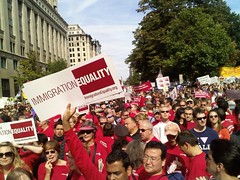
Immigration Equality at the National Equality ...Image by Matt Algren via Flickr
Source: WGLB

By Kilian Melloy

An American organization that assists GLBT asylum seekers reports that it helped a record number of gays from hostile home countries secure safe haven in 2010.

Immigration Equality, working together with legal volunteers, successfully assisted 101 GLBT asylum seekers last year, according to a press release issued by the organization on Feb. 7. The largest number from a single country was 28; those refugees came from Jamaica, one of the most violently homophobic nations in the world.

Gays in Jamaica are reportedly subject to mob violence, sometimes beaten and even murdered in their own homes. Homophobia is deeply rooted in Jamaican culture, with anti-gay songs played at dance halls. Homophobia is further inculcated into the society by anti-gay religious leaders.

A further 10 gay asylum seekers came from other Caribbean nations, the press release noted.

Other sexual minorities who won the right to stay in the United States and not be shipped back to face anti-gay persecution--which can often be life-threatening--came from Russia (seven of the 101 individuals), Uzbekistan (four asylum seekers), and Ghana (three individuals), among other nations.

Thursday, 27 January 2011

Wikileaks, the US Embassy Cables and Migration Issues

Seal of the United States Department of State....Image via Wikipedia   
Source: Franck Duvell: Diary on Human Migration Research

When ‘Cable gate’ – Wikileak’s publication of the US embassies’ reports to the US State Department Washington - hit the headlines in November and December 2010 I was wondering whether there is anything in it for migration and migration policy researchers. So far, I am not aware whether anybody else has already gone through the documents, so I had a quick look. Unfortunately, only a fraction of all cables – 2000 out of 251,000 - are already published on Wikileaks’ website (http://213.251.145.96/cablegate.html).

In short, migration and refugee issues only play a very minor role in the set of documents I have sifted through. And where these are mentioned this is mostly in the context of terrorism, general threats to regional stability and security or with respect to Muslim minority communities. The first impression from these cables is that from the US American consular perspective migration as such is not considered a major issue and is not causing great anxiety whilst Muslim migration and minorities and to some extent border security are issues of concern.
Worldwide: Some reference to migration can be found in the already notorious ‘reporting and collecting needs’ issued by the Secretary of State Hilary Clinton. For instance, the request for West Africa lines out to collect information on ‘population and Refugee Issues’, including ‘population movements in the region, and governments' involvement and response, indications of actual or potential refugee movements within or into the region, locations and conditions of refugee camps and informal refugee and internally displaced persons (IDP) gathering sites and transit routes’ government capability and willingness to assist refugees and IDPs, health and demographic statistics of refugees and IDPs, dynamics and impact of migration and demographic shifts’ (2009, http://213.251.145.96/cable/2009/04/09STATE37566.html). And also in Hungary information is requested on ‘demography, including ...migration’ and ‘plans and efforts to respond to declining birth rates, including through promotion of immigration’ (2009, http://213.251.145.96/cable/2009/06/09STATE62393.html). Similar requests were sent to many other countries.

Wednesday, 18 August 2010

Hate crime in Azerbaijan’s capital Baku? Double murder of two 'transvestites'

Baku panoramaImage via WikipediaSource: Gay Armenia

Via Tert.am, Vesti.az reports on double murder in Baku of two transvestites. Source in Azerbaijan’s capital police district suggested of their "possible non-traditional sexual orientation”. As per reports, they were wearing women’s wigs, lingerie, and having bright coloured nail manicure. They were found dead with multiple stab wounds.


Russian to English Google translation

In Yasamal district of Baku for the day with a second murder, but this time double.

It was reported Vesti.Az in the 27th branch of the Police District.

As at H. Javid Ave 546 bodies had been found two men with multiple stab wounds.

As a result of the investigative and operational activities undertaken by members of the police department of Baku, Baku City Prosecutor's Office and Police Department Yasamal region were identified dead - they were Gasimov Zamig Gasim oglu and Kuzmin Yadigar Eldar oglu.

According to a source in law enforcement, allegedly killed adhered to sexual orientation - from the data obtained at the time of the crime the two young men were dressed in underwear lingerie.

In addition, they were wearing women's wigs, and nail manicure was made of bright colors.

The body of one of the dead were found seven stab wounds, and another - 5.

The case is assigned to the Baku City Prosecutor's Office. By catching the criminal conduct operational-search measures.


Убитые в Баку мужчины были в нижнем женском белье

19:30 11-08-2010

В Ясамальском районе Баку за сутки совершено второе убийство, но на этот раз двойное.

Об этом сообщили Vesti.Az в 27-ом отделении Управления полиции района.

По адресу пр. Гусейн Джавида 546 были обнаружены тела двух мужчин с многочисленными ножевыми ранами.

В результате следственно-оперативных мероприятий, проведенных сотрудниками Главного управления полиции города Баку, прокуратуры города Баку и управления полиции Ясамальского района были установлены личности убитых – ими оказались Гасымов Замиг Гасым оглу и Кузьмин Ядигяр Эльдар оглу.

По словам источника в правоохранительных органах, предположительно убитые придерживались нетрадиционной сексуальной ориентации - по полученным данным в момент совершения преступления оба молодых человека был облачены в нижнее женское белье.

Кроме того, на них был надеты женские парики, а ногтях был сделан маникюр яркого цвета.

На теле одного из убитых было обнаружено 7 ножевых ранений, а у другого – 5.

Дело передано в Бакинскую городскую прокуратуру. По поимке преступника проводятся оперативно-розыскные мероприятия.
Enhanced by Zemanta

Sunday, 4 October 2009

Video: Everybody like something

'Everybody like something' is a short film made for Channel 4's 3-minute wonder episode 'Don't Hate Me Because I'm An Asylum Seeker'. It premiered at Rushes Soho Shorts Festival.

Featuring Gholmreza Shahmohammadi, produced by Bruce Melhuish and Kaleem Aftab and directed by Jesse Lawrence and Cristian Solimeno for la famiglia films.

A gay asylum seeker from the Islamic Republic of Iran decides to take desperate measures when his application for asylum is refused.

Thursday, 24 September 2009

IGLHRC - UN, CEDAW Silent on LBT Women in Concluding Observations

IMG_0907CWGL at the 53rd Session of the Commis...Image by CWGL via Flickr
Source: International Gay & Lesbian Human Rights Commission

IGLHRC is disappointed that the Committee on the Elimination of all Forms of Discrimination Against Women (CEDAW Committee) failed to reference issues relating to sexual orientation or gender identity in its Concluding Observations for the 44th session. The countries reviewed in the 44th session were Azerbaijan, Bhutan, Denmark, Guinea Bissau, Lao People's Democratic Republic, Japan, Liberia, Spain, Switzerland, Timor Leste, and Tuvalu.

The Committee's silence is especially striking in the cases of Azerbaijan, Japan, and Switzerland. Shadow reports focusing exclusively on the human rights violations of lesbian, bisexual, and transgender (LBT) women were submitted by NGOs from these countries, and activists traveled to New York to attend the CEDAW session and speak at NGO meetings on the violations faced by LBT women.

CEDAW's Concluding Observations constitute the Committee's final recommendations to governments about how to further equality for all women. Where women as a group face discrimination or violence, the situation is often even worse for LBT women. Devaluing women on the basis of sexual orientation and gender identity devalues all women, just as adverse treatment of women as a group is particularly detrimental to women who are LBT.

The CEDAW Committee, as well as other human rights treaty bodies including the Human Rights Committee, the Committee on Economic, Social, and Cultural Rights (CESCR), the Committee Against Torture (CAT), and the Committee on the Rights of the Child (CRC), has recognized sexual orientation as a prohibited basis for discrimination. On at least one occasion the CEDAW Committee has also recommended legislation that protects people from discrimination on the basis of gender identity. Other treaty bodies including CESR and CATR have explicitly included gender identity among the prohibited grounds for discrimination.

The following comparisons reiterate some of the concerns that could have been included within the framework of the Concluding Observations. Although the groups’ recommendations were ultimately omitted from the session’s Concluding Observations, they still provide a useful blueprint for governments to act as they fulfill their obligations under CEDAW.

All the shadow reports and Concluding Observations from CEDAW’s 44th Session can be downloaded here.

Azerbaijan:

The Gender and Development Social Union’s shadow report explicitly highlighted a number of areas where LBT women are particularly at risk in Azerbaijan:
  • Prejudice in media and society, including hate speech and hate crimes,
  • Domestic violence and forced marriage
  • Discrimination in employment, health care, and the legal system.
The shadow report specifically recommended that Azerbaijan amend legislation to address family violence against LBT people, prohibit discrimination on the basis of sexual orientation and gender identity, promote education and tolerance, and adopt mechanisms to recognize transgender people in the legal and medical fields.

Azerbaijan should take LBT people into consideration as they implement these recommendations and recognize how LBT people are especially disadvantaged by these forms of inequality identified by the Committee:
  • Stereotypical attitudes toward women and portrayals in the media,
  • Domestic violence and violence against women, and
  • Discrimination in education, employment, and health care.

Japan:

GayJapanNews’ shadow report explicitly highlighted a number of areas where LBT women are particularly at risk in Japan:
  • Barriers to changing legal gender that limit access to health care,
  • information, and venues for expression,
  • Discrimination in health care, education, employment, housing, social security, and asylum,
  • Cultural expectations and pressure to marry, and
  • Domestic violence and violence against women.
The shadow report specifically recommended that Japan adopt anti-discrimination legislation and establish an independent national institution to protect the human rights of LBT people.

Japan should take LBT people into consideration as they implement these recommendations and recognize how LBT people are especially disadvantaged by these forms of inequality identified by the Committee:
  • Unequal provisions for inheritance, custody, adoption, and family law,
  • Discrimination,
  • Stereotypical attitudes toward women and portrayals in the media, and
  • Domestic violence and violence against women.

Switzerland:

The shadow report by Fondation Agnodice, Lesbenorganisation Schweiz LOS, Lestime, Homosexuelle Arbeitsgruppen Zurich HAZ, and WyberNet explicitly highlighted a number of areas where LBT women are particularly at risk in Switzerland:
  • Discrimination,
  • Disparities in health and well-being,
  • Barriers to changing legal gender and name across cantons, and
  • Lack of recognition in family law.
The shadow reports specifically recommended that Switzerland adopt federal legislation prohibiting discrimination on the grounds of sexual orientation and gender identity, permit LBT couples and individuals to adopt, receive fertility treatment, and undergo artificial insemination, include LBT people in data collection, medical training, outreach and prevention programs, and improvements in care, and allowing transgender people to change their legal name and gender without preconditions.

Switzerland should take LBT people into consideration as they implement these recommendations, and to recognize how LBT people are especially disadvantaged by these forms of inequality identified by the Committee:
  • Employment and economic disempowerment,
  • Stereotypes,
  • Domestic violence and violence against women,
  • Lack of protections for rural women, and
  • Lack of protections for women in de facto relationships if these dissolve.

Moving Forward on LBT Issues:

Given the considerable overlap between the problems raised by LBT groups and those acknowledged by the Committee, there is a clear justification for LBT inclusion in these reports. The Committee might consider, at minimum, highlighting the risks that LBT people face by including them in their concern for and recommendations on “vulnerable groups of women” (CEDAW, 44th Sess., Concluding Observations: Azerbaijan paras. 35-38; Japan paras. 53-54; Switzerland paras. 43-44).

In the Concluding Observations of the 44th session of CEDAW, there was no discussion of a host of other unique problems faced by individuals who are LBT–invisibility and marginalization in law and society, discrimination and violence on the basis of sexual orientation and gender identity, and stark disparities in physical and psychological well-being–which merit swift and specific attention.

The concerns of LBT people are unique enough to merit explicit consideration, but they are also inextricably related to the issues being raised by a broader community of women. Given the similarities between the issues that different groups of women face, the concerns of LBT women can–and should–be incorporated into the framework of recommendations by the Committee.

The 45th CEDAW session will be held January 2010 in Geneva, Switzerland. The Committee will review the human rights records of Botswana, Egypt, Malawi, Netherlands, Panama, United Arab Emirates, Ukraine and Uzbekistan. Civil society groups from those countries are encouraged to submit shadow reports on LBT issues.

~~~~~~~~~

For more information see IGLHRC’s July 2009 publication, Equal and Indivisible: Crafting Inclusive Shadow Reports for CEDAW — a handbook for activists who want to write shadow/alternative reports for CEDAW incorporating human rights issues related to sexual orientation, gender identity and gender expression. Download the handbook here.
Reblog this post [with Zemanta]

Sunday, 2 November 2008

EU-Regulations and Asylum Issues

EU MapImage by centralasian via Flickr
Source: ILGA-Europe

Workshop held at the ILGA Europe Annual Conference , Vienna, 30 October - 2 November 2008

By Sabine Jansen, COC Netherlands

I would like to start with some explanation and a few remarks on the Conventions that apply to LGBT asylum seekers in Europe. After that I will give two examples of issues in asylum policy that form specific obstacles to LGBT people. Then I will say something about two recent cases that are important for the Netherlands and maybe for other European countries as well.

Convention matters

In theory LGBT asylum seekers who flee for reasons related to their sexual orientation or their gender identity in most European countries could qualify for asylum. In the Netherlands this is case-law since 1981. There are two possible ways.

To qualify for a refugee-status under the 1951 Refugee Convention (the Geneva Convention) one should have a well-founded fear of being persecuted for one of the grounds mentioned in this convention: race, religion, nationality, political opinion or membership of a particular social group. Although ‘Sexual orientation’ or ‘gender identity’ are not explicitly mentioned in the Convention, LGBT people can be seen as ‘members of a particular social group’, who share a common characteristic and have a distinct identity due to the perception in the society of origin. On this ground they should be protected against persecution by the Refugee  Convention. 

The second way in which LGBT people could obtain asylum is a status based on Article 3 of the European Convention on Human Rights, that forbids to send someone to a situation where he or she has a ‘real risk’ of being subjected to ‘torture or an inhuman or degrading treatment or punishment’. This is also called ‘subsidiary protection’.

These two asylum statuses are also described in the EU Refugee Status Directive, that has been adopted by the EU member states and came into force in 2004.[1] It contains minimum standards: states are allowed to give more protection than is prescribed by the Directive.

The Directive should have been implemented in your national legislation since October 10th 2006. Now that this date has expired, people can call upon the Directive itself in the national procedures. The national judge should then apply European law.

The Refugee Directive says in Article 10 explicitly that ‘depending on the circumstances in the country of origin, a particular social group might include a group based on a common characteristic of sexual orientation.’ National legislation of the EU member states must therefore include in the ground ‘particular social group’ the possibility of groups based on sexual orientation .

Article 10 continues: ‘Sexual orientation cannot be understood to include acts considered to be criminal in accordance with national law of the Member States.’ I do not understand the intention of this phrase. It resembles Country Reports with sentences like: ‘Homosexual acts are punishable by law, the penalty is three years of imprisonment. The penalty on homosexual acts with a minor against his will is seven years.’ We would call this ‘rape’ or ‘child abuse’ instead of homosexuality. This kind of information does not belong in a Country Report chapter on the situation of LGBT people. Why would the Directive describe criminal sexual orientation acts? To exclude criminal asylum seekers one could apply other articles of the Directive.

When I did research on the legal position of homosexual asylum seekers in the Netherlands, I identified several problems, of which I will now describe two examples. If you want more information about these issues, I could send you the article I wrote, although an extra problem is, that it is in Dutch.[2]

State protection against non-state actors

Sometimes LGBT people flee their country of origin, because they are persecuted directly by the authorities. But more often the persecutors are so-called ‘non-state actors’, family, neighbours etc. For a long time the idea was that a real refugee is someone who is politically active and persecuted by the state. So women and LGBTs, who often flee because of violence by sexist or homophobic non-state agents, did not fit this image. It is very important that the Directive explicitly recognizes non-state actors as actors of persecution or serious harm.

When a LGBT person is so mistreated by non-state actors that he or she decides to leave the country in search of safety elsewhere, one of the questions that is posed by the Immigration officer is: ‘Did you go to the local authorities to ask for protection?’ Sometimes the answer is: ‘Yes, but they refused to help me’ and sometimes the answer is: ‘No, because I am afraid of the police’.

A gay man from Algeria fled to the Netherlands after he was gang-raped by fifteen ‘civilians’. His asylum claim was refused, because he should have asked the Algerian police to protect him. He did not do so, because a few years earlier he was raped by a police officer and in Algeria homosexuality is punishable with three years imprisonment. According to Dutch Immigration officers the first rapist was just one policeman and he could have asked help from other or higher authorities. It’s true that homosexual acts are criminal in Algeria, they argued, but rape is too. Finally they granted him asylum, but this took almost four years of procedures.

In general, people fleeing because of persecution by non-state actors are supposed to seek protection in their home state first. Though in my opinion it is not reasonable to expect from an LGBT person to turn to the police for protection in a country where homosexuality is a crime or where the general atmosphere is homophobic.

Article 6 of the Refugee Directive states that actors of persecution include non-state actors, ‘if it can be demonstrated that the State is unable or unwilling to provide protection’. But who has to demonstrate this, on whose shoulders is the burden of proof? The general answer is: ‘the asylum seeker’, but I think the burden of proof should be on the receiving state. The state should first demonstrate that the authorities of the country of origin are in general able and willing to offer protection to LGBT people, before expecting the asylum seeker to turn to the police.

There is support for this idea in the Refugee Directive. Article 7 of the Directive says that protection is generally provided, when the state takes reasonable steps to prevent the persecution. The state should operate ‘an effective legal system for the detection, prosecution and punishment of acts constituting persecution’ and the applicant should have access to such protection. In homophobic societies this kind of protection will seldom be available. So, when someone was persecuted by homophobic non-state actors in the state of origin, you could try to refer to the Directive.

The right to privacy or private life

In 1981 the European Court of Human Rights (ECHR) decided that the provision that criminalized homosexuality in Northern Ireland was a violation of the right to privacy in Article 8 of the European Convention on Human Rights (ECHR).[3] This decision was followed by similar judgements on the criminalization of homosexuality in Ireland and Cyprus.[4]

The only time a gay asylum case was decided upon by the European Court of Human Rights was in 2004 when the Court judged the case of a gay man from Iran who sought asylum in the UK. The Court rejected his claim at the right to private life in Article 8 of the Convention. Although homosexuality is a crime in Iran, this does not mean that deportation of a person to this country is a violation of Article 3 or 8 of the ECHR. Iran is outside the European Union and this country is not a party to the European Convention.[5]

Decision-makers sometimes argue that gay people will not be persecuted as long as they act discreetly or are not openly gay. And of course, if all LGBT people would stay in the closet completely, there would probably be no harassing, rape, ill-treatment, murder, torture or discrimination of LGBTs. The Netherlands recently adopted the policy not to use this argument anymore, but for instance the UK still does: The British Home Secretary said that ‘Gay and lesbian asylum-seekers can be safely deported to Iran as long as they live their lives "discreetly".’[6]

The advice to act discreetly upon return is a violation of  the right to privacy and ‘the right to privacy includes the choice to disclose or not to disclose information relating to one’s sexual orientation or gender identity’, as the Yogyakarta principles state.[7] The Michigan Guidelines say: An individual shall not be expected to deny his or her protected identity or beliefs in order to avoid coming to the attention of the state or non-governmental agent of persecution.[8]

In the case Bensaid v. UK (2001) the European Court of Human Rights stated that ‘private life’ is a broad term and that gender identification, name, sexual orientation and sexual life are important elements of the personal sphere protected by Article 8 ECHR. It might be a good idea for people in the UK to start a procedure at the ECHR stating that the claim to act discrete is a violation of the right to privacy protected by article 8 ECHR. And the Dutch Government should convince other European members to follow their policy not to expect LGBT people to live discreetly.

Two recent cases

A case that attracted a lot of attention in the EU was the case of Mehdi Kazemi from Iran. He  first applied for asylum in the UK, after he had heard that his boyfriend was executed in Iran and he feared the same fate. Nevertheless, his case was refused. Then he fled to the Netherlands. The Netherlands has the policy to grant asylum to all LGBT people from Iran, but Mr. Kazemi’s asylum claim was refused again because of the Dublin Convention, which prevents application for asylum in more than one EU country. He was sent back to the UK. After a lot of protests and demonstrations from several LGBT-organisations in the UK and the Netherlands and a resolution from the European Parliament, Kazemi was finally granted asylum in the UK. To avoid this kind of Dublin cases in the future the Dutch Government should export the policy to grant asylum to LGBT people from Iran.

There was also the case of the Iranian lesbian Pegah Emambakhsh, whose partner was sentenced to death by stoning. The last report on her situation dates from last March, when she was still in the UK, fearing deportation to Iran. I wonder if anybody knows what has happened to her? 

Last year the case of mr. Salah Sheekh from Somalia against the Netherlands was decided upon by the European Court of Human Rights.[9] He won the case because according to the Court his expulsion to Somalia would be in violation of article 3 of the Convention. Mr Sheekh was a member of the Somali clan of the Ashraf, and as a result of this the Netherlands had to change the asylum-policy. We now have two new categories: ‘vulnerable minority groups’ and ‘groups at risk’. Vulnerable minority groups are for instance single women in Afghanistan and Christians in Iraq. Their burden of proof is much lower. A few days ago, in a meeting with Dutch government officials we heard that they plan to recognize homosexuals from Iraq and Afghanistan as ‘groups at risk’. If these asylum seekers  pass an individual examination with limited evidence, they will get a refugee-status. So that is good news, although it has a somewhat bitter taste, because very recently the categorical protection for asylum seekers from Central Iraq was ended.

This summer the European Commission presented a policy plan on asylum, as part of the creation of a Common European Asylum System (CEAS). One of the overarching objectives of this CEAS is to incorporate gender considerations and take into account the special needs of vulnerable groups. I don’t know if ILGA is already creating LGBT input in this harmonisation process, but I think this would be a good idea.

I would like to end with a subject that is, as far as I know, in the Netherlands hardly an issue: Immigration sometimes does not believe someone to be gay. Here in Vienna for instance I heard that lesbian women from Zimbabwe are denied asylum in the UK, because they have children and for that reason are not believed to be gay. And I also heard the story of a man from Azerbaijan, who sought asylum in the Czech republic. To test his gayness the Czech authorities showed him porn-videos, while putting a device around his penis, to measure his reaction to the porn. This is a gross violation of human rights and if this is true, human rights organisations should send a fierce protest to the Czech authorities.

Anyhow, I would be very interested to hear how the situation of LGBT asylum seekers is in other EU-countries. So I hope we can exchange ideas and experiences in this workshop or during this conference.

[1] Directive 2004/83/EC on minimum standards for the qualification and status of third country nationals or

stateless persons as refugees or as persons who otherwise need international protection and the content of

the protection granted, (2004) OJ L304/12.

[2] ‘Op de vlucht voor homohaat, over discriminatie en discretie’, Nieuwsbrief Asiel- en Vluchtelingenrecht 2006, nr. 3, p. 124-146.

[3] ECHR, Dudgeon v. United Kingdom, 22 October 1981, 7525/76.

[4] ECHR, Norris v. Ireland, 26 October 1988, 10581/83; ECHR, Modinos v. Cyprus, 22 April 1993, 15070/89.

[5] ECHR, F. v. United Kingdom, 22 June 2004, 17341/03.

[6] The Independent, 23 June 2008.

[7] The Yogyakarta Principles on the Application of International Human Rights Law in relation to Sexual Orientation and Gender Identity, March 2007.

[8] The Michigan Guidelines on Nexus to a Convention Ground, University of Michigan Law School, Ann Arbor USA, March 2001.

[9] Salah Sheekh v. The Netherlands, 11 January 2007, 1948/04.
Reblog this post [with Zemanta]

Related Posts with Thumbnails