Tuesday, 31 August 2010

Video: Breaking the Chains: LGBTI activism in Uganda

By Alyssa Eisenstein

A year ago, three American Evangelicals traveled to Uganda for a conference on “the gay agenda” to speak about curing homosexuality. The Anti-Homosexuality Bill was proposed just a few months later and introduced some of the harshest punishments in the world for homosexuals. It calls for lifetime imprisonment for all LGBT people, death to homosexuals who are HIV positive and prison for any Ugandan who fails to report LGBT Ugandans within 24 hours of the Bill passing.

Despite the security risks, Ugandan activists are raising the alarm about this human rights abuse. Recent Northwestern University graduate Alyssa Eisenstein traveled to Uganda this spring to hear from these inspiring men and women. With interviews from LGBT activists, legal and political authorities, university students, village leaders and even a traditional healer, "Breaking the Chains" profiles these activists as they tell this story in their own words.


Breaking the Chains from Alyssa Eisenstein on Vimeo.

Funded by the Eric Lund Global Research and Reporting Grant at the Medill School of Journalism at Northwestern University.

In Australia, detained gay asylum seeker alleges assault

Andrew John Brent comments that this assault at the Villawood detention centre complex in Western Sydney happened after Leela was moved into a higher security setting (an area which criminals waiting for deportation are kept), following previous homophobic attacks. As a result of this latest incident Leela has been moved to housing within the complex  and is very happy about this. He says "There is a strong possibility that if I can find him appropriate community housing he can wait out the remaining ASIO [security] checks externally, so fingers crossed."

Source: The Australian

Police are investigating an alleged attack on a young asylum-seeker.

The alleged assault happened after he was placed in an isolation unit with a former professional kickboxer who has a 17-year criminal record of violence.

Tamil Leela claims the fellow Villawood centre detainee yelled at him, grabbed him and punched him in the face at 3.15am yesterday for telephoning his mother in Sri Lanka while the fellow detainee was watching television nearby.

Leela, 28, arrived at Christmas Island by boat last year and has been found to be a refugee. He said he had been a journalist in Colombo but fled after being beaten by Sri Lankan police. The Department of Immigration and Citizenship told him in April, shortly after he was transferred to the mainland, that he would receive a visa pending the result of a security check by ASIO, which is not yet complete.

Monday, 30 August 2010

UK asylum detainees denied healthcare

May_30_Health_Care_Rally_NP (667)Image by seiuhealthcare775nw via FlickrSource: Liberal Conspiracy

By ‘Alien from zog’
 
I don’t know if any of you have ever received the following chain email, I got sent it a few months back:

If you cross the North Korean border illegally you get 12 years hard labour.
If you cross the Iranian border illegally you are detained indefinitely
If you cross the Afghan border illegally you get shot
If you cross the Saudi Arabian border illegally you will be jailed
If you cross the Chinese border illegally you may never be heard from again
If you cross the Venezuelan border illegally you will be branded a spy and your fate will be sealed
If you cross the Cuban border illegally you will be thrown into prison to rot.

If you cross the UK border illegally
A Job
A Driver’s licence
A Free roof over your head
Free education
Free healthcare
Of course the truth is subtly different.

Currently around 3000 people are being held in Britain’s 11 detention centres. Not only are we locking people up but we also deny them even basic healthcare.

Margaret McCartney, a Glasgow GP wrote about the state of healthcare within the detention centres in last week’s British Medical Journal (not freely available unfortunately), but here are some important points.
  • Patients with chest pain are ignored by medical staff
  • An outbreak of Tuberculosis was ignored for three week
  • Constant failings to address ‘residents’ mental health needs

Video: Transsexual asylum seeking in Australia

Source: Pamela Creative Commons Artist

Seeking asylum in Australia based on the benefit of having a change of name.

Sunday, 29 August 2010

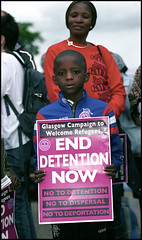
Our national disgrace: The detainees wrongly held in UK 'prisons'

End Detention NowImage by Gareth Harper via FlickrSource: The Voice

By Merissa Richards

Hundreds of black people are currently being held in immigration detention centres - some have been held for several years. So, how fair is our system of deportation? Merissa Richards spoke to detainees, campaigners and the UK Border Agency.

The coalition Government announced recently that they will be closing down the family wing at Yarl's Wood detention centre in Bedfordshire, where in controversial circumstances women and children awaiting deportation from the UK are held.

While the move has been welcomed by immigrant welfare organisations, there is still a great deal of concern over the numbers of people being held in detention while their right to stay in Britain is being examined. There is also disquiet among lawyers and campaigners that many of those in detention are being held illegally and have a clear right of abode in the UK, and many have mental health issues or are victims of torture – grounds which should legally stop someone from being held in detention.

Earlier this year, a freedom of information request by the BBC as to the extent of compensation payouts made by the Government to those found to be held illegally, was refused. However, former immigration minister Phil Woolas admitted that millions of pounds had been paid to migrants for wrongful detention.

A survey of solicitors by the BBC found evidence of payments totalling at least £2m. According to the BBC in the past three years five legal firms have won compensation for a total of 121 individuals. In one case a Congolese family were paid £150,000.

There are currently around 2,800 people in detention, of which over a third are of African or Caribbean origin. Last year a total of 1,065 were deported to Africa and the Caribbean. Many detainees have claimed that they are being unlawfully detained and in some cases wrongly refused asylum, with the tacit support of immigration lawyers who they claim do little to help them.

In many cases those held in detention centres have been convicted of a criminal offence and, therefore, their cases arouse limited public sympathy and support.

During The Voice’s own investigation we came across one detainee who had been held for three years while his case was investigated. Someone being held in prison-like detention for three years without a trial or conviction may shock many Britons unaware that this is going on right now in this country.

In France, a gay asylum seeker tells why he fled Cameroon

Source: Yagga.com

By Audrey Banegas

Google translation

Stephane M is a young Cameroonian of 24 years. In March 2010, he has been arrested in a hotel in Douala with two friends, for homosexuality. A crime in Cameroon, punishable by sentences of up to five years in prison. Stéphane should be judged on Monday August 9, but he chose to seize an opportunity presented to him to come to France - just days before his trial - and seek asylum.

Stephen has agreed to give her testimony, tell his story, his arrest, his trial, his life as a young gay in Cameroon, between assaults and death threats, and his arrival here on French soil, his application for asylum

Tell us your story.

I was arrested, questioned in my country, in the lobby of a hotel with two friends, one Australian and one Cameroonian, by plainclothes police. It was March 26, a Friday, around noon. We were driven to the border police when they tried to force us to admit that we had had dealings with the Australian. They told us that if we confessed they would release us and that charging the Australian. We have not sold. We knew they also charged us.

They also asked us to pay five million CFA francs, or around 8,000 euros for not sending the case to court. As we refused to pay and that we had with the Australian report, about 18:30, they took us to the police where we were kept three days without minutes, without being heard.

Maldives... the sunny side of life?

Photographs from MaldivesImage via WikipediaSource: Rainbow Maldives

A deft slogan no doubt for a website promoting tourism to the Maldives, but not everyone will have the priviledge to see the sunny side of it, especially those seven locals who got arrested in December of 2009 for suspected homosexuality activity. In Maldives homosexuality is a crime and apparently the sun doesn't shine favourably on everyone.

The following is taken from the ILGA report of 2009 regarding countries where being gay is a crime persecuted by law:

'The Penal Code of Maldives does not regulate sexual conduct. It is instead regulated by uncodified Muslim Sharia law, which criminalises homosexual acts between both men and between women. For men the punishment is banishment for nine months to one year or a whipping of 10 to 30 strokes, while the punishment for women is house arrest for nine months to one year. There have been reports of women being sentenced to a whipping as well for lesbian acts.'
I should add the Maldives was also one of the 57 UN countries which not only opposed a statement for the decriminalization of homosexuality presented to the UN General Assembly on 18 Dec 2008 on the intitiative of France, but signed an opposing statement (backed mainly by Muslim countries), which saw the issue as mainly an internal affair and the legitimization of homosexuality as leading to deplorable acts such as paedophilia (the old rotten chestnut).
Enhanced by Zemanta

Saturday, 28 August 2010

UK legal aid cuts - Fiat justitia ruat caelum

law lawImage via WikipediaSource: Migrants Rights Network

Fiat justitia ruat caelum is a Latin legal phrase, meaning "May justice be done though the heavens fall."

By Jan Brulc

In the weeks before Refugee and Migrant Justice (RMJ) went into administration, Migrants' Rights Network sent a letter to the Ministry of Justice (MoJ), highlighting some of the issues that cropped up in the process leading to the closure of RMJ, mostly related to the Legal Aid reform and the new system of payment of legal aid to organisations representing their clients.

It wasn’t till recently that we received a reply from Ministry of Justice. The letter we've sent to them was based on the template RMJ communications team circulated among their contacts. So, I would imagine that everyone else who took the time to write to Kenneth Clarke (we haven’t heard back from Mr Damian Green, and it seems that emails sent to the Government don't oblige them to write back), got a similar reply. And for that reason, it is worth dissecting a few statements from the letter.

Let's begin with this: “Though some initial disruption is unfortunately inevitable [with the transfer of work to new service providers], every effort will be made to minimize this.”

Two days ago a statement from the Legal Service Commission (LSC) confirmed that of the 12,500 live cases handed to them after the closure of RMJ, all had now either been marked as closed by the LSC staff or transferred to another provider. Sounds good, except that it's not. It was the death of Osman Rasul in the beginning of August, that made it abundantly clear that the transfer was not a smooth process. Far from it and the background on the case of Mr Rasul highlights this. Mr Rasul had needed to pursue his application to remain in the UK through an appeal. And while more than 1,300 asylum appeals were successful in the first quarter of 2010 alone, these are extremely costly and asylum seekers are regularly turned away by their legal representatives, because the work isn’t profitable.

Uganda’s First Lady promotes youth hatred of gays, yet wonders why the educated flee

Source: Truth Wins Out

By Michael Airhart

Ugandan First Lady Janet Museveni — longtime ally of The Family and genocidal pastor Martin Ssempa — cautioned 8,000 youths at a convention 9 August against promoting tolerance of homosexuality.

From AllAfrica.com:
“In God’s word, homosexuality attracts a curse, but now people are engaging in it and saying they are created that way. It is for money The devil is stoking fires to destroy our nation and those taking advantage are doing so because our people are poor,” she said. Mrs. Museveni advised the youth not only to listen to messages on how they can make money but also focus on spiritual growth. “You know that you will lose everything else when you lose your soul.”
Uganda’s tribal and sexual hatreds, the corruption of its despotic leadership, and its suppression of creativity and individuality lead many graduates to flee the country at the earliest opportunity.

Instead of correcting these social ills for which she and her husband are responsible, the First Lady accused expatriates of selfishness.

[Museveni] also decried what she called selfishness of especially the educated who leave the country as soon as they are educated by the same nation.
“They bite the hand that fed them and they appease their consciences by blaming whichever government is there. These are a few of the ills that have beset our nation. We need to consciously make our minds to succeed,” she said.
Enhanced by Zemanta

Friday, 27 August 2010

Newsflash! UK Border Agency keep getting it wrong

Source: Refugee Action

In response to the Control of Immigration Statistics 2009 and Quarter 2 2010, released by the Home Office today, Dave Garratt, acting Chief Executive of Refugee Action, said [our emphasis]:
"We are concerned that the latest figures show that one in four initial asylum refusals is later found to be wrong at appeal. For certain nationalities, such as for people from Somalia, this figure rises to 1 in 2. We are particularly concerned that this comes at a time when the government is planning to make cuts to legal aid for asylum appeals.

"The review of legal aid, coupled with the latest fall in asylum applications, is an opportunity for the government to push forward with its commitment to getting decisions right first time. Providing asylum seekers with good quality legal advice as early as possible will help to achieve this. In turn, this would significantly reduce the number of cases which go to appeal and thereby represents a clear opportunity to make significant savings."


Enhanced by Zemanta

In India, no activists for poor gay men

Source: Express News Service

By Ashley Tellis

It has been more than a month now since news broke of Irfan trying to commit suicide by self-immolation. Irfan is the rikshawalla who went home with Prof Siras on the day he was illegally filmed having consensual sex with Siras at his house after which the latter was suspended from the Aligarh Muslim University (AMU).

Siras was subsequently found dead and the case is still under investigation as it is not clear if it was murder or suicide. Instead of interrogating the allegedly corrupt and sick Vice Chancellor of AMU, the various officials involved in the so-called ‘sting operation’ and the hypocrites and cowards in AMU, the police have been consistently harassing this rikshawalla. They have taken him into custody over three times now (though there is no FIR or anything against him) and beat him severely.

Irfan’s desperation at this continued harassment and abuse forced him to attempt to end his life. His wife saved his life and reports say his only crime was to have sex with Siras in an attempt to make some money.

The classist and elitist nature of the so-called queer movement becomes clear here. Where are the emails expressing outrage at the harassment of Irfan? Where are the online campaigns collecting signatures in support of Irfan? Where is the fact-finding committee on the harassment of Irfan? Where are the NGOs who work with MSMs (surely Irfan qualifies as one) when they are needed to protect a poor rikshawalla from being systematically tormented by the police?

In South Africa, LGBT refugees face xenophobia

Source: South African Broadcasting Corporation

By: Kabelo Mhlambiso

Gays and lesbians from outside South Africa who stay in the country say they fear double stigmatisation and violence in the wake of xenophobic threats that after the 2010 FIFA World Cup all foreigners would be sent packing.

Hugo Withakenge Murphy 31, a bisexual man from the Democratic Republic of Congo who stays in Johannesburg CBD, says even though he has only faced minor cases of hate speech particularly when using public transport, he fears that one day he may speak the wrong language at a wrong place.

“I feel that people like us who stay in urban areas do no face half the issues of xenophobia and homophobia like our brothers and sisters who stay in townships. But you never know who you may piss off just by speaking your home language.”

Meanwhile *Sipho Mvelase a gay man who is a South African citizen says xenophobic attacks of 2009 cost him his 2 year relationship since his ex partner, originally from Zimbabwe, left him fearing for his life.

“He told me that he does not trust any South African and that he feels really unsafe around me. He was even reluctant to be seen with me in public since I am noticeably gay, fearing that he will suffer attacks both for being a foreigner and for being a homosexual. Having seen the images in the media of foreign people being burnt to death, he left me for good.”

Thursday, 26 August 2010

The Foreign Office and LGBT human rights: fake concern from shameless Labour

David Miliband, the current Secretary of State...
By Paul Canning

Labour really is shameless in hoping we'll all forget the gaping, gigantic, ginormous gaps in its LGBT record isn't it?

On asylum it's taken months before one solitary leader has acknowledged their appalling record - something completely and deliberately ignored during the election campaign in favour of a 'forget that, look over here' approach of 'keep pointing at the domestic legislative record' and 'yell loudly whenever some odd right-wing Tory 'misspeaks''.

On LGBT rights overseas, as I've documented, under Labour it was all about EU members with the occasional stretch to Africa and never about the world's biggest LGBT rights catastropy - Iraq. During the election the leading contender for the leadership David Miliband even told someone to shut up about Iraq during an LGBT event. The international record for Labour is actually thin, weak and late but you wouldn't know it from them banging on about it. What Hillary Clinton has done in less than two years puts their 13 to shame. Or rather it should.

Now LGBT Labour is joining in with Amnesty International amongst others blasting William Hague's Foreign Office on the new government's record internationally on human rights in general and LGBT specifically. The reason? Because of the generalised cost-cutting effort, they're looking at stopping publishing the annual human rights report as a glossy brochure and instead just publishing it online.

That's it. That's the big 'sell out'.

Jamaican says Gay Games provide escape from homophobia

Source: Deutsche Welle

By Andrew Bowen

As the shot rang out in the stadium, three men took off in the first heat of the 200 meter qualifiers, age group 45 to 49, at the eighth quadrennial Gay Games in Cologne. Seconds after the start, James had already taken the lead and he eventually crossed the finish line well ahead of his opponents.

"He is our personal Usain Bolt in Cologne, 29.05 seconds," shouted the announcer to a cheering audience.

James, whose name has been changed to protect his anonymity, is from Jamaica, the sprinting capital of the world. He later told Deutsche Welle it was his fastest 200-meter time ever.

'Free to be me' campaign call for UK LGBT asylum seekers

By Paul Canning

One of Britain's oldest refugee campaigning groups has thrown its weight behind LGBT asylum seekers.

Refugee Action, founded in 1981 to provide a "radical new approach towards the successful resettlement in the UK of refugees and asylum seekers", has launched the 'Free to be me' campaign. It is calling for the government to 'follow on' from July's Supreme Court decision which nullified government policy that told asylum seekers to 'go home and be discrete'.

The campaign wants proper training for UK Border Agency (UKBA) decision makers, saying that the process LGBT asylum seekers are subjected to is often "unfair and degrading". They say that the methods employed for asylum seekers to 'prove' their sexuality are often "stereotypical and offensive". As a result, many are wrongly assessed, they say.

Stonewall's report on LGBT asylum, released in May and based on interviews with both asylum seekers as well as UKBA workers, documented the lack of knowledge around sexuality in the 'global south' and included pleas from many UKBA workers for better information and training. We've reported on the 'country information' supplied to those workers is often partial or even misleading.

One UKBA senior caseworker is quoted in Stonewall's report as saying that in order to decide if an asylum applicant was gay, "I would look at how they've explored their sexuality in a cultural context - reading Oscar Wilde perhaps, films and music."

It also quotes a Nigerian asylum seeker's experience:
They ask about who you have sex with, how many people and how many times. When you've never told anyone and now you have five people asking you questions about this - I found it difficult to talk about.
An anonymous UKBA worker commentating on the freemovement blog's coverage of the Supreme Court decision said:
Now it’s down to the hard task of testing peoples sexuality, I am terrified to see what sort of questions the interviewers come up with….. Who is Dorothy?….. Is Lady Gaga a man?….. And of course following on from Lord Rodgers comments any man who can’t describe what Kylie was wearing at her last concert in great details or at least provide his ticket stubs will be disbelieved.
Refugee Action say that
Currently, Home Office officials don't understand that:
  • If you've had to cover up being gay all your life, evidence of previous relationships is not easy to prove.
  • You might be too scared to say you're gay at your first interview. If you've fled torture for being gay, being open with officials will be a terrifying ordeal.
  • Even where same-sex relationships aren't illegal. people are cast out by their families, forced into marriages or violently attacked.
What they're asking is that UKBA staff should be properly trained in the law, culture and everyday practice that influence an LGBT person’s ability to live freely and safely in their country of origin. The campaign's theme is:
Living freely and safely is everyone’s right. It’s time to put an end to double standards.
Campaigns officer Sara Ayech says that over 500 people have already taken the action online and when they took the campaign to Brighton's LGBT Pride event earlier this month another 200 people signed the action card.


This Saturday they'll be at Manchester Pride.

After three months in captivity, Syrian gay men released

Coat of arms of Syria -- the "Hawk of Qur...Image via WikipediaSource: change.org

By Jordan Rubenstein

In March and April, the Syrian government raided more than four private gay parties and arrested 25 young gay men in attendance at the parties. Most of the men were charged with “having a homosexual act,” and some were charged with organizing illegal obscene parties or encouraging homosexual acts.


Syrian law clearly states that engaging in homosexual activity is illegal. Article 520 in the penal code of 1949 prohibits “carnal relations against the order of nature” with a penalty of three years in prison.But does a law against homosexuality really excuse raiding private parties? These men were attending a party behind the closed doors of one of their homes. The Syrian government put men at extreme risk without adequate reasoning to lock them up in the first place. In Syria, the stigma against homosexuality is so bad that the men are now ostracized from their communities.

For three months after the incident, all of the men remained in police custody because their families would not bail them out. Luckily, the men were released from police custody last Thursday. The Syrian authorities released the men without a trial because the Syrian authorities were embarrassed by the attention drawn by the arrests.

Wednesday, 25 August 2010

Why American LGBT should defend the 14th amendment

Lincoln Memorial Lincoln_MemorialImage via WikipediaSource: The Advocate

By Rachel B. Tiven

COMMENTARY: Don’t know much about history, do they?

That’s a sad statement to make about the U.S. Congress, but evidently a true one, given the recent pile-on of Republican senators calling for repeal — or “investigation” — of birthright citizenship. Senate majority leader Harry Reid noted that his colleagues have “either taken leave of their senses or their principles.”

In fact, they may have taken leave of both, as their ridiculous, racist campaign betrays a basic misunderstanding of American history and of the Constitution.

First, a quick history lesson: Before the Civil War, there was no definition of American citizenship. Slaves were not citizens, and women’s citizenship was tenuous at best. A woman who married a foreign national could be stripped of her citizenship, and of course, women, slaves, and most nonwhites could not vote. Neither the Declaration of Independence nor the U.S. Constitution, as originally ratified, defined who was an American citizen or how to become one. The Supreme Court’s infamous Dred Scott decision — which brought pre-Civil War tensions closer to a boil by holding that Congress could not prohibit slavery in federal territory — reaffirmed that “Negroes” were not and could not be citizens.

For slaves, the needed result of the Civil War was not just freedom from bondage but entry into the social contract. Freedom without citizenship was an empty promise, and thus 2-1/2 years after the Thirteenth Amendment ended slavery, Congress ratified the Fourteenth Amendment.

Finally some humility from a Labour leader on LGBT asylum

Ed Milliband MP speaking at the Labour Party c...By Paul Canning

Ed Miliband has become the first Labour Party leadership candidate to come out and criticise the government he was part of for its treatment of LGBT asylum seekers.

Writing for pinknews.co.uk he said:

I also believe we needed to show greater leadership on the question of those seeking asylum because they face persecution in their home country because of their sexuality. The fact that many forced to return to their home country were advised to be "discreet" is tantamount to an admission that the system recognised the dangers of their forced return but did too little about them. I don’t believe the answers are easy but we must find them even when they are difficult. My family fled persecution by the Nazis and I will always speak out for the protection of gay and trans people fleeing abuse and against persecution around the world.
His brother David, who is currently slightly leading Ed amongst pundits as the expected winner of the leadership campaign (and is also the descendant of asylum seekers), has by contrast been all over the place: during the election the issue was ignored or treated with indifference (here he was following the strategy of LGBT Labourites); when questioned in government he advanced the same bizarre line of 'pride' in Britain's treatment of LGBT asylum as that advanced by notorious anti-migrant and tabloid approval seeker the Labour Minister of State for Borders and Immigration Phil Woolas.

When given the opportunity in July to agree that 'Labour had let down gay supporters in this area', he refused to criticise the government he was in.

Asked in that interview about the Supreme Court decision which eviscerated the government LGBT asylum policy of 'go home and be discrete' he claimed not to know of it and gave the same stock response as other then and now former Ministers, including Gordon Brown, have ("I think the whole point is that [things are done] on a case by case basis"), a spin line which ignores the existence of Labour's 'discretion' policy, as advanced by them to the Supreme Court (or homophobia in the UK Border Agency for that matter).

Yet one month before in an online question-and-answer session he was asked whether "telling [LGBT asylum seekers] to ‘keep it a secret’ .. is a surrender and degrading to the individual?"

David Miliband typed:
We should stick to our international obligations – no ifs not buts.
This was the very point on which the Supreme Court decision hinged! His answer surely suggests that he knew this yet a month later he'd somehow forgotten that 'telling people to ‘keep it a secret’' was policy and fell back to the rote answer.

Of the other leadership candidates only Diane Abbott has a record of defending asylum seekers including LGBT ones and has criticised the Labour government's treatment of them during the leadership campaign.

Enhanced by Zemanta

How EU integration bars the persecuted from finding refuge in Europe

European countries according to the EUImage via Wikipedia

Source: guardian.co.uk

By Les Back

The European commission's enthusiasm for "diversity talk" is connected to an admirable yearning to see Europe as a place of refuge to those facing persecution.

The desire for a more integrated Europe is in part a response to the shadow that Nazism cast over the ideals of European civilisation. But the experience of those seeking asylum in Europe today is closer to this past than many in Brussels would find comfortable.

Recent years have seen a convergence by centrist governments in western Europe with regard to migration policies, including the Lisbon treaty, the returns directive and the proposal for a European blue card. Taken together these shifts have effectively hardened the attitude of European states on the issues of border control.

African Anglicans park tank on Archbishop Williams' foot

Brian made this picture while Rowan Williams, ...Image via Wikipedia

Source: guardian.co.uk

By Andrew Brown

The Archbishop of Canterbury's presence in Kampala is an occasion for diplomacy. His host, Archbishop Henry Orombi of Uganda, has gone further than almost any other senior Anglican in formally denouncing him as a heretic. The Ugandan church is deeply implicated in a bill that would introduce the death penalty for homosexuals.

Homophobia is here a recognised tool in church intrigues: Pastor Robert Kayanja, one of the most successful prosperity gospel preachers in Kampala was last year accused of being gay by rivals who kidnapped and may have tortured one of his assistants to prove this.

Yet the links between Ugandan and English churches are close and in some cases personal. The Archbishop of York, John Sentamu, was born there, and only came here as a refugee from Idi Amin's tyranny.

In fact Robert Kayanja, the accused pentecostal preacher, is his half brother. Sandy Millar, the founder of the Alpha Course, and the epitome of an upper-class Anglicised Scot, was consecrated as a missionary bishop in the Church of Uganda when he retired as rector of Holy Trinity Brompton. That gesture looked at the time like a parking of tanks on Rowan's lawn, but Orombi's view is that liberals have no lawns.
"[The] Time is now for 'African Anglicanism' to rise up and begin to bring fresh life in 'the ailing global Anglicanism'"

Tuesday, 24 August 2010

From Baghdad to Brooklyn: following a gay Iraqi refugee’s quest for asylum

By Jennifer Utz

In the fall of 2006, I journeyed to the Middle East as an independent journalist to cover the growing Iraqi refugee crisis. At the time, one in five Iraqis had left their homes. With nearly four million people displaced, it was the largest refugee and displaced persons community in the world.

I soon realized no one was immune from the dangers that faced Iraqi citizens. However, one specific group seemed to be under particular risk -- members of the lesbian, gay, bisexual, transgender (LGBT) community.

In the fall of 2005, Grand Ayatollah Ali al-Sistani had called for the killing of homosexuals "in the worst, most severe way possible." As a result, a spate of brutal attacks against homosexuals began throughout the country. Gay men and women were systematically targeted and sometimes stoned to death in the streets, a story almost completely ignored by the media.  I met one gay man who had fled after he stepped outside one morning to find the severed head of a male victim (presumably that of another gay man), also with a note attached – "Get out of town poppy."

Another young man, 24 year-old Mohamed, had left his Baghdad home after a note had arrived on his front door reading "If your gay son doesn't leave the country, we'll kill the whole family." He told me he considered himself lucky – "at least they warned me." His mother put him on a plane two weeks later.

[Video clip below the fold]

Asylum seekers win new strength to fight after Yarl's Wood hunger strike

Source: guardian.co.uk

By Karen McVeigh

The government's recent announcement that it would close the family section of the Yarl's Wood immigration centre as part of its plan to end child detention was universally welcomed; MPs, children's groups and human rights groups had long condemned the "moral outrage" of locking them up. But it gave scant comfort to the women detained in the complex's remaining three wings, many of whom have spent long periods separated from their children.

Six months after the start of a hunger strike by up to 70 women at Yarl's Wood, to highlight what they say was unfair and degrading treatment, the Guardian has spoken to several of those who took part.

They are fighting a legal battle to gain official recognition that the protest even took place – something the Home Office and the private security firm which runs the Bedfordshire facility dispute – and to secure an inquiry into their allegations of violence and racial abuse by guards.

Behind the locked doors of the prettily named Avocet, Bunting and Dove wings in Yarl's Wood are many extremely vulnerable women, among them victims of torture and rape, and those who have fled domestic violence, destitution or both.

Seven people spoke to the Guardian, all but one of them mothers, whose children were mainly either British-born or had spent most of their lives here.

Mauritius: kidnapped to "cure" their homosexuality

An enlargeable basic map of MauritiusImage via WikipediaSource: Tetu

Translation by F Young

Introduction by Nicholas Ritter of Collectif Arc-en-Ciel:

Although LGBT issues are evolving in the right direction in Mauritius, it takes time. Mauritius is a VERY conservative country and also VERY religious. Therefore parents who learn that their child is gay rarely accept it and act sometime like barbarians.... Thanks to the courage of those girls and the media support this strory finished with a happy end. Thanks God we are still in a democracy even if sometime its smell like banana....


By Habi Bangré

Some families arrange the kidnapping of their own child to put an end to homosexual love. A practice that the Collectif Arc-en-Ciel fights on the spot as best it can.

On June 6, Shalima’s life was radically changed. The 20-year-old Mauritian was violently abducted right before her friend’s eyes and confined for over a week in her parents’ house. "My loved ones never accepted my sexual orientation, and by abducting me, they quite simply wanted to take me away from the woman I love," said Shalima to local newspaper KotZot News.

In the Indian Ocean island of Mauritius, sodomy is prohibited and society is intolerant of gay and lesbian relationships. "We've already had a case where a young girl was abducted on the beach by her parents and confined in the same way [as Shalima], or where a young girl was locked up in a psychiatric hospital and physically threatened by her family. But for every one who has the courage to testify, how many cases are kept quiet?” asks Nathalie Ahnee, President of the Collectif Arc-en-Ciel (“rainbow collective”) local association.

The police are not always cooperative. In the case of Shalima, "the police refused to take the complaint of her friend who had witnessed the abduction (...) arguing that there was nothing to prosecute, even trying to discourage and upset this young woman," said Nathalie Ahnee. Then, they did not take it up as a case of someone having been kidnapped and being held, disregarding the notion of "failure to assist a person in danger" and claiming that the parents had the right to act this way as they were her parents."

Monday, 23 August 2010

UK asylum seeker takes his own life after losing legal aid

Source: guardian.co.uk

By Owen Bowcott and Natalie Hanman

For two hours Osman Rasul perched on railings surrounding the seventh floor balcony of a Nottingham tower block. He blanked out police officers attempting to talk him down and at 7pm last Sunday, placing his hand on his heart, he looked up to the sky and leapt.

The 27-year-old Iraqi Kurd, classified by the local refugee centre as a "destitute asylum-seeker" and in a fraying relationship with the mother of his two children, had lost the legal aid he needed to pursue his application to remain in the UK. A trip south to confront Home Office immigration officers in Croydon saw him being turned away and told to find a solicitor.

Nine years of legal limbo, his friends suggested, had induced mounting desperation. Rasul anticipated deportation and all hopes of a life in Britain had evaporated by the time he jumped from Clifford Court tower. The waiting ambulance carried his body to the Queen's Medical Centre. At 7.21pm he was pronounced dead.

Iraq: The war against sexual minorities continues

Iraqi Police patrolImage via WikipediaSource: Iraqi LGBT

You don’t even need to be gay or lesbian in Iraq to be in mortal danger from the Iraqi Police force. The latter have been mounting an aggressive campaign against anyone who is merely, by rumour, suspected to be gay or lesbian.

The Iraqi Lgbt network of activists inside Iraq have collected new and alarming reports of attacks on the LGBT communities during the month of July. Since June there have been consistent raids on Iraqi LGBT’s safe houses as well as harassment, abuse and assaults on gays, mostly by the Iraqi police. This trend seem to be intensifying now in frequency and brutality. It seems that Iraqi gays are systematically targeted and killed by the Iraqi police as well as suffering from increased homophobia, no doubt intensified by the authorities’ negative campaign.

On the 5th of July, in the city of Nasiriyah, south east of Baghdad, eye witnesses members of the Iraqi LGBT network, reported that three gay men were seized, beaten and taken handcuffed into a vehicle belonging to the Iraqi ministry of interior. The three gay men were deliberately targeted and forcibly removed from within a group of up to 9 other men. This is a clear and new proof that the Iraqi authorities continues it’s witch hunt campaign by identifying gay men on checking points when they have selected these three men who were not seen or heard from since their brutal arrest.

On the 8th of July in the city of Al Kut two men which were well known as gay in the community were surrounded and beaten up by a group of thugs for allegedly wearing trendy clothes. Eye-witnessed by a friend of the Iraqi LGBT network, the men were seriously wounded and their present condition is unknown.

Sunday, 22 August 2010

Report: Present UK legal aid system acts to disincentivise quality

Poor pay sees lawyers stop legal aid workImage by publik16 via Flickr


While it is clear that quality work costs, this review has found evidence that poor quality work costs much more in the longer term both to the public purse and in human terms to individual asylum applicants. The LSC's Graduated Fee Scheme pays for legal aid work through a series of fixed fees. The evidence suggests that these fixed fees, combined with the low threshold level of quality at which legal aid providers can enter and operate in the UK market for asylum advice, may be designed to incentivise efficiency but in fact are likely to cost more in the long term.

The quality of legal representation is of paramount importance to asylum seekers whose cases routinely raise issues of life and liberty. This report, part of a research project looking at the costs of providing quality legal representation, outlines new findings that show the present legal aid system acts to disincentivise quality.

This report draws together original research, including interviews with stakeholders and refugees, a preliminary analysis of a file review exercise, together with a review of existing evidence. The report starts by identifying the key elements of high quality legal representation in asylum work drawing these together into a definition that will be used to identify how much high quality legal work costs to deliver. The research then establishes the key role that quality legal representation has to play in a cost effective decision making system. It then argues that the present LSC funding system acts to prevent quality provision.

The first report in this research project concluded that spending sufficient time to exercise knowledge and expertise and build a good relationship with the client is an essential ingredient to quality. It also pointed to evidence that quality work is more likely to achieve early resolution of the case, saving money in the long term.

A preliminary analysis of the file reviews conducted as part of this research shows a correlation between cost and quality and between quality and successful outcomes. Interviews with legal representatives, Home Office and judicial stakeholders suggest that quality appears to be suffering: for example, critical witness statements in adult cases have now become a rarity: it appears that only representatives committed to quality work continue to prepare them.

All providers who reach a minimum level of quality are currently paid an identical fee under the Graduated Fee Scheme, reducing the incentive to strive for high quality, in effect penalising those firms that do, and forcing the choice between financial survival and responsibility to their clients.
Enhanced by Zemanta

Iranian security forces threaten Iranian refugees in Turkey, says report

Coat of arms of the Islamic Republic of Iran. ...Image via WikipediaSource: Hürriyet Daily News

Iranian refugees in Turkey who have recently emigrated for political reasons are more vulnerable than Iraqi and Afghan refugees, according to a report. Security forces from Iran have often entered Turkey to pursue and terrorize asylum-seekers, said the report prepared by OMID Advocates for Human Rights.

The possibility of encountering Iranian security forces creates fear, suspicion and anxiety within the refugee population in Turkey said the report entitled “Report on the Situation of Iranian Refugees in Turkey.”

An OMID delegation interviewed Iranian refugees and asylum seekers as well as organizations to help these migrants in Turkey.

“Two refugees reported to the OMID’s delegation that they had been assaulted by Farsi-speaking men. Another refugee reported being questioned and threatened while in the hospital by representatives of the Iranian government stationed at a consulate in Turkey,” said the report.

Saturday, 21 August 2010

In Canada, gay Jamaican wins refuge

Coat of arms of Jamaica.Image via WikipediaSource: Toronto Sun

A openly gay man who is married to his partner has won a bid for refugee status due to concerns his life may be in jeopardy if he is deported to his native Jamaica.

Marlon Cunningham, 45, who lives in Toronto, had his refugee case thrown out in September 2009 after a member of the immigration and refugee board failed to consider all the evidence at his hearing.

Cunningham filed an appeal to the Federal Court of Canada and was granted another hearing last week.

Justice Frederick Gibson said the IRB member didn’t consider information on the treatment of homosexuals in the Caribbean.

The member “erred in discounting reports of violence against homosexuals in Jamaica,” Gibson said in his decision.

“The failure to consider relevant evidence would be sufficient to grant a judicial review,” he wrote.

Cunningham married a fellow Jamaican in July 2009 and is active in the Jamaican-Canadian community, court heard.

“He faces risk if returned to Jamaica,” Gibson wrote.

He said a failure to acknowledge new evidence or take it into account can lead to Cunningham facing “a personalized risk of persecution or a risk to his life.”

He faces “cruel and unusual treatment or punishment if returned to Jamaica,” the decision said.

The board has recognized that gay men and women are targeted in Jamaica.

Enhanced by Zemanta

Video: Iranian lawyer Mohammed Mostafaei talks to Amnesty International


Iranian justice system 'in tatters'

Audio: Gays' global search for acceptance

Source: NPR

Discussion by Tony Cox on 'Talk of the Nation' on 'Gays' Global Search For Acceptance'. With Gregory Branch, correspondent, GlobalPost.com, Andrew Meldrum, senior editor for Africa, GlobalPost.com and Rachel Tivens, executive director, Immigration Equality.

Around the globe, men and women are being punished, sometimes with death, because of their sexual orientation. A recent study by the International Lesbian, Gay, Bisexual, Trans and Intersex Association reveals that it is a crime to be gay in 76 countries. As a result, many gays live in constant fear or become refugees fleeing for their safety.

Some nations are now considering whether sexual orientation is grounds for political asylum. Today, we're going to talk about gay and lesbian rights in countries other than the United States.

Friday, 20 August 2010

Cross-dressing men flogged in Sudan for being 'womanly'

Coat of arms of Politics of SudanImage via WikipediaSource: BBC

A group of young Muslim men have been publicly flogged in Sudan after they were convicted of wearing women's clothes and make-up.

The court said the 19 men had broken Sudan's strict public morality codes.

Police arrested them at a party where they were found dancing "in a womanly fashion", the judge said.

The men were not represented in court and said nothing in their defence, some hid their faces from the hundreds of people who watched as they were lashed.

The sentence of 30 lashes was carried out as soon as the court in Omdurman, near Khartoum, gave its ruling.

They must also pay fines of as much as 1,000 Sudanese pounds ($400, £252).

One lawyer, who did not want to be named, told Reuters news agency the men had not received a fair trial.

"These people did not get a chance for justice, public opinion and the media prejudged them and lawyers were too scared to come and defend them," he said.

Newspapers had called the party a "same sex wedding".

Northern Sudan is governed by Sharia law, under which homosexuality is illegal.

Laws governing "indecent clothing" were highlighted by a case last year in which a female journalist was sentenced to be flogged for wearing trousers.

The sentence was commuted to a fine.

Homosexuality is not tolerated in Southern Sudan either, where most people are Christian or follow traditional beliefs, the BBC's James Copnall says.

South Sudan President Salva Kiir recently told a radio station that homosexuality was an "imported" idea.

"It [homosexuality] is not in our character. It is not there and if anybody wants to import it to Sudan it will always be condemned by everybody," he said.

Enhanced by Zemanta

Egptian lesbian refused US asylum

Seal, United States Court of Appeals for the T...Image via WikipediaSource: Leagle

Paul O'Dwyer, an immigration attorney in New York specializing in asylum law, comments that:

She wasn't actually refused asylum, she wasn't eligible to apply for it because of her criminal convictions. What she applied for, and was denied, was permission to remain in the US on the basis that she would be tortured by the Egyptian government. Those cases are a lot more difficult than asylum cases, and it seems that her evidence was not very strong, which is unfortunate. However, I would not read much more into the decision than that.
~~~~~~~~~~~~~~~~~~~~~~~~

BADAWY v. ATTORNEY GENERAL OF U.S.
SALAMA RABABA BADAWY, Petitioner,
v.
ATTORNEY GENERAL OF THE UNITED STATES, Respondent.
No. 09-3300.
United States Court of Appeals, Third Circuit.
Submitted Pursuant to Third Circuit LAR 34.1(a) August 4, 2010.
Opinion filed: August 6, 2010.
Before: FUENTES, VANASKIE and VAN ANTWERPEN, Circuit Judges.
NOT PRECEDENTIAL
OPINION
PER CURIAM.

Salama Rababa Badawy, a citizen of Egypt, was admitted to the United States in July 1978, at age 3. In September 2007, she was convicted in New Jersey of possession of a controlled dangerous substance with intent to distribute. See N.J. Stat. Ann. §§ 2C:35-5b(10)(b); 2C:35-7. Badawy was charged with removability for having been convicted of an aggravated felony as defined in Immigration and Nationality Act ("INA") § 101(a)(43)(B) [8 U.S.C. § 1101(a)(43)(B)] (illicit trafficking in controlled substance), see INA § 237(a)(2)(A)(iii) [8 U.S.C. § 1227(a)(2)(A)(iii)], and for having been convicted of a controlled substance offense, see INA § 237(a)(2)(B)(i) [8 U.S.C. § 1227(a)(2)(B)(i)]. Badawy conceded that she was removable as charged and sought relief under the United Nations Convention Against Torture ("CAT"), alleging that she will be tortured or killed in Egypt because she is a lesbian and because she has two children born out of wedlock, visible tattoos, and a criminal record involving drugs.

Despite "recogniz[ing] the weakness" in Badawy's CAT application, the Immigration Judge ("IJ") granted relief. Specifically, the IJ concluded that Badawy's "characteristics," when considered in conjunction with other "factors" that were specifically related to her, made it more likely than not that she would be subject to torture if removed.[ 1 ] This determination was based in part on In re G-A-, 23 I. & N. Dec. 366, 372 (BIA 2002), where the Board of Immigration Appeals ("BIA") granted CAT relief to an Iranian Christian of Armenian descent who had lived in the United States for over 25 years "based on the combination of factors presented, including [the applicant's] religion, his ethnicity, the duration of his residence in the United States, and his drug-related convictions in this country." The Government appealed.

Thursday, 19 August 2010

Australia refuses gay Pakistani asylum

Courtroom 1 in the High Court in Canberra.Image via WikipediaSource: Australian Policy Online

By David Hume

On 26 May 2010, a divided High Court set a high bar for those seeking to challenge refugee decisions on the basis that they are irrational or illogical. In ordering that a decision of the Refugee Review Tribunal denying an asylum seeker a visa should stand, a majority of the Court said there was “room for a logical or rational person to reach the same decision”. The decision was, according to the majority, not “unintelligible”.

The proceedings in the case – Minister for Immigration and Citizenship v SZMDS (SZMDS) – took a familiar path. A decision denying a visa was appealed up to the High Court at which point the asylum seeker lost.

In 2009, 11 per cent (6 of 53) of High Court decisions involved immigration and asylum decisions made by the Minister for Immigration and Citizenship or his delegate. The Minister won all six. Fully 65 per cent – or 179 of 276 – of unsuccessful applications for leave to appeal to the High Court in 2009 involved the Government and an unsuccessful visa applicant. In other words, in 2009, out of 185 decisions involving the Minister for Immigration and Citizenship, the Minister won all 185.

The respondent in SZMDS was a citizen of Pakistan. In August 2007, he sought a protection visa in Australia on the grounds of his belief in and practice of homosexuality. The respondent said that he had become aware of his sexuality in a period between October 2005 and July 2007 when he had been living and working in the United Arab Emirates (UAE). Under the Migration Act, the respondent would be granted a protection visa if the Minister (or his delegate) were satisfied that the respondent was a refugee. That issue depended on whether the respondent had a well-founded fear of persecution in Pakistan.

Presentation: 'Over Not Out': LGBT asylum seeker housing and homelessness

Presentation to Double Jeopardy conference, London, 6th July 2010 by Sarah Walker and Dr Charlotte Keeble, Research and Consultancy Unit at Refugee Support, Metropolitan Support Trust.

'Over Not Out': housing and homelessness issues specific to lesbian, gay, bisexual and transgender asylum ...

UK asylum win for bisexual Ghanaian

By Paul Canning

The bisexual Ghanaian asylum seeker Baffour Obeng has been released from detention on the order of an Immigration Tribunal judge. According to the journalist Simon Lewis, who has been helping him, "the judge at the tribunal indicated that [his asylum] claim would be successful but Baffour is still awaiting official confirmation."

Lewis said that the judge cited the July Supreme Court decision which said that LGBT asylum seekers could no longer be told to 'go home and be discreet'. In previously ordering his removal using the 'discretion' argument the Home Office had admitted that there would be "no protection available [from authorities] if you were to experience problems on account of your sexuality."

Obeng has been in detention for six months. In June he had no solicitor and a removal flight was booked for June 13. But a campaign was started, the Home Secretary's office was flooded with faxes and emails, a solicitor found, the flight was canceled, and Baffour was told by the Home Office that his case would be "substantively re-considered".

Baffour traveled to Europe in 2005 with his father, who has Dutch citizenship, both escaping a particularly violent inter-family chieftainship dispute which claimed the lives of four people.

For the first time, in Europe Baffour was able to be open about his sexuality, and began a relationship with another man. In Ghana, this would have been extremely dangerous, as well as being illegal. However, his coming out also led his father and family to abandon him. Baffour thinks his father has returned to Ghana, but is unable to contact any of his family any more - they will not speak to him.

With no access to documentation of his father's European citizenship, which would have allowed Baffour the right to stay in the UK, he was placed in a detention centre and faced forced removal from the UK. This terrified him as friends in Ghana warned him that his "secret" is out, and that it would be very dangerous to return.

Homosexuality is illegal in Ghana and the local LGBT community operates at least one safe house to protect people from attacks. Blackmail and extortion is widespread. The US Department of State human rights report, published March 2010, says:
LGBT persons face widespread discrimination, as well as police harassment and extortion attempts. Gay men in prison are often subjected to sexual and other physical abuse. The law makes consenting homosexual acts a misdemeanor, and strong sociocultural beliefs discriminate against and stigmatize same gender sex.
A prominent heterosexual supporter of LGBT in Ghana, Nana Oye Lithur, recently was not appointed to represent Ghana on the African Union's Commission on Human and People’s Rights (ACHPR), it is thought because of her support for LGBT.

Baffour told NCADC:
Without your help they would have send me already. Thank you so much to all the people who support me. It's rough inside, but it helps to know people are campaigning. Now please help others in this situation, there are too many needing help.

Wednesday, 18 August 2010

Hate crime in Azerbaijan’s capital Baku? Double murder of two 'transvestites'

Baku panoramaImage via WikipediaSource: Gay Armenia

Via Tert.am, Vesti.az reports on double murder in Baku of two transvestites. Source in Azerbaijan’s capital police district suggested of their "possible non-traditional sexual orientation”. As per reports, they were wearing women’s wigs, lingerie, and having bright coloured nail manicure. They were found dead with multiple stab wounds.


Russian to English Google translation

In Yasamal district of Baku for the day with a second murder, but this time double.

It was reported Vesti.Az in the 27th branch of the Police District.

As at H. Javid Ave 546 bodies had been found two men with multiple stab wounds.

As a result of the investigative and operational activities undertaken by members of the police department of Baku, Baku City Prosecutor's Office and Police Department Yasamal region were identified dead - they were Gasimov Zamig Gasim oglu and Kuzmin Yadigar Eldar oglu.

According to a source in law enforcement, allegedly killed adhered to sexual orientation - from the data obtained at the time of the crime the two young men were dressed in underwear lingerie.

In addition, they were wearing women's wigs, and nail manicure was made of bright colors.

The body of one of the dead were found seven stab wounds, and another - 5.

The case is assigned to the Baku City Prosecutor's Office. By catching the criminal conduct operational-search measures.


Убитые в Баку мужчины были в нижнем женском белье

19:30 11-08-2010

В Ясамальском районе Баку за сутки совершено второе убийство, но на этот раз двойное.

Об этом сообщили Vesti.Az в 27-ом отделении Управления полиции района.

По адресу пр. Гусейн Джавида 546 были обнаружены тела двух мужчин с многочисленными ножевыми ранами.

В результате следственно-оперативных мероприятий, проведенных сотрудниками Главного управления полиции города Баку, прокуратуры города Баку и управления полиции Ясамальского района были установлены личности убитых – ими оказались Гасымов Замиг Гасым оглу и Кузьмин Ядигяр Эльдар оглу.

По словам источника в правоохранительных органах, предположительно убитые придерживались нетрадиционной сексуальной ориентации - по полученным данным в момент совершения преступления оба молодых человека был облачены в нижнее женское белье.

Кроме того, на них был надеты женские парики, а ногтях был сделан маникюр яркого цвета.

На теле одного из убитых было обнаружено 7 ножевых ранений, а у другого – 5.

Дело передано в Бакинскую городскую прокуратуру. По поимке преступника проводятся оперативно-розыскные мероприятия.
Enhanced by Zemanta

Related Posts with Thumbnails