

Source: PRA
Sexual minorities in Africa have become collateral damage to our domestic conflicts and culture wars as U.S. conservative evangelicals and those opposing gay pastors and bishops within mainline Protestant denominations woo Africans in their American fight, a groundbreaking investigation by Political Research Associates (PRA) has discovered.
Globalizing the Culture Wars: U.S. Conservatives, African Churches, and Homophobia, a new report by the Rev. Kapya Kaoma, PRA Project Director, exposes the U.S. Right’s promotion of an agenda in Africa that aims to criminalize homosexuality and otherwise infringe upon the human rights of LGBT people while also mobilizing African clerics in U.S. culture war battles. U.S. social conservatives, who are in the minority in mainline churches, depend on African religious leaders to legitimize their positions as their growing numbers makes African Christians more influential globally.
The investigation’s release could not be timelier, as the Ugandan parliament considers the Anti-Homosexuality Bill of 2009. Language in that bill echoes the false and malicious charges made in Uganda by U.S antigay activist and Holocaust revisionist Scott Lively that western gays are conspiring to take over Uganda and even the world.
These partnerships have succeeded in slowing the mainline Protestant churches' recognition of the full equality of LGBT people, in part due to liberals’ sensitivity to the charge of colonialism. However, as Kaoma argues, it is U.S. conservatives who are imposing their own concerns about homosexuality on Africa. Further, although U.S. conservatives have organized African religious leaders as a visible force opposing LGBT equality, it would be wrong to conclude that all of Africa stands with these clerics and their U.S. patrons.
In the United States, Kaoma focuses on “renewal” groups in The Episcopal Church, United Methodist Church USA, and Presbyterian Church USA; U.S conservative evangelicals; and the Institute on Religion and Democracy, a neoconservative think tank that for decades has sought to undermine Protestant denominations' tradition of progressive social justice work.
In Africa, Kaoma investigates ties U.S. conservatives have established with religious leaders in Nigeria, Uganda, and Kenya and the impact of homophobia exported from the United States to these Anglophone countries.
As Kaoma argues, the U.S. Right – once isolated in Africa for supporting pro-apartheid, White supremacist regimes – has successfully reinvented itself as the mainstream of U.S. evangelicalism. Through their extensive communications networks in Africa, social welfare projects, Bible schools, and educational materials, U.S. religious conservatives warn of the dangers of homosexuals and present themselves as the true representatives of U.S. evangelicalism, so helping to marginalize Africans’ relationships with mainline Protestant churches.
"We need to stand up against the U.S. Christian Right peddling homophobia in Africa," said Kaoma, who in recent weeks challenged U.S. evangelist Rick Warren to denounce the bill and distance himself from its supporters. "I heard church people in Uganda say they would go door to door to root out LGBT people and now our brothers and sisters are being further targeted by proposed legislation criminalizing them and threatening them with death. The scapegoating must stop."
While the American side of the story is known to LGBT activists and their allies witnessing struggles over LGBT clergy within Protestant denominations in the United States, what’s been missing is the effect of the Right’s proxy wars on Africa itself. Kaoma’s report finally brings this larger, truly global picture into focus.
“Just as the United States and other northern societies routinely dump our outlawed or expired chemicals, pharmaceuticals, machinery, and cultural detritus on African and other Third World countries, we now export a political discourse and public policies our own society has discarded as outdated and dangerous,” writes PRA executive director Tarso Luís Ramos in the report’s foreword. “Africa’s antigay campaigns are to a substantial degree made in the U.S.A.”
Leaders within mainline Protestant denominations hailed the report.
"The exploitation of African Christians by right-wing organizations in the United States is reprehensible. Where were these individuals and organizations and their leaders during the struggles against colonialism and apartheid? They certainly were not standing in solidarity with the people of Africa. Today, they use a variety of corrupt practices and methods in a vain attempt to turn back the tide of history. This report reveals the truth about what is going on and should be required reading for American church leaders," said Jim Winkler, the general secretary of the international public policy and social justice agency of The United Methodist Church.
For his 16-month investigation, Kaoma, an Anglican priest from Zambia, traveled in the United States and Uganda, Kenya, and Nigeria, attended the notorious antigay conference of Uganda’s Family Life Network in March, and documented concerns among the region’s clergy that U.S. conservatives are contributing to corruption among bishops with their lax requirements for donated funds.
Although written primarily for a U.S. audience, Globalizing the Culture Wars is certain to cause a stir in English-speaking Africa, where conservative U.S. evangelicals have for too long escaped the close scrutiny of African social justice activists and movements.
The full report in PDF format
Kapya Kaoma
Project Director Kapya Kaoma is an Anglican priest from Zambia now leading churches in the Episcopal Diocese of Massachusetts. A doctoral candidate at Boston University School of Theology, he has studied in evangelical schools in Zambia and the United Kingdom. From 1998 to 2001, he served as dean of St. John’s Cathedral in Mutare, Zimbabwe and lecturer at Africa University, where he coauthored a text in ethics, Unity in Diversity. From 2001 to 2002, he was academic dean of St. John’s Anglican Seminary in Kitwe, Zambia, where he launched its women’s studies and church school training programs. An active campaigner for women’s reproductive rights, Kaoma is a passionate activist for social witness in the world.
Political Research Associates
Political Research Associates (PRA) is a progressive think tank devoted to supporting movements that are building a more just and inclusive democratic society. We expose movements, institutions, and ideologies that undermine human rights, with a focus on the U.S. political Right. Political Research Associates seeks to advance progressive thinking and action by providing accurate, research-based, information, analysis, and referrals.
Monday, 30 November 2009
Investigation Exposes Influence of U.S. Religious Conservatives in Promoting Homophobia in Africa



Sunday, 29 November 2009
Gordon Brown raises anti-gay laws with Ugandan president

The prime minister has raised Uganda's controversial proposed laws on homosexuality with the country's president at the Commonwealth Heads of Government conference in Trinidad. Gordon Brown told Yoweri Museveni that he was opposed to laws that could result in the execution of gays.
A Downing Street source said: "The Foreign Office will be following the passage of the bill closely and we will continue to do everything we can privately and publically to prevent its passage . . . it has been raised in the strongest terms at the highest possible level today."
The bill, which had its first reading in Parliament last month,would mean death or life imprisonment for those convicted of homosexuality. Those found guilty of "promoting" homosexuality would also received harsh punishments.
The death penalty would be used against those found guilty of "aggravated homosexuality"- a sexual act where one person has HIV or AIDS.
Gay rights groups have urged Commonwealth leaders to throw Uganda out of the Commonwealth unless it drops the proposed law.
Earlier this week, Museveni said: "I hear European homosexuals are recruiting in Africa.
“We used to have very few homosexuals traditionally. They were not persecuted but were not encouraged either because it was clear that is not how God arranged things to be.”
"You should discourage your colleagues [who are gay] because God was not foolish to do the way he arranged.
"Mr and Mrs, but now you have to say Mr and Mr? What is that now?”
Earlier this month, the Foreign Office told PinkNews.co.uk: "The adoption of the bill could do serious damage to efforts to tackle HIV and its criminalisation of organisations that support homosexuality could, in theory, encompass most donor agencies and international NGOs.
"The UK, alongside our EU partners, has raised our concerns about the draft bill and LGBT rights more broadly with the government of Uganda, including with the prime minister and several other ministers, the Ugandan Human Rights Commission, and senior officials from the Ugandan Ministry of Foreign Affairs.
"We will continue to track the passage of the bill and to lobby against its introduction."
Although Brown's discussions with President Museveni have not been made public, his spokesperson said that he raised the issues and that the British government's view on this matter was clear.
Brown's position was echoed by Canada's prime minister Stephen Harper. His spokesman said: "If adopted, a bill further criminalising homosexuality would constitute a significant step backwards for the protection of human rights in Uganda."
Friday, 27 November 2009
I fell for the woman of my dreams... and she turned out to be a he

By David Lowe
When Ian Young sat down next to a beautiful woman in a packed cafe in Kuala Lumpur, he had no idea they would one day be married.
Nor did he know that his pretty companion was a man.
In just three years, Ian has gone from being a straight lad from Derby - who was with his previous girlfriend for eight years - to being in a full-time same-sex relationship.
Ian married 36-year-old Fatine, who is a pre-op transsexual, in a British civil partnership ceremony in May.
But now Fatine faces deportation back to Malaysia, where homosexuality is ILLEGAL.
Ian, 30, who owns his own property maintenance company, says: "I know it is hard for people to understand but I love Fatine. I feel lucky to have met such a caring, wonderful person.
"It doesn't matter to me that she is a transsexual - it's the person she is inside that I care about and love.
"I can't contemplate the idea of us not being together. I look at her and see a beautiful woman."
Ian met Fatine in a Starbucks cafe in the Malaysian capital's famous Petronas Towers in August 2006. He was working as a security officer in the country at the time.
He says: "I asked if I could nick the seat next to her. When she looked up and said, 'Yes' I was overwhelmed by her striking eyes and exotic features.
"We started talking and I was immediately impressed by how good her English was. When she got up to leave I asked for her number.
Kissed
"That's when she said she might not be what I was looking for and that she was actually a transsexual. I just said, 'Oh' and blushed with embarrassment. But for some reason I wasn't put off.
"I'd never met a transsexual before and my instinct was that I liked Fatine. Even if it was just as friends, I wanted to meet her again."
Two days later Ian and Fatine, who was born Mohammed Fazdil Bin Min Bahari, met at a bar - and kissed at the end of the night.
Ian says: "It just felt right. My first impression in the coffee shop was that Fatine was a woman.
"If she happened to have male sex organs then that was some sort of birth defect. I never thought of her as a man."
The couple met twice more and agreed the feelings they had were more than just friendship.
Ian says: "I was planning to go back to the UK but Fatine was such a warm, gentle person she drew me in.
"I was treated like a meal ticket by other Malaysian girls. But Fatine was different - a successful make-up artist and independent woman."
But the fledgling relationship was not without its problems.
Ian says: "Being a straight man I did have a few concerns about the way I was feeling.
"I wondered if it meant I was gay and I was scared what had happened wasn't right, but I couldn't ignore how I felt."
Fatine, who has taken female hormones since the age of 17, does not want gender reassignment surgery because of the risks involved and because she is happy with her body as it is.
She was also nervous about starting a relationship in a country where transsexuals are often sacked or arrested.
Ian says: "She was disowned by her mother and had encountered a lot of prejudice.
"I began to understand that Fatine and her friends were not a freak show but ordinary people like you or me who just happened to have been born into the wrong body."
When Ian's contract finished five months later he returned to Derby, but he and Fatine realised they both felt strongly about each other. Ian arranged to return to Kuala Lumpur to work, but not before telling all to his mum Patricia.
He recalls: "Mum was fantastic. Having her support was a huge weight off my shoulders."
On his second visit, in October 2007, Ian and Fatine felt ready for a physical relationship.
Ian says: "I was scared about what would happen if sex didn't work. I needn't have worried and it only helped bring us closer. If you love someone, you accept their body no matter how it is."
In December 2008 Ian arranged for Fatine to travel to the UK on a visitor's visa. However, a holiday soon became a long-term stay.
Ian says: "The realisation we could walk down the street together and be happy made it hard to contemplate ever going back to Malaysia.
"I started feeling incredibly proud to have Fatine on my arm."
A month into Fatine's visit Ian proposed and they applied to the Home Office for a Certificate of Approval to Marry. This allowed them to proceed with a civil partnership, which they hoped would support Fatine in getting a permanent visa.
Ian says of the ceremony: "My friends and family turned out to Derby Register Office and their presence was a huge boost.
"Everyone was so supportive. Mum said, 'I've got a son and a daughter now'. For Fatine it was strange to be surrounded by people who were so accepting of her and our relationship.
"Fatine wore a beautiful red silk dress and looked utterly stunning."
Ian has been pleasantly surprised by people's acceptance. He says: "There is always a moment of shock on their face when they find out Fatine isn't a woman. Seconds later they accept it, then ask if I'm gay. But, as strange as it sounds, I'd never say I fancy men."
Despite their dedication to each other, the couple's plans to stay in the UK are now in turmoil after Fatine's Leave To Remain Visa was refused in September on the grounds of an incorrect passport photo.
Their second application was rejected because it was received after Fatine's visitor's visa expired. She has now been told to return to Malaysia.
Ian says: "I simply don't accept the reasons we have been given for each refusal of the application.
"Our local MP has even got in touch with the Home Office but they won't budge. They say Fatine has to return to Malaysia, which is something we wouldn't be able to do as a couple.
"Over there we would face imprisonment just for living together.
"We want to do simple things like have a mortgage. We feel desperate, our options are quickly running out.
"Fatine can reapply from Malaysia but who knows how long that would take, or if it would even be accepted.
"We might be different from your average couple but we love each other - and being forced apart is our worst nightmare."
Head of Immigration for the UK Border Agency, Matthew Coats, said: "This applicant entered the UK as a visitor. The rules are clear that a visitor must leave the UK within six months but may reapply for a new visa from their country of origin."
Wednesday, 25 November 2009
Lesbian U.S. soldier wins bid for asylum

Source: Ottawa Citizen
By Janice Tibbetts
OTTAWA — A lesbian soldier who deserted the U.S. army won a key court victory Friday when a judge ordered the refugee board to reconsider her failed asylum claim and take into account compelling evidence that she was persecuted and that her sexual orientation could mean stiffer punishment for going AWOL.
Federal Court Justice Yves de Montigny's order for the board to consider a gay U.S. soldier as a credible refugee candidate is believed to be a first, said a spokesman for the U.S. military.
"I have never heard of anybody attempting to do that before," said army spokesman Lt.-Col. Christopher Garver.
Pte. Bethany Smith, 21, will have another chance to argue her case for staying in Canada, rather than face deportation and a possible court martial in the U.S. for fleeing the military base at Fort Campbell, Ky., two years ago.
"I did a happy dance when I heard," said the deserter, now an Ottawa call centre worker who has adopted the name Skyler James.
Smith, who says she was outed by another soldier who spotted her walking hand-in-hand with a woman at a shopping mall, contends in court documents that she was badgered daily, saddled with extra work by her superiors and received more than 100 threatening notes on her dormitory door, including a death threat.
Smith says that she sought a discharge from the army — under the U.S. "Don't Ask, Don't Tell" policy that permits openly gay soldiers to leave — but that she was told the paperwork would not be done until after she returned from a scheduled deployment to Afghanistan.
She said she considers herself among the hundreds of U.S. war resisters who have fled to Canada as "conscientious objectors."
Most have had no success in securing refugee status, but de Montigny concluded that Smith's sexual orientation puts her in a more sympathetic category.
"She could be punished not only on AWOL (absent without leave) and desertion charges, but also for simply being gay," he wrote.
Garver, who is based at the Pentagon, said that it is not military policy to punish gay deserters more harshly than heterosexuals who desert the forces.
De Montigny also ruled the refugee board did not properly consider the fact that Smith served at the same base as Pte. Barry Winchell, a gay American soldier who was beaten to death with a baseball bat almost a decade ago.
"At the heart of the applicant's claim is that she is a lesbian member of the U.S. army, who was harassed and threatened at the same base where a gay member of the army was beaten to death, and who feels she could not rely on her superiors to secure protection," de Montigny wrote. "She fears that she could be punished for leaving an environment where her life is in danger."
The government does not have the right to appeal the ruling at the Federal Court of Appeal, said Justice Department spokesman Brian Harvey. However, if the refugee board rules in Smith's favour, the government could return to the Federal Court to challenge that decision.
Harvey urged the court during the September hearing to reject Smith's claim, saying that it is not the job of the Canadian courts to interfere with U.S. military justice and its treatment of deserters.
"There's no evidence that she faces tougher sentencing treatment because of her sexual orientation," Harvey told the judge, adding that Smith joined the army voluntarily.
Harvey argued that refugee status should not be granted lightly, simply because Smith faces prosecution in her home country.
Smith's lawyer, Jamie Liew, said the government tried to begin deportation proceedings against Smith this fall.
While Canada has granted refugee status to gays and lesbians who face persecution abroad, Liew said she knows of no cases involving U.S. soldiers.
De Montigny also ordered the board to reconsider expert evidence that the U.S. army brass is "too often complacent and sometimes even actively participate in the harassment and abuse directed at gays and lesbians in the military."
He said Smith offered evidence the military is not discharging as many gay and lesbian soldiers as it did in the past, providing a chart showing a steady decline since 2001, due to the need for more soldiers to serve in Afghanistan and Iraq.
Tuesday, 24 November 2009
Iran: The Court of Appeal had overturned the death sentence of Nemat Safavi: case takes a new turn
Source: Nemat Safavi blog
[Google translation]
In the afternoon Sunday, November 22 and in the absence of confirmation, and with all reservations, we have learned that the Court of Appeal where he had forwarded the dossier of Nemat Safavi had revoked the death sentence of Nemat Safavi. Remember that today has been working day in Iran.

The information comes from sources in Tehran calling persianbanoo. A pseudonym behind which hides an opposition journalist network using Twitter to deliver news of Iran abroad. According to LGBT activists in Britain to whom we have consulted this afternoon, the source credibility they deserve to be on your list of contacts of origin.
At the moment we have asked both networks confirmation Iranians in exile, Iranian LGBT activists, the very Spanish embassy in Iran, and Correspondent of EFE in this country and we are expecting that any of them give us an answer. Also expect further confirmation of the news as it maintains the reservation, although it is clear that much more information Nemat the hitherto b Araja.
Apparently, according to Human Rights Activists and other Persian opposition website (same information is repeated here), both are news today, a record of 4 March 2009 (14 Esfand 87), provided that the Ardebil Appeal Court should review the case of Nemat Safavi (having been rejected the case in the Supreme Court). Here is a fitting English translation where it talks about other cases, some already mentioned in this blog.
This seems to confirm the possibility that the hearing is concluded or perhaps longer, according to information provided by the tweet of Persianbanoo, was concluded today.
We believe that the Court of Appeal has ruled this does not mean that the process is exhausted and maybe even the Supreme Court must resolve. It could also be, as in the infamous case of Makwan Moloudzadeh, some sort of appeal court's own Ardabil or a senior committee of ayatollahs themselves to print a new twist to the matter and reactivate the death sentence. Finally, we should not forget that Nemat still in prison and that their ultimate fate depends on many factors. In Iran everything is possible.
As you can see all caution is low, however, the Nemat case today comes from a new direction. It is not so much whether there is or not, where is and how, but knowing what the situation is appropriate, therefore not dependent on the Supreme Court but the Court of Ardabil and act urgently to their release.
Gay refugees flee persecution but remain at risk

Source: Worldfocus
By Gizem Yarbil
Lesbian, gay, bisexual and transgender (LGBT) refugees are among the most vulnerable refugee groups in the world today, according to Neil Grungras, the executive director of Organization for Refugee, Asylum & Migration (ORAM).
ORAM is a San Francisco based, not-for-profit international organization providing advocacy for refugees who have fled sexual or gender based violence. Many of ORAM’s clients have undergone or have been marked for imminent imprisonment or torture. Some face execution.
Many of them flee not only prosecution by law but also their own families. They often leave home with no possessions and have no support from anywhere. On their journey to a “safe haven,” usually in western countries like the U.S. or Canada, these refugees first arrive in transit countries, which are neighboring countries adjacent to where they’ve just escaped.
These countries are also called “countries of first asylum.” Here, they often face harassment, physical violence and marginalization.
ORAM is currently providing legal representation to LGBT refugees in Turkey. The vast majority of them are Iranians who have fled execution or other severe punishment in Iran and Turkey happens to be their “country of first asylum.”
Worldfocus producer Gizem Yarbil interviews Neil Grungras about ORAM’s refugee clients in Turkey. A refugee and immigration advocate with more than 20 years of experience, he has worked extensively on behalf of vulnerable refugees and asylum seekers.
Worldfocus: Can you tell us about your clients you currently work with in Turkey? Where are they mainly from and what kind of prosecution are they fleeing?
Neil Grungras: Our clients in Turkey are predominantly sexual minorities - lesbians, gays, bisexual and transgender individuals from Iran. The abuses they face almost always emanate from the Iranian authorities. These include harassment, arrest, interrogation, torture, beatings, and execution.
It is estimated that 4000 LGBTs have been executed in Iran since 1978. While no one can be certain of the exact figure, LGBTs live in constant fear of discovery or outing there.
Worldfocus: Why did these LGBT refugees choose to go to Turkey and what are some of the challenges facing them there?
Neil Grungras: Most of our clients have fled to Turkey in fear of imminent arrest or other serious harm. Iranians find it extremely difficult to access Europe or North America. At the same, time, those who hold passports are able to enter Turkey without visas, and transportation there is plentiful and affordable.
Clients who go to Turkey do so with much trepidation. While the Turkish government does not persecute LGBTs, conditions in Turkey for these individuals are extremely harsh. Like other refugees there, our clients are typically not permitted to work, and have no access to normal health care, social assistance or housing. LGBTs in Turkey are also targeted with violence by local populations, and the authorities are often unable to extend them protection. Several of our clients in Turkey have been beaten and many have been threatened with violence. In some towns, the situation is so severe that some refugees fear venturing outside in daylight. During the past year, many of our clients have reported threats and actual violence against them. A few clients were beaten so seriously that they required hospitalization.
We recently detailed these and other abuses in our co-publication with Helsinki Citizens Assembly – Turkey titled Unsafe Haven: The Security Challenges Facing Lesbian, Gay, Bisexual and Transgender Asylum Seekers in Turkey [PDF].
Like LGBT refugees elsewhere, those in Turkey are “doubly marginalized,” and the few survival mechanisms available to other refugees are closed off to them. For example, while most refugees seek housing with their own countrymen and countrywomen, LGBT refugees are often targeted BY their compatriots, who view them with shame and treat them accordingly. This “double marginalization” can bring lethal consequences.
It is also important to understand the unseen yet very real subjective component of our clients’ fear. All have come to Turkey after a lifetime of fear of discovery, followed by the direct threats or violence which compelled their departure from their home countries. Most have been deeply traumatized by these events. All bear the physical and emotional scars of the past. They are the least capable to deal with the kind of abuse they must endure in Turkey.
Worldfocus: How long does it usually take a LGBT refugee to get resettled in a western country and do they have any legal protection in their “countries of first asylum” until they get fully resettled?
Neil Grungras: Bear in mind that most refugees fleeing persecution escape to adjacent countries, which often share cultural, religious and moral traditions with the place they have escaped. They must often live in close quarters with other refugees and migrants from their countries of origin, who are most often extremely hostile to them. For this reason, most LGBT refugees are afraid to “come out” in their countries of first asylum. Most in fact never seek protection due to this and similar fears. ORAM will soon launch a survey of refugee assistance organizations in key areas. We decided to undertake this after coming to understand that even the humanitarian agencies and NGOs assigned to assist refugees in countries of first asylum can be hostile to LGBTs who may seek help.
Turkey, which as we discussed. can be a dangerous place for LGBT refugees, is relatively “mild” in this sense. Consider that most Afghani LGBTs who flee their homes must spend time in Iran. Likewise, most LGBTs leaving Sudan will go to Egypt. Yet both Iran and Egypt produce their own LGBT refugees.
The fear factor is most insidious in environments where refugees’ movement is restricted. This is the case, for example, in the refugee camp context. But other places are often not much better. In Turkey, where there are no camps, refugees are required to live in towns called “Satellite Cities” and are not permitted to leave without police permission. In such places, once one is discovered, the dangerous consequences can be inescapable.
As for resettlement, the vast majority of refugees in the world – LGBT or not – are NEVER resettled. Most eke out miserable existences in countries of first asylum. The lucky few are resettled, but this takes years. In Turkey two years is the absolute minimum. Many wait three, four or five years.
Worldfocus: How is it different to be a LGBT refugee than a political or ethnic one for example? Do you think LGBT refugees are at a disadvantage and is it harder for them to make it to a safe haven?
Neil Grungras: In 25 years of working with a variety of refugees, I have never seen a group which encounters more hardships — on any of these fronts. Political and ethnic refugees can usually look to their families or their communities for support. LGBT refugees are typically escaping from their families or communities, and must continue to do so in their countries of first asylum. They arrive with virtually none of the skills or resources needed to survive, and must often hide from the only communities which speak their language. Most are barred from the few employment opportunities available and from the other scant resources which refugees can access in countries of first asylum. I never cease to be amazed at the fortitude our clients have to overcome these mountainous obstacles.
Sunday, 22 November 2009
Groundbreaking new report on the legal situation of homosexuals in Arab countries.

Mr. Nizar Saghieh and Dr. Wahid El Ferchichi
Source: bekhsoos.com
Lebanon-based LGBT organization Helem launched on Monday, December 21, 2009 in Beirut a groundbreaking report on the legal situation of homosexuals in Arab countries.
Funded by the Ford Foundation, the publication, titled “Homosexual Relations in Penal Codes: General Study on Laws in Arab Countries with Reports on Lebanon and Tunisia”, is part of a series of thematic researches that address the effect of Article 534 on the political, civil, economical, social and cultural rights of gays and lesbians and other individuals who wish to express their sexual orientation and needs.
“The report is the result of a year and a half of work,” said Helem’s Charbel Maydaa. “We hope it will promote a calm and democratic discussion on sexual and gay rights as well as private liberties, and our right as citizens of this country and this world to lead a full life that is not oppressed on the basis of our sexual needs.”
He added: “It will serve as the basis of Helem’s future planning and advocacy work.”
The report was prepared by Dr. Wahid El Ferchichi, law professor at the Tunisian University, and Mr. Nizar Saghiyeh, Lebanese attorney at law and independent legal researcher.
Dr. El Ferchichi presented an overview of the comparative study on laws related to homosexuality in the Arab World, with a focus on the situation in Tunisia.
“This legal study covers laws and legislation in 20 Arab countries, which almost all penalize homosexual acts, whether they expressly mention them or not.” he said. “In spite of the differences in the penalties, homosexual acts, and the overall framework, sanctions are absolute violations of human rights, not just gay rights.”
Dr. El Ferchichi stressed that the “most vulnerable groups to the control of the law in Arab countries are women and homosexuals.”
Paths to reconciliation revolve around the “promotion of human rights and the decriminalization of the homosexual act in the laws,” Dr. El Ferchichi said. However he warned that decriminalization doesn’t necessarily mean acceptance or the legalization of this act. “It only means ridding our Arab legislations of all unjustified aspects,” he said.
Mr. Saghiyeh introduced the results of the research on the implementation of Article 534 of the Lebanese Penal Code, which penalizes “sexual acts against nature” with up to one year in prison.
“I thought Article 534 wasn’t implemented,” he said. “But it is with both men and women. And I was surprised to find there was a number of prosecutions on the basis of 534.”
Mr. Saghiyeh said that there was a kind of “social schism” between the general discourse on gay rights found in Beirut, for example, and the courts, where people are being arrested and prosecuted. “There are no arguments that say the Article violates private liberties,” he said. “There is no hint whatsoever to that [discourse] or the possibility of finding a similar legitimacy.”
He saw the report as a means to bridge the gap between the discourse in the public sphere in Beirut and the judges’ verdicts in the hopes of repealing the Article through the judiciary instead of politicians.
His research covered roughly 50 verdicts over the last five years in Beirut, Baabda and Tripoli.
“We analyzed proofs, pursuits, penalties, and the concept of Article 534 as well as its elements to understand how it’s being implemented,” Mr. Saghiyeh explained, stressing that the entire implementation process is a grave violation of privacy.
At the end of his presentation, Mr. Saghiyeh recommended that documentation of court proceedings continues, that a model court of the prosecution of a homosexual, based on judicial precedents be prepared to train lawyers, and that audiences be held with lawyers and judges to introduce the rights discourse to courts.
Then came the most gratifying moment of the press conference.
Mr. Saghiyeh announced that after completing his part of the report in mid-November, a verdict came out of the court in Batroun in relation to Article 534, in which the judge discussed nature, negating the application of the Article on homosexuals.
“I think the verdict warrants no comment,” he said, reading parts of it out loud.
![Reblog this post [with Zemanta]](http://img.zemanta.com/reblog_e.png?x-id=e5efaf0c-f99f-4b33-bb52-a812890f8686)
Saturday, 21 November 2009
Millions mis-spent on HIV prevention in Africa, gays ignored

Ideology not science drove the prevention side of PEPFAR, the US international HIV/AIDS programme, during the Bush administration, an insider with personal knowledge of the situation said last week. The charge is not new but the source and the details are. They came at a forum at the liberal think tank The Center for American Progress.
They are contained in a new report and recommendations, "How Ideology Trumped Science: Why PEPFAR has failed to meet its potential," written by Scott Evertz, which is to be published shortly. He was the domestic "AIDS Czar" appointed by President George Bush in 2001. He lasted only 15 months before being shifted to a position in the department of health dealing with AIDS internationally.
Speaking at the forum, Mr Evertz called PEPFAR (President's Emergency Program for AIDS Relief ) "a heroic programme of monumental consequences" in terms of testing, treatment, prevention of mother to child transmission, and care for orphans. "However, from the very early discussions about the PEPFAR programme it became patently clear to me that we weren't going to discuss certain harm reduction strategies in relation to either our domestic or international programming."
Bush "did indicate to me rather strongly that needle exchange and condom distribution were out of the realm of discussion...It was very clear to me that our prevention efforts were going to be somewhat challenging, because there was an ideology that existed from the beginning as we approached prevention," Evertz said.
A disdain for science "led to de-gaying of HIV/AIDS, de-IDUing [injection drug users] [of HIV/AIDS]...Vulnerable populations quickly became set off to the side as a result of ideologies that drove opinions about how we would do prevention in the administration."
Mr Evertz said that such an approach made no sense when estimates of the prevalence of HIV among men who have sex with men (MSM) are 30% in Ghana and 43% in coastal Kenya. Among the first $3bn (1.8bn; {euro}2bn) that PEPFAR spent on prevention, a mere $100 000 went to a single programme targeting that risk group.
He recounted how one potential candidate for the Presidential Advisory Council on HIV/AIDS, who had run an AIDS services group for decades and had the support of his Republican governor, "was summarily axed from consideration because he was supportive of needle exchange and condom distribution."
Many of the advisers to the administration on global AIDS issues were drawn from the abstinence movement within the religious right in the United States. Mr Evertz quoted one spokesman for an evangelist group as saying, "AIDS has created an evangelism opportunity for the body of Christ unlike any other in history."
Mr Evertz said the conservative US group the Children's AIDS Fund applied for a $10m grant to promote abstinence education in Uganda. A technical review committee said it was not appropriate, but Andrew Natsios, then the administrator for the US Agency for International Development (USAID), over-rode that advice and awarded the grant. Protests from Democrats in Congress did not succeed in reversing the award.
"By funding programmes such as this and usurping a strategy by which grants are approved by technical experts paid by the American taxpayers, we were sending a message to some of our partners on the ground ...we want a programme that is centered on abstinence," Mr Evertz said.
The administration used PEPFAR as an opportunity "to excite the (political) base" of support for it among religious conservatives. They were comfortable working with "the innocent victims of AIDS, namely women and children living in Africa," he said.
Mr Evertz said the draconian anti-gay legislation being considered by the Ugandan parliament is "absolutely, positively inexcusable. We need to use PEPFAR funds to discourage such behavior and to encourage work" with gay groups. However, when pressed later, he said funds should not be withdrawn from treatment programmes; once antiretroviral treatment is begun, it must be sustained.
"When homophobic groups are funded...they help to legitimate the stigmatisation, the discrimination," said Ronald Johnson from the lobbying group AIDS Action Council. "That is the environment we need to change by not funding those programmes and making clear that the human rights approach" is the best way to address the AIDS pandemic.
Kent Klindera works for the US charity amfAR to try to strengthen the capacity of groups doing prevention work in Africa among gay men. He said that some people worry that if PEPFAR money is withdrawn from a country, then gays will be blamed for that and made a scapegoat. Others compared the situation to apartheid and called on the US and Europe to apply the equivalent of sanctions, which helped to bring down apartheid.
Mr Klindera called the PEPFAR five year strategic plan, released on 30 November, "wonderful rhetoric." He was encouraged by the programme's "rights based approach." But "one problem is that MSM is not clearly defined."
Mr Klindera cited a programme in Kenya where the focus is preventing the infection of "innocent" women whose husbands are having sex with other men. He said, "The growing openly gay community is not being served at all."
Mr Johnson also found the five year plan "a breath of fresh air," but at the same time, "I kept looking for that next sentence that wasn't there," when it came to implementation.

Mr Evertz's report initially was supposed to be released at the 15 December forum but it is being held for last minute revisions to reflect release of the PEPFAR five year strategic plan and congressional action this past weekend that lifted the ban on funding syringe exchange programmes and the requirement for abstinence programmes.
![Reblog this post [with Zemanta]](http://img.zemanta.com/reblog_e.png?x-id=f92e3f21-7c43-4d9e-88d1-825b43cdf4f2)
Iraq: Terror campaign against LGBTs continues

FOR IMMEDIATE RELEASE
IRAQI LGBT – November 2009 – The rise of fundamentalist groups in Iraq since the 2003 U.S. led invasion has proven deadly to LGBT Iraqis, who are now being forced to either hide or face the consequences.
Using the internet as a means to track down new victims, militia members are now employing computer analysts to monitor traffic on gay dating and networking websites in the region. They work with internet café owners to single out people who frequent these sites and set up fake profiles in the attempt to lure them out.
On the 28th of August, police raided the houses of Asad Galib and Faeq Ismail, both 24 years old, and took them into custody. They were held and questioned for about four hours, accused of viewing gay websites in an internet café on the 21st of July. Both men denied the accusations and explained that the websites had already been open when they had begun using the computers. They were later released and are now in contact with Iraqi LGBT, a London based organization working to support and protect LGBT individuals in Iraq.
Others who have been accused or are suspected of such activities have not been as lucky.
On the 2nd of September, the body of 21-year-old student Mizher Hussien was discovered in Al Najaf, a city south of Baghdad. His head and genitals had been severed, and he had the word “pervert” written in black across his chest. The details of his murder are unknown, and Iraqi police have refused to launch an investigation into the cause or motivation of the crime.
On the 18th of September in Al Shatra Amara, two bodies were found exhibiting signs of torture. They had both been decapitated and left with a paper stating, “This is the end of all pervert homosexuals”.
Iraqi LGBT has been working since 2003 to raise awareness of the abuses being committed against LGBT people in Iraq, as well as provide protection to those who have been targeted. The organization currently funds a number of safe houses in the region, with nearly 100 individuals in Iraq directly benefitting from their work. In addition, Iraqi LGBT has been involved in securing asylum for Iraqi refugees who have been forced to flee the country.
Unfortunately, Iraqi LGBT has not been able to help everyone. The organization estimates that over 720 LGBT men and women have been murdered by these extremist militias in the last six years. The Iraqi government has largely been absent in pursuing the roaming death squads who carry out these acts, likely due to the influence of extremist Shia religious parties that are calling for a moral cleansing of Iraq.
With extremist militias threatening all those known to support LGBT rights, including the 2006 raid of an Iraqi LGBT planning meeting in which five activists were arrested, there is little hope for Iraqis suffering under the new socio-political climate. Once the most liberal and secular of the Arab nations, nowadays a religious extremism has taken hold of the country to the detriment of its people.
Iraqi LGBT calls for immediate international action to prevent the further torture and execution of LGBT people in Iraq. More information and details on making donations to the safe houses effort can be found at the Iraqi LGBT blog http://iraqilgbtuk.blogspot.com/.
Ali Hili - Iraqi Lgbt - Chair
22 Notting Hill Gate
Unit # 111
London , W11 3JE
United Kingdom
Mob: ++44 798 1959 453
Website : http://iraqilgbtuk.blogspot.com/
iraqilgbt@gmail.com
Friday, 20 November 2009
Does Alan Johnson have the blood of the innocent on his hands?
 Image by Getty Images via Daylife
By Thomas Byrne
“The Eye didn’t need yet another speech from Alan “Turnabout” Johnson last week on immigration to know that power at all costs has triumphed over principle.
Two years ago, Johnson, then mere MP for Hull West and Hessle, made a “life or death” appeal to Home Office ministers to intervene in the case of an asylum seeker who had found refuge in his constituency but was facing deportation. To return this man to his country with its dangerous human rights record “would be devastating for him, his family, indeed it could prove fatal”, pleaded Johnson. “There are few cases where we need our system to work more than this one.”
But last month the 35-year-old was returned to that very country, thanks to none other than Alan Johnson, home secretary and prize hypocrite – according to Labour activists in his constituency (where one has given up his lifelong Labour party membership in protest.)
The move came despite a detailed report prepared by the Medical Foundation for the Victims of Torture, which concluded that the many scars on the man’s head, stomach, legs, soles of his feet, hands and toes were “highly consistent” with his detailed accounts of the torture he had endured as an opposition activist. Because there are genuine fears for his safety, the Eye is not identifying the man or his country.
But none of this holds sway with Johnson. He recently wrote a detailed letter to the Rev Mick Fryer, who has campaigned for the asylum seeker to be accepted as a genuine refugee: “Having looked at the case in detail I am satisfied that the proper processes have been followed and that it would be inappropriate for me to intervene in this matter.”
The man was living openly in the UK, integrated into society and going through the proper legal processes in the belief that he would be granted refugee status. That is until his former champion turned his back on him. The Eye asked Johnson’s office about this particular U-turn. Answer came there none.”
Originally published in the 13- November – 26 November Issue of Private Eye.
Are we going to see the likes of John Rentoul giving up their AJ4PM campaign in the light of hypocrisy and backstabbing such as this? (I’m not surprised if this is one of the many questions to which the answer is no.)
Amnesty International has catalogued the humans rights abuses of the country which thius man comes from, and states that the cases it has exposed mainly involve killing and torture for the repression of political dissent namely working there as a press officer for the opposition party. After other members of his party had been subjected to torture, he fled to the UK, and settled in Hull, where he lived for seven years.
Since arriving here he has married, and together they have had a baby girl, who is approaching her 1st birthday. They regularly attended a local church. He was a volunteer for the Citizens Advice Bureau, and a member of the Labour party. He may now well have been abandoned by Alan Johnson but not his community. Thanks to the efforts of his vicar and fellow church-goers who held revolts at Heathrow Airport. In February his asylum application was refused. The UK Border Agency have three times failed to deport him,. On one occasion he was even on the plane, but it took an intervention from an Air France pilot to secure his stay in the UK.
He was moved between five detention centres in as many months, separated from his wife and baby. During two of his attempted deportations, he claims he was kicked and beaten by guards. (Not that we have that in the UK of course), now, he is sent home possibly to his death.
What motivation does Alan Johnson have for turning his back on his man? Is it in the light of him admitting mistakes were made on immigration? Is there something wrong this man was supposed to have done? We can’t know until we extract an explanation from him.
A request to make of any readers in Hull why not e-mail Alan and try get a comment where Private Eye failed? It’s not like he’s got anything to be ashamed of is it? No blood on his hands is t… oh wait
![Reblog this post [with Zemanta]](http://img.zemanta.com/reblog_e.png?x-id=3ec1339a-3a59-428d-85a9-843ee48d46b2)
Tuesday, 17 November 2009
Iran: Call for Action - Send Appeal to Stop Execution of Three Persons For Homosexual Act
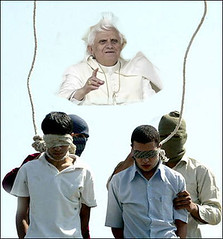
Nemat Safavi from the city of Ardebil, Mehdi P. from Tabriz, and Mohsen Gh. from Shiraz were all arrested, tried and sentenced to death in different courts in Iran, based on accusations of homosexual acts (known as "Lavat").
They were under the age of 18 at the time of arrest and have been kept in prison since then. In Nemat’s case, he was jailed for five years so that he would reach the legal age (according to Islamic law) at which death sentences can be carried out.
Human rights activists working on Nemat's behalf have determined that the authorities in Ardebil are claiming Nemat dons not even exist. Having observed many similar cases before, IRQR considers this statement to be reason for even greater worry.
Mehdi and Mohsen are awaiting their execution despite the fact that they have both pleaded innocent and have denied the allegations. There is not one single witness in either of the cases, and even the judge himself has no evidence whatsoever to prove that the plaintiffs are guilty. (According to Islamic law, the accused person would accept his guilt four times, or there would be four male adults testifying on the crime committed, before a court can legally rule on someone’s guilt.)
Nevertheless, the judge has ruled that Mehdi and Mohsen be sentenced to death by the powers vested in him by Islamic punishment rules, which allow a judge to issue a verdict based on his own personal knowledge, even when no physical evidence or witnesses were available.
IRQR is requesting the Iranian government to do the followings:
• Stop the executions immediately
• Give unrestricted access of Human Rights committees and organizations to these cases
• Allow these plaintiffs to be tried in legal courts of law following the international standards, which clearly indicate that no one should be executed for the crimes they have committed when they were children (below age 18 in Iran).
IRQR is asking all individuals, organizations and human rights activists to take action and help us to stop these unlawful and barbaric executions.
RECOMMENDED ACTION
Please send appeals to:
Head of the Judiciary
Ayatollah Sadegh Larijani
Howzeh Riyasat-e Qoveh Qazaiyeh (Office of the Head of the Judiciary)
Pasteur St., Vali Asr Ave., south of Serah-e Jomhouri, Tehran 1316814737, Islamic Republic of Iran
Email: info@dadiran.ir
Leader of the Islamic Republic
Ayatollah Sayed ‘Ali Khamenei, The Office of the Supreme Leader
Islamic Republic Street – End of Shahid Keshvar Doust Street, Tehran, Islamic Republic of Iran
Email: info_leader@leader.ir
via website: http://www.leader.ir/langs/en/index.php?p=letter (English)
http://www.leader.ir/langs/fa/index.php?p=letter (Persian)
To follow up please copy us on your email at info@irqr.net
![Reblog this post [with Zemanta]](http://img.zemanta.com/reblog_e.png?x-id=cfe016f9-356a-4f59-8bbc-800a04a9435c)
Gay Ghanians to tell Commonwealth Heads of Government what they need

Member 'Hitman61' drafted some issues which were for scrutiny and discussion by the members before submitting it to the organisers of the Society.
SUBMISSION TO THE COMMONWEALTH DISCUSSION FROM GAYGHANA.ORG
Background
The main stumbling blocks to the normalisation of homosexual behaviour in Ghana is its illegality and public opinion. British colonial law is still in effect and, although it does not mention homosexuality, it is usually applied to that behaviour. Criminal Code 1960- Chapter 6, Sexual Offences Article 105 reads as follows: Whoever is guilty of unnatural carnal knowledge— (a) of any person without his consent, is guilty of first degree felony; (b) of any person with his consent, or of any animal, is guilty of a misdemeanour The explicitly biblical terms of the law – “unnatural carnal knowledge” - also highlights the negative role of the Ghanaian form of Christianity.
Decriminalisation
We believe that a change in the law is the key which will allow further development. In reality, the law is rarely used but if the status quo was threatened it surely would be. Presently, it mainly serves as a symbolic condemnation and keeps people underground and fearful of the consequences if challenges were made.
Ostracism
The state does not intervene in every aspect of the lives of its citizens in the same way as in Europe. Where there are laws they are not always enforced. Strong public opinion plays the main role in maintaining norms. Public opinion is the first barrier that people who have same-sex relationships have to deal with. Public opinion uses a series of themes to back up its misinformed opinion – culture, religion and a misunderstanding of biology. The ultimate sanction is ostracism. When your family and community is often your only means of support, this is a serious affair. However, in big cities such as Accra this system is starting to break down. As in other countries, women who engage in homosexual activity are considered non-existent.
Areas for Intervention
If the commonwealth was to have a role in intervening in this issue it could play a number of supporting roles. The following categories play an important role in the public discourse around this issue and the commonwealth could intervene in each of these areas:
Culture
This includes the self-denial that homosexual behaviour has ever been a part of traditional Ghanaian culture. Following this logic, if homosexuality was not part of Ghanaian culture it must have been imported.
Religion
A fundamentalist, literal interpretation of Christianity has led to the idea that homosexuality is a sin and could also be caused by possession of evil spirits. Stemming from this is the idea that homosexual behaviour is against the natural order, is physically dangerous and a psychological disorder. There is also the negative role of American fundamentalist Christianity that is being imported into Ghana and is supporting these views.
The need for education
The general public has no information or understanding about this issue. This is because their mis-information comes from the media and pastors. We therefore propose that the following groups should be worked with in order to inform them of the issues:
1. Journalists and broadcasters
2. Pastors
3. Judges
4. Government ministers
5. Police and army
6. Teachers and university lecturers
7. Doctors and nurses
Roadmaps
We also propose the following roadmap strategies:
1 A study to show how Commonwealth countries can improve the rights of people - men and women - involved in homosexual activity.
* It should focus on those Commonwealth countries which have worked to protect their human rights over the last 10 years.
* The roadmap may suggest Commonwealth support to fund legal challenges in the courts, where discriminatory and oppressive laws remain in force.
2 To showcase the model laws in Commonwealth countries that have removed all forms of discrimination and introduced legal recognition of the rights of their citizens regardless of sexual behaviour.
3 To produce a human rights track record of each Commonwealth country over the last 10 years showing how its human rights have improved.
* A league table should be prepared ranking the best to worst records.
Benchmarking
The table should serve as the basis for ethical investors who wish to reward Commonwealth countries that respect the rights of their LGBT citizens.
Potential Problems
The visible face of gay in Ghana is the effeminate homosexual which threatens the notion of family, tradition and masculinity in its challenge to social normality. As the only visible model this can also be problematic although should not be stigmatised by us.
With the commonwealth becoming involved, there is a danger that the opposition will see (in their eyes) another attempt to import homosexuality.
There is also the danger of imposing a Western view of (homo)sexuality. The North American model of homosexuality is persuasive as it is the most vocal and visible and helps when applying for funding. Ghanaians, however, should also be challenged by the Institute to develop models according to their local culture and not simply mimic the language and identity politics of the West.
![Reblog this post [with Zemanta]](http://img.zemanta.com/reblog_e.png?x-id=d4542794-2933-435f-920b-0019c39a0eff)
Monday, 16 November 2009
Cameroun: My Illegal Detainment for “Promoting Homosexuality” Sheds Light on the Urgent Need for Protection of Sexual Rights

By Sebastien Mandeng
Sébastien, a member of the Association for the Defense of Homosexuality (ADEFHO), an IWHC partner, was illegally detained for several hours last week for ”promoting homosexuality” before finally escaping the grip of the policemen. The following is his account of the experience, which reveals a disturbing lack of rights and recourse available to the LGBTI population in Cameroun:
I am free! I am a Camerounian activist for LGBTI rights, and was held illegally by a police squad in Douala (the economic capital on the west coast of the country) for seven hours. I was arrested under charges of conversations against nature with a homophobic taxi-driver.
The altercation was started by the taxi-driver.
When returning from a trip with some friends, we hired a taxi, and during the ride we spoke about subjects relating to LGBTI rights and the need for decriminalization. From time to time the taxi-driver intervened in our conversation, and I asked for his opinions on the subject.
It was precisely at this moment that the situation took a turn for the worse.
He began driving much faster, shouting that instead of taking me to the final destination I had requested, he would take me to the nearest police station. When we arrived there, I paid the fare, and he became hysterical, crying out that he works hard with his hands and cannot tolerate homosexual practices.
When I arrived at the police station, it was four o’clock in the morning and the police locked me, barefoot, in a cell with no electricity, and insisted that the locked cell would provide protection. Throughout the hours I remained in custody I was subjected to insults, mocking and sarcasm from the policemen, who demanded to know why I don’t like women, why I prefer men, and “unnatural relations.”
Article 347 of the Cameroun penal code (ordinance n°72/16 of September 28, 1972) punishes by imprisonment from 6 months to 5 years and a fine of 20,000 to 200,000 FCFA any person who has sexual relations with someone of the same sex.
At one point the police threatened to insert their fingers into my anus in order to verify whether I am often sodomized, in order to charge me with homosexual activity later. I forcibly resisted, insisting that anyone who touched me would have to do so over my dead body.
After passing the night in the police cell, I was finally released after requesting legal council, and to be officially charged and placed in custody.
Although this incident was harrowing, I probably won’t consider filing a legal suit. They didn’t touch me physically, it was only the same insults and injuries we suffer daily, so I think I will stop here and hope that it never happens again to anyone.
Sébastien Mandeng is a lawyer in training who interned with the law firm Mes. VIAZZI-AUBRIET-BATTU-NKOM-IPOUCK, all advocates specializing in human rights. He currently works as the vice-president of the Association for the Defense of Homosexuality (ADEFHO).
For more information about this incident, or about the defense of homosexuality in Cameroun, you can contact him directly at adefho@live.com/sebmandeng@yahoo.fr
(Tél : (+237) 75 17 65 24)
Saturday, 14 November 2009
Sri Lankan gay man granted asylum in USA
 Image via Wikipedia
Equal Ground, a non profit organization seeking human and political rights for the Lesbian, Gay, Bisexual, Transgender, Intersex and Questioning (LGBTIQ) community of Sri Lanka, says that a Sri Lankan that sought asylum in US based on gender discrimination in his home country has been granted asylum there.
The person nicknamed as Sam has emailed to Equal Grounds “I am very happy to inform you, that I was granted my gay asylum in USA. As I know I am the 3rd person whom granted gay asylum in USA. Equal Ground and you personally helped me on this matter a lot. I am thanking Equal Ground and personally for you Rosanna, because you helped me in every way not only giving a declaration, personally advising me on my problems which happen to me because of my gay activities… “
Equal Ground says that the organization ' sincerely hopes that there will come a time when wonderful people such as Sam don’t have to flee this country because of the way they are treated here for being gay, lesbian, bisexual or transgender. We hope in time, the laws will change and people are more accepting.'
Homosexuality is a crime under Sri Lanka's law.
![Reblog this post [with Zemanta]](http://img.zemanta.com/reblog_e.png?x-id=ab8253d7-85c1-47f5-add9-396a527af4d2)
Wednesday, 11 November 2009
Greece: The Unwanted
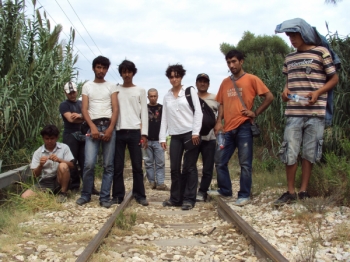
As the French and British governments discuss how to deal with migrants camped outside Calais, Unreported World travels to the European Union's eastern border, to the illicit crossing points for hundreds of thousands of Afghans making their way to our shores.
Reporter Jenny Kleeman and director Jacob Waite begin their journey on Turkey's north-west coast, just eight miles from Greece and the EU. It's 2.40am and the team come across a people smuggler and 25 migrants - men, women, children and even toddlers, all from Afghanistan.
One of them tells Kleeman that he'd fled Afghanistan aged 13, after his father was taken away by the Taliban, and he'd worked in Iran for four years to earn $4000 to pay the smuggler. The fee covered a small inflatable dinghy, a little food and some basic life jackets. The team watches as all 25 get into the rickety craft and start paddling towards Greece. No one knows how many migrants try to make the eight-mile crossing, or how many drown. It's common for bodies to be found in the seas.
On the Greek island of Lesbos, which is popular with British tourists, the team meet another migrant, Massu, who's crossed over from Turkey the previous night. He's been walking across the island for eight hours with his wife, son and baby, on their way to the ferry terminal to try to get to Athens.
Thirteen thousand migrants are picked up by the Greek police on Lesbos every year. They are then held at the Pagani detention centre. It's very rare for journalists to be allowed in, but, after negotiations, the team gains access. The centre was built for 300, but often holds more than 1000 people. It's crowded, hot, dirty and smelly. The detainees claim they have no access to clean water, translators or doctors. Many say they feel unwell. In one cell for women and children there are two bathrooms to cater for around 100 people.
Kleeman recognises one of the migrants she'd seen setting off in the dinghy from Turkey. He tells her he was caught by the police and beaten up before being detained in the centre. Another detainee, Monir, tells her he used to work as a translator for the US army in Afghanistan. But, his family was threatened by the Taliban as a result, and they told him to leave the country.
Afghan migrants who are released from detention are given 30 days to leave Greece. Without a passport, they've got no way of doing it legally. Many move on to the Greek capital to consider their next move.
The team follows the migrants to Athens. In Attikis Square, a meeting point for Afghans, they hear allegations that police violence against migrants is common. Around the square, many are crammed into tiny flats, living in squalor. Kleeman visits one flat, home to 21 flea-bitten people, who share one bathroom. It's overrun with cockroaches.
Kleeman puts the migrants' allegations of ill treatment to the government minister responsible for their welfare. He tells her that he intervenes when he has reports of ill treatment. But, he says, at the same time, it's extremely difficult to cope because of the sheer numbers, and the EU as a whole needs to do more.
The team moves on to the port of Patras, from where ferries head off to the rest of Europe. Around the port, migrants are living in camps along railway tracks as they try every day to stow themselves away in lorries. The walls of the port are topped with razor wire, but it's full of bits of cloth torn from the clothes of the migrants who've been trying desperately to get inside.
It's clear that these desperate and determined people will stop at nothing for their chance to start a new life in Europe.
Watch the programme
USA: Esmeralda: A Transgender Detainee Speaks Out
Esmeralda: A Transgender Detainee Speaks Out from Breakthrough on Vimeo.
Source: Restore Fairness
Courage comes in many different forms. For Esmeralda a transgender asylum seeker from Mexico who faced horrific circumstances in immigration detention, it came in the form of seeking justice. Kept in a segregated cell with other transgender detainees, Esmeralda never realized that her experience in detention would match the trauma of discrimination she had faced back home. But her story is also one of hope for change.
While the Obama administration has pledged to reform the detention system, its promises do not go far enough. Spread over a patchwork of more than 500 county jails, privately run prisons and federal facilities, immigration detention is a $1.8 billion business estimated to hold 442,941 detainees in custody in 2009 alone.
Transferred far away from their homes and families, stories are rife of how detainees are denied visitation, access to lawyers, medical care, and are subject to physical and verbal abuse. Many vulnerable people, including asylum seekers, pregnant women, children, lawful permanent residents and even U.S. citizens are among those detained.
Listen to Esmeralda’s voice of courage and take action now to fix a broken detention system.
Tuesday, 10 November 2009
UNHCR accepts three gay Iranian refugees

IRQR supports the many Iranian gay refugees who flee to Turkey.
The three are Ali, 31 years-old, Ahmad, 30 years-old, and Farhad, 25 years-old.
![Reblog this post [with Zemanta]](http://img.zemanta.com/reblog_e.png?x-id=2c1032a3-fdc2-4ad5-a450-0895f64d9ec8)
One Day, One Struggle: A Campaign for Human Rights in Muslim Societies

Source: Bitch
By Mandy Van Deven,
November 9 over twenty organizations in eleven countries held "simultaneous events and public demonstrations on topics like protesting customary practices such as honor killings and FGM/C, overturning discriminatory and life threatening laws like stoning or lashing of women, and calling for LGBT rights, the right to sexuality education and the right to bodily and sexual integrity of all people."
The One Day, One Struggle campaign is a joint effort organized by the Coalition for Sexual and Bodily Rights in Muslim Societies (CSBR), a solidarity network comprised of NGOs and academic institutions in the Middle East, North Africa, and South and Southeast Asia that work to promote sexual and bodily rights as human rights in Muslim societies. The CSBR emerged in 2001 from the “Women, Sexuality and Social Change in the Middle East and Mediterranean Symposium” organized by Turkey's Women for Women’s Human Rights (WWHR), a global nongovernmental organization (NGO) interested in gaining legal reforms in Muslim societies worldwide.
On the eve of the campaign initiation, I spoke to WWHR campaign coordinators Pinar Ilkkaracan and Irazca Geray about the goals of the premiere advocacy event.
What is the purpose of One Day, One Struggle?
Issues around sexuality and sexual and reproductive rights display a huge variety in different Muslim societies. For instance, so-called honor crimes continue to be a widespread violation of women’s sexual and bodily rights in the Middle East, but it is almost unheard of in Southeast Asia or the Sub-Saharan Africa. And homosexuality, for instance, is punished as a criminal offence in many countries of the Middle East, but it is widely accepted in Indonesia, the country with the largest Muslim population in the world. Despite all these differences, there is a common fact shared by all participants of this campaign: the attacks on sexual and reproductive rights are escalating, which is a result of rising conservatism that is fueled by militarism, increasing inequalities, the politicization of religion, and Islamophobia in the post-9/11 context. All this has strengthened the patriarchal and extremist religious ideologies that use sexuality, especially women’s sexuality, as a tool of oppression.
Our efforts to reverse this tide constitute the basis of the One Day, One Struggle campaign, which aims to make the struggles of sexual and reproductive rights advocates in Muslim societies visible at the international level.
Why is it important to have a coalition of people organizing for human rights across Muslim societies?
Coalition building across various regions and between NGOs and academic institutions on various themes related to sexuality has been extremely useful for our struggles. We have been able to inform and update each other on how human rights violations in the domain of sexuality are being legitimized in different countries. This gives us the information and experience needed to build the necessary strategies against the misuse of religion as an instrument of control and sexual oppression in our individual contexts and regions. We have been able to support each others' work by producing and disseminating reports and publications on the legal reforms in our own countries and by holding the very first high-level, international meetings on sexual and reproductive rights in countries like Lebanon and Tunisia, where previously sexuality had been a taboo.
The CSBR is not a coalition working for the rights of only Muslim women, it is not a religious or faith-based network, and we are not working only in Islamic countries. The coalition also does not just have Muslim members. It includes people who are Jewish, Christian, Buddhist, and other religious minorities from Muslim-majority countries, as they are also affected by various practices that violate human rights related to sexuality. The CSBR includes both women and men and has a very diverse membership ranging from women’s human rights NGOs to LGBTQ organizations to groups that work on HIV/AIDS to academic institutions and departments.
What do you hope to achieve with this event?
We hope to show that even if we are in different countries and even on different continents, when working on issues related to sexuality, we are united in our struggle to realize sexual and bodily rights in Muslim societies. The One Day, One Struggle campaign aims to raise public awareness on sexuality and sexual rights in our national contexts and to draw international public attention to issues around sexual and bodily rights in our regions. In each host country, the CSBR members are focusing on the pertinent issues within their own context.
For instance, CSBR member organizations in Tunisia are focusing on the urgent need for sexuality education, while in Indonesia they have come together to make the public, media, and health care providers aware of the fact that the practice of female circumcision is a form of violence against women. Another CSBR organization in Indonesia is trying to mobilize against the recently passed law on stoning as a punishment for adultery in Aceh. In Palestine CSBR members are holding a week-long campaign against femicide and the impact of the Apartheid Wall and house demolitions on women. In the Sudan they are coming together with public figures and Ministry of Health representatives to discuss how to work towards women’s empowerment and also contribute to campaigns to end female genital mutilation. In Malaysia they will call a press conference to abolish Section 498 of the Malaysian Penal Code. Campaign activities are also varied, ranging from conferences to artistic performances to book launches.
What challenges have you faced organizing One Day, One Struggle?
Getting the press not to interpret “Muslim societies” simply as “Islamic countries.” Stereotyping of Muslim women has been a big challenge as well, but this is also why we are doing this campaign: to show that even though it is not covered as such in the Western media, there is not one single definition of what it means to be a “Muslim society.” Practices and issues are very diverse and a lot of courageous work is being undertaken by the sexual and reproductive rights advocates in Muslim societies.
Logistically, it was not easy to organize this campaign in eleven countries spread across such a wide geography. Things that may seem like small details--such as time differences and the fact that all organizations have different capacities to access internet--can be very problematic. It was definitely very encouraging to create such a link across boundaries, languages, and themes.
Will this be a one-time event or do you plan to repeat it annually?
We wish we could say this will be a one-time event that will help achieve all our aims, but obviously the likelihood of that happening is slim. Depending on the outcomes of this campaign, the CSBR will decide if and how to turn this collective effort into an annual campaign.
![Reblog this post [with Zemanta]](http://img.zemanta.com/reblog_e.png?x-id=2926216d-07ce-4c40-88ef-dfdc5c136ef2)
Namibia: Political Parties Ponder Homosexuality

by Nangula Shejavali
Various political parties last week set out their position on homosexuality - a subject often regarded as taboo.
The topic has enjoyed very little, if any, discussion in the National Assembly at all, though Jerry Ekandjo in 1998 reportedly stated that he would table anti-homosexual legislation in Parliament.
This never happened.
However, much anti-gay rhetoric has reared its head in the past, with former President Sam Nujoma in 2001 being quoted as saying that "the Republic of Namibia does not allow homosexuality [or] lesbianism here", and "the Police must arrest, imprison and deport homosexuals and lesbians found in Namibia".
At a forum with political parties as part of the Women Claiming Citizenship Campaign, respecting and ensuring the rights of gay, lesbian, transgender, bisexual and intersex Namibian citizens - who are often discriminated against for their gender or sexual orientation - was highlighted as a major issue for political parties to address.
When push came to shove in stating their positions, most of the eight parties present - the All People's Party (APP), the Congress of Democrats (CoD), the National Democratic Party (NDP), the Namibia Democratic Movement of Change (NDMC), Nudo, the Rally for Democracy and Progress (RDP), Swanu, UDF - declared that human rights were for everyone, irrespective of their sexual orientation.
Only NDP and UDF remained silent on the issue.
The NDP's representative, Lukato Lukato, who stated that the party's policy on HIV-AIDS is that "the Lord will respond to this killer disease", made no comment on the homosexuality discussion.
The UDF's Werner Claasen was also silent on his party's position, instead launching into an unwelcome electioneering campaign before being brought to order by the audience, who had come to hear political parties' positions on various issues.
NDMC representative Joseph Kauandenge said: "If a person is lesbian or gay, whose issue is it? It's not a problem as long as it is done in their own private home and in their own private time."
Swanu representative Unaani Kauami expressed the same sentiment, and both came under fire for trying to make the issue of discrimination an insignificant one, with one audience member questioning, "If I am in a relationship, and I am being abused and having my rights violated, is that a private issue? Talking about privatising issues is making it okay. Let's talk about this, dialogue, publicise it," she said.
Swanu later clarified its position, stating that as far as the party was concerned, "it is a violation of human rights to discriminate against someone for their sexual orientation".
APP representative Lena Nakatana also cited human rights as the point of departure, saying that Namibian homosexuals were still Namibians, taxpayers and voters, entitled to the same rights as any other Namibian.
"Whether I support them or not is not the issue," she said.
When a member of the audience questioned the 'human rights' argument of the political parties by terming homosexuality as unethical and saying that gays and lesbians would not go to heaven, Nakatana countered that "whether or not we accept it, gays and lesbians were also made by God".
While Nudo described homosexuality as a "strange new" issue, party representative Utjiua Muinjangue also made it clear that Nudo's position was to respect human rights, irrespective of sexual orientation.
She emphasised that there was a need for openness in discussing homosexuality, adding that "the fact of the matter is that we have these people amongst us, and we need to look at the issue differently, accept them, and all live happily."
RDP representative Steve Bezuidenhout stated that "the supreme law of this land has given rights to all citizens of the country, to all people, irrespective of sex and creed. I don't want to make a special issue of gays and lesbians because they are Namibians, they are taxpayers, and they have rights just as with all Namibians".
He added that "the RDP Government will defend and protect the Constitution. With this protection, the rights of gays and lesbians will be respected."
Noting current national legislation, Congress of Democrats representative Ben Ulenga said that sodomy laws still exist and remain in force in Namibia, stating that this was in stark contrast to ensuring universal human rights, as enshrined in the Namibian Constitution.
He added that his party does not discriminate against anyone in society.
"Gays and lesbians are human beings just like any other person. They are all welcome in the party as anybody else, and are free to run for office in the party," he said.
He added that describing gays and lesbians as a "new or strange" phenomenon was incorrect, as they had been present since time immemorial, adding that there had been homosexuals in the army during his time as a PLAN soldier, and during his time in prison.
Ulenga also promised to introduce the subject in Parliament, noting that there hadn't been any debate on the issue.
Though invited and slated to speak on the programme, the DTA, Swapo, RP and DPN did not send representatives to participate in the discussion.
![Reblog this post [with Zemanta]](http://img.zemanta.com/reblog_e.png?x-id=f1b41177-c118-41f1-9556-5ad3e06f631a)


 RSS feed


 Join our page

