Donations

People say we're "invaluable", "indispensable" and "an essential service" — please consider making a donation.

Wednesday, 30 November 2011

Immigration detention to feature at UN human rights review of UK

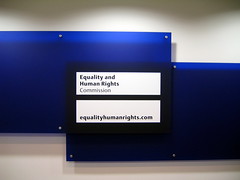
Equality and Human Rights CommissionImage by rich_w via Flickr
Source: Detention Forum

In a move that has been welcomed by many detention NGOs, national human rights bodies such as Equality and Human Rights Commission (EHRC) and British Institute of Human Rights (BIHR) have highlighted immigration detention as one of the key human rights issues in the UK in their submissions to the Universal Periodic Review of the UN Human Rights Council.

Immigration detention was one of the 22 human rights issues covered by EHRC’s UPR submission.  The submission states that EHRC is “concerned with safeguards of the detained fast track system for individuals pending asylum decisions and the length of time people can spend in detention awaiting removal.”  It goes on to mention a wide range of problems such as provision of mental health and interpretation services and detention of vulnerable people.

BIHR’s voluntary-sector-wide submission cited data from Yarl’s Wood Befrienders: the group assisted 32 women claiming to be victims of torture or trafficking detained at Yarls Wood Immigration Removal Centre in 2011. It was endorsed by a number of supporters of The Detention Forum.

A large number of detention NGOs, such as Gatwick Detainee Welfare Group, Dover Detainee Visitor Group, Association for Visitors to Immigration Detainees, Bail for Immigration Detainees, Detention Action, Yarl’s Wood Befrienders and Campaign to Close Campsfield, also provided submissions which often dealt with some of the specific detention issues in depth.

Detention featured prominently in other human rights NGOs’ submissions. The Equal Rights Trust focussed on detention of stateless persons, while René Cassin recommended a strict time limit on detention to reduce long-term detention. Freedom from Torture raised their concern that victims of torture are routinely detained despite the safeguards put in place by the UK Border Agency and called for the abolition of the Detained Fast Track.

The Universal Period Review’s oral examination of the UK Government will take place in May 2012.
Enhanced by Zemanta

Nigerian legal attack on LGBT worsens

By Paul Canning

Nigeria's Senate 28 November passed an 'anti gay marriage' bill adding further penalties and extending its scope.

The Senate added to provisions targeting those living together (and those who don't report them) with new clauses making it illegal to register gay clubs or organizations, as well as criminalizing the “public show of same-sex amorous relationships directly or indirectly” with 10 years imprisonment.

Says Associated Press:
…The bill also could target human rights and HIV-prevention programs run by the U.S. Agency for International Development and the Center for Disease Control and Prevention in Nigeria, which has the world’s third-largest population of people living with HIV and AIDS. A U.S. Embassy spokeswoman declined to immediately comment.
Sen. Baba-Ahmed Yusuf Datti said during Monday's debate:
"Such elements in society should be killed."
Davis Mac Iyalla campaign director of the Nigerian LGBT in diaspora group, said:
“The Nigeria senators have further demonstrated their hate, discrimination and oppression of vulnerable LGBT Nigerians. I call on all respected human rights activists to join forces with us to fight the bill.”
The campaign group expressed its concerns that the bill would further turn many LGBT Nigerians living in diaspora into asylum seekers and refugees. Yemisi Ilesanmi from the group has condemned what she has called the "deafening silence" of Nigerian liberals and the left on the bill. Some Nigerian human rights groups have pointed out that a bill supposedly aimed at gay people will impact marginalised groups like migrant workers, making them subject to bribery demands from police.

The Initiative for Equal Rights (TIERs) Executive Director- Joseph Sewedo Akoro said:
“The implication of this bill is enormous and threatens TIERs legal position to operate as a human rights organization in Nigeria.”

“We are greatly concerned by this development and hope that the House of Representatives will be careful in dealing with the bill: recognizing the provisions of the constitution towards human rights promotion and international human rights obligations.”
Writing in Behind The Mask, Akoro noted that "International opinion didn’t seem to trouble lawmakers, some of whom laughed and joked during the debate."

"One senator however worried that the bill would hinder the tradition of Nigeria’s Igbo ethnic group in the southeast. In this community infertile wives are allowed to “marry” other women to bear their husbands’ children," he wrote.

TIERs called for other members of the Nigeria Human Rights Community to raise their voice in disapproval of the bill. It also called for both the Nigeria Human Rights Commission and the National Agency on the Control of AIDS to speak out. Neither has thus far.

Peter Tatchell, Director of the human rights advocacy organisation, the Peter Tatchell Foundation, added: 
"This bill violates the equality and non-discrimination guarantees of Article 42 of the Nigerian Constitution and Articles 2 and 3 of the African Charter on Human and People's Rights, which Nigeria has signed and pledged to uphold."
"There is a good chance that this bill, and Nigeria's long-standing criminalisation of same-sex relations, can be challenged in the courts. This could be a future option for LGBTI campaigners and human rights defenders."

"The law against homosexuality is not an authentic national law that originated in Nigerian jurisprudence. It was imposed on Nigeria by the British colonial administration in the nineteenth century. Despite Nigeria now being an independent country, this British colonial law has never been repealed."

"Our Nigerian colleagues are still hopeful that they can defeat the bill at the next stage. We stand in solidarity with their struggle for LGBTI equality," he said.
Nigerian LGBT in diaspora held a protest in front of the Nigerian House in London recently and there will be another protest rally at the Nigerian embassy in New York, 5 December.

The bill now goes to the House of Representatives, then for signature by the President, Goodluck Jonathan.
Enhanced by Zemanta

Australia releases detained asylum seekers

By Paul Canning

In a major reversal of past policy, Australia has begin releasing asylum seekers who have arrived by boat into the community.

Mandatory detention for them was the policy, adopted as a 'deterrent' by the previous conservative government.

Those released will have the right to work and access health services. Priority for community release under the new bridging visa program will go to asylum seekers who have spent the longest time in detention.

Boat arrivals will also be treated like others who arrive by plane and allowed access to the Tribunal which considers asylum cases. The special rules for boat arrivals saw decisions being consistently overturned on appeal, showing their unfairness.

It is only because of a High Court decision in December last year that boat arrivals could access judicial review at all.

Another legal decision has forced the government to change tack, the one which spiked the so-called 'Malaysia solution' where all boat arrivals would be sent to camps in that country.

Australia's High Court decision was based on a lack of protections for refugees in Malaysia, where beatings of them have been documented in the media and with Malaysia not being a signatory to the Refugee Convention.

Mandatory detention has come under increasing pressure, with moves made earlier to release children and a leading Australian current affairs program documenting the mental harm caused by long-term detention only last month.

Richard Towle, Pacific UNHCR representative, told ABC:
"What we're talking about is people who are claiming asylum and whether they remain in detention or go into the community whilst their claims are looked at and we've always said that it's much fairer and more humane to allow people who don't pose any threats to the community or security risks to the country to be released into the wider community where they can live as normally as possible while their claims are be assessed, that reduces the pressure on the immigration system, it's cheaper and it reduces the high risk of what we've seen recently of self-harm and suicides and very damaging consequences at immigration detention centres. So we believe all round it's a very positive development. That's an approach that's adopted by most asylum countries around the world and we're very pleased that Australia is moving in that direction."

"This is by far the widest practice by countries in the industrialised world, the whole scale and widespread use of mandatory detention for asylum seekers is not used by other countries by and large and that's why we're very pleased that Australia is moving away from those policies heading towards ones that are based on individualised risk assessment, so that by far and the large number of asylum seekers are allowed to remain in the community. They don't pose any threat, they're able ideally to look after themselves. Those with work permits will be able to find work and be self-sufficient and have much better psychological support in the community, rather than in detention."

Tuesday, 29 November 2011

Change UK law on HIV drugs for asylum seekers: British HIV Association

None - This image is in the public domain and ...Image via Wikipedia
Source: The Guardian

By Sarah Boseley

The law that stops visitors to the UK and asylum seekers from getting NHS Aids drugs must be changed, a senior HIV doctor says, not just in the interests of humanity, but because the drugs now reduce the chance that they will infect other people.

Jane Anderson, the new chair of the British HIV Association, which represents doctors in the field, says there is no sense in leaving people without treatment, following studies that this year showed the drugs prevented transmission as well as keeping people alive.
"The legislation raises complications about getting the right treatment into the right people. It deters people from coming to services and it is very confusing," said Professor Anderson.
The rules were drawn up under the last government in response to tabloid fears of waves of illegal immigrants heading for the UK for free Aids treatment. That, says Anderson, is a nonsense.
"The majority of people do not present for HIV care before nine to 18 months after arriving in the country, when they are ill or pregnant. We've never seen people getting off planes and rushing to HIV clinics," she said. Labour's stance was at odds with its policy to the developing world, she added. "The previous administration was very committed to ensuring adequate HIV care happened outside the UK, but at the same time as having barriers within our own borders."
Lord Fowler, the former Tory health secretary behind the "Don't Die of Ignorance" Aids campaign of the mid-80s, also called for the rules to be changed in his report on HIV earlier this year.

Many of those with HIV in the UK are in marginalised groups. HIV infection has not stopped rising in the UK, particularly among men who have sex with men and in the African-Caribbean community.

Infection still carries a heavy stigma. Among the patients at the Homerton hospital in east London, were she works, Anderson says about 30% "haven't really told anybody much" that they have HIV. Many of those who do face discrimination and rejection by their community, families and friends.

Anderson and her colleagues are also concerned about new commissioning arrangements in the NHS. While specialist care will be organised by the National Commissioning Board, testing and prevention are likely to be localised and the long-term needs of patients who are living longer will probably be managed by GPs.
"We have some of the best outcomes in the world and the best surveillance and we're not doing a bad job," said Anderson. "We're being asked to change the way in which we do that very good job with financial pressures and a structural re-organisation, neither of which are really designed to deliver joined-up care to a group of people who are already in a complicated place in society."
The stigmatised and marginalised people living with HIV infection may not get as good care as the middle-class "worried well" who know how to demand attention, she said.
Enhanced by Zemanta

Gay Holocaust exhibit opens in Belgrade

By Paul Canning

An exhibition documenting the Nazi treatment of gay people has opened in Belgrade.

According to ARTEQ, an association that helped organise the show in the Belgrade City Museum, the exhibition will seek to confront stereotypes and tackle prejudices around sexual minorities in Serbia.

Serbia has some of the lowest numbers for tolerance of gay people in the Balkans, according to surveys. In September, authorities banned the Belgrade gay pride parade, citing violent threats from right-wing and Orthodox activists.

After coming to power in Germany in 1933, the Nazis victimized tens of thousands of people because of their sexual orientation.

Homosexuals were sent to concentration camps, where they suffered a similar fate to millions of Jews and hundreds of thousands of Romany who were marked for death. While the Jews were forced to wear a yellow badge in the shape of the star of David, homosexuals were required to wear a pink triangle.

Homosexuals in Germany continued to suffer persecution after the end of World War II, as Nazi-era laws against them were kept in place for years.

The extent of Nazi crimes against homosexuals was only revealed in the late 1970s.

The exhibition, “Nazi terror over homosexuals 1933 – 1945”, runs at the Belgrade City Museum from December 2nd to 23rd.

The show has been jointly organised by ARTEQ with Queer Zagreb from Croatia. It is part-funded by the City of Belgrade and the Serbian Ministry of culture and information.

ARTEQ say:

“The objectives of this significant cultural and socially responsible project are to disclose the historical facts by using authentic documents from Nazi Germany era to raise awareness about suffering of the homosexuals under Nazi regime, to provide framework for combating stereotypes about LGBT persons in Serbian society, to promote tolerance towards minorities and to stimulate different social factors to take part in the process of fostering anti-fascist activism and building a non-discriminatory society.”

As well as the exhibits, visitors will have the chance to watch documentaries, a movie about the gay British computer scientist Alan Turing, and a TV show on Belgrade pride by Serbian broadcaster B92.
In March, Macedonia opened the first Holocaust museum in the region.
Enhanced by Zemanta

Video: The law that crosses the line

Video by STOP The Infiltration Prevention Law campaign - Hotline for Migrant Workers (Israel).

Monday, 28 November 2011

Russia 'starving' detained migrants

By Paul Canning

An Uzbek news source is reporting that detained migrants in a remote centre in Russia are "emaciated, exhausted and unwell" from being fed only bread and water for months.

The same detention centre was investigated by the BBC in April. They found disturbing evidence of neglect, abuse, and overt racial discrimination by officials.

The detention centre is hundreds of miles from Moscow, in the northern Ural mountains.

“The immigrant workers are being taken off trains and brought to the detention centre ‘to ascertain their status’, but often this process lasts for months,” a well placed source employed in Uzbekistan’s penal system told Uznews.net, asking not to be identified.

The source said that those released from the centre fear "even more unpleasant consequences” if they speak out.

Uznews.net quotes a young man, Sodyk, saying that there were around 40 Uzbek workers who were emaciated, exhausted and unwell. Most were aged about 20 but looked much older. Many had had their passports taken away illegally by the local police.
“Every so often they would allow us to make a phone call but only to other parts of Russia,” Sodyk continued. “The food rations for the most part consisted of a piece of bread with water; for dinner they only gave us boiled water.”
The BBC report found refugees living in a collection of rotting mobile homes that had been used by East German labourers in the 1980s.

The buildings were falling apart. In the bathrooms, there were holes in the walls. Many of the rooms had buckets in the middle of the floor to catch the water dripping through electrical fittings in the ceilings. Most walls were warped with water damage.

The buildings were well insulated, but the residents said some bedrooms were bitterly cold when the temperature outside dropped to -30C.

The BBC reported racism directed at the Africans in the camp and locals shouting Nazi slogans at the refugees as they were being interviewed.

Russia's Federal Migration Service's official spokesperson was sacked after he told the BBC:
"What is now at stake is the survival of the white race. We feel this in Russia. We want to make sure the mixing of blood happens in the right way here, and not the way it has happened in Western Europe where the results have not been good"
Enhanced by Zemanta

St. Petersburg: How you can help fight anti-gay laws in Russia?

Image of St. Petersberg gay demo, broken up by police and attacked by fascists, source GayRussia
Source: LGBT Human Rights Project GayRussia.Ru

Many of you have been asking us how you can help to fight the bill in the most effective way. This Press Release aims to answer your questions as well as bring more insight about the context.

In the last few days, GayRussia has been consulting with its activists, other Russian based LGBT activist groups and legal specialists to think of how to best address the current circumstances.

First, you need to know that the bill is politically motivated: Russia’s Parliamentary election will take place on December 4th and targeting LGBT is a way to earn support from religious and nationalist organizations. The bill received support from Valentina Matvienko the former Governor of the city who is now the speaker of the Upper Chamber of Parliament. Politicians in Moscow said that they are ready to implement a similar law in the Russian capital but also at the Federal level.

Second, we want to stress that the ban of the promotion of LGBT rights on the public place is de facto enforced in Russia since 2005. Implementing this law is only materializing what has been a sad reality for years. For several years, GayRussia has been denouncing the absence of freedom of assembly, freedom of expression and freedom of association for Russian LGBT. As a reminder, over 300 public events applied by GayRussia have been banned, LGBT groups partnering with us have been denied registration by the government in several regions, our activists have been often fined, arrested, judged and humiliated. They introduced 20 cases with the European Court of Human Rights and the United Nations. Russian prosecution refused to open criminal investigation against Mufti Talgat Tadjudin, the Governor of Tambov, Oleg Betin, and the former Mayor of Moscow, Yuri Luzhkov, for calling hatred or to kill LGBT people. The Russian Courts even legalized the insult “gomik” (faggot) which was used by Yuri Luzhkov while referring to gays.

Third, we see this law as a "unique" chance for the Russian LGBT community to re-mobilize itself as it did in 2002 upon the attempt to re-criminalize homosexuality and in 2006, on the eve of the first Moscow Gay Pride.

Russia’s LGBT community has historically been divided and GayRussia would like to hope that today’s attacks by politicians in St. Petersburg will serve as a lesson for LGBT groups in St. Petersburg who have been appearing in the media since 2005 arguing that both “gay prides” and “gay marriage” are provocations.

Migrants in Egypt targeted for body parts

By Paul Canning

People fleeing persecution in countries like Eritrea are being killed in Egypt for their body parts.

According to a doctor in a town on the Sudan-Egypt border quoted by South Africa's Weekend Argus newspaper, a number of “disemboweled bodies” have been discovered. Organs, especially kidneys, were missing.

A recent car crash in Sinai provided evidence. The doctor who was driving the car was killed and, inside the vehicle, officials discovered a small refrigerator containing several human organs. There is other evidence including photographs from a morgue in the Egyptian port town of al-Arish showing scars in the abdomens of refugees who did not make it.

At least 27 refugees have alleged that Egyptian Bedouin people-smugglers have threatened to steal their organs unless they or their families paid money, Physicians for Human Rights (PHR) Israel says.

The Egyptian authorities are known for ignoring the treatment of migrants by traffickers and others, or, in the case of those trying for the Israeli border, actually shooting to kill. They deny the evidence of any trade in body parts.

Italian-based Eritrean agency Agenzia Habeshia provided evidence of some 300 Eritreans and Ethiopians who are being held in police stations in Aswan in Southern Egypt and in the military camp of Shelal in “inhuman and degrading conditions”.

The inter-governmental organisation International Organisation for Migrants (IOM) has listed the situation in Aswan as “very serious”.

Beatings are a regular feature of detention and political and religious refugees in particular are subjected to torture to make them sign “voluntary repatriation requests”.

IOM say that last week more than 100 Christian Eritreans who suffer religious persecution and fear for their lives in Eritrea, were beaten repeatedly until they signed.

“Refugees and asylum-seekers returned to Eritrea have been detained incommunicado and tortured upon return,” Amnesty International said. They have accused the Egyptians of denying refugees access to UNHCR.

The situation in camps run by traffickers is worse, with slavery well documented aside from the alleged, lucrative body parts trade. In the Sinai, criminals hold hostage, kill, torture, and rape migrants.

PHR Israel earlier this year published a survey based on interviews with 284 asylum seekers who made it to Israel. Some 44 per cent said they witnessed violence and/or fatalities of other asylum seekers while they were in the Sinai and the vast majority (88 per cent) stated they experienced severe hunger and food deprivation.

Many women have asked for abortions after being raped.

A leader from the largest Bedouin tribe told CNN said he was aware that rogue elements of his tribe are engaged in people trafficking, bonded labor and torture.

Several hundred Eritreans were recently released from hostage by local Bedouin police working with an NGO coalition. But authorities have been slow to act, if at all, despite being given details about individual criminals.
Enhanced by Zemanta

Sunday, 27 November 2011

Video: Protest locks down Glasgow UKBA reporting centre


Source: NCADC

On Monday, NCADC joined the Unity protest in Glasgow against the resumption of dawn raids on asylum-seeking families in the city. Unity had called the protest after two lone parent mothers were raided the week before, including Nigerian mum Funke Olubiyi and her five year old son Joseph, residents of Govan.

NCADC walked to the protest with refugees and volunteers from Govan and Craigton Integration Network, and supporters from No Borders North East, up from Newcastle for the day. At Brand Street we met our friends from Unity, Justice and Peace Scotland and Glasgow Campaign to Welcome Refugees.

The protest had begun at 7am, when three activists chained themselves to the gates of the reporting centre, while one scaled a scaffolding tripod, blocking the gates and making sure that no dawn raid vans would leave the UKBA car park that day. They were soon joined by about 100 or so supporters, including many asylum seekers who spoke of the fear they feel every time they have to report, and now the fear of being raided at home.

There was music and drumming and singing of African and Scottish songs and hymns. After a couple of hours the three chained to the gates were removed, but the man on the tripod stayed in the air for an impressive 10 hours, finally coming down at 5 o'clock.

The point had been made, and the media coverage helped spread the word: people in Glasgow still believe that dragging mothers and children from their beds to detention and deportation is totally unacceptable. The practice was stopped in Glasgow in 2006, following a long campaign of protests, direct action, campaigning and lobbying. It appears that a new campaign is starting in the city.

Enhanced by Zemanta

In Japan, justice stalled in brutal death of deportee

Abubakar Awudu Suraj
Source: Japan Times

By Sumie Kawakami and David McNeill

Abubakar Awudu Suraj had been in Japan for over two decades when immigration authorities detained him in May 2009. The Ghanaian was told in Yokohama of his deportation to Ghana at 9:15 a.m. on March 22 last year. Six hours later he was dead, allegedly after being excessively restrained by guards.

Jimmy Mubenga also died last year while being held down by three private security guards before takeoff on a British Airways flight from London to Angola. The father of five had lost his appeal to stay in the U.K. and was being deported. Mubenga put up a struggle and died after the guards sat on him for 10 minutes, say witnesses.

But the details of the deportations of two men from rich countries back to their native Africa, and their aftermath, are strikingly different. Mubenga's death is already the subject of a vigorous police inquiry, front-page stories and an investigation by The Guardian newspaper. The case has been discussed in Parliament, where security minister Baroness Neville-Jones called it "extraordinarily regrettable."

Suraj has received no such honors. The 45-year-old's case has largely been ignored in the Japanese media and no politician has answered for his death. An investigation by Chiba prosecutors appears to have stalled. There has been no explanation or apology from the authorities.

His Japanese wife, who had shared a life with him for 22 years, was not even aware he was being deported. She was given no explanation when she identified his body later that day. His body was not returned to her for nearly three months. Supporters believe he put up a struggle because he wanted to tell his wife he was being sent home.

An autopsy report seen in a court document notes abrasions to his face, internal bleeding of muscles on the neck, back, abdomen and upper arm, along with leakage of blood around the eyes, blood congestion in some organs, and dark red blood in the heart. Yet the report bizarrely concluded that the cause of death is "unknown."

Any movement in the Suraj case is largely down to his wife, who wants to remain anonymous. She won a lawsuit against the Justice Ministry, which oversees immigration issues, demanding it disclose documents related to his death. The documents were finally released in May, more than a year after he died.

According to the documents, Suraj was escorted from Yokohama by nine immigration officers to Narita airport. After spending about two hours in a waiting room at the airport, he was taken to another vehicle, in handcuffs and with a rope tied around his waist. They arrived at the aircraft at 1:40 p.m.

Suraj stepped out of the vehicle at 2:20 p.m. The immigration officers said in the documents that because he was protesting his deportation, they restrained him face down and carried him onto the Egypt Air MS965 flight for Cairo. They used an additional pair of metal cuffs around his ankles (a prohibited practice) and forced him to sit in an aisle seat on the back row.

One officer took out four pairs of plastic restraints that he had bought with his own money and tied the handcuffs to his belt. Other officers gagged him so tightly with a towel (again, illegally) that his front teeth bit through the towel. One officer pushed Suraj's neck from behind to bend his body further forward. Suraj was motionless by 2:35 p.m.

At the request of the cabin crew, the officers moved Suraj to a window seat, but he was unresponsive. The officers reasoned that he was just pretending to be sick, but the cabin crew saw Suraj was leaning motionless against the window and asked for him to be removed from the plane at 2:50 p.m. No resuscitation attempt was made until he was carried out of the aircraft and into the vehicle they came in. A doctor in an airport clinic confirmed his death at 3:31 p.m.
"These documents based on the accounts of the officers point to illegal and excessive use of restraints," says Sosuke Seki, a lawyer involved in the case. "Immigration officers are supposed to videotape deportation procedures when restraints are applied, but the officer in charge of Suraj's deportation specifically ordered videotaping to be stopped when he was carried into the aircraft. Whether this was intentional or not must be revealed in the trial."

Saturday, 26 November 2011

New development of LGBT human rights in Latin America, Caribbean

Map displaying the parties to the ACHRImage via Wikipedia
Source: The Inter-American Commission on Human Rights (IACHR)

During its 143rd regular session, the Inter-American Commission on Human Rights (IACHR) decided to create a Unit on the Rights of Lesbian, Gay, Bisexual, Trans, and Intersex (LGBTI) Persons, in order to strengthen its capacity to protect their rights.

In recent years the IACHR has closely followed the situation of the rights of LGBTI persons, primarily through precautionary measures, hearings, country visits, and promotional activities. The Commission has sought to protect and promote their rights and has witnessed the serious human rights violations that many of these individuals face in their daily lives.

The Commission has confirmed that LGBTI persons face serious discrimination, both in fact and in law, in the countries of the region. Among other violations, the IACHR has received information about murders, rapes, and threats to which LGBTI persons are victims. In addition, LGBTI persons face significant barriers in their access to health, employment, justice, and political participation.

The new Unit is part of the comprehensive approach the IACHR has adopted through its Strategic Plan, which promotes the harmonious development of all its work areas based on the interdependence and indivisibility of all human rights and the need to protect the rights of all individuals and groups historically subjected to discrimination.

Next year the Commission will evaluate the Unit's work and whether sufficient resources exist to make its efforts sustainable, along with the overall functioning of its Strategic Plan, and will decide on whether to create an Office of the Rapporteur on the Rights of LGBTI Persons.

A principal, autonomous body of the Organization of American States (OAS), the IACHR derives its mandate from the OAS Charter and the American Convention on Human Rights. The Inter-American Commission has a mandate to promote respect for human rights in the region and acts as a consultative body to the OAS in this matter. The Commission is composed of seven independent members who are elected in an individual capacity by the OAS General Assembly and who do not represent their countries of origin or residence.
Enhanced by Zemanta

Video: Updates on Nigerian anti-gay bill

By Paul Canning

A vote on Nigeria's proposed anti-gay law is scheduled for next week, according to the group Nigerian LGBTIs in Diaspora Against Anti Same Sex Laws.

The group has been attending the Nigerian parliament to observe proceedings, despite initial difficulties in gaining admittance and following the hostile reception which LGBT advocates received at a hearing on the laws, held 31 October.

The group held a protest at the Nigerian embassy in London, 15 November, and were snubbed by the Nigerian High Commissioner to the United Kingdom, Dr Dalhatu Sarki Tafida , who refused to meet with them. The Embassy also ordered that the protest move over the road - because 'red carpet' visitors were due to arrive.

Protest organiser Yemisi Ilesanmi told Behind The Mask that “the behaviour was unethical, discriminatory and shows a lack of respect and contempt by the High Commissioner for the citizens of Nigeria especially the LGBT community.”

The protesters carried placards, banners and slogans with messages such as, “Kiss Homophobia, Bi-phobia and Trans-phobia Goodbye,” “Proudly Gay, Proudly Nigerian,” “Some Nigerians are Gay, Get over it,” “Kiss Anti Same Sex marriage bill and Sodomy laws Goodbye” and “Stop turning us into refugees, Repeal Sodomy laws Now!”.

Speaking on the megaphone, Davis Mac-Iyalla urged Nigerians to repent of their homophobia; he also demanded that the Senators should stop peeping into citizens bedrooms and instead take seriously the important task of moving Nigeria’s economy forward.

Tokunbo Oke, a Nigerian human right defender and straight ally urged the Nigerian government to stop its discrimination of Lesbians, gays, bisexuals and Transexuals. He said the emphasis of the Nigerian government should be on curbing corruption and not how to further criminalizing its vulnerable citizens.

The draconian proposed anti-same-sex marriage bill would punish people of the same sex who live together as a couple with up to three years in prison. Anyone who "witnesses, abet[s] and aids" such a relationship could be imprisoned for up to five years. The bill could even be used against foreign same-sex couples if they enter Nigeria.

Damian Ugwu, a rights activist at the Lagos-based Social Justice Advocacy Initiative, said that the bill could have serious implications even for people who aren’t gay. Migrants in search of work in bigger centres are a vulnerable group.
“It’s going to give the Nigerian police, who are already known for abusing their power, a license to violate the rights of both gay and non-gay people. It’s going to create an avenue where young men and women, who often live together in big cities for financial reasons, will become targets for extortion,” he said.
Analysts see the bill, which has been shelved twice in five years, as a potential boost to the popularity of a government whose approval ratings have stalled since elections in April this year. Most Nigerians strongly disapprove of homosexuality, with many seeing it as a foreign import at odds with a deeply religious society.

A 2008 survey by non-profit, Nigeria’s Information for Sexual and Reproductive Rights, of 6,000 Nigerians on their attitudes to homosexuality, found that only 1.4 percent of respondents said they felt “tolerant” towards sexual minorities.

Ilesanmi has condemned what she has called the "deafening silence" of Nigerian liberals and the left on the bill.
"The rights of lesbians, gays, bisexuals, transsexuals and Intersex not to be discriminated against are not yet considered human rights by Nigerian Left, Progressives, and human rights defenders. In the course of my advocacy for LGBT rights, I have lost many “comrades” as friends, many called me unpalatable names, many used hate speech to describe gays and lesbians, some said it was not the right time to engage in this debate or fight for sexual minority because there are more important issues to be tackled like unemployment, removal of fuel subsidy, corruption." 
"I wonder how the Right to Life and Right to be free from Discrimination could be termed as unimportant by activists. Also disturbing is the fact that few progressives that supported LGBTI rights and signed the online petition I created against the bill, were bullied by the “elite” leftists, our so called ‘senior comrades’ chastised them and claimed they are losing focus!" she wrote.
Video of the London protest:

Video: Sri Lankan gay activist speaks out

Coat of arms of Sri Lanka.Image via Wikipedia
By anonymous

I am recording this video because I was arrested and put in jail two times in Sri Lanka for being a gay person. I am not mentioning my name here or either showing my face because I have to go back and forth to Sri Lanka to visit my parents. My parents do not allow my sexuality and I am not out to them about it.

I am safe and living my gay life happily because now I live in outside of my country. I know lot of my fellow gay brothers and sisters are suffering in Sri Lanka because they were persecuted by Sri Lankan police and not getting any help from the Sri Lankan government either. Not only that, they were not accepted by the traditionally thinking society in Sri Lanka.

Homosexuality is a criminal offense according to the penal code 365A in Sri Lanka. That you could be arrested and put in jail for up to 12 years.

This is only two of many persecution incidents happened to me in Sri Lanka for being a gay person. Also, there are so many other gay brothers and sisters who have had or still having similar kind of persecutions or even worse incidents in Sri Lanka because of their sexuality.

Most of these incidents are undocumented as everybody is scared to come out and tell about it.


Enhanced by Zemanta

Friday, 25 November 2011

Video: New Turkish film shatters taboos


By Paul Canning

A new Turkish film loosely based on the life of murdered Turkish gay activist Ahmet Yıldız is winning awards and opening worldwide in January.

Zenne” (Zenne Dancer, or "dancing man, man dancer" in Turkish) won five Golden Oranges at the Golden Orange Film Festival, Turkey’s most prestigious film event. It is co-directed by M. Caner Alper and Mehmet Binay.

Yıldız was shot on leaving a Istanbul cafe in 2008. He tried to flee in a car but it crashed and he died. It is believed that he was a victim of a so-called 'honour' killing, gunned down by his father.

Yıldız had gone to police after being threatened by his family but the case was dropped. No one has been arrested for his murder.

A friend of Yildiz told the Independent:
"He could have hidden who he was, but he wanted to live honestly. When the death threats started, his boyfriend tried to persuade him to get out of Turkey. But he stayed. He was too brave. He was too open."
Turkey has a history of honour killings. A 2008 survey estimated that one person every week dies in Istanbul as a result of honour killings.

In the film, Yıldız is one of three friends. The others are Can, a belly dancer and openly gay man who is protected by his family, and Daniel, a German photojournalist who provides an outsider's perspective on Turkish attitudes to homosexuality.

Says newspaper Hürriyet:
“Zenne” aims straight at the heart of patriarchy coming in all shapes and sizes, from state-induced laws, to the treatment of gay men in the military and to hate crimes. The film comes with a twist on the prevailing honor killings that have taken and continue to take the lives of many women.
The twist is why “Zenne’s” Golden Orange success and its erstwhile inclusion in a film festival in eastern Turkey mean something a whole lot more. The Malatya International Film Festival had invited “Zenne” to be one of the eight films to be included in its national competition.

However Alper and Binay say that, uniquely, their film was asked to provide a permit from the Culture and Tourism Ministry for the Malatya festival. “Are disguised obstacles being placed in front of ‘Zenne’?” they said. The film ended up not being shown.

Censorship, particularly online censorship, is a source of growing concern in Turkey. There have also been thwarted attempts to close LGBT organisations by bureaucrats.

The film covers how gay men in Turkey, to avoid the draft, are asked to provide photographic or video evidence. Der Spiegel reported last year that the Turkish armed forces had “the world’s greatest porno archive” because of its policy.

Earlier this year, Amnesty International issued the report 'Not an illness nor a crime': Lesbian, gay, bisexual and transgender people in Turkey demand equality. It said that:
“In cases of violence within the family, protection mechanisms are not available for many individuals due to their sexual orientation or gender identity. It was frequently reported by activists that transgender women and men, gay men, but most frequently lesbian and bisexual women were subjected to various forms of violence within the family.”
Enhanced by Zemanta

Resource: The Positive Spaces Initiative (videos)

The Positive Spaces Initiative (PSI), now in its third phase, is part of the Creating Safe and Positive Space for LGBTQ Newcomers Initiative. This project is funded by the Government of Canada through Citizenship and Immigration Canada and runs in Ontario.

The main objective of this project is to support the immigrant and refugee serving sector to more effectively serve LGBTQ (Lesbian, gay, bisexual, transgender, queer and/or questioning) newcomers.

Lesbian, gay, bisexual and transgendered (LGBT) individuals are an integral, though often invisible, part of immigrant and refugee communities. Immigrant and refugee-serving organizations have an obligation and responsibility to provide relevant, effective and appropriate services for these immigrants and refugees who are often marginalized within multiple communities.

The project says:

One of the most common misconceptions we heard throughout our provincial consultations was that LGBTQ newcomers do not exist, and there is therefore no need for LGBTQ-inclusive settlement services. From others, we were told there is little understanding about how settlement issues are experienced differently by LGBTQ newcomers. Finally, we heard that queer colleagues working in the settlement sector do not feel safe or fully supported in their workplaces. The invisibility and silencing of LGBTQ peoples daily lived experience was further bolstered by very little formal documentation of LGBTQ newcomers and settlement service providers in Ontario. It was in this context that the need for this research emerged.
Main activities to achieve the project’s objective include:
  • Conduct regional and provincial consultations
  • Provide sector wide training and information sessions
  • Promotion of settlement services to LGBTQ newcomers
  • Enhance the anti-oppression strategies within the sector, in partnership with other organizations
  • To work with community partners and others to collect resources, information and tools to be included on settlement.org and etablissement.org
  • Identification of safe, positive and welcoming spaces for LGBTQ newcomers
The project is now running facilitator lead training that addresses all components of service delivery within the Settlement Services for the  Lesbian, Gay, Bisexual, Trans., Queer/Questioning (LGBTQ) communities. It has also created E-Learning Modules, information and fact sheets.

Videos made by PSI


More videos

Workers face curb on bringing foreign spouses to UK

David Cameron is a British politician, Leader ...Image via Wikipedia
By Paul Canning

The UK is proposing a rule change which would mean half of all workers wouldn’t be able to bring a foreign-born spouse to live with them in Britain.

An advisory committee is proposing the introduction of a minimum gross (i.e. before tax) income threshold of at least £18,600 ($29,388) and perhaps as much as £25,700 ($40,606), which would be required to bring your partner to live with you in the UK.

The committee estimates that 45% of current applicants would not meet the lower income threshold and 64% of current applicants would not meet the higher threshold.  Around 50,000 family visas are granted to immediate relatives of British residents every year.

Prime Minister David Cameron has already expressed support for the idea, saying it is aimed at reducing “a significant burden on the welfare system and the taxpayer.” But the committee which dreamt it up was tasked with finding ways of meeting the British government’s target reduction plan for immigration.

Partly due to the pound losing its value, emigration has fallen to its lowest level in a decade. And according to Oxford University’s Migration Observatory, once you cut out British people coming home, migrants from the EU, student visas and work visas (which are also being cut), you are left with very few immigrants to stop. Hence the focus on people entering via marriage or civil partnership as a means to meeting the pledge to ‘cut immigration.’

The proposal would lead to a significant bias against applicants from Scotland and the north of England, where average incomes are lower. There would therefore be a bias in favor of migration to the London area. It would also make it harder for women to bring in their partners, as they earn less than men.

The figures cited also assume that there are no children or dependents in the household, and the committee proposes a multiplier formula to address this issue, meaning that much higher income thresholds might be introduced for those with children, possibly over £40,000 ($63,000).

There is no evidence that large numbers of migrants entering by the family route are living on welfare, or that current policy is failing to deal adequately with the problem of forced marriages.

Matt Cavanagh, the associate director of the Institute of Public Policy Research, told The Guardian:

“We’re not talking about people who are destitute or living on benefits, we are talking about people who are working and getting an average wage. If the government goes ahead with this policy, it is likely to be challenged in the courts.”
Enhanced by Zemanta

Thursday, 24 November 2011

Video: Dignity, Not Detention campaign.

Source: Detention Watch Network (DWN)


Racial profiling and detention of immigrants continues to increase over the years, supported by enforcement policies that are funneling people into detention and deportation in unprecedented numbers. According to the Detention Watch Network (DWN), under current U.S. immigration law, over 200,000 immigrants are imprisoned every year during their deportation hearings without any individual assessment of their risk to public safety or their vulnerability in detention.

Migrants are dehumanized as "illegals" and then caught up in a system that criminalizes them and defines them as "criminal aliens."  With that understanding people are denied due process within the current immigration system. In this system, legal representation is not provided and mandatory detention makes it even more difficult for people to find the necessary resources to fight their case.


Alongside many organizational partners, DWN is advocating for humane reform and working to educate the public and policy makers through the recently launched Dignity, Not Detention campaign. The campaign calls for the restoration of fundamental human rights and due process in the U.S. immigration detention and deportation system.
Immigration policies require whole categories of non-citizens to be imprisoned without any individual assessment of their risk to public safety or flight or of their vulnerability in detention while the government tries to prove that it has the authority to deport them (DWN Facts).

In the touching campaign video above, DWN members comprised of migrants, advocates, journalists and attorneys, hold signs expressing several ways in which mandatory detention is destructive and dehumanizing, but they also share their vision for a brighter world.
Enhanced by Zemanta

Western leaders condemn Russian 'gay propoganda' law

Arrest of Nikolai Alekseev at St Petersberg Pride in June 2011
By Paul Canning

Both the British and the American governments have condemned Russia's 'gay propaganda' law.

The law, which has been rushed through the St. Petersburg Legislative Assembly, prohibits so-called propaganda of ‘sodomy, lesbianism, bisexualism and transgenderism, and pedophilia to minors.’ It passed second reading this week but lawmakers have delayed the third reading until 30 November, according to a video statement by Russian lesbian leader Polina Savchenko.

The bill was introduced by Vladimir Putin’s ruling United Russia party and the same law is reportedly being considered by the Moscow region and also federally. It is broadly written, so could potentially ban wearing a rainbow flag badge or even a public presentation about or concert of music by the gay Russian composer Tchaikovsky where his sexuality was mentioned. It also deliberately conflates homosexuality and paedophilia, as have its proponents.

The UK Foreign Office and the US State department condemnations are unusual. Both been been condemned by Russian activists for a perceived acquiescence to Russian anti-gay actions.

Although the State Department did issue a statement after this year's Moscow Pride demonstration was banned and a number of people arrested, including two Americans, they had said nothing about previous Moscow Pride bans, said nothing when leader Nikolai Alekseev was kidnapped last year and when Hillary Clinton visited Moscow in 2009 to unveil a statue of the gay American poet Walt Whitman activists had then appealed to her to use the opportunity to support LGBT rights in Russia - she didn't.

The organizers of St Petersburg Pride asked the US Consulate in St. Petersburg last year to help by screening the documentary, Beyond Gay, the Politics of Pride, which features the differences between several Gay Prides around the world. The Americans refused, and the excuse was:
“We cannot show a Canadian documentary in the US consulate.”
The State Department made no statement following the banning and subsequent arrests at the St Petersberg Pride demonstration in June this year.

The UK Foreign Office said:
The message of this law, that homosexuality is unacceptable, let alone in any way similar to a crime like paedophilia, is wrong.  It goes against European and Russian commitments to human rights, including the guarantee of non-discrimination set out in the European Convention on Human Rights.

The idea that children need protecting from ‘gay propaganda’ is also mistaken.  In the UK we have also had discussions about how to teach children about sex and relationships.  But as Prime Minister Cameron said in 2010  - ‘We need good sex and relationship education. That education should teach people about equality and the sort of country we are – that we treat people the same whether they are straight or gay, or black or white or a man or a woman. It is important that ethos is embedded in our schooling’.
The UK has assumed the Chairmanship of the Council of Europe, which includes Russia, and says that the law will be raised both by the Consulate General in St Petersburg and at the next EU-Russia consultations later this month.

The UK has also initiated condemnatory joint letters from 12 European countries to authorities in St Petersberg.
"The United States places great importance on combating discrimination against the LGBT community and all minority groups," the State Department said. 
"Gay rights are human rights and human rights are gay rights."
Lance Price, Director of the UK-based international LGBT group Kaleidoscope Trust, said that he believed that international pressure on the authorities is working.
"We hope that our government, in conjunction with others around the world, will maintain the pressure," he said.
Nikolai Alexseyev called for pressure on the European Court of Human Rights to speed up consideration of the complaint before the court regarding the first 'gay propaganda' law, in the Ruzlan region.

Interviewed by Doug Ireland in August last year regarding the attitude of foreign governments to supporting Russian LGBT activists, Alekseev said that Russia prior to 9/11 was often criticised internationally for human rights abuses but after, not so much:
"You know, if tomorrow the Kremlin starts to put us in jail, do you think someone will care? Does someone care when human rights activists are arrested? Not anymore. They used to care," said Alekseev. 
"Europeans have experienced the collateral damages of the fight between Russia and Ukraine on the issue of imported natural gas. When Russia switched off the gas to Ukraine, Western Europe started to be cold as well. The Europeans understand that they have limited margin of maneuver with Russia... Human rights activists in Russia are the hostages of this geopolitics. And I am including us in that pot," he said.
Savchenko said of the delayed third vote on the St Petersberg bill:
"This victory is a very small step. The threat to the LGBT community and human rights remains very real and there is still a very long way to go. This delay by lawmakers wins us time to CONTINUE TO PRESSURE our government. We ask you to continue your support by:
  • Requesting your leaders to contact our politicians and speak out against this law
  • Requesting your mass media to cover the issue and approach our politicians for comments
  • Signing the petition on AllOut (www.allout.org/russia_silenced)"
AllOut.org Co-Founder Andre Banks said that their petition, which is directed at world leaders and being used to lobby foreign ministries, was nearing 200,000 signatures:
"It's moments like these that highlight exactly why we launched All Out just under a year ago: to stand with our friends around the world when they’re under attack, and to keep opportunistic governments from playing politics with fundamental rights," he said.
Enhanced by Zemanta

Audio: Interview with Ugandan gay activist Frank Mugisha

Interview with 2011 Robert F. Kennedy Human Rights Award winner Ugandan gay activist Frank Mugisha by Michel Martin on NPR.


Enhanced by Zemanta

Beirut as an LGBT refuge? "It’s not great"

Vista de la ciudad de Beirut, Líbano.Image via Wikipedia
Source: Globalpost

By Don Duncan

The Algerian secret service gave transsexual Randa Lamri an ultimatum: Leave the country within 10 days or risk imprisonment and the defamation of her family.

Lamri, like many persecuted gays, lesbians and transexuals in the region, looked to Beirut for refuge.

“I was scared for my security and for the future of my family,” says Lamri, 39, who came to Lebanon on a tourist visa and immediately set about securing a work visa so that she could stay longer.

A founding member of an underground lesbian, gay, bisexual, transgender and intersex (LGBTI) rights association in Algeria called Abu Nahas, Lamri’s way of life had begun to provoke anonymous death threats from Islamist groups and persistent calls and visits to her workplace and family home from authorities.

Finally, the pressure became too much for her to bear.

“My brother-in-law told me: ‘If you die or go to prison and we find out why, your family will be disgraced and I’ll divorce your sister,’” Lamri says over coffee recently in an east Beirut café. She is tall with long jet-black hair and speaks in hushed words punctuated by the occasional toothy giggle.

Like many of the dozens of LGBTI people who flee to Lebanon from Middle Eastern and North African countries each year, Lamri joined up with a network of acquaintances, many of whom she’d met through activism back in Algeria. Relieved to have escaped the dangers facing her at home, Lamri quickly settled into her new-found freedoms in Lebanon.
“Life is much better here than in Algeria,” she says. “Dressing like a woman in Algeria can lead you to anything from three months to three years in prison. Here, there are no laws against transsexualism.”
Many LGBTI refugees here depart home in such haste that there is not enough time to go through the minimum two-month long visa process to get to Europe or North America. So Lebanon has, for many, become the only feasible refuge. It has a simpler visa procedure (many can get it on arrival at the airport) and enjoys a general perception in the region that its capital Beirut is a liberal, relatively gay-friendly city.

“I think the first place they think of [coming to if they can't get to Europe or North America] would be Beirut, primarily because there is an LGBT infrastructure,” says Rasha Moumneh, researcher for the Middle East and North Africa for Human Rights Watch. “You have LGBT organizations, you have the UNHCR here, which is very aware of the specificities of LGBT asylum seekers and refugees.”

The “LGBT infrastructure” Moumneh mentions includes the only openly active LGBTI NGO in the region, Helem, as well as various LGBTI-sensitized services such as ReStart, a clinic which offers psychological counseling for refugees fleeing traumatic conditions, a UNHCR office which is familiar with and sensitized to the specific needs and vulnerabilities of the LGBTI community, as well as a pretty vibrant gay scene of bars, cafes and nightclubs.

“I didn’t think Lebanon was going to be as liberal as it is,” says Lamri, who entered the country in 2009.

It is hard to find an accurate figure of how many LGBTI people fleeing their countries arrive in Lebanon yearly. Out of fear of deportation, many stay away from registering themselves with any NGO or with the UNHCR. Many of those who do register, cite other reasons for fleeing, such as war and internal strife in the case of Iraqis and Syrians. The UNHCR office in Beirut says it gets up to two dozen people annually claiming refugee status for reasons related to their sexuality or gender status. Gay rights groups cite similar figures but acknowledge that this may be just the tip of the iceberg. Some activists say the true figure could be as much as triple the UNHCR figure.

From time to time the numbers spike severely, when there are political developments in other countries, sending members of the LGBTI community fleeing. A coordinated campaign in Iraq in 2009, against gay men primarily, led by the Shia Mahadi Army militia and the Sunni Al Qaeda in Mespotamia militia, claimed the lives of hundreds. Iraqi gay men, or men suspected of being gay, were hunted down in a move to “clean” the morality of Iraq which had been “corrupted” by the foreign influence brought by the U.S invasion in 2003.

A Human Rights Watch report details a litany of threats and torture that Iraqi men faced – being burnt alive, being hung in public places, decapitations, castrations, rape, anuses being glued shut. The campaign sent hundreds fleeing, many to Beirut.

Hamdia, a 20-year-old Iraqi gay man living in Beirut, had already fled before the 2009 homophobic campaign of violence, which has made it unlikely he will ever move back. His family fled to Syria in 2006, after his 11-year-old brother was kidnapped by a gang and was released for a $60,000 ransom. Hamida, who goes by a pseudonym, was still in high school at the time and finished it in Damascus, but the $60,000 ransom meant that his family could no longer afford to send him to London for university as planned. He now studies fashion design in Beirut.
“In Syria, you don’t feel safe. You have the secret police and they are watching you,” he says in his apartment in the west Beirut neighborhood of Hamra. “In Iraq, they think Beirut is like Europe and they have this picture that it is perfect. Beirut is better, sure, but it’s not great.”

Wednesday, 23 November 2011

Alabama’s immigration law driving businesses away

Which way???Image by Monica Arellano-Ongpin via Flickr
By Paul Canning

If the threat to Alabama’s $5.5 billion agricultural industry from its controversial immigration law wasn’t enough, now it appears it might start scaring away other industries too.

That threat has been highlighted by news of the arrest last week of a Mercedes Benz executive.

The unnamed executive, a manager with the car company, was visiting on business and driving a rental car. He was stopped for not having a tag. He had his German identification with him, but not his driver’s license, so he was arrested and charged with the new offence of ‘driving without a proper ID’. (Previously, drivers who lacked licenses received a ticket and a court summons). He was released after a colleague retrieved his passport and license from his hotel.

Mercedes Benz has their US manufacturing plant in Tuscaloosa, which explains why Republican Governor Robert Bentley called the state’s homeland security director, Spencer Collier, after hearing of the arrest to get details about what had happened.

Collier claimed to the Washington Post that the call was nothing special and certainly nothing to do with the petty arrest of an executive of a major foreign investor in the fifth poorest American state.

“It’s just to make sure they’re using best practises and following the law,” he said.

The chief executive of Alabama’s state pension system, David Bronner, said last week that other states competing with Alabama for foreign-owned industries are using the law to portray Alabama as an unfriendly place.

There are reports that Spanish megabank BBVA Group has cancelled plans for an $80 million tower in Birmingham and that Golden Dragon, a Chinese copper pipe manufacturer, is having second thoughts about a $100 million plant in Thomasville — because of the state’s immigration law.

“Asians, Hispanics, they all have the same feelings you or I have,” Bronner says. “Why would they come here when we treat them differently than Illinois or Kentucky. It’s a huge problem, because people don’t understand how much we rely upon different cultures of the world to maintain our growth here in Alabama. Alabama needs growth, and we need people to maintain growth.”

The most important component in economic development and industry recruitment, Bronner says, is making prospects feel welcomed to Alabama.

If the Hispanic feels he’s not welcome, the Chinese will think the same thing, then the Japanese and the mathematician from India, especially when you can go 50 or 100 miles and not have to put up with it.
We accomplish nothing but hurt ourselves. If we would have passed an immigration law that was softer — we could have done anything less than Arizona — and sent a message to Washington, we could have made the locals happy but we didn’t have to be the poster child.

Not only do we get all the abuse, we lose industry and we get to pay the big legal bills. For what? If you’re just blowing smoke, beating on your chest, what are you accomplishing?

Thomasville Mayor Sheldon Day told Business Week that “up until a few months ago, nobody raised the immigration issue.” But now those considering opening plants in the town are bringing it up regularly because he believes competing states are mentioning it in their negotiations and trying to portray Alabama as unwelcoming to foreigners.

Bronner says anyone who thinks the immigration law won’t have a huge impact on business is in denial.

“Anytime a state screws up, or a governor says something bad, we use it. When we were recruiting Hyundai against Kentucky, anytime we could find something Kentucky did bad, we made sure Hyundai found out about it.”

“That’s the way it works,” he says.

Agriculture is already devastated. Brian Cash, an Alabama tomato farmer, told PBS:

“Tomato production contributes $1.6 billion a year to the state’s economy, but without immigrant labor, that money will disappear. We grow it. Hispanics pick it. That’s just the way it is.”
Enhanced by Zemanta

Related Posts with Thumbnails

