Monday, 31 January 2011

Can Tunisian gays be optimistic about the 'Jasmine Revolution'?

Source: TÊTU

By Sébastien Letard

[Google translation]

INTERVIEW. After 23 years of dictatorship, the revolution of Jasmine and the departure of President Ben Ali gave hope a wind of freedom in Tunisia. The Tunisian director Mehdi Ben Attia gives his point of view.

As in most Arab countries, homosexuality is banned in Tunisia. Since 1913, the Tunisian Criminal Code punishes "sodomy between consenting adults" three years in prison, although in fact the gay community enjoys relative freedom. The Revolution Will it improve things? TÊTU asked the Tunisian director Mehdi Ben Attia if he believes this wind of freedom will also benefit gays and lesbians in Tunisia. Entretien. Maintenance.

TÊTU: In your film, The Edge, released in May 2010, wanted to show you a happy homosexual. Do you consider that homosexuality is more accepted in Tunisia than in other Arab or Muslim?

Mehdi Ben Attia: Yes, it is a social fact relatively more visible and more accepted in Tunisia. However, there are laws. They are little used but they exist. And it is mostly the company is conservative. For 7 or 8 years, I feel that is emerging gay scene. There are pockets of tolerance, first in the arts and culture and in some cities. But for the rest of society, they are very frowned upon practice.

TÊTU: But then, what is tolerated? What is frowned upon?

In US, 'gay it up' if you want asylum

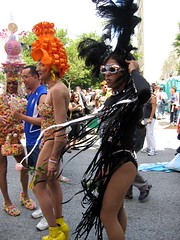
drag queensImage by mauri212 via Flickr
Source: New York Times

By Dan Bilefsky

NB: This article has been the subject of a letter labeling it as misleading.

Romulo Castro considered attending his asylum interview in Rosedale, Queens, dressed as Fidela Castro, a towering drag queen in six-inch stilettos, a bright green poodle skirt and a mane of strawberry blond hair. In the end, Mr. Castro, 34, opted for what he described as understatement: pink eye shadow, a bright pink V-neck shirt and intermittent outbursts of tears.

After years of trying to conceal his sexual orientation back home in Brazil (where Fidela never made an appearance), Mr. Castro had been advised by his immigration lawyer that flaunting it was now his best weapon against deportation.

“I was persecuted for being fruity, a boy-girl, a fatso, a faggot — I felt like a monster,” said Mr. Castro, who reported being raped by an uncle at age 12, sexually abused by two police officers, and hounded and beaten by his peers before fleeing to the United States in 2000. “Here, being gay was my salvation. So I knew I had to put on the performance of my life.”

Amid international outcry over news of the Czech Republic’s testing the veracity of claims of purportedly gay asylum seekers by attaching genital cuffs to monitor their arousal while they watched pornography, some gay refugees and their advocates in New York are complaining that they can be penalized for not outwardly expressing their sexuality. While asylum-seekers and rights groups here expressed relief that use of the so-called erotic lie detector is impossible to imagine in the United States, some lamented in recent interviews that here too, homosexuals seeking asylum may risk being dismissed as not being gay enough.

New service for queer Iranian refugees in Toronto

Logo of Iranian Railroad for Queer RefugeesImage via Wikipedia
Source: Iranian Railroad for Queer Refugees

The Iranian Railroad for Queer Refugees (IRQR) is providing a new service to Iranian queers especially those who lives in Toronto. Shila who is currently completing her Psychology degree at York University is one of our great volunteers at the IRQR. She agreed to moderate our weekly support group for Iranian queers who needs help.

We would like to invite Iranian queers to join us to meet others and share their concerns and worries in a completely friendly and confidential environment. We, also, would offer a phone line that would let those who cannot join us within the obtained hours, for any reason, to call in and share their concerns in Farsi.

These weekly meetings will taking place on Wednesdays between 2 to 3 pm at the IRQR conference room (Ontario Room) located at 20 Bay Street, 12th Floor in Toronto. If you do not live in Toronto or you prefer to talk over the phone, you can call us at 416-214-1840 (Switchboard) and ask the receptionist for the Ontario Room.
Enhanced by Zemanta

Sunday, 30 January 2011

African migrants report torture, rape on way to Israel

Map of the Sinai Peninsula with country border...Image via Wikipedia
Source: Al-Masry Al-Youm

African migrants en route to Israel are subject to torture, rape and assault by traffickers in Egypt's Sinai desert, Israeli Physicians for Human Rights (PHR) said, citing interviews it conducted with victims.

"From January to November 2010 we referred 165 women who travelled through Sinai to (Israeli) hospitals for abortions. We believe half of these women were sexually assaulted in Sinai," said Shahar Shoham, a case worker in PHR's open clinic in Jaffa.

PHR has been collecting testimony from migrants who say Bedouins whom they pay to smuggle them through Egypt's border with Israel hold them for days and sometimes weeks, demanding more cash and abusing them physically until the money is paid.

"I was beaten, electrocuted, tied up and thrown outside at night. We ate once in three days. There was one woman -- the traffickers raped her," Germai Omar, a 30-year-old Eritrean farmer, told Reuters in Tel Aviv.

He said he was detained for a month in the Sinai by the traffickers who demanded he add US$1,500 to the original fee of US$2,500. Omar contacted his family by cellphone and they gave the cash to the smugglers' contacts in Cairo.

Israel says some 35,000 migrants from Eritrea, Sudan and other African countries have entered the country illegally mostly in search of work.

British judge's ruling on Brenda Namigadde: ignorant but typical

Arms of the United Kingdom with Crown and GarterImage via Wikipedia  
By Paul Canning

The UK political gossip website Political Scrapbook this morning leaked the full judgment rejecting Brenda's fresh claim to pinknews.co.uk (overturned soon after by an appeal court judge, actually whilst Brenda was on the plane). Political Scrapbook highlights the judge's point that he was rejecting her in part because she didn’t read lesbian magazines or other media.

The judgment says:
“I find that the Appellant was not and is not, on the evidence before me, a lesbian. That her credibility is affected by her conduct. l am not obliged to accept her say so of these issues. l find such peripheral information to describe what went on, either in Uganda or in the United Kingdom, very generalised and quite simply lacking in the kind of detail and information of someone genuinely living that lifestyle. The Appellant claims to have freedom to live a life unconstrained and without prejudice. l find the information as to how she has done so over the lengthy period she has been in the United Kingdom singularly lacking in detail or coherence. The Appellant appears to have taken no interest in forms of media by magazines, books or other information relating to her sexual orientation. Whilst there is no requirement to do so it does seem strange, if she is exercising the real sense of freedom she claims, that she does not do so.”
As one commentator pointed out, the reference to magazines and books is demonstrably ignorant: "Asylum seekers in the UK live in extreme poverty and she would not have had the money to buy lesbian magazines, books or other media."

But this ignorance is not confined to the UK. The New York Times reported yesterday that American lawyers advise asylum clients to 'gay it up' for judges because of similar ignorance about who LGBTI people are.

Reports by Stonewall and by UKLGIG have found this sort of judgment in previous cases. Stonewall quoted one UKBA senior [my emphasis] caseworker as saying that in order to decide if an asylum applicant was gay, "I would look at how they've explored their sexuality in a cultural context - reading Oscar Wilde perhaps, films and music." The report says that many case workers, unsure how to treat sexuality-based claims, will deliberately refuse in order to hand it on for judicial decision.

Stonewall said that:
"Many judges, like Home Office decision-makers, struggle because they have no reference points to help them understand the reality of gay peoples’ lives in the UK and in other countries." 
"The feelings of shame, stigma and self-hatred that many gay asylum-seekers feel about their sexual orientation make it very difficult for them to answer these questions. Sexually explicit questions being asked by a figure of authority are even more difficult to answer. Applicants’ responses may therefore be vague or even evasive and these responses tend to be interpreted by judges as evidence that an applicant is lying and therefore may be used to dismiss an appeal."
Stonewall's report calls for judges to receive training on the effects of trauma and its impact on how people recount their stories at interview and in court and for The Judicial Appointments Commission to be asked by ministers "to take substantive steps to ensure that asylum and immigration judges start more effectively to reflect the communities they serve."

The government has promised that this culture within the immigration judiciary and within the UKBA would change. But many are cynical (or realistic) about how the system will react to efforts to change it.

An anonymous UKBA worker commentating on the freemovement blog's coverage of the Supreme Court decision which ended the 'go home and be discrete' policy said:
Now it’s down to the hard task of testing peoples sexuality, I am terrified to see what sort of questions the interviewers come up with….. Who is Dorothy?….. Is Lady Gaga a man?….. And of course following on from Lord Rodgers comments any man who can’t describe what Kylie was wearing at her last concert in great details or at least provide his ticket stubs will be disbelieved.
Past experience suggests that without serious, top-down leadership and direction, change will come extremely slowly.

S. Chelvan, human rights barrister at No 5 Chambers, says that last year's landmark Supreme Court decision ended the 'discretion test' laid down in a previous judgment. That could have been summed up as 'is being forced to be discrete ‘reasonably tolerable''. He points out in the Stonewall report that years after ‘reasonably tolerable' was clearly defined in law there were still judges making decisions which failed to use the ‘reasonably tolerable' test defined in then case law - and hence rejected asylum cases.

Others quoted in the Stonewall report point to judicial ignorance. Jody, a UKBA presenting officer, said:
"A lot of it comes down to the knowledge of the judges. You get judges who say well a parent would never report their own kids to the authorities for being gay, which shows a complete lack of understanding. They will beat them; they will kill them."
"Judges really bring their own prejudices to court and these affect their decisions seriously. Some will also bend over backwards to make sure the Home Office wins the case.
Robert, UKBA senior caseworker, said:
"The demographics of the judiciary haven’t changed. It’s still white, middle class males of a certain age and I’m not sure they fully grasp the concepts of identity issues."
S. Chelvan:
"I had a Pakistani client who was 17 when he came to the UK. He was found kissing his boyfriend, caught by the police and beaten over the head. In the UK he came out to his uncle who threatened him, told him to leave the house and said he’d inform his family in Pakistan that he was gay who would kill him if he ever returned. All these facts were accepted by the Home Office or the fast-track tribunal. However when the question was posed, on relocation outside his home area, what does he say when somebody asks him ‘Why aren’t you married?’ the judge said, well all he needs to say is, ‘I’m not the marrying kind’. That client is now in Pakistan hiding because he was sent back."
Adebayo, Nigerian asylum-seeker:
"I’ve got scars on my dick from when I was tortured, but the judge said they think the scars are just from having gay sex."
What is clear from this case and many others is that the Home Office has not fulfilled the Coalition government's promise. It is also clear that they have taken no notice of the massive campaign for Brenda and have refused to use the power which they possess to intervene.

Enhanced by Zemanta

Resource: In US, LGBT lawyers and firms now in searchable database

law lawImage via Wikipedia
Source: National LGBT Bar Association

A new searchable legal directory lists American firms owned by lesbian, gay, bisexual and transgender lawyers and partners who identify themselves as LGBT.

The directory lists partners from several top law firms, including Foley & Lardner, which sponsored the directory. The publisher is the National Lesbian, Gay, Bisexual & Transgender Bar Association.

The aim of the directory is to help diversity-minded clients locate LGBT lawyers, according to D’Arcy Kemnitz, executive director of the National LGBT Bar Association. The directory lists more than 300 LGBT lawyers who have made partner or established their own practices, according to a press release.
Enhanced by Zemanta

Saturday, 29 January 2011

Video: More criticism of Obama's immigration enforcement policy

ICE Special Agent arresting a suspect.Image via Wikipedia
Source: Chicago Tribune

By Antonio Olivo

More than three-quarters of the roughly 630 illegal immigrants in Illinois turned over to federal authorities under a program targeting hardened criminals had no prior criminal convictions, according to a report released 14 January.

Nationwide, 27 percent of those arrested under the federal "Secure Communities" program had no prior criminal records, according to an analysis of federal data from 2008 to last July 31 by the Illinois Coalition of Immigrant and Refugee Rights.

The findings, which were disputed by federal immigration authorities, add to a drumbeat of criticism by immigrant advocates frustrated by a lack of action in Congress even as deportations escalate — nearly 54,000 illegal immigrants have been kicked out of the country since October.

13 January, Chicago's City Council passed a resolution calling on the federal government to stop deporting people in "mixed-status" families, meaning some members have legal U.S. status.

Police disrupt Kenyan mourning for David Kato

Outside Ugandan Chancery

By Denis Nzioka

Gay Kenya members, human rights activists and LGBTI persons held a vigil at the Uganda High Commission’s Chancery in Riverside Drive amid tight watch and arrest threats from police officers called in by officials of the High Commission.

Members had first assembled at the Uganda High Commission Offices in Uganda House, Kenyatta Avenue to show solidarity with their Ugandan comrades after the killing of David Kato, a leading gay rights activist in Uganda. David Kato was killed after his photo appeared in a tabloid paper calling for his execution.

Gay Kenya’s Denis Nzioka and David Kuria, the organizers of the vigil, took a letter to the High Commission requesting permission to hand over the wreath and were told it was taken to the ‘right’ person. Half an hour later, some three uniformed Kenyan police officers came to the reception area and were lead inside the offices only to return a few minutes later and stood guard where the participants were seated.

Denis Nzioka reports that:
"One of the police officer took a call and I heard him saying over the phone that they (the police officers) were at the Uganda High Commission offices as they was a protest taking place and was asking if the (police) van had arrived. He was carrying in his hand the same letter we had given earlier."

Near 22m Africans left continent in 2010; biggest exodus by Nigerians

HULA LAKES, ISRAEL - NOVEMBER 27:  Migrating c...Image by Getty Images via @daylife
Source: Global Post

By Nigerian Curiosity

According to the World Bank's Migration And Remittances Factbook 2011, 21.8 million Africans left the continent in 2010. That number represented a total of 2.5% of the continent's population. Nigerians apparently left the country in large numbers as well, representing the 6th largest group of emigrants.

The top 10 countries from which Africans emigrated in 2010 are as follows:

   1. Burkina Faso
   2. Zimbabwe
   3. Mozambique
   4. Cote D'Ivoire
   5. Mali
   6. Nigeria
   7. Sudan
   8. Eritrea
   9. Democratic Republic of Congo
  10. South Africa

Friday, 28 January 2011

Brenda Namigadde wins second chance, no thanks to Theresa May

Terengganu Sports Complex at dawnImage by NeeZhom Photomalaya via Flickr
By Paul Canning

In an extremely last minute decision, Barrister Abdulrahman Jafar has managed to pursued an Appeal Court judge to grant an injunction stopping tonight's removal of Ugandan lesbian Brenda Namigadde on Flight VS671 at 9.20pm to Nairobi.

What is clear at this point is that the Home Secretary, Theresa May, had decided not to use her powers to prevent the removal.

All day and evening activists have been hoping for any sign that the government, particularly in the light of the murder of the Ugandan activist David Kato, would reconsider Namigadde's case. In the hours up to her flight, hopes were raised when The Guardian reported that the Shadow Home Secretary Yvette Cooper has put out a statement saying that she had been told that the 'case would be reconsidered'. Her lawyer last Monday filed a new claim for asylum, based in part on the deteriorating conditions for LGBT in Uganda. Did this mean that the new claim had been accepted?

The support for Brenda could not have been greater. At time of writing over 50,000 people have signed a petition from 160 countries. Theresa May's office had apparently been "deluged". Those using London's transport system today would have seen the free newspaper 'Metro' which splashed with Brenda's story on its cover. As the Guardian wrote, MPs have been making representations to May as have Euro MPs. Numerous media outlets have covered her story and shortly the BBC's flagship news shows 'Newsnight' will cover it.

I have been working on this case with the indefatigable  Melanie Nathan of LezGetReal - who secured the admission by 'Kill the gays' bill author David Bahati MP that Brenda must "repent" or be imprisoned if she returns to Uganda - and the great, new international LGBT defence organisation allout.org since last Sunday, when we first became aware of it.

Says Nathan:
"I am so relieved for Brenda - that she is safe. During those many hours of uncertainty, while advocating behind the scenes, I kept thinking of what it must be like to be Brenda in each of those given moments. How it must have felt to not know. How it must have felt when David Kato was murdered, when she thought all was lost; that ride to the airport. I believe notwithstanding the fact that she is safe, she has endured cruelty at the hands of the UK asylum system. What she has gone through has been psychological  torture.I hope this case will change how asylum is handled  for all LGBT people around the world. In the USA and in the UK."
However despite all the signatures, all the media attention, in the end her legal position revolved entirely on the government contesting whether she is in fact lesbian - and if that failed, which it nearly did, her will to physically resist removal.

As I wrote earlier in response to the statement of Matthew Coats, head of immigration at the UK Border Agency, who said: "Ms Namigadde's case has been carefully considered by both the UK Border Agency and the courts on two separate occasions and she has been found not to have a right to remain here.An immigration judge found on the evidence before him that Ms Namigadde was not homosexual."

UK Lesbian and Gay Immigration Group has shown that almost all of a sample of cases examined by them were initially thrown out, so Brenda's case could properly be said to have only been examined once. (There is no evidence to suggest that the rate of rejection has changed since the UKLGIG report was published a year ago. Anecdotal evidence is of an increase in challeges to whether claimants are gay or not.)

The one Tribunal hearing she had was missed by two witnesses who would have spoken to her sexuality - so on the basis of two people missing a hearing the risk would be taken to return her to a country where it is patently unsafe to be a lesbian? And there was other evidence presented by Brenda, including sworn statements.

At that point of rejection the odds were stacked against her. She was on the 'fast track' to removal.

The placing of sexuality-based asylum claims in the 'fast track' system has been heavily criticized. Once disproportionately initially rejected at 'first blush' LGBT are more likely to be placed in 'fast track' where applicants and their lawyers had much less time to prepare an appeal, for, it is argued, often complex claims to be properly considered.

LGBT are far more likely to initially claim on other grounds - because they come from the 'global south' and are closeted (it has been suggested that Brenda's decision to 'come out' late weighed against her). They can come up against homophobic translators or even those judging their claim, as documented in Stonewall's landmark report which includes interviews with Border Agents with little or no understand of the cultures they come from and hence the claimant's own regard of their sexuality. There are numerous reasons why these asylum claims are complex.

By coincidence this week the Conservative MP for Brighton, Kemptown, Simon Kirby, asked the Immigration Minister, Damien Green MP, in the House of Commons about whether he had given consideration "to the participation of (a) women and (b) lesbian, gay, bisexual and transgender persons in the detained fast-track procedure."

Green replied:
"Entry to the detained fast-track procedure is determined by reference to published policy available on the UK Border Agency website. The policy lays out categories of claimant who, for reasons of particular vulnerability such as late pregnancy, children or serious disability, are excluded from entry to the process. For all other claimants, the key factor determining entry to the process is whether a quick, fair and sustainable decision can be taken on the case."

"We do not intend to specifically add to an exclusion list all applicants on the basis of claimed or accepted gender, gender identity or sexuality. However, if on a case by case basis, any claimants from these groups are identified as having a claim of particular complexity, the general consideration referred to previously regarding amenability to a quick, fair and sustainable decision will apply."
Translation: we don't accept that these cases are complex. Green is here rejecting the evidence of the Stonewall report.

In another current Ugandan asylum case, still being appealed, gay man Garrick Nyeswa was told in his rejection letter that “there is no evidence to confirm that homosexuals are persecuted in Uganda.”

According to the Home Office's website, the latest 'country information' (known as COI and provided to Border Agents and used to make decisions) is from February 2009.

There has been consistent criticism of the quality of COI. As several reports have found, COI reports on persecution in individual countries is partial, inaccurate and misleading as well as out of date. It often conflicts with the Foreign Office assessment of the risks to UK LGBT citizens visiting the same country as well as information in the Foreign Office Human Rights Report.

During the election, then Conservative leader and now Prime Minister, David Cameron told me:
It's also important that the guidance the Home Office produces for asylum adjudicators to use in judging claims provides up-to-date and accurate information on homophobic persecution in every country.
The fresh claim for Brenda is partly on the basis of the new information of the deteriorating situation for lesbians and gays in Uganda, which appears to have been ignored in the assessment of her claim.

Yvette Cooper said in her comment today to the Guardian:
"The UK Border Agency's operational guidance for Uganda is now nearly two years old and does not mention LGBT rights. It needs to be updated as fast as possible to reflect the current situation on the ground."
The UK has previously decided to stop the return of failed asylums seekers: to Zimbabwe during the height of the violence there.

The government has been asked to recognise by Stonewall, UKLGIG and other NGOs that sexuality-based asylum cases are almost always complex, should be allowed more time and therefore not place them in 'fast-track': they have refused.

The Coalition government agreement says (page 18):
"We will stop the deportation of asylum seekers who have had to leave particular countries because their sexual orientation or gender identification puts them at proven risk of imprisonment, torture or execution."
The experience we have just been through with Brenda Namigadde demonstrates that they have broken this promise.

LGBT Asylum News has three separate and independent pieces of evidence that say that Brenda is a lesbian. We would not have embarked on this campaign if we believed she was not.

If we can demonstrate that in five days why cannot a system supposed to offer santuary to those who need it?
Enhanced by Zemanta

London vigil for murdered Ugandan activist David Kato; delivery of Brenda Namigadde petition

The UK's new Home Secretary, Theresa May, givi...Theresa May image via Wikipedia

The allout.org petition which sends email messages to Home Secretary  Theresa May to stop the removal of Ugandan lesbian asylum seeker Brenda Namigadde is passed 40,000 at 4pm GMT today and is adding many thousands every hour. Her office has said they are "deluged." As well many hundreds, if not more, supporters have sent individual emails and there is at least one other petition.

The petition was delivered to May at 12.30pm today, when that number stood at 22,000.

A vigil in memory of murdered Ugandan activist David Kato at 11am today (to coincide with David's funeral) at the Ugandan High Commission, demanded that Brenda not be removed.

Photos by James Murray.

LGBTI Kenyans react to murder of Ugandan activist David Kato

Source: GALCK

The Gay and Lesbian Coalition of Kenya is shocked and outraged at the news of the murder of David Kato, SMUG’s Advocacy and Litigation Officer. We join our Ugandan brothers and sisters in mourning this truly tragic attack on our community.

David had been an outspoken human rights defender who never shied from engaging the Ugandan society on the need of having all Ugandans including LGBTI Ugandans be treated as equal citizens under the law. This dastardly attack and murder of a LGBTI Human Rights defender is an attack on all of us and we support SMUG’s call for prompt and thorough investigations by the relevant authorities.

For those who do not believe that hate speech kills well here is the proof. Over the past few years, hate speech and action have been blowing into our region mainly led by American evangelical pastors. Together with hate filled pastors in the region a slow, poisonous and murderous environment has been created specifically targeting the regions LGBTI communities. We at GALCK denounce this movement and request all right minded people to condemn it and to work diligently to remove it from our midst.

Tony Blair and asylum: The narratives, conceptualisations, restrictionism

Logo Labour Party UKImage via Wikipedia
Source: Refugee Studies Centre

By Bethany Maughan

Over the last twenty years, there has been a radical shift in public perceptions of and political reactions to asylum seekers in democratic states across the world. As numbers of asylum seekers have risen, at times dramatically, governments of all political persuasions have implemented restrictionist policies designed to prevent and deter individuals from seeking asylum.

This political and conceptual transformation has been particularly marked in the United Kingdom. This paper seeks to examine the development of this restrictionist trend by exploring the conceptual foundations of New Labour’s asylum policies.

Tony Blair’s asylum policies: The narratives and conceptualisations at the heart of New Labour’s restrictio...
Enhanced by Zemanta

In Zimbabwe, LGBT rights worker speaks of her imprisonment

Ignatius Muhambi, left and Ellen Chademana employees of the Gays and Lesbians of Zimbabwe(GALZ), arrive at the magistrates courts in Harare
Source: mamba online

Ellen Chademana, a receptionist at Gays and Lesbians of Zimbabwe (GALZ), has written a frightening account of being arrested and tortured on a trumped-up charge of the possession of pornography. She, along with another GALZ employee Ignatius Muhambi, was arrested following a May 2010 police raid on the LGBT rights group’s Harare office.

An additional charge of "undermining the authority of or insulting [the] president" because of a placard that made a critical reference to President Robert Mugabe was not pursued by prosecutors. Both were acquitted on all charges by the courts; Muhambi in July and Chademana in December. It is believed that the raid and arrests were little more than quasi-official harassment against the LGBT community in Zimbabwe where homosexuality remains illegal - with penalties including jail-time.
Imagine spending your birthday surrounded by hostile strangers, with no decent clothing, no access to sanitary wear, in a cold and extremely filthy place, with human excreta all over the floor and being subjected to the most inhumane treatment.

Thursday, 27 January 2011

Wikileaks, the US Embassy Cables and Migration Issues

Seal of the United States Department of State....Image via Wikipedia   
Source: Franck Duvell: Diary on Human Migration Research

When ‘Cable gate’ – Wikileak’s publication of the US embassies’ reports to the US State Department Washington - hit the headlines in November and December 2010 I was wondering whether there is anything in it for migration and migration policy researchers. So far, I am not aware whether anybody else has already gone through the documents, so I had a quick look. Unfortunately, only a fraction of all cables – 2000 out of 251,000 - are already published on Wikileaks’ website (http://213.251.145.96/cablegate.html).

In short, migration and refugee issues only play a very minor role in the set of documents I have sifted through. And where these are mentioned this is mostly in the context of terrorism, general threats to regional stability and security or with respect to Muslim minority communities. The first impression from these cables is that from the US American consular perspective migration as such is not considered a major issue and is not causing great anxiety whilst Muslim migration and minorities and to some extent border security are issues of concern.
Worldwide: Some reference to migration can be found in the already notorious ‘reporting and collecting needs’ issued by the Secretary of State Hilary Clinton. For instance, the request for West Africa lines out to collect information on ‘population and Refugee Issues’, including ‘population movements in the region, and governments' involvement and response, indications of actual or potential refugee movements within or into the region, locations and conditions of refugee camps and informal refugee and internally displaced persons (IDP) gathering sites and transit routes’ government capability and willingness to assist refugees and IDPs, health and demographic statistics of refugees and IDPs, dynamics and impact of migration and demographic shifts’ (2009, http://213.251.145.96/cable/2009/04/09STATE37566.html). And also in Hungary information is requested on ‘demography, including ...migration’ and ‘plans and efforts to respond to declining birth rates, including through promotion of immigration’ (2009, http://213.251.145.96/cable/2009/06/09STATE62393.html). Similar requests were sent to many other countries.

Resource: forced marriage in the UK

Source: Foreign + Comonwealth Office

If you or someone you know is being forced into marriage either in the UK or abroad, you can contact the Forced Marriage Unit (FMU).

The FMU helps and advises people who are being forced into marriage. The FMU’s caseworkers understand the issues that  people from the LGBT community can face, including the family pressures and how dificult it is to talk about these situations. 

They do not judge.

The FMU offers confidential support and information and can also put you in touch with LGBT organisations that can support you.

You have a right to choose, and the FMU is there to help you.

You can:

  call  (+44) (0)20 7008 0151
    between 9am and 5pm,
    Monday to Friday
    Emergency Duty Oficer 
    (outside ofice hours) 
(+44) (0)20 7008 1500

  or e-mail   fmu@fco.gov.uk

Find out more about the work of the FMU at www.fco.gov.uk/forcedmarriage

FCO: information on Forced Marriage

LGBTI activist in Uganda believed murdered

Activist David Kato, RIP
Donations can be made in David’s memory to bring more legal and human rights work to Uganda, as well as providing safety and sanctuary for other Ugandans facing persecution by clicking HERE.

Source: Sexual Minorities Uganda (SMUG)

Sexual Minorities Uganda (SMUG) and the entire Ugandan Lesbian, Gay, Bisexual, Transgender, and Intersex Community stands together to condemn the killing of David Kato and call for the Ugandan Government, Civil Society, and Local Communities to protect sexual minorities across Uganda.

David was brutally beaten to death in his home today, 26 January 2011, around 2pm. Across the entire country, straight, lesbian, gay, bisexual, transgender, and intersex Ugandans mourn the loss of David, a dear friend, colleague, teacher, family member, and human rights defender.  

David has been receiving death threats since his face was put on the front page of Rolling Stone Magazine, which called for his death and the death of all homosexuals. David’s death comes directly after the Supreme Court of Uganda ruled that people must stop inciting violence against homosexuals and must respect the right to privacy and human dignity. 

Sexual Minorities Uganda and the Ugandan Lesbian, Gay, Bisexual, Transgender, and Intersex Community call on the Police and the Government of Uganda to seriously investigate the circumstances surrounding David’s death. We also call on religious leaders, political leaders and media houses to stop demonizing sexual minorities in Uganda since doing so creates a climate of violence against gay persons.

Val Kalende, the Chair of the Board at Freedom and Roam Uganda stated that:
“David’s death is a result of the hatred planted in Uganda by U.S Evangelicals in 2009. The Ugandan Government and the so-called U.S Evangelicals must take responsibility for David’s blood!”

Wednesday, 26 January 2011

In Thailand, the 'butch lesbian' subculture finds film outlet

Thailand, which has the world's only 'Tom' (butch lesbian) magazine, has a new 'Tom' movie. Doug Sanders reports.
The new Thai-language movie, "Yes or No" (Yak Rak Kor Rak Leoi), happily has English subtitles. There are two lead female characters.

Pie is a typical Thai college girl, dressed in the obligatory black skirt and white blouse. She is pretty, self-centered, bossy and from an apparently privileged and prosperous urban family background. In western slang, she is a ‘spoiled brat.’

Kim is a ‘farm girl.’ She is a ‘Tom’ with short hair, no visible breasts, and, in some scenes, cargo pants. She smiles boyishly on the cover of the November issue of the Thai language magazine Tom Act. Tom Act is celebrating its third anniversary.

Oops! Pie and Kim are booked together as roommates in a college residence. When Pie first sees Kim, she asks “are you a girl?” Kim is innocent; it seems, about being a Tom, asking what it means and what signals that she is a Tom. She has never had a boy friend or a girl friend, she says.

In Iraq, enforced disappearances threaten all

Iranian Martyr Cemetery in YazdImage via Wikipedia
Source: IRIN

Asma Al-Haidari, an Amman-based Iraqi human rights analyst and advocate, says the phenomenon of enforced disappearances in Iraq touches the whole population, irrespective of age, gender, ethnicity or religious belief.

The number of missing persons in Iraq ranges from 250,000 to over one million, according to the International Commission on Missing Persons (ICMP).

The length of time over which enforced disappearances have occurred in Iraq, starting with the Iraq-Iran war (1980-88), render this issue particularly complex, according to International Committee of the Red Cross spokesperson for Iraq Layal Houraniyeh. The issue of enforced disappearances in Iraq represents, according to IMCP, “a major long-term challenge”.

Article 2 of the International Convention for the Protection of All Persons from Enforced Disappearance defines enforced disappearance as “the arrest, detention, abduction or any other form of deprivation of liberty by agents of the State or by persons or groups of persons acting with the authorization, support or acquiescence of the State, followed by a refusal to acknowledge the deprivation of liberty or by concealment of the fate or whereabouts of the disappeared person, which place such a person outside the protection of the law.”

Human rights champion praises Scots welcome for refugees

Source: Scottish Refugee Council

Shami Chakrabarti, director of human rights organisation Liberty, called on Scots to ‘set an example of welcome’ to refugees from across the world today (Friday, 14 January)

Speaking as a guest at the Scottish Refugee Council Annual General Meeting, held at Edinburgh’s City Chambers, Chakrabarti stated the need to recognise the importance of the 1951 UN Refugee Convention, which marks its 60th anniversary this year.

She said: “The UN Refugee Convention is more important now than ever when we think of the refugees yet to come and the lives yet to be saved by this incredibly important document.

"The Convention isn’t just a wonderful, beautiful antique that we should treasure. It’s just as pertinent now as it was 60 years ago, and even more pertinent in our  shrinking, interconnected world. “I think there's a real opportunity for Scotland to build upon its tradition of warmth and welcome, and set an example here in the UK and in Europe for welcoming refugees. We don’t want a fortress Europe keeping refugees out.”

Chakrabarti is director of Liberty, a UK-wide charity which campaigns to protect our basic rights and freedoms. She is well-known as a commentator and challenger on human rights for us all – including people who’ve sought refuge in our country.

In the run-up to the UK Elections last May, Scottish Refugee Council joined Liberty and the Refugee Council in England to call on party leaders and candidates to sign an asylum election pledge and remember the importance of providing safety to people fleeing war, torture and persecution in debates on asylum and immigration. A total of 1,031 candidates signed the pledge including the leaders of all four main parties (Conservative, Labour, Lib Dems and SNP).

In 2011, Scottish Refugee Council, along with many other refugee charities, will be marking 60 years since the UN Refugee Convention was put in place. It is as crucial as ever that our governments honour their part in this lifesaving document – and continues to protect the rights of people fleeing war, torture and persecution.
Enhanced by Zemanta

Tuesday, 25 January 2011

UK preparing to put asylum seeking Ugandan lesbian "in real danger”

Get notified when this page changes!
by WatchThatPage.com

By Paul Canning

8.30 pm GMT, 28 January: Brenda has lost appeal for fresh claim. Final legal stop is if a Court of Appeal judge will reconsider. Activists are calling Virgin Atlantic to refuse to carry her on flight VS671 (Nairobi).
9.30 pm: The appeal court judge has granted a temporary injunctions stopping her removal.

Brenda Namigadde wins second chance, no thanks to Theresa May

British judge's ruling on Brenda Namigadde: ignorant but typical

Next hearing, Monday 7 February, Royal Courts of Justice.


A 22,452 strong petition for Brenda Namigadde was delivered to Theresa May MP, Home Secretary at the Home Office in London, Friday 28 January at 12.30pm.
More pictures from the vigil and petition delivery

  • Ugandan lesbian asylum seeker threatened with removal by UK today
  • 'Kill the gays' bill author sends her message: she should "repent and reform" or be imprisoned - she won't
  • Placed like other lesbian asylum seekers in fast track
  • Are new rules on treating such cases being applied?
  • Action alert: how you can help, sign petition
  • Guardian, Huffington Post, BBC, CNN coverage - Metro cover
  • Over 60,000 sign petition from 85 countries: 'deluge' of email
  • Leading Ugandan LGBTI activist killed, presumed murdered 
  • Does Foreign Office want Brenda saved, to weaken anti-gay Ugandan MP Bahati? 
  • Shadow Home Secretary told 'case is to be looked at again'
  • London Ugandan embassy vigil 
  • Bombshell info on why Brenda's lesbianism rejected 
  • Government DID refuse to intervene, ignoring campaign 
  • MP submits motion for Brenda to House of Commons

Updating, scroll to end

The author of Uganda's notorious 'kill the gays' bill has contacted a US journalist to pass the message to a lesbian asylum seeker to return home - but to stop being homosexual or she will be arrested.

Uganda-born student, Brenda Namigadde, 29, is currently detained in Yarl's Wood immigration removal centre and has a removal order for this Friday, 28 January. Asylum has been refused on grounds she is not believed to be lesbian and she has been placed in 'fast track. A fresh claim for asylum with new evidence was put in yesterday.

In an astonishing interview with the bill's author, David Bahati MP, Melanie Nathan of LezGetReal relates how Bahati contacted her, concerned about how Namigadde might be effecting Uganda's image.

Denise McNeill freed from prison, out on bail

O OUTRO LADO DO MEDO É A LIBERDADE (The Other ...Image by jonycunha via Flickr
The asylum seeker Denise McNeill was today given bail after nearly a year's detention in Holloway Prison, according to No One Is Illegal.

McNeill led a hunger strike last year in protests at conditions at Yarl's Wood detention centre, which was allegedly violently broken up by guards. She has been held at Holloway Prison since.
"I think they moved me from Yarl's Wood to cover up what they'd done: to stop my ability to talk out," she has said.
Source: NCADC

Yesterday, one of the Yarl’s Wood 3, Denise McNeil, was granted bail at an immigration court in Hatton Cross. Her supporters in the courtroom clapped as the judge made his decision.


Denise was released from Holloway prison this evening. She said
‘After 28 months, 1 week and 5 days I am finally reunited with my family and supporters. We’re going to keep campaigning for Sheree and Aminata and all the people in Yarl’s Wood until it’s closed’
In February 2010, refugees and migrants held at the Yarl’s Wood immigration prison organised a hunger strike, demanding an end to indefinite imprisonment and abuse. Their courageous protest lasted five weeks, despite violent attacks by Serco’s private security guards, who manage the detention centre. Their action was ‘for everyone in detention.’

Over 70 women of colour participated in the hunger strike which forced the authorities to release many of them. In retribution, several people involved in the hunger strike were singled out and moved to prisons. The effect of this is also to intimidate other detainees from speaking out about their experience of the immigration system.

After Denise was released today two women targeted in this way are still behind bars: Sheree Wilson and Aminata Camara. They are being held without charge and a court order. They have been away from their families, friends and communities for far too long. Today supporters said that the campaign to free them would continue.
‘We are delighted that Denise has been released from prison today’ one of her supporters said. ‘We will continue to fight for Sheree and Aminata to be granted bail and for Denise to stay in Britain with her children. When they try to silence people by putting them in prison we will fight back’
Supporters packed the court today to show solidarity with Denise. A letter from Denise’s youngest son was also given to the Judge. Denise said ‘Tre’s letter touched the heart of the Judge’. Several groups were represented including No One is Illegal, No Borders, Crossroads Women’s Centre, Communities of Resistance, Stop Deportation Network and members of the RMT.
1. For more information, contact George Lavender 07783322752 or email freedenisenow@gmail.com
2. On New Year’s Eve, friends, family and supporters of the Yarl’s Wood 3 came together outside Holloway Prison for a noisy demonstration of solidarity. Messages of support came from organisations and individuals in Britain, and around the world. In Sweden, a giant banner was hung in central Malmo, calling for ‘ Asylum for all in 2011′. indymedia
3. A Facebook page for the campaign has been created
4. Nick Clegg was widely criticized for ‘rebranding detention’
5. For more information about Denise McNeil’s campaign, visit her NCADC campaign page
6. Asylum seekers win new strength to fight after Yarl’s Wood hunger strike’
Twitter feed: @freedenisenow


Enhanced by Zemanta

The failure of UK MPs to hold Border Agency to account

BRIGHTON, ENGLAND - SEPTEMBER 30:  Keith Vaz, ...Image by Getty Images via @daylife
Source: openDemocracy

‘Much of the delay in concluding asylum and other immigration cases stems from poor quality decision-making when the application is initially considered,’ says Keith Vaz, chair of the Home Affairs Select Committee (HASC) in their report on the UK Border Agency’s work.

Two cheers for Vaz and the HASC! It might be three if only they were clearer and more forceful in their criticism of an agency whose deficiencies are systemic and rooted in a culture characterised by denial and deceit.

The automatic disbelief that greets asylum seekers from their first moment of arrival, coupled with a shocking disregard for human rights, compounded by the lack of legal services that might check official incompetence have created a Kafkaesque nightmare for vulnerable people who come to these shores seeking sanctuary.

‘More consistent and rigorous scrutiny of applications would lead to fewer delays, fewer appeals, less uncertainty for the applicant, less pressure on the officials themselves, and probably lower costs for the UK taxpayer,’ says Vaz, noting mildly that this ‘is also likely to require more consistent and considered direction from those setting policy for the Agency than has sometimes been the case.’

The MPs ‘lack confidence’ in the Border Agency’s effectiveness in ‘making sure that its contractors provide adequate training and supervision of their employees in respect of the use of force,’ and add: ‘This is a fundamental responsibility of the Agency and is not simply a matter of clauses in contracts or formal procedural requirements.’

But Vaz and his colleagues must be aware that the failings go far deeper than that. Last March, when Dame Nuala O’Loan, investigating allegations that contractors’ staff had roughed up asylum seekers, found ‘inadequate management of the use of force by the private sector companies’ and made 22 recommendations for change, UKBA chief executive Lin Homer did something quite extraordinary. She attacked the doctors and lawyers who had brought the abuses to light, for, ‘seeking to damage the reputation of our contractors’.

UN official: Europe is ignoring its refugee obligations

Source: UNHCR

A top UNHCR official has questioned the approach that some European countries take towards people fleeing the indiscriminate effect of generalized violence in countries like Afghanistan, Iraq and Somalia, saying it "often defies common sense."

UNHCR Director of International Protection Volker Türk, at a forum organized in Brussels 18 January to launch UNHCR's Commemorations Year in Europe, said that some asylum states maintain that people fleeing conflict or large-scale violence cannot qualify as refugees. Türk said he believed this went against the spirit of the 1951 UN Refugee Convention, adding that "protecting refugees is what the Convention is made for."

Türk, whose speech addressed protection gaps in Europe, noted that there had been debate in the European Union (EU) in the 1980s and 1990s about the "non-state agent of persecution" issue, with some countries arguing that persecution coming from non-state agents was not sufficient to merit granting refugee status. That debate was resolved by the adoption of the so-called EU Qualification Directive, which favoured a broader interpretation of persecution.

Article 15c of the document extends subsidiary protection to civilians who would face a risk of serious harm in a situation of indiscriminate violence if sent home. But this provision is couched in what Türk called the "convoluted language of political compromise" and, as a result, it remains little utilized.

Türk pointed out that despite the EU Qualification Directive some European countries still send people back to areas marked by generalized violence such as Afghanistan, where the fluid and volatile nature of conflict and the worsening situation had led to an increased number of civilian casualties, more frequent security incidents and significant population displacement.

Three men hanged for allegedly raping a teenage boy in Iran

Coat of arms of the Islamic Republic of Iran. ...Image via Wikipedia
Source: Gay Middle East

By Dan Littauer

The government run Iranian judiciary website reported that three men were hanged 24 January after their death sentenced was approved by Iran's supreme court. The three were arrested in June 2007 and later convicted in court for raping a teenage boy in Iran.

Many men are executed in Iran for alleged rape of another male, the Iranian penal code does not distinguish clearly between homosexuality, sodomy or rape. In many cases the Iranian courts sanctions confession under torture as evidence and a rather arbitrary ruling based on the "judges special knowledge." GME was, until now, unable to verify the details of this case - if the allegations were true or, as often the case, fabricated or distorted by the authorities.

Saghi Ghahraman, chair of the Iranian Queer Organization (IRQO) commented:
"there is a lack of transparency in the Iranian courts, which has always been a problem during the past 30 years. This has worsened following the 2009 elections, and includes all cases tried in courts and not only related to sodomy."
The name of the three men hanged today:
  • Ghavaam Ataakeshzadeh, son of Shakoor
  • Mustafaa Karimi Khanghaah, son of Mohamad
  • Reza Dehghaan, son of Hoseinali
Enhanced by Zemanta

Monday, 24 January 2011

In US, gay Romani Romanian seeks asylum

Flag of the Romani people, made using these di...Image via Wikipedia   
Source: CAIR Coalition

LK is a 23 year old Romanian citizen.  He entered the United States with his family either as a refugee on December 1, 2008 and adjusted to Legal Permanent Residence on July 13, 2009.  He fears returning to Romania because he fears persecution as a Gypsy and a homosexual.

LK claims that his family has been persecuted as Gypsies and that he was physically assaulted numerous times for being one.  He was forced out of school because people threw rocks at him when he tried to attend class.  He claims his grandfather was murdered for money and because he was a Gypsy.  He describes multiple incidents of persecution against his family because of their ethnicity.   He claims his mother also had difficulty finding work because she was a Gypsy.  LK claims that in 2007 there was an attempted kidnapping and attempted rape against his sister.  He also has stated that his sister’s son was kidnapped and sold.  LK’s sister has since disappeared and he fears she is dead.

LK is openly gay and enjoys wearing women’s clothing.  As a child his mother kept him inside often so that he would not be accosted for being gay. When he was approximately twelve years old, he says that he was pushed from a 3rd or 4th floor apartment window for being a homosexual.  He suffered a severe head injury which has caused permanent short term memory loss, as well as chronic headaches.  The police never pursued the matter.  LK claims to have been physically assaulted numerous times for being a homosexual.

In UK, new instructions on deciding LGBT asylum claims

'Sexual orientation and gender identity in the asylum claim' is the revised asylum policy instructions followed by asylum case owners in the UK Border Agency. They are the Government's policy on asylum and were required to be changed following last July's Supreme Court decision.

We will be discussing these instructions further in a future post.

Sexual orientation and gender identity in the asylum claim

Enhanced by Zemanta

Ezra Nawi: Activist in Palestine, in Israel and a gay Arab Jew

Ezra NawiEzra Nawi image via Wikipedia   
By Michael Luongo

The two men’s soft banter contrasts with their rough manual labor. They call each other “habibi,” Arabic for “darling,” as they belt out commands amid the harsh clanging of the metal pipes crashing into the bed of an ancient truck. On its own, habibi has no romantic meaning for men, but I also hear them say “karim” back and forth, meaning “gentle” or “kind” one, never sure if it's another term of endearment or talk about the work. The heavy pipes need several men to lift them carefully so they do not fall onto the excited children who have gathered in this blackened, scrap strewn metal shop in Yatta, in Palestine’s West Bank.

It’s an unusual scene beyond language.

The center of attention is the activist Ezra Nawi. At 59 years old, he is a Mizrahi, or Arab, Jew, born to Iraqi immigrants. Ezra is also openly gay. He is in trouble with the law, but not on this side of the Barrier Wall. It’s the Israeli government and Army that have launched a campaign against him, hauling him and his Palestinian former lover, Fuad, through the Israeli legal system. Ezra’s homosexuality is one weapon used against him.

Ezra has most recently been accused of striking an Israeli policeman during a February 2007 Palestinian house demolition, recorded in the 2007 film Citizen Nawi by Nissim Mossek. As the house collapses, Ezra and the policeman run in.

Related Posts with Thumbnails