Monday, 31 August 2009

Pakistan’s Undesirables: ‘Dealing with’ the Hijra Problem

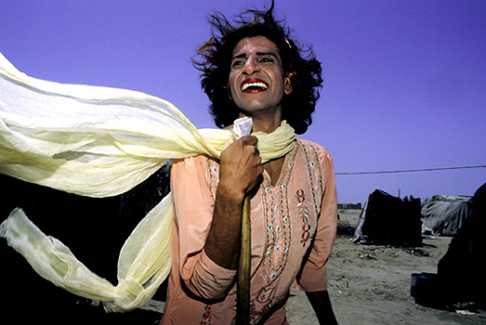
Free Sajjda still awaits Freedom!!

Free Sajjda still awaits Freedom!!


Source: Sherryx's Weblog


Through the last month, Pakistani media celebrated the recognition of the citizenship rights of the hijra community by a Supreme Court ruling which declared them entitled to ‘protection guaranteed under Article four (rights of individuals to be dealt with in accordance of law) and Article nine (security of person) of the Constitution’. The ruling has been hailed as an important step toward the integration of ‘the Third sex’ into the Pakistani society, who are now going to be registered and surveyed (with ‘Third Sex’ designating their gender on the ID cards and forms) so as to enable them to access the services of state social welfare departments and financial support programs. What does it mean – recognition of citizenship rights? It means enfranchisement, access to avenues of power and justice, along with better opportunities for education and health-care. But those lofty goals of modernity that always excluded the hijra are still going to remain out of their reach – the future of economic empowerment for anyone on the margins of Pakistani economy is bleak, the road to justice is not particularly favorable to the poor and the illiterate, and the hijra as yet do not enjoy any special ‘minority’ rights that are needed for political mobilization and combating discrimination in a liberal democracy. Yes, modernity in Pakistan does not seem likely to empower our social outcasts.

There has been little serious discussion of this SC ruling online or in the print media: no speculation whatsoever over the meaning of gender in Pakistan, or whether this ruling is right in creating a hijra subject for the purposes of bureaucracy. What is going to constitute ‘the Third sex’? And what happens to those who do not qualify for this category? What about those ‘gender-confused’ people who do not want to be identified as ‘Third sex’, preferring instead to be identified as ‘male’ or ‘female’?. According to the article quoted above, the hijra are ‘left by the society to live by begging, dancing and prostitution’, to be exploited by the ’self-styled guru’ – does it mean that after this ’social uplift’ program, they will be made to give up their lifetyle? What if they can’t? Does discrimination go away after formal barriers to progress have been removed, or does it merely become invisible and more difficult to fight? With the avenus of empowerment formally open to them, wouldn’t the society find it easier to blame them if their ‘begging and dancing and prostitution’ continues? Will they be persecuted or will we realize that a ‘respectable’ life is just not possible for the hijra without a radical change in the society, its institutions and maybe our ideas of ‘respectable’?
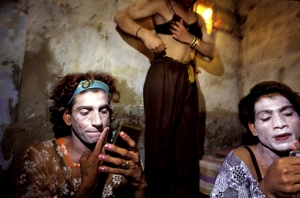
hijras_getting_dressed_copyThese questions do not surface because of the complete exclusion of a view from the transgender standpoint in our media. This not only means that the interests of the transgendered go largely unarticulated in our media, but also that the experiences of hijra remain shrouded in mystery. With a bourgeois mentality that is reluctant to recognize gender deviance (’inverted’ gender identification, same-sex desire, transvestism, and other inappropriate behavior, all of which, it can be argued, find a measure of acceptance among the more traditionally minded who allow their sons and daughters to join the hijra), the hijra are comfortably assigned a ‘Third sex’, . Online, a few articles can illustrate this: it is thought that the hijra are ‘almost invariably hermaphrodites’, when in fact they are not, consisting in a large number of ‘biological’ males who would be described in the West as ‘transgendered’ and ‘transsexual’. Because of that, you find people talking about ‘the true hijra‘ and ‘the cross-dresser’ who only tries to pass off as a hijra. The castration ritual evokes feelings of fascination and horror; it is something that goes against the ‘rational’ sensibilities of most Pakistani moderns. Of course most of us are conditioned to react with feelings of revulsion and pity for their lifestyle, associated with shameless beggary, singing bawdy songs, dancing in the streets, prostitution and even theft and kidnapping. But these feelings also show under the ruse of rationality in articles like this and this. Such write-ups also show the hijra as the enigmatic, untamed Other of the Pakistani society. This is why it is easy to link the hijra with the rise of prostitution, the spread of HIV and other ‘evils’, especially for those who do not want to criticize the system of relationships that produce these problems. It seems as if we do not want any understanding of the hijra; we have alwayswanted to fina a way to deal with them.

An understanding of the hijra begins with an understanding of the society. Ours is a society where, in traditional spaces, you find life strictly segregated on the basis of gender, and where it’s not segregated, there is blatant male privilege. The (patriarchal) family reigns supreme as an institution that organizes much of life, based on appropriate gender role socialization, a preference for sons over daughters, early marriages marked by ceremonies that are a public spectacle, and an exclusive system for the care of the young and the old. Transgendered children have an awkward presence in this life - they cannot take the responsibilities of a son, nor can they be married off. And who will take care of them when they grow old? All this makes the marginalization of all ‘gender-confused’ a necessary condition of our social organization. And the ‘unfortunate condition’ of the hijra as a community becomes even more understandable when you think about the effects of urbanization and modern life itself, which has taken away their traditional place in the society and exposed them to sexual exploitation

And so, I do not find this Supreme Court ruling very heartening. There’s nothing radical about it: by proposing that ‘the hijra problem’ can be solved by ‘registering and surveying’ them, it locates the problem in a few particular conditions of the hijra life, and not in the society. And of course no real change will be achieved: the program will suffer from the usual pitfalls of an inefficient bureaucracy. Moreover, the cause of the hijra is in danger of getting co-opted, who do not need to worry now that the State is doing all it can to save them. Gender injustice is a site of revolutionary potential, and that can be lost with the State apparatus formally committed to the ’social uplift’ of the hijra. But, like I said before, there will be no real ’social uplift’ because the focus is on saving them from this unfortunate situation, rather than working to change the deeply embedded norms of our society

But perhaps the greatest danger, to which I’ve only alluded so far, is further entrenchment of the gendered order. The hijra have traditionally aroused feelings of awe in the rest of the society, because they defied gender as taken for granted by everyone else. Increasingly, people’s attitudes toward them is changing, as people rid themselves of ’silly superstition’ and see the hijra as part of the lumpen masses. And I can see this official recognition as ‘the Third sex’ taking the demystification of the hijra further along. When they are seen as another sex category, the gendered body politic of the society comes to regulate and control them as well, their bodies becoming ’sexed’ and providing the basis of a sex role, a body ideal, and a clothing distinction that applies to their sex. Much more likely is a medicalized view that ‘pathologizes’ their condition as defective maleness or femaleness (’intersex’ as the medical classification goes), like it did in late 19th century Europe and became a part of the notorious eugenics movement. The concept of ‘intersex’ is heavily criticized by transgender activists in the US. In Iran, an adherence to this concept has led to a State-funded program of SRS operations which has both religious and scientific backing. The rationale behind these potentially life-threatening operations is the ‘integration’ of their ‘hijra’ into the society, but that does not necessarily mean a better life (from the documentary ‘Transsexuals in Iran’) for the gender-ambiguous of Iran.

At this point, we cannot project anything about the future of the hijra of Pakistan. But what is clear is that there are good reasons to be skeptical about this Supreme Court ruling. Perhaps then, the wise thing to do is to see this decision as inevitable in the given political context (as Basim Usmani reflects toward the end of his article), and not to endorse it as a positive step toward the liberation of the gender-ambiguous from an oppressive social structure.


Sunday, 30 August 2009

August 30 - International Day of the Disappeared


The International Day of the Disappeared is a reminder that hundreds of thousands of families are still unaware of the fate of their loved ones missing in conflicts.

UK is not a signatory to the *'International Convention for the Protection of All Persons from Enforced Disappearance'. The government is still considering all the legal ramifications of signature and ratification. In parliamentary debates Foreign Office ministers have reiterated that the UK has a policy of only signing a Convention if they have a commitment to ratify it within twelve months.

The International Coalition against Enforced Disappearances (ICAED) wants to put pressure on the UK government to sign and ratify the Convention for the following reasons:
* The ratification of the Convention would constitute an unmistakable signal that the government is committed to ensuring that enforced disappearances will not be tolerated.
* Signature and ratification of the Convention would provide protection for all British citizens anywhere in the world from enforced disappearance. Moreover, it would provide those victims and families of victims with the means to seek justice on their own behalf or on behalf of their loved ones.
* The problem of enforced disappearance is a global one. A global problem can only be countered with a strongly supported global solution.
* Signature and ratification of the Convention would improve the government's human rights legacy.
* The Convention would allow the UK government to address the matter of enforced disappearance carried out by other countries through the universal jurisdiction provision in the Convention.
* Finally, the Convention would put in place measures that would prevent the practice of enforced disappearance on UK soil.
In recent years there have been claims of UK complicity in rendition, secret detention and enforced disappearance of individuals in the context of counter-terrorism.

What ICAED want from the government of the UK

For the UK government to sign and ratify the UN Convention for the Protection of All Persons from Enforced Disappearance with no limiting reservations, in doing so sending a clear signal of their commitment to human rights internationally.

You can take action

ICAED ask you to E-mail/Fax/write a letter to the Secretary of State for Justice and Lord Chancellor, Jack Straw at the Justice Ministry. Model letter ICAED-JS.doc attached, which you can copy/amend, write your own version.

Rt Hon Jack Straw MP
Secretary of State for Justice and Lord Chancellor
Ministry of Justice
102 Petty France
London
SW1H 9AJ
UK
Fax: 020 3334 3668 from outside the UK ~ + 44 20 3334 3668

Amnesty International

"You could be taken at any time, day or night. You might be at home, at work or traveling on the street. Your captors may be in uniform or civilian clothes. They forcibly take you away, giving no reason, producing no warrant. Your relatives desperately try to find you, going from one police station or army camp to the next. The officials deny having arrested you or knowing anything about your whereabouts or fate. You have become a victim of enforced disappearance.

"Enforced disappearance is a grave human rights violation and a crime. Amnesty International defines an enforced disappearance as the detention of someone by the state or its agents, when the authorities deny that the victim is in custody or conceal what has happened to them. Enforced disappearances have occurred across the world - in Sri Lanka, Russia, El Salvador, Morocco, Iraq, Thailand, Pakistan, Bosnia, Equatorial Guinea, Egypt and Argentina, to name a few. No one is immune; victims have included men, women and children.

"An enforced disappearance violates the rights of both the disappeared person and their relatives. Disappeared persons are denied the right to a proper arrest and to a fair trial. They may be tortured, detained in poor conditions and eventually killed. The relatives of the disappeared persons suffer anguish every day, not knowing what has happened to their loved one; they are victims, too. They often encounter social isolation, with relatives and neighbors being too afraid to offer aid or support. If the disappeared person was the main breadwinner for the family, they can also suffer economic hardship. http://tinyurl.com/DayOfTheDisappeared

*'The International Convention for the Protection of All Persons from Enforced Disappearance' is an international human rights instrument of the United Nations and intended to prevent forced disappearance. The text was adopted by the United Nations General Assembly on 20 December 2006 and opened for signature on 6 February 2007. As of July 2009, 81 states have signed, and thirteen have ratified. It will come into force when ratified by 20 states-parties.
Reblog this post [with Zemanta]

Armenia: Homophobia turns deadly

Flag of Armenia (1918)Image via Wikipedia

Source: Global Voices

By Onnik Krikorian

Even if homosexuality was decriminalized in Armenia in 2002, society remains largely intolerant and traditional in its values. Naturally, in a country where nationalist ideology is also somewhat prevalent, fears that homophobia might turn even more extreme appear to be turning into reality. With blogs providing LGBT activists with a medium through which to voice their concerns, such fears can now be highlighted more openly than before.

This is especially true when in many cases it is actually the local media, and even some civil society groups, which seeks to promote homophobia. However, in recent weeks the level of intolerance in the mainstream media has alarmed many, with one newspaper going so far as to seemingly encourage hate crimes against members of the LGBT community in the country.

Pink Armenia comments on such developments.
It’s a pity but again l have read a homophobic article in an Armenian newspaper lately. […]

I don’t know why but almost all journalists mainly discuss the topic of homosexuality, I don’t know why but they never remember that there were and are many outstanding people among them, they just insist that it is amoral. It is evident misinformation of the society.

I won’t forget to mention that in the last article that I have read was a call to abuse and even kill homosexuals. I think that many will agree that appropriate punishment must be applied toward such people.
Unzipped: Gay Armenia also comments on what it views as a call to eliminate homosexuals in the country — literally.
When someone is homophobe, it’s bad enough. But when that homophobe advocates killing, he is crossing the line.

I have to confess, I do not read Iravunk tabloid. If it’s not for my friends, I would have been unaware of this whole bunch of ‘articles’ over the last week or so devoted to gays there.

[…]

Iravunk’s journalist then notes that “we do not want you to take this story as a call for killing. We simply wanted to present this story”. Obviously, what they effectively did is to advocate killing of gays.

[…] there is definitely enough evidence for opening the case against Galadjyan and his tabloid for inciting murder and hatred.

As a rule, one hate goes hand in hand with another hate. If you look at Iravunk’s articles, they are not just homophobic, but racist, full of hate to everyone who is different. […]
A week later, if such concerns might have been considered by some to have been exaggerated, the same blog reports that they were very real indeed.
Group of Armenian ultra-nationalists, a copycat of Russia’s and others’ neo-nazi, united under the so called Hayrenik (‘Motherland’) movement, published a post on their website threatening the life of Armenian author writing under the name Dori An. Dori An is the author of award winning gay-themed short story in Yerevan. […]

They provide Armenian government with the ultimatum type message: either you silence Dori An, using “legal means”, or we will do it by our means and methods. ‘Message’ is accompanied by Al-Qaeda terrorist-like picture, or its poor copycat.

Failing to produce any ‘results’ by ‘fighting external enemies’, and failing on all fronts, these ultra-nationalists try to create ‘internal enemies’ to justify their very own existence.

This is a direct threat to person’s life and the right for free speech, the very basic human rights protected under Armenian constitution. After all, this is effectively a terrorist-like ultimatum to Armenian government, and law enforcement agencies in Armenia should take up the case for further proceedings.
It remains to be seen whether the voices of such bloggers are heard by the authorities and action is taken to prevent homophobia in Armenia from turning deadly before it's too late.

Reblog this post [with Zemanta]

Saturday, 29 August 2009

Providing support for the Maldives

{{Potd/2007-12-25 (en)}}Image via Wikipedia

Source: Sydney Star Observer

By Lyndon Barnett

From his new home in New Zealand, Malé-born Grant (name substituted) and his boyfriend recently formed the Maldives’ first gay rights lobby and support group.

“We decided to found Rainbow Maldives as an online community that would support queer Maldivians and their allies, and help foster a sense of community, while maintaining enough anonymity to protect those who fear persecution or prosecution,” Grant said.

“Our group seeks to build and consolidate the Maldivian LGBTQ community, and increase queer visibility and awareness, with the eventual aim of making the Maldives a safer, more accepting place. The only platforms previously available online were focused solely on hooking up, so we’d like to move beyond that into slightly more productive areas.”

For Grant, the online option was a second choice to a visible presence.

“We tried to get to the heart of the queer community in the Maldives, before realising it couldn’t be done — the community was just too fragmented, too underground. In an Islamic nation with an increasingly radicalised religious community, it can be too dangerous for most people to be out. The Maldives enforces Sharia law, where convicted homosexuals generally serve a prison term,” he said.

“Pedophilia is also rampant in the Maldives, although until very recently no one really talked about it because there’s a stigma attached to homosexuality. Victims of sexual abuse where the abuser was of the same gender are often reluctant to talk about it for fear of being labelled gay. I was subjected to sexual abuse from age five to 16.”

In launching Rainbow Maldives, Grant hopes to capitalise on the current mood for change. In October 2008 the country saw the first-ever multi-party election, ousting Maumoon Abdul Gayoom from the presidency, which he had held since 1978.

“During the lead-up to the election a desire for change swept the entire country, with widespread political agitation taking place. After the success of the election, people felt change was within their grasp,” Grant told SSO.

“The queer reform movement is inextricably linked to the legal reform movement in general. Currently no defendant can be certain whether the case will be decided according to its merits, or according to the whim of the judge. Equality before the law and consistent application of the law are noticeably absent in the Maldives and until this is corrected, any lobbying for sexual rights is likely to be ineffective at best.”

Grant is heartened by the recent parliamentary elections where the conservative Adhaalath Party failed to secure any seats, demonstrating that Maldivians are potentially more moderate than previously thought.

Ultimately, Grant believes the first step to overcoming homophobia is education.
“Ignorance is rampant in the Maldives. The queer community needs to become more visible, and to educate the population at large about what it means to be queer. We’re trying to create an environment in which such a lobby group could be taken seriously,” he said.

“We feel even if the nation isn’t ready for change at a statutory level, dispelling gross ignorance will go a long way towards establishing a more positive environment for the queer community.”

Reblog this post [with Zemanta]

Friday, 28 August 2009

Swedish transgender belly dancer helps launch Arab gay initiative


Source: The Local

By Rami Abdelrahman

Dressed in a flashy black belly-dancing outfit, Nancy is a hobby transgender dancer from Iraq, ready to take to the stage with full make-up and skinny high heels. She is preparing to entertain more than 200 other Arab gays, lesbians and transgender people in Stockholm, Sweden.

The setting is the Stockholm headquarters of the Swedish Federation for Lesbian, Gay, Bisexual and Transgender Rights (RFSL). The occasion is the launch of Arab Initiative, the first Arab LGBT rights group in Europe.

Nancy has been in Sweden six years now. She lives with her Iraqi family in a Stockholm suburb and hides her preferred gender identity and hobby from her family.

“I was a hobby trans even back in Iraq. I believe most of my friends back then were bisexuals, they just refused to admit it, even if I had a relationship with them,” Nancy says, as she keeps watch of the entrance to the RFSL party premises.

She lets a fellow Iraqi in, and kisses him on both cheeks. Turning around, Nancy says her family would never accept her lifestyle and explains how she has to stay out with other Iraqi friends when she’s in town dressed up as the person she prefers to be.

“However, people here are more open to accepting a transgender belly dancer than in the Middle East.”

Ali, who started the Arab Initiative, takes some time off from serving alcoholic and non-alcoholic drinks to members and their friends to speak about the purpose of the organization.

“Our aim is to create new bridges between European and Arab cultures, spread information about the Arab world in Sweden, support LGBT people with an Arabic background, and hopefully to bring more tolerance and understanding of their issues and defend their rights in Sweden and abroad,” he says.

“We as Arabs are discriminated against in general as an immigrant group, and then we are discriminated against again amongst our own minority for being gay,” he adds.

Ali and his peers have received funding from the European Union, which supports several LGBT organizations for immigrant minorities around Europe.

Since its establishment last May, the Arab Initiative has held parties, partaken in two Pride festivals, arranged three film showings, and four seminars.

“We have been making connections with LGBT groups in the Middle East, promoting ourselves locally through word of mouth, and standing up for LGBT rights against media producers who portray this particular group in a negative way.”

Ali adds that it is not a political organization, but mostly a place for Arab LGBT people to find support and meet their peers.

Karin Båge, head of RFSL in Stockholm, says that her group was contacted by the Arab Initiative. RFSL quickly gave the group full access to its premises, skills, and contacts.

The difficulties faced by gays in Iraq was brought into sharp relief this week as Human Rights Watched published details of a murderous militia-led campaign against homosexuals in the Middle Eastern country. In response, RFSL called on the Swedish government to halt all deportations to Iraq of people who have sought asylum on the basis of sexual orientation or gender.

"We urge Sweden to investigate the possibility of evacuating homosexuals, bisexuals and transgender people who are at risk of being subjected to 'sexual cleansing'," RFSL chairperson Sören Juvas wrote in a press release on Monday.

Sa’ad Ibrahim, 37, is an Iraqi citizen who was granted asylum last May after being threatened with death due to his sexual orientation.

“One day in 2006, I received a call between 8 and 9 in the evening when I had arrived home from work. A friend of mine told me that another friend of ours had disappeared. So we asked around and after ten days we found out that his dismembered body had been found. Three of my friends were killed this way. I am the only one alive in my previous circle of friends,” Sa’ad tells The Local.

He had previously received written threats in his ladies’ shoe shop in a conservative Shiite district of Baghdad, where he was told he was a “fag” and that “God hates fags."

“Around 9.30 to 10 at night there were six people asking about me around the corner. I got the message to leave before they made it to my shop: I escaped through the back door and left everything behind me. I went far away to my uncle’s place where I stayed for the next five months. Every day I would imagine myself torn to pieces.”

He made his way to Sweden through a smuggling network, using up all the money he had managed to gather. When he came to Sweden he was devastated and lonely, he says.

“Now I am very happy because here I am able to mingle and mix with all sorts of people. I met an Iranian man who became my boyfriend. I fell in love with him, as he took me to the Pride festival, which turned my life around 180 degrees. I was totally amazed by the energy of the festival.”

Meanwhile, it was time for Nancy to mount the stage and wow the crowd with her belly dancing shakes to Arabic music. Swedes, Arabs, Africans and people of other ethnicities, men and women, straight and gay, gathered around the stage and clapped to the rhythm – a sight unseen in any Arab country.

Ali said the Arab Initiative will be organizing similar parties this autumn. The soonest will be in observation of Ramadan, the holy fasting month in the Islamic calendar, which starts this Saturday.

Wednesday, 26 August 2009

Campaigners attack asylum support pilot

Street Sleeper 2 by David ShankboneImage via Wikipedia

Source: Inside Housing

By Emily Twinch

A pilot scheme designed to get rough sleeping failed asylum seekers off the streets faster has been criticised for being too narrow and bureaucratic.

Campaigners say the trial should be open to families, and that the form that has to be completed to access support is overly complicated.

Failed asylum seekers who are unable to go back to their home countries qualify for support from the government under section 4 of the Immigration and Asylum Act 1999.

The pilot scheme, which was due to be launched earlier this month, is supposed to help eligible parties get quicker access to accommodation.

Voluntary groups are asked to identify people who are 'genuinely street homeless' and qualify for the support in one or two days. They are then moved to a hostel in Birmingham until section 4 accommodation can be found with one of the government's providers, which should take place within nine days.

The process is underpinned by a new national application form, and should be faster than current schemes which can take several months. But organisations dealing with asylum seekers say the form will make it more difficult to get help.

Dr Rhetta Moran, matron of Refugees and Asylum Seekers Participatory Action Research, said: 'This is really about finding other ways to limit the numbers of section 4 awards.

'What they are doing is asking for a deeper level of information about your homelessness.'

Campaigners have also criticised the pilot for being for single adults and childless couples only.

Dave Stamp, project manager of Asylum Support and Immigration Resource Team, said: 'The pilot projectŠ specifically excludes some of the most vulnerable groups, stating that it "will be for adult singles and childless couples only".'

Gerry Hickey, legal advisor at Asylum Support Appeals Project, added: 'It's a step in the right direction, where people qualify they need to be supported immediately.

'But it needs to be rolled out to everybody. It's a shame it does not include families because they are often the most vulnerable.

'We are concerned about the length of the form and the time and resources of smaller organisations to fill that in and whether people will understand it'.

A Home Office spokesperson said: 'This [new] form provides the UK Border Agency with more information than before. It also removes the need for UKBA to request more information, which happened in some cases.
'The form was introduced following lengthy consultation with key stakeholders including the voluntary sector. We will review the form after three months of operation.'
Reblog this post [with Zemanta]

Tuesday, 25 August 2009

Gay Iranians face stark decisions, slim hopes in election unrest

After his arrest Hamid was held in detention for 48 hours, where he alleges he was beaten with an electric baton.


Source: Xtra

By Greg Beneteau

The plight of many politically active gay Iranians is typified by Hamid, a 29-year-old who volunteered in the campaign of presidential candidate Mir-Hossein Mousavi.

Hamid (an alias used to protect his identity) was arrested by police in 2007 during an entrapment campaign targeting gay chat rooms. While in custody his interrogators made him sign a document confessing his homosexuality.

So when Hamid was rounded up at a pro-Mousavi demonstration in Shiraz last month authorities wasted no time making an example out of him. He was held in detention for 48 hours, where he alleges he was beaten with an electric baton. At publication time he was trying to cross the border into neighbouring Turkey and seek asylum.

The pictures he sent to Arsham Parsi, executive director of the Toronto-based Iranian Queer Railroad, highlight the bleak reality faced by queer Iranians following the contested reelection of President Mahmoud Ahmadinejad in June.

"He decided to leave the country because his security and well-being were at risk," says Parsi, who has been advising Hamid on how to obtain refugee status.

Parsi says that many Iranian queers campaigned for Mousavi, considered a moderate, or the reformist candidate Mehdi Karroubi — anyone but Ahmadinejad, whose term in office was marked by vigorous persecution of gays.

Several gay Iranians have reportedly been arrested as part of the government's bloody crackdown on street demonstrations. Those who are already known to be gay risk jail time or abuse in Iran's notorious prison system, says Parsi.

The dangerous situation has led to a jump in the number gays fleeing the country. In a typical month, Parsi says, the Iranian Queer Railroad becomes aware of one or two refugees applying for resettlement in a queer-friendly country. But in the last two months "we've received 15 applications, which is a high volume," says Parsi.

The involvement of gay protesters in the fight over Iran's presidency might baffle some Western observers. What could they hope to achieve when the true power lies with the country's theocratic rulers?

Given the Islamic republic's entrenched system of sharia law, which dictates the death penalty for gay sex, improvements in queer rights are usually measured by how much authorities turn a blind eye, notes Janet Afary, professor of history and women's studies at Purdue University and author of Sexual Politics in Modern Iran.

Under the leadership of reformist president Mohammad Khatami from 1997 to 2005 authorities observed a "don't ask, don't tell" policy around gay relationships and even allowed the publication of queer newspapers.

"They were not accepting of homosexuals but they were not aggressively pursuing them, either," says Afary.

Ahmadinejad, on the other hand, pioneered using the internet to track down gays while paradoxically telling US students at Columbia University in 2007, "In Iran we don't have homosexuals like in your country."

The lack of discussion about gay rights in the reform camp could signal a disinterest in continuing the provocative policies of the past four years, Afary says.

"If anything, at this point I think [change] would mean simply ignoring gay relationships, as they had done before."

Still, the protests provided hopeful signs for change on the horizon. Afary says the prominent presence of women in street protests hinted that the unrest was being driven by a "sexual revolution" — an expression of discontent over Iran's strict enforcement of gender and sexual morality.

During the election campaign candidates like Mousavi and Karroubi (backed by a majority of Iranians, according to independent polls) proposed an end to state-sanctioned polygamy and greater rights for women in marriage and divorce.
The issue showed Iranians had become disillusioned with the state regulating people's personal lives, says Afary.

But Peter Tatchell, a prominent UK gay rights activist and critic of Iran, doubts feminism in Iran would have spill over effect for gay rights.

"Quite rightly [feminists] fear that embracing the LGBT cause will be used by the regime to discredit the women's movement," he says, adding that support of gay rights would likely cause a rift between progressive and religious factions of Iranian feminism.

Confronting sexual violence is another way reform activists have challenged social norms. Following the arrest of hundreds of post-election demonstrators both male and female detainees came forward to allege rape at the hands of prison guards.

Accusations of sexual violence in Iran are usually considered taboo and handled quietly but this time the victims found high-profile backers inside the country, including Karroubi, who asked for a meeting with senior officials to present evidence of the crime. Media outlets in Iran reported the allegations, prompting widespread debate.

Such frank discussions about sexual abuse are "unprecedented" in the country's history, says Afary. "In previous decades people would usually not want to divulge such issues. They would be too ashamed.... [Now] there is a discussion and conversation in Iranian society on rape as a weapon of war, essentially."

These tentative steps suggest the current regime's stranglehold on sexual morality is beginning to loosen. But for gays like Hamid who marched and suffered with his fellow countrymen, Parsi says even victory for the opposition wouldn't improve their lives in the short term.

"It was never a choice between good and bad," says Parsi. "It was a choice between bad and worse."

Monday, 24 August 2009

Senegal: Free the Men Arrested for Homosexuality in Darou Mousty


Source: International Gay and Lesbian Human Rights Commission (IGLHRC)

On June 19, 2009, four men from the city of Darou Mousty, in the department of Kébémer in the Louga region, were arrested and subsequently detained at a police station in the city. These four men were arrested for alleged sexual acts “against nature.” There are also reports that the police forced these men to reveal the names of people who are supposedly “homosexual.” The week of August 10, 2009, two of the men were convicted of “unnatural” offenses, despite the only evidence against them being denunciations from townspeople. One man received a sentence of 2 years in prison and the other 5 years. A third man, who is seventeen years old, will stand trial August 24, 2009 in a court for minors. The status of the fourth is unknown.

Senegal is one of the few francophone African countries that criminalizes homosexuality, under Article 319 of the Senegalese Penal Code. Last year, nine members of AIDES Senegal were arrested and sentenced to 8 years in prison for “indecent conduct and unnatural acts” and “conspiracy.” The Court of Appeals in Dakar overturned the sentences in April 2009.

Laws criminalizing and detentions of people because of consensual sex between persons of the same sex are arbitrary and violate international law. Such laws violate Articles 2 and 26 on the rights to equality before the law, freedom from discrimination, and privacy of the International Covenant on Civil and Political Rights, as stated in Toonen v. Australia (1994) and by the U.N. Working Group on Arbitrary Detention. In addition, the Committee on the Rights of the Child has stated its concern over laws that criminalize “homosexual relations, including those of persons under 18 years old” as being impermissible discrimination on the basis of sexual orientation under the Convention on the Rights of the Child (General Comments 3 & 4, Concluding Observations: Chile, April 2007).

The criminalization of consensual same sex relations runs counter to the guarantees of nondiscrimination and equality before the law in Articles 2, 3, and 28 of the African Charter on Human and People’s Rights and Article 7 of the Senegalese Constitution.

More information on lesbian, gay, bisexual, and transgender (LGBT) issues in Senegal.

Take action

Join the International Gay and Lesbian Human Rights Commission (IGLHRC) in calling on the Senegalese government to release the men convicted, to not convict the 17-year-old awaiting trial, and to end the pattern of systemic persecution against perceived sexual minorities by repealing Article 319.

Click here to send a letter of protest to the Senegalese authorities.

Contacts:

Mr. Abdoulaye Wade, President of the Republic

Avenue Léopold Sédar Senghor BP 4026
Dakar, Senegal
Telephone : (221) 33 880 80 80

Mr. Souleymane Ndéne Ndiaye, Prime Minister

Building Administratif - 9e étage - BP 4029,
Dakar, Senegal
Fax: (221) 33 823 44 79
Email: Premier.ministre@primature.sn

Mr. Pape Diop, President of the Senate

52, rue Mouhamed V
Dakar, Sénégal
3131 DK.RP
Fax: (221) 33 821 16 52
Email: info@senat.sn

Mr. Cheikh Tidiane Sy, Minister of the Interior

Pl. Washington - Bd de la République BP 4002,
Dakar, Senegal
Fax: (221) 33 821 0542

Mr. Madické Niang, Minister of Justice

Building Administratif 7e étage BP 4030
Dakar, Senegal
Fax: (221) 33 823 2727

Mr. Paul Badji, Ambassador of the Permanent Mission of the Republic of Senegal to the United Nations

238 E 68th Street
New York, NY 10065
Fax: +1 212 517 3032
Email: Senegal.mission@yahoo.fr

Mr. Amadou Lamine Ba, Ambassador of the Embassy of Senegal to the USA

2112 Wyoming Avenue, NW
Washington D.C., 20008
Fax: +1 202 332 6315
Email: contact@ambasenegal-us.org, alsarba@yahoo.com

Mr. Ousmane Camara, Ambassador of the Permanent Mission of Senegal to the United Nations in Geneva

93, rue de la Servette
1202 Genève, Switzerland
Fax: (+41 22) 740 0711
Email:mission.senegal@ties.itu.int

CC : communications+action.alert@iglhrc.org


Suggested letter

Your Excellencies:

I am writing to express my concern and disappointment over the recent reports of the arrests of June 19, 2009 and the convictions of the week of August 10, 2009 of four men in the town of Darou Mousty in Louga for alleged homosexual acts. A third man, who is seventeen years old, will stand trial August 24, 2009 in a court for minors. These men were targets of persecution because of their perceived sexual orientations and were convicted without evidence beyond denunciations. There are also reports that they were forced by the police to denounce others.

I call on you to support the release of all these men just as the Court of Appeal in Dakar did in April 2009 when it released the nine men arrested and convicted under Article 319 of the Penal Code, which criminalizes consensual sex between persons of the same sex. Due process and equality before the law are fundamental commitments that Senegal has enshrined in Articles 7 and 9 of its Constitution and in other laws, and must be respected for all people, regardless of their actual or perceived sexual orientation.

I also call on you to repeal Article 319. The criminalization and detention of people because of their actual or perceived sexual orientation is arbitrary and violates international and African law. Laws criminalizing consensual homosexual sex violate Articles 2 and 26 on the rights to equality before the law, freedom from discrimination, and privacy of the International Covenant on Civil and Political Rights (ICCPR), as stated by the Human Rights Committee in Toonen v. Australia (1994) and by the U.N. Working Group on Arbitrary Detention. In addition, the Committee on the Rights of the Child has stated its concern over laws that criminalize “homosexual relations, including those of persons under 18 years old” as being impermissible discrimination on the basis of sexual orientation under the Convention on the Rights of the Child (General Comments 3 & 4, Concluding Observations: Chile, April 2007). The criminalization of consensual same sex relations also runs counter to the guarantees of nondiscrimination and equality before the law in Articles 2, 3, and 28 of the African Charter on Human and People’s Rights.

The arrest and conviction of these men is an instance of the systemic persecution sexual minorities and their defenders in Senegal. To ensure the human rights of all people, this law must be repealed and the people it targets must be protected from discrimination and abuse.

Sincerely,

Name:
Organization:
Country:

Reblog this post [with Zemanta]

New Zealand Refugee and Asylum Policy

Source: gaynz.com

By: Craig Young

After the resolution of provocation defence and adoption reform issues, asylum and refugee policy may be the next major area of concern for LGBT New Zealanders. As I’ve noted beforehand, there are a handful of homophobic ‘black spot’ nations whose LGBT inhabitants are at risk from human rights and civil liberties violations.

New Zealand should be doing more about this, through renewed governmental human rights initiatives and membership of multilateral forums like the United Nations, APEC and CHOGM. Furthermore, we should press for an increased overall intake of refugees and asylum seekers from societies like Uganda, Nigeria, Zimbabwe, Iraq and Iran, given their current crises. Russia and Jamaica are in a different situation, given that Jamaica suffers from widespread poverty. However, economic pressure might be prudent in this situation, especially insofar as the United Nations and CHOGM are concerned. Perhaps UNDP Director Helen Clark could be constructively lobbied to this end.

Expatriate Australian UK LGBT rights activist Peter Tatchell is fiercely critical of the British asylum seeker process, arguing that it imposes impossible burdens on potential claimants who are trying to escape transphobic and homophobic persecution in their countries of origin. He argues that British asylum seeker policy seems deliberately intended toward often erroneous assumptions that all asylum seeker requests for sanctuary are somehow “fraudulent.” Detention, torture and rape are insufficient grounds in themselves, and LGBT asylum seekers may be forced to return to societies like Iran or Jamaica, which have execrable LGBT human rights and civil liberties records, he argues.

Granted, New Zealand doesn’t have as dire a recent history of asylum seeker abuse as Australia did during the Howard era, and its shameful detention seeker camps in the outback, in which asylum seekers did not receive social welfare benefits and suffered prolonged isolation and imprisonment until the Rudd administration closed them down. However, in our own case, the Ahmed Zaoui case suggests that refugee and asylum policy here may not be as resilient as it could be. One should watch forthcoming developments in this policy area with interest and concern.

Reblog this post [with Zemanta]

Sunday, 23 August 2009

The right to be gay and Muslim

Source: Radio Netherlands Worldwide

Gay in Egypt
Homosexuality is not specifically prohibited in Egypt, but gays are regularly arrested and charged with “debauchery”. One of the most infamous cases occurred in 2001 when 52 men were arrested during a police raid on a floating night club, the Queen Boat.
We speak to one of the men, Mazen who was jailed for a year and sought asylum in France.

Listen

Gay life in Istanbul
Homosexuality is not illegal in Turkey but gays and lesbians are regularly harassed by the police and the general public. Homosexuals, bisexuals and transgender people have been fighting for over a decade to create space for themselves.
We talk to Emre-Can, a young man living in Istanbul, about gay life in Turkey.

Listen

The gay Imam
Most Muslim clerics condemn homosexuality outright, citing several verses from the holy Koran. But there are Imams who are actually gay themselves. Eric Beauchemin speaks to Imam Muhsin Hendricks from South Africa who explains how he reconciles his faith with his homosexuality.

Listen

Saturday, 22 August 2009

Sweden refuses asylum to homosexual Iraqis


Source: The Local

A Swedish gay rights organisation has called on the government not to deport any homosexual Iraqi asylum seekers in the light of a shocking new report categorising an extermination campaign against gay men in the Middle Eastern country.

According to a new report from Human Rights Watch (HRW) gay men in Iraq run a high risk of being tortured or murdered by Iraqi militias.

The Swedish Federation for Lesbian, Gay, Bisexual and Transgender Rights (RFSL) has now called on the Swedish government to halt all deportations to Iraq of people who have sought asylum on the basis of sexual orientation or gender.

"We urge Sweden to investigate the possibility of evacuating homosexuals, bisexuals and transgender people who are at risk of being subjected to 'sexual cleansing'," RFSL's chairperson Sören Juvas writes in a press release on Monday.

The HRW report, entitled "'They Want Us Exterminated': Murder, Torture, Sexual Orientation and Gender in Iraq,", details that Mahdi army militias are behind a campaign that began in the western Baghdad suburb of Sadr City and has now spread to cities across the country.

"A wide-reaching campaign of extrajudicial executions, kidnappings, and torture of gay men...began in early 2009," the human rights group writes in a 67-page report published on Monday.

According to Amnesty International, cited by the Dagens Nyheter (DN) newspaper, 25 gay men have been murdered in Iraq so far this year.

According to Swedish Migration Board (Migrationsverket) figures around 300 people apply for asylum in Sweden each year on the grounds of their homosexuality.

There are no official figures for how many are approved or denied but according to cases witnessed by RFSL's refugee administrator in Stockholm as many as a third may be refused, DN writes.

According to the 2005 Swedish Aliens Act a refugee is classified as an "alien" who "feels a well-founded fear of persecution on grounds of race, nationality, religious or political belief, or on grounds of gender, sexual orientation...or because of his or her fear is unwilling, to avail himself or herself of the protection of that country."

"It is unreasonable to blow your own trumpet with a law that should give protection but in practice is not used. Then it would be better if the government were honest and says that it does not consider it an important issue," Sören Juvas at RFSL says.

Reblog this post [with Zemanta]

Friday, 21 August 2009

Detention, Removal and People Living with HIV

In recent years, there has been increasing concern at failures to meet the HIV-related needs of asylum applicants. In particular, the process of detention and removal has resulted in real difficulties for asylum seekers living with HIV.
Advice for healthcare and voluntary sector professionals

This booklet is a practical resource that provides information and advice for healthcare, voluntary sector and other professionals working with detained HIV positive asylum seekers in Immigration Removal Centres (IRCs). It may also be helpful for those working with HIV positive detainees in other detention settings such as short-term holding facilities or prisons.


NAT and BHIVA Booklet on HIV and Removal Centres (June 2009) EMAIL-1

Thursday, 20 August 2009

Trinidad: CAISO – seeking equal rights for gays, lesbians


Source: Trinidad + Tobago's Newsday

By MELISSA DASSRATH

For those who know the anguish, shame and self-loathing that goes with caging your identity in the closet, the organisation Coalition Advocating for Inclusion of Sexual Orientation (CAISO) has emerged with the hopes of educating policymakers and pushing for policy reform. CAISO is of the view that the goal of Vision 2020 is obsolete if the Government continues to turn a blind eye to issues of gender identity and sexual orientation.

CAISO which was formed a month ago, is one of the many incarnations of organisations representing members of the gay, lesbian, bisexual and transgender (GLBT) community in the country. Existing members of Friends for Life, 4 Change, Velvet Underground, Men who have Sex with Men (MSM) and the Trinidad and Tobago Anti-Violence Project made a collective decision to come together and lobby for the GLBT community to be included in the National Gender Policy.

The group was formed as a reaction to the unsettling statements made by the Minister of Community Development, Culture and Gender Affairs, Marlene McDonald, expressing her ambivalence to GLBT people of Trinidad and Tobago. Speaking at a post-Cabinet press conference about the draft document for the National Gender Policy and Action Plan, Minister McDonald declared: “We are not dealing with any issues related to...same-sex unions, homosexuality or sexual orientation.”

CAISO was appalled by the archaic approach to dealing with the issues of sexual orientation and are actively campaigning for acceptance and equality. David DK Soomarie told Sunday Newsday: “The Minister’s statement was sadly, sadly 1919. Saying that you are not dealing with your own citizens is the kind of power-drunk thinking that we expect from unaccountable governments in places like Iran and Zimbabwe, not here in Trinidad and Tobago. Our vision is to build Trinidad and Tobago into a developed nation in its treatment of sexual orientation and gender identity.”

Local poet Jaase wondered: “When will the government show its commitment to the citizenship and human rights of the GLBT people, who are the fabric of our nation, if they won’t do so in the National Gender Policy.” While Pride Month marks the 15th anniversary since the first GLBT event, CAISO representatives explained that their community has been around and active a lot longer than that. Kerwyn Jordan said that many other groups, although somewhat inactive now, have been in existence for years. The Gay Enhancement Association of Trinidad and Tobago (GETT) and Artists Against Aids, for example, have been trying to build activism and advocacy around issues that oppress and discriminate against persons with alternative sexual orientations.

These groups have been collaborating closely with the University of the West Indies, the Rape Crisis Society, Young Men’s Christian Association (YMCA), the Family Planning Association and international research, advocacy and human rights groups. According to Soomarie: “CAISO recognises that if we are going to be successful in getting our message out there, then we have to work with other lobby groups so we can create supportive partnerships that are mutually beneficial.”

He added that the CAISO is bringing the GLBT community together to foster a safe and nurturing environment that offers sound advice: “Many of the groups have been trying to do in their own way, to try to create spaces for the community to interact together. Because it is important that we are connected. Particularly for people who are now coming out, they don’t feel like they have any support.”

CAISO aims to establish a more organic relationship among members of the GLBT community because they recognise the isolation, limitations and possible dangers of operating exclusively in cyberspace. “Because we are underground, there have been many instances where people in our community engage in risky behaviour including dating online and meeting potential mates and then are taken advantage of.”

Many gay men been subjected to taunting, beatings, rape and even blackmail, CAISO members noted, and most of these crimes remain unreported because of the apathetic attitude of police officers. According to the group many uninformed officers ridicule the victims instead of seeking out the perpetrators. Collin Robinson described how one homosexual male was violated and threatened and left for dead: “An intelligent, middle-class gay guy from a good family background who is working in the human services. He met someone online and after chatting on the internet for a while and talking on the phone for a while, they decided to meet in person. When they are all alone and getting intimate, the guy locks his neck and ties him up. Two other men arrive and beat and then gang rape him. They then took his ATM card and tried to withdraw money, but they realised he gave them the wrong PIN number. So they came back and beat him again. They took a picture of him and threatened to expose him, if he went to the authorities. After the ordeal, they dropped him off somewhere. He never bothered to go to the police or even meet with us and accept any help or medical attention.”

CAISO aims to dispel homophobic beliefs, but said that the laws and those who enforce them need to protect the GLBT community from sexual and gender-based violence. Soomarie stated: “We cannot continue to operate in a society that allows that kind of injustice to happen to anyone, especially to the most vulnerable person. We have figured out it is wrong to do it against disabled persons. Its wrong to do it to elderly people. Why is it right to do it homosexuals, bisexuals and transgender persons? Why are we any different? At the end of the day we are human beings and we are entitled to our rights as well.”

Jordan explained that CAISO represents all those silent voices within the community who want to let the public know that they are here and eventually have equal status. He said in most cases the finger of blame is pointed to the victim, a gay man, for supposedly forcing himself on the accused and, therefore, asking for trouble.

CAISO holds regular monthly meetings, discussion forums as well as social mixers and fund-raising events. At Alice Yard in Woodbrook recently, CAISO organised a calypso event which celebrated the artform and the imaginative ways artistes have treated homosexuality.

The group wants to meet with Minister McDonald to discuss the concerns of the GLBT community. Robinson said that this is a good opportunity to open up the floor for discussion: “This is an invitation to the Minister to come to the table and sit down and talk about what needs to happen. We were intentionally written out of the Equal Opportunities Act. So if you are not putting us in the Gender Policy, then where are you putting us?”

UK Border Agency shames our nation


Source: The Guardian

How many more damning reports about the treatment of asylum and immigration applicants will it take for the Home Office to act?

By David Ramsbotham, former HM chief inspector of prisons

Last week the HM chief inspector of prisons, Dame Anne Owers, published a short thematic review of gaps in the safeguards for immigration removal. It is but the latest exposure of the government's continued failure to clean up the way in which individual applicants for asylum or immigrant status are treated by the UK Border Agency (UKBA). It follows a dossier entitled Outsourcing Abuse, handed to the then home secretary Jacqui Smith just over a year ago on behalf of a number of organisations involved with immigration issues, containing details of 48 examples of excessive use of force by "escort" contractors, resulting in injuries to individuals. As a result, Dame Nuala O'Loan was commissioned to conduct an inquiry into the evidence, so far unpublished.

Last year also saw the publication of reports by the Independent Asylum Commission. One of its recommendations, all of which were shared with the UKBA before publication, was the elimination of the "culture of disbelief" – which seemed to colour official reaction either to individuals seeking asylum, or those who cite torture as a reason for not being returned to their country of origin. The fact that the shameful situation now exposed by Owers has been known to the government for some time seems to indicate that this "culture of disbelief" is still alive and well.

Winston Churchill famously said that the way in which a country treats its criminals is one of the most unfailing tests of civilisation. The most obvious way in which any country can judge the civilisation of another is by the way in which it treats its citizens. By this, many must place the UK very low down in the civilisation pecking order – and this should greatly concern anyone who cares about our international standing and reputation.

In recent years, immigration has become an emotional as well as an electoral issue, because of the numbers of people who seek sanctuary in this country; a level of demand which seems set to increase rather than decrease as the effects of climate change bite on less favoured locations. This is all the more reason for the government to put the UKBA house in order. There can be no excuse for delaying the elimination of conduct that borders on the criminal, practised in its name, particularly as so much detailed evidence has been available for so long.

I don't know what more can be done to encourage the government to get a move on. At least, it could set and publish the publication date of Dame Nuala O'Loan's report, together with a time-limited plan for the UKBA to act on the chief inspector's shaming exposures.

Reblog this post [with Zemanta]

Cyprus: Ombudswoman says society must change its attitude to homosexuality


Source: Cyprus Mail

By Lucy Millett

THE OMBUDSWOMAN has accused the government of ‘turning a blind eye’ to the issue of gay rights.

In her capacity as head of the Anti-Discrimination Body, Iliana Nicolaou has said that the society must change its attitude to homosexuality and the state must stop behaving as though homosexual couples do not exist.

According to Nikolaou the government is guilty of discrimination by not recognising the rights of married gay couples to reside in EU states with their spouses even if they are from countries outside the bloc.

The Ombudswoman said that the state has an obligation to make it easier for partners to enter and reside in Cyprus, according to EU law.

The lack of legal recognition of same-sex partnerships means that non-EU nationals with Cypriot or EU partners are not granted residency and are often deported.

This happens despite the EU directive that Member States must facilitate entry and residence for people who are included in the definition of “family members”.

This should not be limited only to relations based on traditional marriage but also include people who live together. Member States must facilitate the right of residence of these partners, including spouses of a different sex, and must justify any refusal to grant entry or residence.

According to a Legal Services ruling last July, even though EU states are not obliged to accept gay partners of legal residents “taking into consideration the developments in human rights on homosexual issues, we can’t exclude the possibility of the European Court recognising gay relationships in the future. This would mean that EU states are obliged to accept gay partners as legal residents, like (heterosexual) married couples”

Nicolaou submitted her report to the Interior Ministry, requesting measures to stop all discrimination against gay couples. The report was based on two cases. One case involved an Iranian man in a relationship with a Cypriot man. The Iranian was denied political asylum even though he faced execution in Iran.

The Ombudswoman and two foreign NGOs asked for the case to be re-examined by the Asylum Revisory Authority, who eventually granted him asylum, deeming it too dangerous to send him back.

Nicolaou said: “Granting this man asylum was the first significant example of sensitisation towards the matter of discrimination against homosexual people and the persecution they suffer due to their sexual orientation.”

The second case involved a Canadian man in a civil marriage with a Cypriot man. The authorities have refused to grant him residency but only a visitor’s visa. As a result of this he cannot work, making life in Cyprus very difficult for him.

A 2006 poll showed that 75 per cent of Cypriots still disapprove of homosexuality, with only 14 per cent in favour of same-sex marriage and 10 per cent in favour of authorising adoption.

Wednesday, 19 August 2009

Ministers Must Halt Deportation Of Gay Iraqi

Sarah TeatherImage via Wikipedia

Source: Sarah Teather

Brent's local Liberal Democrat MP Sarah Teather has demanded that the Home Secretary halt the deportation of a gay Iraqi man living in her constituency, and revise the ruling that it would be safe for him to be returned.

This week a Human Rights Watch report stated that gay Iraqi men are being tortured and then murdered in what appears to be a co-ordinated campaign involving militia forces.

Sarah has worked on behalf of her constituent, whose name has been kept secret to protect his safety, ever since the initial government decision to deport him. The news that anti-gay attacks are on the rise in Iraq makes it even more certain that Sarah's constituent would face execution if he returned to Iraq.

Despite this compelling evidence of homophobic persecution, the Home Office has not yet accepted that the man has grounds to remain in the UK.

Local Liberal Democrat MP for Brent East Sarah Teather said:

"In light of this deeply distressing report, Immigration Ministers must show some basic humanity and reverse the decision to deport my constituent. If this deportation goes ahead there is a terrible risk that this man will be killed. How can we possibly claim to be a country that values human rights if we are willing to endanger a life in this way?

"Human Rights Watch have shown that the situation for gay men in Iraq is horrific. Persecution, barbaric violence and killing is a daily fact of life for gay Iraqis. This is exactly the life of fear that the UK government is proposing for my constituent.

"I have done all I can to persuade Ministers that they should protect my constituent, and will continue to fight on his behalf. The UK government must send a clear and unambiguous signal that they oppose the death penalty, by refusing to send this man to face execution."

Reblog this post [with Zemanta]

US Congressmen face uphill battle to pass pro-gay immigration reform

jerry nadler on ear marksImage by azipaybarah via Flickr

Source: Bay Area Reporter

by Matthew S. Bajko

The two congressmen leading the fight for pro-gay immigration reform in Washington acknowledge they have an uphill fight to see their legislation passed by both the House and the Senate.

The Human Rights Campaign chose the lawmakers to be featured speakers at its annual gala in San Francisco Saturday, July 25, and both spoke of the obstacles they must overcome in addressing the discrimination faced by binational LGBT couples.

Congressman Jerry Nadler (D-New York) has spent nearly a decade pushing his Uniting American Families Act, which would allow the same-sex foreign-born partners of LGBT American citizens to immigrate to the U.S. Under the current policy, LGBT Americans cannot sponsor their partners for citizenship like heterosexuals who marry foreign-born spouses.

The result is that binational LGBT couples face difficult decisions about where to live or even if they can remain together. Their options are often limited.

Some live apart for months on end until the foreign-born partner receives permission to visit the U.S. on a tourist visa; or the American citizen must live overseas to be with the person they love until the day their partner gains U.S. citizenship.

Each year since 2000 Nadler has introduced his bill so that an LGBT American citizen does not have to "choose between their partner and their country."

Not only does the American partner suffer, said Nadler, but "their children, partner, and family also suffer." Ending the anti-gay immigration laws would "end this cruelty," he added.

But his bill has failed to gain traction within the House, and the legislation's co-sponsor, Congresswoman Jackie Speier (D-San Mateo), recently acknowledged to the Bay Area Reporter it has few chances of being passed anytime soon.

Rather than push for a stand-alone bill, Nadler has joined forces with Congressman Mike Honda (D-San Jose) to push forward the California representative's Reuniting Families Act (H.R. 2709), a comprehensive immigration reform bill that includes the pro-gay provisions of Nadler's bill.

"Mike took my language," Nadler said in an interview with the B.A.R. at the HRC fundraiser. "This year or next we will pass comprehensive immigration reform. It's been our focus to get our bill passed in Honda's bill."

Honda applauded his colleague for pushing the issue for so many years. He said he decided to include the pro-gay immigration reform in his bill after a constituent, Judy Rickard, spoke out at a town hall he held in Milpitas about her inability to be with her British-born partner, Karin Bogliolo, for longer than six-month stretches at a time.

"It never dawned upon me it was an issue until she gave her powerful testimony, and I went back to Congress and looked at the bill and said I have no choice but to include all families or we can't call it the Reuniting Families Act," said Honda during his speech.

Honda said he asked himself, "How do we define the word family?"

"To me family means all families, including same-sex partners and their children," he said.

Yet complicating passage of his bill is the fact that the Senate version, introduced by Senator Robert Menendez (D-New Jersey), does not include the pro-gay language. Menendez does support the Senate version of Nadler's stand-alone legislation introduced by Senator Patrick Leahy (D-Vermont), the chairman of the Senate Judiciary Committee. Leahy presided over a hearing on his bill June 3, a day before Honda introduced his comprehensive measure in the House.

Similar to Nadler's legislation, Leahy's bill also faces hurdles to becoming law. He has even failed to gain support from Senator Dianne Feinstein (D-California), despite her recent intervention to block the deportation of lesbian Pacifica resident Shirley Tan.

Nadler said he doesn't know what will happen in the Senate but is hopeful that the House will pass Honda's bill and the pro-gay language "will be in the negotiations for the overall bill" that gets sent to the White House. President Barack Obama has signaled that he supports ending the discriminatory policies toward LGBT binational couples.

Honda has lined up 67 co-sponsors as of this week for his legislation, far short of what is needed to pass it out of the House. At the HRC dinner he said that 34 members of Congress who received 100 percent scores on the national LGBT lobbyist group's congressional scorecard are among those who have yet to sign on to his legislation.

A check this week by the B.A.R. between the listed co-sponsors of Honda's bill and the HRC scorecard for 2008 found only 32 current House members who had perfect scores but had yet to sign on as co-sponsors. The discrepancy is likely due to the resignations this year of both California Representatives Hilda Solis (D-El Monte) and Ellen Tauscher (D-Walnut Creek) for posts in the Obama administration.

In the Bay Area the perfect scorers absent from Honda's list of co-sponsors include George Miller (D-Martinez); Anna Eshoo (D-Palo Alto); and House Speaker Nancy Pelosi (D-San Francisco), though due to her position Pelosi refrains from co-sponsoring most legislation. Also absent from the list is Speier, who won a special election for her seat last year, despite the fact the bill incorporates the language from the legislation she is co-sponsoring with Nadler.

At the HRC dinner, Honda asked the audience to request that the organization include the Reuniting Families Act as part of its next scorecard so that the scores reflect those House members who do not back his bill.

David Stacy, an HRC senior public policy advocate, told the B.A.R. the group prefers to score members on their actual votes, rather than co-sponsorship of bills. Since they have in the past scored members on their support for Nadler's stand alone bill, he said it is unlikely they would also score support for Honda's legislation.

"It wouldn't make sense to score both since they are the same issue," said Stacy. "We are strongly supportive of the Reuniting Families Act and hope we have a vote to score."

The next scorecard will not be released until October 2010, and any decisions on how to tabulate it won't be made until closer to the end of the congressional session, said Stacy.

This year's gala did not see a return of the protests at last year's event that had many local and state politicians boycotting or refusing to attend the HRC dinner. Local activists picketed the fundraiser to show their outrage at HRC's backing in the fall of 2007 a federal Employment Non-Discrimination Act that excluded protections for transgender people.

At the last minute Los Angeles Mayor Antonio Villaraigosa backed out as a keynote speaker due to union backing of the pickets. The only gay politician to attend was Campbell City Councilman Evan Low.

Notably absent last year was out San Francisco Supervisor Bevan Dufty, who stayed home and catered a pasta and pizza dinner for the protesters. Attired in a ruffled tuxedo shirt, Dufty's attendance at this year's fundraiser raised eyebrows among some in the crowd.

One member of HRC's Federal Club, consisting of people who give $5,000 or more annually, said Dufty was not welcome at the event and his involvement in last year's protest would impair his ability to attract HRC's local big money donors to fund his mayoral run in 2011.

Dufty said even HRC President Joe Solmonese told him he was "surprised" to see him at the dinner. But when Dufty was introduced among the list of local politicians at the event, his name elicited a loud round of applause. Joining Dufty at the event was his new out colleague on the board, Supervisor David Campos .

Openly gay state Senator Mark Leno (D-San Francisco) also returned to this year's event and was given a speaking slot from the stage in honor of his involvement kicking off the first local HRC gala 25 years ago. Back then Leno and his late partner served as table captains and sold 10 tickets.

The second year they sold 12 tables, and by the third event, Leno had been named co-chair of the dinner. Since then Leno has been a longtime Federal Club member and he predicted, "We are going to see magic happen the next couple of years" due to HRC's leadership in Washington.

Solmonese referred to the ENDA controversy in his prepared remarks, once again joking that the most difficult job within HRC is to be a co-chair of the San Francisco gala.

"Remember last year's dinner? It occurred to me we have gotten this far by knowing who our friends are and who our real enemies are," said Solmonese. "Last year the concept of who our friends are got a little muddled."

He defended HRC's stance on the ENDA bill, arguing that the strategy had set the stage for passage of a trans-inclusive ENDA by the House this year.

"We did the work. We never wavered. And here we are," he said.
Reblog this post [with Zemanta]

In the shadows too long, one of Kenya’s gay male prostitutes speaks out for change

John Mathenke, a Nairobi sex worker, was diagnosed with HIV in early July. He has gone public with his story and started an organization to help other young gay sex workers avoid contracting the disease. Photo by Siena Anstis.

Source: This magazine

By Siena Anstis

John Mathenke, a Nairobi sex worker, was diagnosed with HIV in early July. He has gone public with his story and started a health education organization to help other young gay sex workers avoid contracting the disease. Photo by Siena Anstis.

John Mathenke was once arrested for being gay but, after failing to pay the customary bribe, was forced to have sex with the policeman. He had an orgy with a priest who publicly excoriates homosexuality, along with five other Masaai boys. And his Arab trader clients curse him during the day, but come back looking for sex at night.

Such is the life of a homosexual prostitute in Nairobi, Kenya. “It’s better to be a thief than a gay in Kenya,” he says. Both are often punished by death, but being the latter means never revealing yourself to the public and remaining perpetually closeted. It means dealing with homophobes at day and pleasuring them at night.

Mathenke, a quiet-spoken young man, is forthright with his story. His gay identity has not been shamed or hidden by years of abuse. His ability to tell his intimate story to a stranger is testament to his bravery. He tells me that he wants to be openly gay – and to help those who want to do the same – in a country where all odds are stacked against him.

His forced silence is not only affecting Kenya’s gay population. According to the BBC, gay men in Africa have 10 times higher HIV rates because of homophobia. These gay men often have “cover wives” who are also eventually affected by HIV. It’s a vicious cycle in a country where the government has proved reluctant to address the mental and physical repercussions of homophobia.

In 2002, Mathenke left his poor community and followed other dream chasers to Nairobi. He paid a barber $30 to be trained as a haircutter. His perfect English eventually landed him a job selling textbooks in a lavish Westlands shopping center. This was the scene of his first same-sex experience. While, subconsciously, he knew it had always been a part of him—he says he used to wear long shirts when he was small and tied a rope around his waist to pretend it was a dress—he had never experienced sex with a man.

A Frenchman would come in, day after day, he says. He would open thick African history books and look at pictures of naked men. He bought many books; some that Mathenke would help him carry to the car. He never thought much of this flirtation, until the man took him out for dinner. Inebriated, they went back to the Frenchman’s home and had sex. The man took him home almost every night after that. In the same store, Mathenke encountered the priest with whom he had a five-person orgy.

At this time, Mathenke was discovering his sexual identity and decided to move to Mombasa, an area rumored to be less hostile to gay relationships. $700 in his pocket, he put himself up in a hotel. Eventually the money dried up and he was left desperate. He went to Mercury, a local bar, and was offered money for sex with an older European.

“When you’ve had sex with someone once, they don’t want you again,” explains Mathenke. Customers became few and far between and he continued to sleep on park benches, washing in the seawater in the morning. He also faced continued stigma: “Arab traders would insult us at day, and come looking for sex at night.” A lot of his clients were—and are—popular religious leaders who would curse homosexuals in public and find pleasure in paid homosexual company in private.

Mathenke eventually returned to Nairobi, where he settled in with a new boyfriend. He continued to see clients from the big hotels: the Hilton, the Serena, the Intercontinental. He had yet to use a condom.

Community outreach by Sex Workers Outreach Program (SWOP) in Nairobi eventually led him to his “second-home.” Provided with free health services and counseling, he tested positive for HIV/AIDS three weeks ago. So did his partner. Instead of bemoaning his future, Mathenke has launched himself into a new project. He is bringing together groups of young gay sex workers and helping them form an advocacy organization, Health Options for Young Men on HIV/AIDS. He is teaching these young men—some only 12 years old—about using condoms and lubricant when having sex with men.

Mathenke’s work is necessary. Many of the bars and hotels on the coast and in Nairobi are, by default, gay bars. The men frequenting these places pay off the police so that they’ll be left alone. But violent raids continue to happen. At the same time, homophobia ensures that these men are never reached by HIV/AIDS awareness. Changing public behavior is key to lowering the HIV rate and protecting all Kenyans, gay or otherwise.

While the government has long been reluctant to address the role of homophobia in increasing HIV/AIDS rates, there have been some positive changes over the years. Gloria Gakaki, a social worker at SWOP, highlights the brave role of Dr. Nicholas Maraguri, Head of the National AIDS and STD Control Programme (NASCOP), who is pushing the government to address HIV among Kenya’s hidden gay populations. Maraguri has also been meeting directly with male sex workers to get a more in-depth idea of what their problems are, and how government can help.

For further information on SWOP or to donate to Mathenke’s new organization, please contact Gloria Gakaki at Ggakii@csrtkenya.org.

Reblog this post [with Zemanta]

Related Posts with Thumbnails
