Monday, 14 June 2010

Guardian editorial: Home Office LGBT asylum decisions "breathtaking"

Logo of the British newspaper The GuardianImage via Wikipedia
By Paul Canning

The Guardian newspaper in an editorial to mark the start of Refugee Week has called on the government to live up to "David Cameron's early words about taking refugees "to our hearts"".

It says that 'hope' has been engendered by Cameron's words - "a contrast with his predecessor as Tory leader, Michael Howard" - as well as "the infusion of Liberal Democrat thinking into the coalition agreement".

However it points to two early examples which 'sit uneasily' with such hope: the coalition government's promise to 'end child detention' whilst removing minors to unstable Afghanistan, and; LGBT asylum:
As for the coalition's promise to bar the removal of asylum seekers who live in fear of their home country's law owing to their sexuality, a great deal of work will be needed to translate warm general words into individual decisions. Practitioners claim 49 sexuality-based claims in every 50 are refused at the first hearing. People can be advised to go home and "be discreet" about their homosexuality, and that is only after they have seen off the breathtaking cases often made against them. Home Office officials will cheerfully cite an individual's failure to visit gay clubs or browse on gay websites as evidence that they may be straight.

... As things stand, asylum seekers are too often made to feel as if they have left one country where they face persecution, only to arrive at another where they are presumed to be liars.


Enhanced by Zemanta

Yarl's Wood lesbian hunger striker still in detention

By Paul Canning

The Black Women's Rape Action Project has reported on the woman involved in a hunger strike in February at the Yarl's Wood detention centre in Bedfordshire, which included a Jamaican lesbian.

They say that 13 of the original 25 have now been released.
All had spent months in detention and one woman had been there for a year and a half.  Some had WON THEIR CASE but were being kept inside by a vindictive Home Office which was appealing the judgement.  Women described feeling like forgotten people.  One of the key demands of the hunger strike was for an end to indefinite detention.

The collective power generated by the hunger strike has had a huge impact helped greatly by the widespread publicity.  Judges who were previously hostile and discriminatory are suddenly more willing to consider granting bail. Women, previously disparaged as “bogus asylum seekers” who “prolong their own detention” are being seen for who they are: rape survivors who have suffered terrible violence and trauma and mothers who have lived and raised families in the UK for years and who are distraught at being separated from their children.
Two of the hunger strikers have been removed and the group say that "many believe they were both fast tracked out of the UK as punishment for the crucial legal and co-ordinating work they did."

Ms O, a lesbian woman from Jamaica, remains inside Yarl's Wood because the Home Office won their appeal against the court’s original decision to grant her leave to remain. Her legal team have submitted a further appeal based on evidence of the violence she would suffer if returned.

In March UK Lesbian and Gay Immigration Group (UKLGIG) reported in 'Failing the grade' that two thirds of the cases reviewed for the report were refused because UK Border Agency (UKBA) staff said that claimants could 'internally relocate'. The report noted that this is especially difficult for lesbians and gay men in a small island nation like Jamaica where there is a culture of virulent homophobia which exists everywhere, with violence committed frequently (and well documented) against lesbians and gay men.
Nine out of ten of the Jamaican cases reviewed were told to go home and relocate. Yet all the cases were claiming asylum precisely because they were 'caught' with a partner or were already perceived to be lesbian or gay. This, says the report "is an impossible no-win situation."

Jamaican cases also face misuse of the actual Home Office signed-off evidence of persecution in particular countries. There have been numerous reports on the problem of the country guidance made available to decision makers. Here's a line from one refusal letter:
“There is no evidence to corroborate that lesbians generally face serious ill-treatment in Jamaica.”
In January glbtqja reported on a 2009 case of 'corrective rape' of a lesbian couple who had relocated within Jamaica to restart their lives due to a previous homophobic attack.

Deportation Story: From Kampala to London and back

Source: Black Looks and NewInternationalist

By Sokari

Fighting deportation is one of the hardest legal battles you could face and fighting to return AFTER deportation is near impossible.   

In 2007, 12,525 failed asylum seekers  people were deported from Britain and 63,140 in total. Of the 24, 550 asylum claims in 2009 73% were turned down one of whom was a young woman from northern Uganda who had sought asylum after being repeatedly raped.

Her case had been pending for 5 years. Every couple of weeks she would report to the police station as all asylum claimants have to do. Each week for nearly 5 years her anxiety would start the week before signing on and become increasingly worse as the day neared.  Each time she signed on she would go into a panic that it would be her last and she would disappear. One Thursday in March 2009 she went to sign on as usual and was immediately locked up and then taken to Yarlswood Detention Center.  

By Sunday she was back in Kampala despite desperate attempts by her solicitor and barrister to stop the deportation. The struggle to bring her back continues and she remains in the protection of a church in Kampala. Her treatment and that of thousands of other deportees amounts to slow but intense torture, always living on the verge of being caught for simply living.

John ‘Bosco' Nyombi is also from Uganda. He came to Britain in 2002 after fearing for his life as a gay man in Uganda. On arrival in London he made a claim for asylum and after three months the Home Office withdraw their case. Despite repeated requests, the Home Office failed to put this in writing as required.   John then found a job but later his application for renewal of his stay was denied so back to court. Again there was no case but from 2004 he was told to report regularly to the police station – the usual procedure for pending asylum cases as I mentioned above. Then on the 9th September he went to sign on as usual and was immediately detained for deportation.

Bosco then describes the day he was transported by force to Heathrow airport by Group 4 Guards [private UK security company]. He was handcuffed,  screaming and struggling they dragged  him out of the van and punched him in the groin, cuffed his legs and put him on the plane. On the 19th September he arrived in Kampala and was handed over to Ugandan immigration.

Two days before this happened Bosco had appeared in the New Vision which reported him as a gay man. He was ridiculed by the immigration and then the police. With the help of a British diplomat,  Bosco managed to return to the UK. In the interview below he tells his story.

The procedure following his seizure at the police station right up to deportation is very typical. In March 2008, Ayo Omotade, a Nigerian on his way home to his brother’s wedding complained to the security guards in a British Airways flight about their handling of a deportee. Ayo was eventually thrown off the plane together with all the other passengers in economy class and he was charged with “of the charge of behaving in a threatening, abusive, insulting or disorderly manner towards crew”. Over a year later after considerable stress to himself and his family, Ayo was found Not Guilty and is presently pursuing a private suit against British Airways.

We rarely get to hear the stories of those deported.  They become invisible, lost as they invariably go into hiding in their home countries fearful of being seen or heard. Thousands and thousands of people across the world living in fear of either being deported or after being deported and this is why John “Bosco” Nyombi’s story is so important.

John's story

Saturday, 12 June 2010

Dakar: from Africa's gay capital to centre of homophobia

Source: afrol News

In colonial times, Senegal's metropolis Dakar was famous for its open and tolerated homosexual prostitution market, and as late as in the 1970s, as many as 17 percent of Senegalese men admitted having had homosexual experiences. Now, Dakar is West Africa's centre of gay oppression.

The government of Senegal has made it clear that homosexuality is un-African. Since 1965, same-sex activity has been punishable by up to five years imprisonment, but only during the last five years, Dakar's former visible gay community has had to go underground, risking punishment.

Dakar's gay history is the best example demonstrating that homosexuality is not un-African. Indeed, homosexuality has been a visible and well-known part of Wolof traditions, and only moralist opinions of the colonialists, later adopted by an increasingly dominant Muslim clergy, led to the suppression of this culture.

The old Wolof name for homosexual men is gor-digen, or men-women. Armand Marie Corre, a French navy doctor stationed in Senegal in the 1870s, writes how he met many locals "with feminine dress and demeanour, who he was told, made their living from prostitution." Dr Corre referred to the Wolofs' appetite for "morbid eroticism" in his critical report; the oldest known written records of homosexuality in Senegal.

In the 1930s, European reports about the exotic gor-digen increase in numbers, reflecting their visibility in the streets of Dakar. Traveller Geoffrey Gorer reports the men-women are "a common sight" and that "they do their best to deserve the epithet by their mannerisms, their dress and their make-up; some even dress their hair like women."

Friday, 11 June 2010

Flight cancelled for Baffour Obeng

By Simon Lewis

Ghanaian asylum seeker Baffour Obeng was due to be removed on Sunday, until he received a fax on Thursday from the Home Office. It said that his ticket back to Ghana has been cancelled and his case would be looked at again.

It could only have been the campaign generated by the National Coalition of Anti-Deportation Campaigns which secured the cancellation. Petitions, letters and emails to the Home Office appear to have made it reconsider its position that that "the independent courts found that the claim was totally without merit".

The news was welcomed by his aunt Pauline Boachie, who lives in Edmonton Green, North London. She said: "We need to say thank you to all the people. A lot of people have been really helpful."

But, said Pauline, "The battle is not over." The Home Office have said that a new decision is imminent, but at the moment Baffour is without representation and needs to secure legal aid. Baffour is still being detained at Colnbrook detention centre at Heathrow and could recieve as little as 72 hours warning if he gets another removal order.

Baffour, 23, is bisexual, and has been abandoned by much of his family. In Ghana homosexuality is against the law and a recent march suggests that anti-gay sentiment is rising in the country, as elsewhere in West Africa.

Baffour has received specific warnings that his life is in danger if he returns, but he was told by the Home Office to move to another part of Ghana and be discreet about his sexuality. In light of the coalition government's commitment to stop deporting people fleeing persecution for their sexuality, and a pending Supreme Court decision, Baffour could become a test case for a new approach to LGBT asylum.


Enhanced by Zemanta

Video: The Fight for LGBT Rights in Uganda and Beyond

Source: Center for American Progress


Uganda’s legislature has been considering virulently antigay legislation for the past year. One of the leading voices against the legislation is Bishop Christopher Senyonjo, a courageous Ugandan who has taken a stand for the lesbian, gay, bisexual, and transgender people of his country at the risk of his own life and career. Senyonjo’s adamant defense of LGBT rights has won him many admirers, including fellow Anglican Bishop and American Progress Senior Fellow Gene Robinson, who is also no stranger to death threats and controversy. The openly gay Bishop Robinson called Bishop Senyonjo “one of my heroes” and “someone who I look to for great inspiration” during a conversation about the global struggle for LGBT rights held at the Center for American Progress this week.

Thursday, 10 June 2010

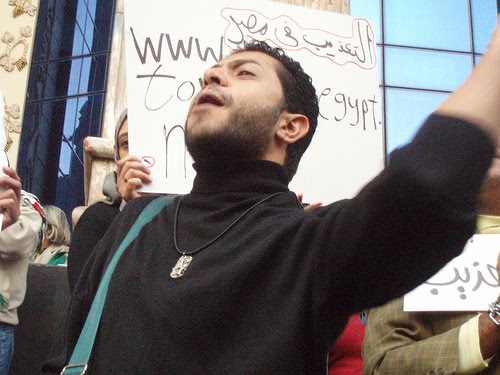
Egyptian dissident a double outsider

Source: Los Angeles Times

By Jeffrey Fleishman and Amro Hassan

Bahaa Saber puts himself at risk to fight for human rights and democracy under the authoritarian Mubarak regime. He also is persecuted for being a homosexual, a taboo in the Muslim nation.

Stiff and sore from his latest police beating, Bahaa Saber wiped back the tears of a man trapped in two lives: a homosexual seeking acceptance from Islam, a political activist marching against a state that counters his demands for democracy with truncheons and tear gas.

Saber's voice is hoarse from years of yelling, his eyes weary from watching all that has not changed. His life has become a series of bruises and protests, of thrusting his fists into the air and scanning crowds as black-clad officers in helmets close in on placards calling for better salaries and freedoms denied.

"You start thinking whether it matters," Saber said. "You can't change a police state or force a revolution with a bunch of activists with different agendas. You can't keep shouting slogans into the wind. It's been like this for 30 years. People are working too hard just to get by. They don't have time to make life better. The government put us [in] this box."

Saber sat in a coffee shop the other day, whispering protest strategies into his cellphone, waiting for the scruff of shoes on pavement. Two blocks away, riot police watched government employees chant outside parliament in a daily ritual of sweat and discontent.

Related Posts with Thumbnails