Donations

People say we're "invaluable", "indispensable" and "an essential service" — please consider making a donation.

Thursday, 31 March 2011

In US, breakthrough on bi-national same sex couples appears reversed

The logo of U.S. Citizenship and Immigration S...Image via Wikipedia
Source: Towleroad

Following up on news that's been developing all week, MetroWeekly reports that the hold placed on denial of green cards to foreigners who are part of same-sex married bi-national couples is now over:

The "hold" on same-sex married bi-national couples' green card applications - celebrated by immigration and LGBT advocates - is over, according to the spokesman for the agency that processes those requests.
"The guidance we were awaiting ... was received last night, so the hold is over, so we're back to adjudicating cases as we always have," U.S. Citizenship and Immigration Services press secretary Christopher Bentley told Metro Weekly this morning.

The agency will continue to "enforce the law," he says, which means that the Defense of Marriage Act -- which prohibits the government from recognizing same-sex marriages -- prevents those green card applications from being approved.
Hopes were raised last Friday, when an article in The Daily Beast reported that two United States Citizenship and Immigration Services (USCIS) District Offices had both confirmed that that alien relative petitions and green card applications filed by married same-sex couples would not be denied, based on legal questions surrounding the Defense of Marriage Act.

The U.S. Citizenship and Immigration Services agency confirmed that to be true, but dashed hopes by warning that enforcement of cases against same-sex couples could resume within weeks.

That hold now has apparently ended.

Enhanced by Zemanta

In UK, Zami Campaign for lesbian asylum seekers launches

By Julie Bindel

g3, the magazine for lesbians and bi-women, and Eaves, the UK’s only safe housing for women trafficked into prostitution in the UK, have launched a campaign to stop deportation of lesbians.

Zami: The Point Of No Return was promted by a case in January this year. 'BN' escaped from Uganda to the UK because of life-threatening homophobia. She was about to be escorted back when she was thankfully saved by an injunction.

“While 'BN' ’s case decided it was urgent that we take action, I have been worried about the situation for lesbian asylum seekers for some time,” says Denise Marshall, chief executive of  Eaves. “It made me realise that what we need for women in that situation is a refuge so we can get them out of detention and into a safe environment.”

'BN' was saved. Having been released from detention, 'BN' is safe for now, but she, along with countless other asylum-seeking lesbians in the UK, could again face deportation unless the government recognises that sending them back to countries such as Uganda is an almost certain death penalty.

“We can’t rely on last-minute interventions by lawyers,” says Linda Riley, publisher of g3. “We need to change the law so this doesn’t happen to a lesbian who has no lawyer at hand and no campaign behind her.”

The Zami campaign will focus on persuading the Home Office that lesbians are extremely vulnerable to violence and oppression if they are returned home, even if it is only same-sex activity between men that is criminalised.

Asylum claims based on sexual orientation have been recognised in this country since 1999, but campaigners say that officials lack essential training and guidance on the issue. The Home Office is more likely to refuse applications from lesbians or gay men seeking asylum than those made by heterosexuals. Between 98 and 99% of claims by lesbians and gay men are refused, compared to 73% for other claims.

The UK Border Agency (UKBA) makes the assumption that if there is no specific law against lesbians in the country of origin, then the claimants are not in danger on return, but that is far from the reality.

Linda Riley feels the situation is urgent.
“As lesbians who are privileged enough to be able to demonstrate publicly for our rights, whether at Pride or on the anti-Pope demo, we cannot just sit back and do nothing,” she stresses. “We have to recognise that it is harder for lesbians to get support from the general public.”
Denise Marshall agrees.
“I would not wish to be a gay man in those detention centres, but for lesbians it can be even worse because we face the threat of misogyny as well as homophobia,” she says. “We live in a country where we have civil partnerships and gay characters in soaps, and therefore we have a responsibility to protect our sisters when they seek refuge here.”
  • To find out more about the campaign and fill out the quick online petition, visit www.zami.org.uk.
Enhanced by Zemanta

Request for contacts: LGBTI resettlement programme

The Organization for Refuge, Asylum and Migration (ORAM) is launching its resettlement programme for refugees fleeing persecution based on sexual orientation or gender identity. The aim is to create supported resettlement environments for lesbian, gay, bisexual, transgender and intersex (LGBTI) refugees.

The pilot resettlement site is San Francisco, but ORAM is also working with ‘groups of five’ sponsorship groups in Canada. ORAM is eager to immediately make this programme available to as many refugees as possible.

Readers are encouraged to contact Rachel Levitan if they know of refugees who would qualify and could benefit from this ground‐breaking program. The email should include a half‐page profile outlining the person’s gender, age, education, employment history, languages, reasons for fleeing country of origin and particular vulnerabilities. Partner groups are ready for an immediate referral.

Enhanced by Zemanta

Video: Migrants and refugees at massive London anti-cuts march

On 26 March up to half a million people gathered in London to protest swingeing government cuts, many of which will massively impact refugee and migrant services. See 'UK government takes axe to refugee and asylum services' for more details.

Source:


Donna Covey, Chief Executive of the Refugee Council gave an inspiring speech at the rally in Hyde Park at the end of the march.

Source: TUC


Donna Covey speaks at March for the Alternative from Trades Union Congress on Vimeo.

Event: Paris: homosexual asylum: the problem of "proof"

Source: Ardhis
 
This Saturday, April 2 from 14h to 16h, at the Espace des Blancs Coats (48 rue Vieille du Temple in Paris 4th, subways Rambuteau or Hotel de Ville), the Ardhis offers two hours of reflection and exchange within Workshops of Assos Spring LGBT (see http://printemps.inter-lgbt.org/ ).

After a presentation of the subject and an evocation of the experience of the association in the coaching and support LGBTI asylum seekers, it will be sucsiter a moment of exchange on issues specific to those applicants for asylum:

  • how to "prove" his sexual orientation during an interview or at a hearing?
  • what should be the "good" practice of administrative or judicial?
  • How can / should be the place of French homosexual activist movement on this issue?
and other matters ...

Asylum seekers will be there to witness and share with the people present.

You are all welcome to listen, question and contribute.

~~~~~~~~

La demande d'asile homosexuelle : la problématique de la "preuve"

Ce samedi 2 avril de 14h à 16h, à l'Espace des Blancs Manteaux (48 rue Vieille du Temple à Paris 4e, métros Rambuteau ou Hotel de Ville), l'Ardhis vous propose 2 heures de réflexion et d'échange dans le cadre des Ateliers du Printemps des Assos LGBT (voir http://printemps.inter-lgbt.org/).

Après une présentation du sujet et une évocation de l'expérience de l'association dans l'accompagnement et le soutien des demandeurs d'asile lgbti, il s'agira de sucsiter un moment d'échange sur la problématique propre à ces demandeurs d'asile:
  • comment "prouver" son orientation sexuelle lors d'un entretien ou lors d'une audience ?
  • quelle devrait être la "bonne" pratique des instances administratives ou juridictionnelles ?
  • quelle peut/doit être la place du mouvement militant homosexuel français sur cette question ?
et autres questions ...

Des demandeurs d'asile seront là pour témoigner et échanger avec les personnes présentes.

Vous êtes tous bienvenus pour écouter, questionner et contribuer

Wednesday, 30 March 2011

Joint EU refugee resettlement programme inches forward

EU ParliamentImage by Louis Kreusel via Flickr  
Via Ecre

During a debate in mini-plenary on 23 March, all major parties represented at the European Parliament (EP) agreed on the need to move forward with the Joint EU Resettlement Programme (JERP).

Since the presentation of a communication and a proposal by the Commission and the adoption of two reports by the EP in May 2010, the negotiations have been in a deadlock. The debate took place following oral questions submitted by the GUE/NGL, the ALDE and the EPP groups, asking if the Presidency would consider the EU Resettlement Programme to be a priority. Nathalie Griesbeck (ALDE) emphasised the “tremendous consensus” in the EP regarding support towards the establishment of the Joint EU Resettlement Programme.

Ms. Győri Enikő, Hungarian Minister of State for EU Affairs and Representative of the Hungarian EU Presidency, acknowledged the urgent need to adopt such a Programme. Indeed, Enikő officially announced that Hungary was preparing a programme to start next year. The Minister also called on Member States to resettle refugees from Libya within their capacities even in the absence of an established programme.

On 30 March, the EU its celebrating its annual Resettlement Awareness Day, which this year focuses on the integration of resettled refugees and is hosted by MEP Rui Tavares, Rapporteur for the Joint EU Resettlement Programme.

Representatives from the US, the European Commission, the Hungarian Presidency and the host himself will present their views on how resettlement can move forward. Resettled refugees, representatives from an NGO and a resettlement municipality in the UK will share their practical experiences on resettlement.
Enhanced by Zemanta

In Scotland, major new LGBT asylum report

By Paul Canning

A major new report on LGBT asylum in Scotland has been released today.

The 202 page report is a a joint project between Scotland's Equality Network and Black and Ethnic Minorities Infrastructure Scotland (BEMIS) and is based on a review of both international and UK literature, stakeholder interviews with 17 organisations, 11 in Scotland and 6 in London and a community consultation event attended by 25 people.

Principal author Tim Cowen said:
“Scotland, and in particular, Glasgow hosts one of the largest asylum and refugee populations outside of London, but the voices of lesbian, gay, bisexual or transgender (LGBT) asylum seekers and refugees have until now rarely been heard. There has been an absence of open discussion and research, and a lack of awareness of the issues encountered by Scotland’s LGBT asylum seekers and refugees. This report provides a platform to enable both services and policy makers to reflect on what is missing and what needs to be done to reduce the fear and isolation experienced by LGBT asylum seekers in Scotland. “
The report concludes that significant barriers face LGBT asylum seekers fleeing persecution face in seeking sanctuary in Scotland. It says that despite recent positive developments such as the Supreme Court ruling, (limited) training for UKBA staff and a new Asylum Policy Instruction for those staff "the current asylum system remains deeply flawed."

It reports on a "culture of disbelief" within the UK Border Agency (UKBA) and unreasonable evidential burdens being placed on individuals, particularly in relation to having to prove their sexual orientation or having their gender identity acknowledged and "huge" gaps in country of origin information used in decision making.

Despite the Supreme Court 'discretion and relocation' ruling it says that UKBA are not proactively reviewing all LGBT asylum cases previously refused on the grounds that the person could go back and be discreet.
"This makes it difficult for the Coalition UK Government to honour their pledge not to deport LGBT asylum seekers who face torture or inhumane treatment."

In UK, gay and lesbian Ugandan refugees tell their story

John Bosco
Source: The Observer

By Elizabeth Day

As a child in Uganda, John Bosco remembers hearing an old wives' tale that if a man fell asleep in the sun and it crossed over him, he would wake up as a woman. "I used to try that as a kid," says John now, some 30 years later. He sits at a table in a busy cafe across the road from the railway station in Southampton, his fingers playing with the handle of a glass of hot chocolate. "I'd spend all day lying under the sun. From childhood, I wanted to be a girl. I wanted dolls. At school, I played netball. I wanted to dress up like a girl … I rubbed herbs into my chest that were meant to make your breasts grow. I tried everything but it didn't work."

He tells me that there was not one single moment when he realised he was gay; that the knowledge of it had always been there, unexpressed until he found the right words. As he grew older, John started being attracted to men. On the radio, he heard stories of gay couples being beaten and killed by police. He says that if he could have changed himself, he would because he so desperately wanted to be considered "normal", to fit in, to make his family proud.

When he went to university to study for a business administration degree, his relatives and neighbours in Kampala would ask why he never had a girlfriend. "I used lots of excuses – I'm not yet ready, or I have a girlfriend who doesn't live in the same area," he says. "It was difficult because you cannot be open [about your sexuality]. You can't socialise like any other person. A lot of the time, you have to keep your distance. You feel you're not yourself. It makes things really hard."

This is the reality of being gay in modern Uganda, a place where homosexuality is criminalised under the penal code, punishable by life imprisonment. According to human rights organisations, about 500,000 homosexuals live in the country, unable to admit their sexuality for fear of violent retribution either from the police or their own communities. Anti-gay legislation is a relic of British colonialism, designed to punish what the imperial authorities thought of as "unnatural sex" – thinking that was subsequently reinforced by wave upon wave of Catholic missionaries.

In Israel, asylum seekers building fence to keep out other asylum seekers

Source: Haaretz

The government is employing Eritrean asylum seekers to help build a border fence designed to keep out other migrants seeking to enter the country from Africa via the Sinai Peninsula.

A man who gave his name as August, one of four Eritreans working for a contractor along the fence route, said he had sought work for a long time before he was told a construction job was available near Eilat.   

He had arrived in Israel five months ago. According to August, the hardest part of the journey was trekking through the African desert. Now, once the border fence along the Egyptian frontier is completed, migrants will find it even more difficult to enter the country.

August laughed when asked if he felt guilty that he was helping put up a structure designed to keep fellow Eritreans out of the country. "I have a family that remained in Eritrea," he said. "While they would love to come here, they know the journey isn't easy." As August tells it, he simply has no choice but to earn a living any way he can.

While the state has legally barred its citizens from employing asylum seekers from Africa, it doesn't enforce the ban. Months ago, the Interior Ministry's Population Registry inserted a clause in the temporary-status visas given to asylum seekers stating that under no circumstances could they be hired.

Tuesday, 29 March 2011

Video: Is Homosexuality un-African?

On March 12 the BBC World Service broadcast a debate from South Africa: 'Is Homosexuality un-African?' The debate drew protests at its venue due to the inclusion of Ugandan MP David Bahati, author of the 'Kill the gays' bill. It's title was also protested in the UK.

Festus Mogae, former President of Botswana, was another panelist. He has spoken in favour of decriminalisation. Other panelists were South African writer Eusebius McKaiser and Paula Akugizibwe, regional treatment advocacy coordinator at AIDS and Rights Alliance for Southern Africa.

The video of the debate has now been posted online.


BBC World Debate: Is Homosexuality un-African? from Ben Cashdan on Vimeo.

The BBC programme was debated at the Frontline Club in London March 10 by a panel chaired by Ben Cashdan, producer of the BBC debate, which included gay Ugandan John Bosco Nyombi and Jonathan Cooper, CE of Human Dignity Trust.


Enhanced by Zemanta

South Africa leads fightback against LGBT rights at United Nations

Sexuality and gender identity-based culturesImage via Wikipedia   
By Paul Canning

South African and international human rights bodies have expressed horror at a resolution tabled by South Africa at the United Nations to establish an intergovernmental process to discuss defining "sexual orientation" and "gender identity".

South Africa has been accused of "collaborating with governments that refuse to acknowledge discrimination on the basis of sexual orientation" and of ignoring its own constitution, which prohibits discrimination based on "sexual orientation."

In both their statement to the UN Human Rights Council and in the resolution they put forward South Africa said that "the issue of sexual orientation needs to be clearly defined." This argument has been put forward by some African countries as well as the 57 member Organisation of Islamic Conference (OIC) as LGBT rights have made steady gains in international bodies. Jessica Stern of the International Gay and Lesbian Human Rights Commission said that the reason for the resolution was because "South Africa has put regional political interests before human rights and is trying to appease other African countries."

OIC and Arab states have also sought to fight LGBT progress as a 'human rights violation' through the “defamation" of religious ideas resolution, which has received extensive support at the UN and is also backed by the Vatican. This is seen as part of an attempt at a wholesale redefinition internationally of the concept of 'human rights'. South Africa alongside China, Russia, and Cuba have backed  the 'defamation' resolution at the UN. However last year some fellow African nations broke with a decade of votes for it: Cameroon, Burkina Faso and Benin abstained and Zambia voted against.

Similarly, the December vote against extrajudicial killings at the UN - which included "sexual orientation" and was the focus of extensive lobbying - saw one third of African countries either be absent, abstain or vote for the resolution, including Rwanda and Angola voting yes. South Africa also votes yes - having earlier voted no - following lobbying by South Africans, and it cited as a reason for the change a "constitutional imperative."

In the debate on the extrajudicial killings resolution the Rwandan delegate pointedly referenced his country's experience in saying that a group does not need to be "legally defined" to be targeted for massacres. "We can't continue to hide our heads in the sand" he said. "These people [LGBT] have a right to life."

South African LGBT activist Zackie Achmat, co-founder of the Social Justice Coalition said that the South African proposal would stop any further UN investigation or report on sexual orientation and gender identity anywhere.
"If enormous hate crimes happen, as in Uganda, then the UN can't investigate. It must first decide what sexual orientation means." 
He said the resolution also suggests that sexual orientation and gender identity are not part of international law. Achmat, noting South Africa's constitutional protections of LGBT rights, said that: "as it stands the [UN] resolution would be unconstitutional."

The South African foreign ministry said: "The issue of sexual orientation is sensitive and impacts on a whole range of issues … this issue should be addressed openly, transparently and inclusively.

The South African Lesbian and Gay Equality Project is this week expected to launch a case in the South African constitutional court to force the government to align its foreign policy with the constitution.

HT: African Activist
Enhanced by Zemanta

US Court rejects asylum 'discretion' argument in Chilean case

Seal of the en:United States Court of Appeals ...Image via Wikipedia

Source: Fahamu Refugee Legal Aid Newsletter

In an unpublished opinion, a US Court for the Ninth Circuit found that the Board of Immigration Appeals (BIA) was misplaced in relying on the repeal of the anti‐sodomy law in Chile. The status of the law is irrelevant to the petitioner’s fear of persecution, given that arresting officers only claimed the statute as a basis for the petitioner’s detention on one occasion and none of the incidents suffered were a result of violating the statute.

The fact that the petitioner had travelled to Chile did not negate his wellfounded fear (Boer‐Sedano v. Gonzales, 418 F.3d 1082, 1091 (9th Cir.2005), and the fact that he was not persecuted during this time was explained by the fact that he did nothing to expose his sexuality to his fellow citizens.

Similarly to the case of Karouni, 399 F.3d at 1173, the argument that a lack of persecution during a short trip to Chile undermines the petitioner’s well‐founded fear of future persecution, is tantamount to ‘saddling [the applicant] with the Hobson’s choice of returning to [Chile] and either:
  1. facing persecution for engaging in future homosexual acts or;
  2. living a life of celibacy’. 
The BIA’s suggestion that the petitioner could be safe in Chile if he behaved like he had during the short journey in essence meant that the INA [Immigration and Nationality Act] wanted the petitioner ‘to change a fundamental aspect of his human identity’.
Enhanced by Zemanta

Monday, 28 March 2011

Libya and refugees: Dirty dealing with Qaddafi

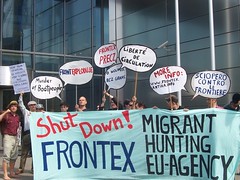
shut down frontex (in front of the frontex HQ)Image by noborder network via Flickr  
Source: IRR

By Frances Webber


When we listen to our leaders' vigorous condemnations of the human rights abuses and lack of democracy of Qaddafi's and other authoritarian regimes in the Mediterranean we would do well to bear in mind how new-founded and limited is their concern for human rights, and how likely it is that they will try to co-opt any new governments in the region to their war against sub-Saharan migrants. For in the past decade, as well as cheerfully returning dozens of suspected Islamists to torture under cover of the flimsiest of diplomatic assurances, Britain and Europe have used Qaddafi and other repressive north African regimes as front men for policies causing thousands of deaths in the Mediterranean and beyond.

Flimsy no torture agreements

The UK has taken the lead in negotiating worthless no-torture agreements designed to secure the return to Libya, Algeria, Jordan, Egypt, Tunisia of people representing no threat to the UK, but who were opponents of their own countries' repressive regimes. Under cover of these agreements, our government has handed people over knowing what their likely fate would be; foreign office officials readily admitted their regimes were torturing states. Where was our government's concern for human rights then?

Video: Record support for LGBT rights at United Nations


On 22 March 2011 the United Nations Human Rights Council (the Council) held a general debate on follow-up and implementation of the Vienna Declaration and Programme of Action (VDPA). The VDPA reaffirms core principles of the international human rights framework, including the universality of human rights and non-discrimination. The highlight of the meeting was a joint statement delivered by Colombia on behalf of 85 States on ending acts of violence and related human rights violations based on sexual orientation and gender identity. 


85 is the highest number of States ever signing on to a statement of this kind. A joint NGO statement, with 119 signatories, including ISHR, commended States for the initiative and noted in particular the broad cross-regional support for the statement.

The debate also saw vital participation of networks of National Human Rights Institutions (NHRI) from all regions, including a cross-regional joint statement of NHRIs in support of the statement by the group of States. It emphasised that NHRIs all over the world are advocating the rights of LGBTI people regardless of the different cultural backgrounds they are working in. The statement further called on the Council to hold a panel discussion on the protection of human rights of LGBTI people.

In US, breakthrough for binational same-sex couples?

Gay Couple with childImage via Wikipedia
Source: Stop The Deportations

As was reported 25 March by Newsweek/ The Daily Beast, two United States Citizenship and Immigration Services (USCIS) District Offices have confirmed that alien relative petitions and green card applications filed by married same-sex couples will not be denied. Instead, final decisions on these applications will be held in abeyance, i.e. put on hold.  This historic first seems to be directly linked to the Obama administration's change of position on DOMA announced on February 23.

The DOMA Project welcomes the new and exciting potential this presents for married gay and lesbian couples to obtain legal status and prevent deportations of the foreign partner. However, in this new and rapidly changing legal environment, we urge attorneys and binational couples to proceed with an abundance of caution.

The significance of the "abeyance" policy is two-fold: first, it means that petitions and applications that normally would have been denied because of DOMA, will now remain in "pending" status, and second, this status will give protection and benefits to the applicant for an indefinite period. The "abeyance" policy, it is presumed, will put these cases on hold while the ultimate fate of DOMA is determined by a decision of the Supreme Court or through repeal by Congress.

Sunday, 27 March 2011

Video: LGBT rights in Asia

Source:

Courage Unfolds is a documentary film that forms a central part of the Courage Unfolds Campaign of the International Gay and Lesbian Human Rights Commission (IGLHRC).

The film, produced by IGLHRC's Asia program (partnered by Lesbian Advocates Philippines (LeAP)), is part of a call for lesbian, gay, bisexual and transgender (LGBT) people to be protected by law, respected by society, and accepted by family. It is a call for the use of the Yogyakarta Principles as a tool to ensure the respect, protection and promotion by governments of the human rights of all people - including LGBT people. This set of international legal principles addresses the application of international law to human rights violations based on sexual orientation and gender identity.

The film highlights the issues faced by LGBT people in Asia and how the Yogyakarta Principles are a relevant and effective tool that LGBT activists can use in their advocacy for human rights.


Film release date is 17 May 2011. It can be ordered by emailing courageunfolds@iglhrc.org.

Enhanced by Zemanta

Death threats against gay Brazilian MP


Source: dosmanzanas

[Google translation]

Jean Wyllys is, since February, the first openly gay Brazil MP, representing the Party for Socialism and Liberdade (PSOL), a small left force. One of his first initiatives was to relaunch the Mixed Parliamentary Front for LGBT Citizenship, comprising representatives from different parties and proposed measures include a proposed constitutional amendment to legalize marriage between same sex. Something that has not been too fond of certain sectors, according to the threats he is receiving.

Wyllys, in addition to having been elected a writer and university professor (and winner of the Brazilian edition of Big Brother in 2005, he became particularly known in Brazil ...) has complained that, since it published its draft forward in the direction of equal marriage has not stopped receiving homophobic abuse and even death threats via social networks like Twitter, not only from their own country but also from the United Kingdom or United States and other countries. Wyllys has already been made ​​in understanding the threats of the Brazilian Congress, and although he claims to feel some concern at the moment has not sought police protection, since in his opinion a "dog that barks does not bite."

Saturday, 26 March 2011

In New York, gay immigrant youth struggle with homelessness

Source:
 
Video: Adrielle Grant is a 19 year old immigrant from Guyana. He is gay and homeless in New York City.


Juan Valdez's story


Source: Edge Boston

By Von Diaz

This story first appeared at Feet in 2 Worlds, an organization dedicated to telling the stories of today’s immigrants.

Juan Valdez vividly recalls the night he left home.

"I grabbed a whole bunch of black plastic bags, packed all of my things, and went to my best friend’s house. And, I mean, what else could I do? I was 16, I didn’t know how to do anything," Juan said.

Juan was kicked out of his house when he revealed to his parents that he was gay.

Adrielle Grant has a similar story.

Friday, 25 March 2011

Event: LGBT immigration, asylum and domestic abuse

Source: LGBT Domestic Abuse Forum

The London based Domestic Abuse Forum is hosting a series of seminars to support organisations and individuals working with LGBT victim/survivors of domestic abuse.

All seminars are free and will include presentations, group work, panel discussions and resources to take away.

LGBT Immigration, Asylum and Domestic Abuse
Friday 15 April
1.30 pm – 5.00pm
at Can Mezzanine, 32-36 Loman Street, Southwark, London SE1 0EH

The seminar aims to…
  • Examine specific issues affecting LGBT victim/survivors with immigration and asylum issues
  • Give an overview of current legal duty to provide help, assistance, support and housing
  • Provide best practice in meeting the needs of LGBT survivors with immigration and  asylum issues
  • Enable you to create an action plan to fast track survivors to appropriate support
Other seminars are:


Friday 10 June
Say It Loud, Say It Proud!
Friday 15 July
LGBT Survivor Service Provision and the Equality Act
Friday 16 September
The Way Forward

Who should attend?
These seminars are essential for any professional, researcher, campaigner or individual coming into contact with LGBT people who have experienced or are experiencing domestic abuse and also for those committed to ending domestic abuse, experienced by LGBT people.

Service user participation
We believe that LGBT victim/survivors of domestic abuse are the experts in this field and as such, welcome and encourage organisations to invite any LGBT service users to all our events.  If attending with a service user please contact the coordinator to discuss any safety issues or email info@lgbtdaf.org

Accessibility
We are committed to making the conference as accessible as possible. Please let us know if you have any particular interpreting or access requirements. The venue is wheelchair accessible throughout and the room is equipped with a sound loop.

To make a booking please request a booking form from Maria Sookias, Coordinator of LGBT DAF on 0207 354 6316 or via email on info@lgbtdaf.org

Childcare
Should you wish to bring your child/children and require child care please contact us and we will help where possible

This event is provided free of charge with thanks to Trust for London.

Video: Is Ugandan 'kill the gays' bill dead?

Via Warren Throckmorton and Jim Burroway


This Ugandan media report calls it a "surprise move" that the administration of Ugandan President Yoweri Museveni has apparently pulled support for the Anti-Homosexuality Bill (AHB). But the bill is still in the Ugandan Parliament and its author David Bahati MP says that he still has support there.

Throckmorton reports that Ugandan radio has said that Bahati has been assured by the Legal and Parliamentary Affairs committee chair Stephen Tashobya that the AHB will be debated. He previously told him that it has been scheduled for debate now that the elections are over. The bill has been in the Parliament’s Legal and Parliamentary Affairs Committee since last April.

A sub-cabinet committee recommended last April that the bill be dropped with “useful provisions of the proposed law” incorporated into the Sexual Offenses Act. Burroway notes that that the bill’s main supporter in the cabinet, former Ethics and Integrity Minister James Nsaba Buturo, resigned last week in compliance with a court order following his loss in the ruling party’s primary elections last year.

Museveni last year strongly suggested that international lobbying directly of him, including by heads of state, about the AHB would lead to the bill being dropped. However he has also noted domestic pressure on homosexuality and notably he complained publicly last year about a local political cartoon depicting him on this issue as a puppet of US Secretary of State Hillary Clinton, former Prime Minister Gordon Brown, and Canadian PM Stephen Harper.


Enhanced by Zemanta

Canadian government partners with gay group to help refugees

Canadian maple leafImage via Wikipedia
Source: Xtra!
By Dale Smith
Immigration Minister Jason Kenney announced on Thursday, March 24 that Citizenship and Immigration Canada (CIC) will partner with the Rainbow Refugee Committee (RRC) to provide up to $100,000 over three years to help settle gay refugees in Canada.

According to CIC, the funds will go toward three months of income support for each refugee that RRC or its partner organizations sponsor. Those sponsoring organizations will have to provide refugees with orientation services, accommodation, basic household needs, basic food staples, clothing and ongoing food needs for the duration of the sponsorship period.

The cost to sponsor one refugee for a year works out to about $11,800.

“We are very pleased to be working with the Rainbow Refugee Committee to help refugees who are in need of protection, particularly those who are persecuted because of their sexual orientation,” says Kenney in the press release. “By partnering with this organization and allowing Canadians to play a part in refugee protection, the private sponsorship program showcases grassroots support for this country’s international commitment to humanitarian action.”

“We see it as a very important first step towards creating more meaningful protection for refugees overseas – and I emphasize a first step,” says Sharalyn Jordan of the RRC.

RRC will work with groups in other cities, such as the Metropolitan Community Church in Toronto, to use the funds for private sponsorship of gay refugees. “The plan really is to work nationally.”

The timing of the announcement, however, is raising a few eyebrows, considering that the details of the agreement have yet to be worked out.

Thursday, 24 March 2011

Congo homosexuality criminalisation bill delayed, not dead

DRC, orthographic projection.Image via Wikipedia  
Source: African Activist

The Congolese Parliament sent a bill that would criminalise homosexuality to the Socio-Cultural Committee on 22 October 2010. In a Behind the Mask interview with Jean Bedel Kaniki of Hirondelles Bukavu, an LGBTI organisation in the Democratic Republic of Congo (DRC), it does not appear that the bill was considered by the session of Parliament ending 15 March 2011. Kaniki predicts that it will be debated in Parliament in June.
Behind the Mask is aware that the bill was not debated by the Socio-cultural Committee during the last and current session of parliament.

Kaniki said it is unlikely that it will be debated during the current session of parliament that ends on the 15 March 2011 since “there have been more pressing issues debated during the last and current sessions of parliament. My prediction is that it will be debated during the next session that will start in June this year.”

“If nothing is done, considering the support the bill has received in the public opinion, the parliament will probably pass the law that criminalizes homosexuality. Elections are around the corner; therefore the vote of the parliament will depend on the role that law could play in political campaign and calculation. “

The Sexual Practices Against Nature Bill will, if passed, criminalize homosexuality and sexual practices with animals such as zoophilia and bestiality

It will also criminalise any activities that promote the rights of LGBTI persons. Section 174h3 of the Bill stipulates that, “all publications, posters, pamphlets, (or) films highlighting or likely to arouse or encourage sexual practices against nature are forbidden within the territory of the DRC and “all associations that promote or defend sexual relations against nature are forbidden within the territory of the DRC.”

Any offender contravening this Bill will be punished by 3 to 5 years in prison and/or a fine of 500,000 Congolese francs (Section 174h1).
Hirondelles Bukavu has struggled to raise funds to challenge this bill in DRC.
Enhanced by Zemanta

Tuesday, 22 March 2011

Video: LGBTI rights in Kenya

The Guardian and Christian Aid have co-created a series of films about poverty worldwide and the issues that affect poverty. As well as the films they are holding live web-chats every Thursday.

The first film is about gay rights in Kenya and tells the story of Melvin and his struggle.

The film is the first of the ‘Poverty Over’ campaign, more about which can be found on the Guardian website.


Enhanced by Zemanta

Sunday, 20 March 2011

New project looks at the impact of forced removal

Longleat MazeImage via Wikipedia

Liza Schuster of City University of London and the Refugee Law Project in Kampala (RLP) Uganda are preparing a research project to document the impact of forced removal on the people removed, their families and their communities.

Before starting the project, they want to bring together people with substantial experience of anti-deportation campaigns to discuss with them:

    a) why/what happens when activists lose contact with the person being deported

    b) what are the key points at which contact is lost (in the UK, during transfer, on arrival at airport (departure or arrival), later

    c) how contact is maintained and what evidence they have for what happens to persons they have been working with who have been deported

    d) what mechanisms they would like to see in place to monitor situation of deportees post deportation, and to create alerts if things are going badly wrong for the returnee

    e) whether and how RLP and the research team can help to build those  mechanisms

    f) stakeholder mapping of both ends of the story (i.e. UK and Uganda)

    g) what kinds of information activists would find important and useful for their advocacy and lobbying in the UK

    h) what format that information should be in - e.g. written reports, statistics, audio or video clips of testimonies from deportees, photographs, etc...

The project will have an academic research dimension, but the project will be explicitly a form of academic activism in collaboration with more traditional 'activists' on the ground.

At this stage, they are interested in deportations to Uganda, but also Afghanistan, DRC, Iran and Pakistan.

Nonetheless, those with experience of deportations to other regions are also welcome.

The project will be launched formally at a workshop in London in Mid May 2011.

Towards that, if you are interested in taking part, monitor what is happening to those around you, who are under threat of deportation or who are removed from date of this bulletin.
  • For further information, please contact Liza Schuster. Email  l.schuster@city.ac.uk

Liza Schuster came to City University of London in September 2005 from the Centre on Migration, Policy and Society, at Oxford University. Before that she was T. H. Marshall Fellow at the London School of Economics working on a comparative project that explored processes of inclusion and exclusion in four European states: Britain, France, Germany and Italy. This work is currently being written up as 'States, Migrants and Citizens: Rights and Racism in Europe'. At City, Liza is continuing this work, as well as a focus on domestic and European asylum policy (especially deportation and detention) and developing her research interests in migration and racism, and migration and rights.


The Refugee Law Project (RLP) seeks to ensure fundamental human rights for all asylum seekers, refugees, and internally displaced persons within Uganda. We envision a country that treats all people within its borders with the same standards of respect and social justice. We work to see that all people living in Uganda, as specified under national and international law, are treated with the fairness and consideration due fellow human beings.
Enhanced by Zemanta

Thursday, 17 March 2011

Event: Manchester lesbian refugee + asylum fundraiser

On Saturday 2 April, Lesbian Immigration Support Group (LISG) in Manchester, UK is holding a fundraiser.

It will be held at the Nip and Tipple Bar and Restaurant (197 Upper Chorlton Road, Manchester, M16 0BH) on Saturday 2 April between 3-7pm.

They'll be live music, a raffle, a quiz and a short film. Drink and food is available at the venue.

For more information email lisg.manchester@yahoo.co.uk

Wednesday, 16 March 2011

Implications for binational couples now Obama admin has stopped defending Defense of Marriage Act

The logo of U.S. Citizenship and Immigration S...Image via Wikipedia 
Source: Immigration Daily

By David A. Isaacson

The Justice Department announced 23 February, that, based in part on the recommendation of Attorney General Eric Holder, President Obama has determined that Section 3 of the Defense of Marriage Act (DOMA) is unconstitutional, and will no longer defend it in court. This is because, facing litigation within the jurisdiction of a circuit court of appeals (the Second Circuit) that has never ruled on the appropriate standard of review to be applied to laws concerning sexual orientation, the Administration determined that a heightened standard of review is appropriate, and that Section 3 of DOMA cannot withstand review under such a standard (although the Justice Department had previously argued that Section 3 could survive the looser rational-basis test applicable under the precedent of some courts of appeals).

The announcement is available online here, and a related letter sent by Attorney General Holder to Speaker of the House John Boehner is available here.

The announcement states, however, that Section 3 of DOMA will remain in effect until either it is repealed or “there is a final judicial finding that strikes it down,” and until such time “the Executive Branch will continue to enforce the law.” The letter to Speaker Boehner states even more specifically that “the President has instructed Executive agencies to continue to comply with Section 3 of DOMA, consistent with the Executive’s obligation to take care that the laws be faithfully executed, unless and until Congress repeals Section 3 or the judicial branch renders a definitive verdict against the law’s constitutionality.”

Tuesday, 15 March 2011

Video: Untold Stories: Iraqi LGBT

Source: Holocaust Memorial Day Trust

Interview with Ali Hili of Iraqi LGBT.


You can uncover the Untold Stories of the other participants and watch the full trailer by visiting http://www.hmd.org.uk/untoldstories

Enhanced by Zemanta

Monday, 14 March 2011

European court finds for HIV positive man against Russia in residency case

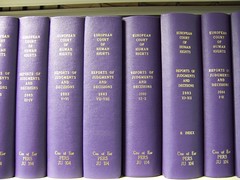
European Court of Human RightsImage by ex_libris_gul via Flickr
Source: ECHR Blog

By Antoine Buyse

10 March the Court concluded in a case against Russia that the refusal of a residence permit to an Uzbek national solely because he was HIV-positive was in violation of the European Convention of Human Rights.

The case of Kiyutin v Russia related to a man who had settled in Russia and married a Russian wife and had a daughter with her, also of Russian nationality. When he applied for a residence permit, he was obliged under Russian law to undergo a HIV test and the result was positive. On the basis of the test outcome his permit was refused by reference to Russian legislation.

The European Court chose to assess the case under a combination of Articles 8 (right to family life) and Article 14 (prohibition of discrimination). First, the Court had to decide whether a difference of treatment based on HIV-positive status fell within the prohibited grounds of Article 14. Since health as such is not mentioned in that Convention provision, the Court had to decide whether this case could fall under the notion of "any other status". In earlier cases in the past two years, the Court had already found that physical disabilities and health impairments fell within the scope of the prohibition of discrimination. Building on this earlier case-law (and on pronouncements by the UN and the Parliamentary Assembly of the Council of Europe), but now in a more general and explicit way, the Court held that (para. 57):
"a distinction made on account of one’s health status, including such conditions as HIV infection, should be covered – either as a form of disability or alongside with it – by the term “other status” in the text of Article 14 of the Convention."

Video: Project Transgender — Various Bodies, the Same Right

Source: Fairhaven College

Elizabeth Vasquez, Ecuadorian Attorney at Law and founder of Project Transgender, speaking at Fairhaven College on February 2, 2011.

Elizabeth Vasquez will speak to the right of all sexual identities to participate in the various cultural and artistic life in their communities; and address the programs established to realize these rights in her country, Ecuador.

Elizabeth Vasquez: “Project Transgender—Various Bodies, the Same Right” from Fairhaven College, WWU on Vimeo.

Sunday, 13 March 2011

America grants a gay, deaf Ugandan asylum

(l to r) CT PRIDE members William Urich and Kalisa* with Attorneys Marisa DeFranco and Amy Grunder moments after Kalisa was granted US asylum.
By William Urich

Recently I traveled to the JFK Federal Building in Boston to appear as a witness on behalf of Kalisa*, who works with Connecticut PRIDE. Kalisa, a Ugandan citizen, petitioned for a stay of deportation and had requested US asylum. For some time now, I have been working with Kalisa's attorney, Marisa DeFranco, to keep the US government from sending Kalisaback to Uganda. We all know what happens there.

Kalisa's case is unique in that he is not only gay, but is also hearing impaired  since the age of 10 when an incorrect treatment for malaria in his village in Uganda left him deaf. There are no protections or accommodations for people with disabilities in Uganda. That fact, complicated by his homosexuality, would surely have made Kalisa another sad statistic if he were to be sent back.

Because of Attorney DeFranco's constant, diligent vigilance and amazingly thorough work over the past year and a half, it gives me an extreme pleasure to announce that Kalisa has been granted asylum by the United States government and is no longer faced with the threat of deportation back to his native Uganda. I should also add that the hundreds of hours of Attorney DeFranco's superior work were completely pro bono.We at Connecticut PRIDE are deeply grateful for her dedication and hard work and share a huge sigh of relief with Kalisa.


*Not his real name. Kalisa asked to use a pseudonym because he fears for the safety of his family in Uganda if his real identity is used.

In Indonesia, religious differences not a problem for ‘waria’

Mariyani
Source: Jakarta Post

By Prodita Sabarini

Amid the recent news of religious fundamentalism spurring violence against minority groups like Ahmadis and Christians, one Muslim transgendered woman is demonstrating the openness of Indonesian society by offering up her Islamic school to fellow transgendered Christians for masses and prayers.

Mariyani, 51, is built like a large matriarch. The transgendered woman has received local and international media attention since 2008 when she transformed her home in a small alley in Notoyudan hamlet, Yogyakarta, into a place for transgendered women to study Islam.

She began Pesantren Waria with Koran readings and prayers every Monday in order to provide a space for transgendered women who were also Muslims to feel comfortable in practicing their faith.

The term waria comes from wanita (woman) and pria (man), and is used to describe people who are born with male reproductive organs but with a female gender identity, i.e. transgendered. Waria decide on their own whether to wear sarong during Islamic prayers — as men do — or to cover their bodies with the mukena — as women do.

Mariyani’s home-turned-school has become a place for waria to seek spirituality and refuge. Recently, a 19-year-old transgendered woman who learned about the school from newspaper articles and the Internet left her hometown in Lombok, where her family was having problems accepting her gender identity, to stay at Mariyani’s place before finding a job at a department store.

Wearing a black hijab, Mariyani said she aspired to provide Christian (Catholic and Protestant) waria a place to congregate.

Saturday, 12 March 2011

In UK, asylum seekers forced to trek across country to lodge claims

Clark at North AveImage by Kymberly Janisch via Flickr
Source: British Red Cross and Refugee Survival Trust

A new report produced by the British Red Cross and the Refugee Survival Trust (RST), highlights the plight of people who currently have to travel from Scotland to Croydon, in South London [c350 miles or 550 Km], to register their claims – with no financial support from the government.

In the 21 Months Later report, The Red Cross and the RST call on the UK Border Agency to meet the travel costs of asylum seekers who have to make the 400-mile trip until the UK government agrees to allow them to claim asylum in Scotland. At the moment, the Red Cross and the RST pay for food and overnight bus travel to Croydon for claimants in Scotland.

Scottish Refugee Council distributes RST grants to people who arrive at our door, having just arrived in the country and wishing to claim asylum. We join in the call for asylum seekers to be able to start their claim in Scotland, and feel the current system is inhumane and unnecessary.

The report is a follow-up to a document entitled 21 Days Later, produced jointly by the organisations almost two years ago, which exposed the plight of asylum seekers facing destitution on the streets of Scotland because of a lack of support.

Video: new documentary takes the viewer to the heart of the struggle for LGBT rights in Belarus

The Eastern Bloc - after the annexations and i...Image via Wikipedia
By Logan Mucha

Often called the last dictatorship in Europe, Belarus is a country where being openly gay leads to beatings and arrests.

East Bloc Love is Australian filmmaker Logan Mucha’s debut feature documentary following the journey of the young Belarusian activist, Sergey Yenin, as he and other activists prepare for a defiant march on the streets of the capital Minsk.
“As a gay male from a Australia, I was inspired by the strength and courage of these activists in the face of their government’s ban on the pride march and the looming violence from homophobic skinheads” says Logan Mucha.
The young director was able to document the personal stories of individuals from countries in Latvia, Romania, Poland, Estonia, Russia and Belarus.  These characters range from activists, a drag queen, a pre-op transsexual and a rock musician, giving the viewer a broad view on the state of LGBT rights in the former Soviet bloc.

East Bloc Love is a co-production with the human rights project, GayRussia and its founder Nikolai Alekseev. The International Day Against Homophobia has also contributed financial support to the film.

The film is currently in consideration for a number of international film festivals and is available for review upon request.

Trailer

Enhanced by Zemanta

Friday, 11 March 2011

Event: national call-in on American LGBT asylum and refuge law

My office's phoneImage via Wikipedia
Source: National LGBT Bar Association

For decades, immigrants have requested asylum by the United States from their home countries due to political strife, economic hardship, or social injustice. With regards to LGBT individuals in many communities abroad it is mortally dangerous to be open with their lifestyle therefore political asylum is critical.

On Wednesday, March 16, the National LGBT Bar Association, in partnership with Immigration Equality, will host a national call-in to discuss developments in the field of LGBT immigration and asylum seekers. It will be led by Justin Connor, with speakers Victoria Neilson, Legal Director at Immigration Equality, Scott Titshaw, Assistant Professor of Law at Mercer University, and Chad Ellsworth, Associate at Fragomen, Del Rey, Bernsen and Loewy, LLP.
Description:

United States asylum law is derived from international agreements written after World War II. With the large influx of migrants from other countries, the U.S. wrote an internationally universal standard that would outline who would be considered as a refugee. Since then, however, courts have needed to expand such definition and circumstances that would consider one who might need asylum. In 1994, Attorney General Janet Reno declared the Matter of Toboso-Alfonso case as precedent, which was pivotal for helping to categorize homosexual men and women as a “particular social group”—which, as explained in the Refugee Act of 1980, is a possible definition for a refugee into the United States. Now in the U.S., as it pertains to the 36,000 binational same-sex marriages, asylum law is a very important issue when it comes to the Federal government recognizing LGBT unions and granting protection.

Moderator:

The sudden rise of a pro-gay foreign policy in the United States

Hillary ClintonImage by Nrbelex via Flickr
Source: Huffington Post 

By Javier Corrales

The Obama administration is often criticized for betraying gay rights. Despite having helped repeal Don't Ask Don't Tell, critics still charge that the White House continually reneges on its pledge to work hard to end marriage bans and gay bashing. Yet, on another unnoticed front, the administration has actually gone far beyond anything ever promised. The administration is taking steps to establish the first pro-gay foreign policy in the history of the United States.

So far, this foreign policy effort is off to a good start. But unless a more systematic approach is taken, the administration's baby steps will remain just that: a decent impulse with little reach.

Arguably, the administration's first steps have been laudable. In January, President Obama issued a public condemnation of the killing of gay activist David Kato in Uganda and of five members of the LGBT community in Honduras. In reality, Obama is merely treading behind the footsteps of Hillary Clinton, whom the The Advocate, a magazine covering LGBT news recently described as the "fiercest advocate" of gay rights in the administration. In fact, Clinton was the first first lady to march in a gay pride parade eleven years ago. Today, she intends to become the first secretary of state to make the State Department pro-gay.

Clinton's mission is simple: eliminate "violence and discrimination based on sexual orientation and gender identity" anywhere in the world. She declared this in a speech in June 2010, in which she also called on U.S. ambassadors and foreign governments to join this battle. She even designated staff to work on ways to advance LGBT rights, created funds to help victims of hate crimes abroad, and even came up with a new slogan -- "Human rights are gay rights, and gay rights are human rights," an adaptation of a similar slogan she once used on behalf of woman's rights.

Related Posts with Thumbnails