Donations

People say we're "invaluable", "indispensable" and "an essential service" — please consider making a donation.

Friday, 30 April 2010

US Senate immigration framework includes LGBT binational families

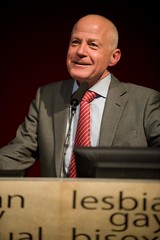
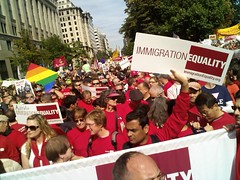
Immigration Equality at the National Equality ...Image by Matt Algren via Flickr
Source: Immigration Equality

A framework for comprehensive immigration reform, authored by Senators Harry Reid (D-NV), Chuck Schumer (D-NY) and Robert Menendez (D-NJ), includes a call for an end to discrimination against lesbian, gay, bisexual and transgender (LGBT) binational families. The principles, which are meant to guide Congressional crafting of immigration reform legislation, specifically call for key provisions of the Uniting American Families Act (UAFA) to be part of a future reform bill.

Immigration Equality hailed the inclusion of the language, which would allow LGBT citizens and legal permanent residents to sponsor their foreign national partners for residency in the United States. Under current law, no such sponsorship is available. An estimated 36,000 face imminent separation or exile because of discriminatory immigration policies. UAFA is sponsored in the Senate by Senator Patrick Leahy of Vermont, and in the House by Congressman Jerrold Nadler of New York.

“Today’s inclusive framework is an historic step forward for lesbian, gay, bisexual and transgender binational families,” said Rachel B. Tiven, executive director of Immigration Equality. “Now, it is time to turn these principles into laws. We will fight to ensure that the Uniting American Families Act is an indelible part of the immigration reform bill.”

“The LGBT community is committed to comprehensive immigration reform that includes everyone,” Tiven added. “Our community understands, all too well, the pain of being punished and singled out for who we are. Our solidarity with the larger immigrant community is deep, and our resolve to fix our broken immigration system is real. We will work for a bill that provides a path to citizenship for the undocumented, including those who are LGBT. Time is of the essence for those facing separation or deportation, and Congress must act, urgently, to pass humane, comprehensive reform.”‪

Immigration Equality also applauded the inclusion of the DREAM Act – a path to citizenship for undocumented students – in the principles released today. Earlier this week, DREAM activists who have walked from Florida arrived in the nation’s capital. Two of them, Juan Rodriguez and Felipe Matos, are also a couple, and have faced additional discrimination because of their sexual orientation. The outline also includes important provisions related to family unification, including ending the unconscionable backlogs that so many families face under the current system.

The group expressed dismay, however, over a proposal to implement a de-facto program for National ID Cards. Such a proposal, known as biometric identification, could be particularly troublesome for transgender immigrants, who struggle to get identity documents which match their correct name and gender.

“Immigration Equality,” Tiven concluded, “is working for a bill that protects LGBT immigrants who so desperately need reform. The path forward is about keeping families together and building a system that values our country’s unique and precious history as a nation of immigrants.”
Reblog this post [with Zemanta]

Zimbabwe: gays and lesbians struggle for basic human rights

Source: SW Radio Africa Transcript

By Violet Gonda

Violet speaks to the Gays and Lesbians of Zimbabwe [GALZ] Programmes Manager for Gender, Fadzai Muparutsa (Pictured). The discussion focuses on the recent reports of violence against the gay community and their struggle for basic human rights. Fadzai also talks about how gay victims of violence are often ridiculed by police officers after reporting an assault; and how even hospital staff mock them when seeking treatment. The discussion also looks at how minority issues are not taken seriously by both the ZANU PF and MDC leaderships.

VIOLET GONDA: An annual report by the US State Department on the human rights situation in Zimbabwe has revealed that homosexual men and women have been subjected to an ordeal known as, ‘corrective rape’. It has been documented in the report that gay men and lesbians are being raped by those who claim to be trying to convert their sexual orientation. The gay community have long been under siege in Zimbabwe and hate speech against this group is common. Robert Mugabe says homosexuality is ‘abhorrent’ and famously described homosexuals as “worse than dogs and pigs”. On the Hot Seat programme is the Gays and Lesbians of Zimbabwe or GALZ, Programmes Manager for Gender, Fadzai Muparutsa. She joins us from Harare to discuss the reports of the new violence against the gay community and the history of their struggle for basic human rights in Zimbabwe . Welcome on the programme Fadzai.

FADZAI MUPARUTSA: Thank you very much Violet.

GONDA: Now let’s start with the issue of ‘corrective rape’ – what exactly is this?

MUPARUTSA: Well people have a certain belief that by, particularly men towards women and particularly women who present themselves as masculine, if they have sex with a man then they will appreciate male sex and want to be in heterosexual relationships. So the idea behind it is that you rape someone and you correct their sexual feelings towards people of the same sex. It’s said to be ‘corrective rape’ but what we have been talking about of late is that putting it in that way will mean that people will think it is something that is positive and that it is corrective but what it is in fact is something that is very negative because it is rape and putting a term like ‘corrective’ in front of it or ‘curative’ before the word rape is in some way desensitising the kind of violations, or the kind of violence that lesbians or gay men experience.

GONDA: And has GALZ, has your Association actually received such reports?

MUPARUTSA: Yes we have. We have received, there aren’t that many, we can’t say it is on the increase but what’s happened of late is that people are talking a lot more about it and so people will come to the office and report cases that they have experienced and particularly at the hands of either their families, because this kind of rape usually happens in private spaces, in the homes or in close knit societies that our members stay in.

GONDA: Now isn’t that taboo, to actually sleep with a member of the same family?

MUPARUTSA: Well it is, it’s a very, it’s a very disturbing act that happens so let’s say my family members feel that I need to be corrected – they will get somebody to force themselves onto me in the privacy of our home and that’s what happens a lot of the time. That’s what I’m saying; it’s something that happens in the private space.

Kenya: Bisexual male sex workers run big risks

Kenya, AIDS postersImage by mvcorks via Flickr
Source: IRIN/PlusNews

At a nightclub in Mombasa, on the Kenyan coast, Tito Bakari* a local man, and Leonard Smithberger, a tourist, make out in a dark corner before the bouncer asks them to leave. Hand in hand they walk to another bar nearby, where they party through the night.

"My love from Germany has been here since Easter - the party has just begun," Bakari told IRIN/PlusNews. Smithberger visits Kenya a few times every year and showers gifts and money on Bakari, who moves out of the house he shares with his wife and child and into his lover's hotel.

Up to 60 percent of male sex workers in Mombasa also have female sexual partners, according to a recent study presented at the 17th Conference on Retroviruses and Opportunistic Infections in San Francisco.

"Although most sex partners of MSM-SW [men who have sex with men sex workers] are men, sex with local women is also common, usually transactional, and often unprotected," the study noted.

"Little is known of the personal risk awareness and motivations for women seeking sex with MSM-SW; however, these issues risk being overlooked by interventions targeting risk reduction between MSM alone."

Kenya's latest AIDS Indicator Survey attributed 15.2 percent of new HIV infections to men who have sex with men, and they are widely thought to be a bridge for HIV transmission to the general population.

Low awareness

The government is conducting a survey that will inform its first HIV campaigns targeted at MSM, who have so far been left out of HIV prevention efforts, allowing them to gain a mistakenly low perception of their own risk.

Thursday, 29 April 2010

Michael Cashman responds to our criticism of Labour's international LGBT record

Michael Cashman MEPImage by LGBT History Month UK via Flickr
By Paul Canning

On Tuesday pinknews.co.uk publicised my strong criticism of UK Labour's international manifesto. It was titled 'Labour is shunning gay Iraqis, asylum seekers' as this was my main point - neither is mentioned in either that or their domestic manifesto and on both Labour has failed to offer support, quite the opposite.

Leading gay politician Michael Cashman MEP has today defended Labour against my criticism in an interview with pinknews.co.uk.

This is what was said:
Today, Mr Cashman pointed to Labour's record on the issue and said the party was continuing to work with groups such as Iraqi LGBT.

He told PinkNews.co.uk: "No British government has done more to tackle discrimination and promote equal rights for LGBT people than this Labour government.

"We are proud to support the campaign within the UN for the universal decriminalisation of homosexuality. It is abhorrent that countries exist which consider it a crime punishable by death.

"Labour’s LGBT International Manifesto has been criticised for not mentioning Iraq. Let’s be clear about this – homophobia exists in every society and every state. There is no fixed list of ‘homophobia free’ states. The manifesto mentions a number of states for which there are particular concerns. That does not mean that there are no concerns elsewhere.

"We remain concerned about the situation in Iraq. That is why we continue to make representations on behalf of individuals like Mr Ali Hili who, as founder of Iraqi LGBT, has worked with the Foreign Office and campaigns against LGBT persecution in Iraq.

"No civilised society condones or supports discrimination and, while it continues to exist, it is right to that we should all remain impatient and be critical of states and institutions that do nothing to address it.

"But the fact remains that this Labour government has led international efforts to tackle discrimination and promote equal rights. Labour is also at the forefront in Europe, not only shaping the EU institutions but shaping attitudes as well."

Mr Cashman added: "It is a regrettable that some people appear to be critical of Labour for producing an International LGBT Manifesto. Perhaps they should be asking why other parties have not published one."
Here is my comment in response to Michael (with additional emphasis):
Michael Cashman has much to be proud of in his work for gay rights internationally. I would single him out in this respect.

Unfortunately, the rest of the party retains an appalling position on asylum. It is the government which he supports which is directly affecting Iraqi gays through denying Ali Hili's request for his asylum claim to be expedited. To prove otherwise all they have to do is for Alan Johnson to intervene and order it. We don't just vote for the Michael Cashmans but also the Alan Johnsons and unfortunately LGBT labour people are left generally trying to claim things will somehow change or in the case of their two manifestos ignoring them.

How, exactly, is 'the party' supporting Iraqi gays? No, it is simply failing to take responsibility for the results of its actions and I stand by 'shunning'. Michael is an exception within his party.

There are also exceptions within the Tories – I would point to London MEP John Bowis' support for Iranian Mehdi Kazemi who Jacqui Smith tried to deport but there are others. Pointing at the Tories in a knee-jerk way simply doesn't work when you fail to address the party's own record. Michael's comments would have more weight if he admitted where the party has gone wrong.

I do not think the Tories would be 'better', but on asylum they could hardly be worse.

And of course it is simply false to say "perhaps they should be asking why other parties have not published [an international manifesto]" when both the LibDems and Greens incorporate strong commitments in their manifestos.

I am glad Michael says "we should all remain impatient and be critical of states and institutions that do nothing to address [the situation in Iraq]". What I wrote was not an criticism of you but the rest of your party and its actions in government. I know and you know that what is promised in the international manifesto may be good but is not good enough.

I truly respect you Michael but it is a plain fact that on Iraq and asylum neither LGBT Labour manifesto has anything to say.

Reblog this post [with Zemanta]

Video: Selly Thiam discusses 'None on Record: Stories of Queer Africa'

Source: Google

The @Google program welcomed Selly Thiam to Google's New York office to discuss her audio based oral history project "None on Record: Stories of Queer Africa (NOR)".

"In 2004, FannyAnn Eddy, an LGBT activist from Sierra Leone,West Africa was murdered in the offices of the Sierra Leone Lesbian and Gay Association. The news of her murder circulated around the world and was a turning point for Selly Thiam, a Senegalese lesbian living in the United States. To honor the African QLGBT (queer, lesbian, gay, bisexual, transgendered) spirit that Fanny Ann embodied, she began collecting the oral histories of QLGBT Africans from the African Continent and in the Diaspora."

"None on Record: Stories of Queer Africa's mission is to bring the stories of QLGBT (queer, lesbian, gay, bisexual and transgendered) Africans into the forefront of media and media-making. It is a web-based archive, a media-making production crew and community-building tool for the global African LGBT population. Here you will find:

  • Stories from QLGBT Africans who have received refugee status or are seeking asylum in Canada, South Africa and the United States.
  • Interviews from South Africas first openly gay music group, 3SUM, and Trans Playwright, Nick Mwaluko.
  • Original, unpublished written works and visual art from QLGBT Africans showcasing how their experiences have shaped them emotionally, politically, socially, and culturally."


Reblog this post [with Zemanta]

People deported by EU member states face torture despite Diplomatic Assurances

Amnesty InternationalImage via Wikipedia
Source: Amnesty International EU

Amnesty International is calling on the member states of the European Union to reject diplomatic assurances against torture and other forms of ill-treatment from countries where people are at risk of severe human rights violations.

In the report Dangerous deals: Europe’s Reliance on “Diplomatic Assurances” against torture, released today, Amnesty International shows that several EU member states have refused to rule out the possibility to extradite individuals who are deemed to constitute “a threat to national security” by arguing that such transfers can be “human rights friendly” – a notion that is false and threatens the absolute ban on torture.  Several cases in the report illustrate how the use of diplomatic assurances threatens the ban on global torture and how deficiencies in the practice have lead to some individuals being tortured and ill-treated.

“Both the European Charter of Fundamental Rights and the UN Convention Against Torture clearly state that it is prohibited to return people to places where they risk being ill-treated. Yet, countries in the EU ignore their international obligations by relying on hollow diplomatic assurances from countries where post-return monitoring is flawed and torture and other ill-treatment is well-documented,” says Nicolas Beger, the director of Amnesty International’s EU office.

The United Kingdom has been the most influential and active promoter in Europe of the use of diplomatic assurances to forcibly return people to countries with appalling human rights records. The UK government has negotiated framework agreements with Ethiopia, Jordan, Lebanon and Libya, which include promises that the receiving countries will treat returned individuals humanely. The United Kingdom is planning to continue to conclude similar framework agreements in the future despite widespread criticism, the overwhelming risk of torture and judgments from the European Court of Human Rights stating that diplomatic assurances don’t protect individuals from torture.

Italy has deported several individuals alleged to be terrorist suspects to Tunisia and other countries since 2008 and at least one individual was tortured eight months after being returned despite assurances from Tunisian authorities that he would not be ill-treated upon return. Human rights violations have also been experienced by people deported from Spain to Russia.  Against all the evidence, other EU member states such as Sweden and Denmark have stated that they will not rule out the use of diplomatic assurances in the future and only a decision by the European Court of Human Rights is currently preventing Germany from deporting a person to Turkey.

“European governments use diplomatic assurances in their own self-interest to evade their international responsibilities. It is time for EU countries to fully respect the human rights of all individuals and instead focus on eliminating torture in countries where it is persistent,” concludes Beger.
Reblog this post [with Zemanta]

Wednesday, 28 April 2010

During an election 'usually, however, there is only silence'

Phil WoolasImage via Wikipedia
Source: OurKingdom
By Clare Sambrook 
When terrified men, women and children are being shunted off to countries where they face real and imminent risk of rape, torture, genital mutilation or death, an MP’s urgent appeal to government may tip the balance, stalling removal directions, making time to get legal advice.

But not during a general election campaign, when MPs lose their right to represent constituents' grievances. ‘We will not be able to respond to former MPs, or prospective parliamentary candidates on individual cases,’ says the UK Border Agency, ‘unless there is a signed letter of authority from the individual they are representing.’

For an asylum seeker banged up unexpectedly in a detention centre, isolated from help and support, with little English, no legal advice, restricted access to a fax machine, and facing a dawn deportation flight, the effect until May 6th is likely to be: no representation.

‘The family is Sudanese — a mother with three girls, aged 14, 10 and three,’ Conservative MP Alistair Burt told the House of Commons one evening last summer. ‘They have been in this country for a couple of years . . . The father disappeared in Darfur and the family applied for asylum, but the application was turned down.’
Burt, whose Bedfordshire constituency contains Yarl’s Wood detention centre (pictured) , where the family had been held for nine weeks, went on: ‘The three girls face the inevitable prospect of female genital mutilation when they return — the 14-year-old faces it almost immediately on her return. It is impossible to describe to the House the horror and apprehension that the family feel about their imminent return.’

He said: ‘I was contacted suddenly before their anticipated removal, and I asked whether the minister would be good enough in the circumstances . . . to put the removal directions on hold and allow the family more time to see a new solicitor and present another case. On the afternoon in question, the family . . . were in a van on their way to the airport when news came through from the minister’s office that he had been kind enough to grant a stay of removal directions.’

Despite receiving minister Phil Woolas’s cancellation orders, the private contractors, G4S, drove the family onto the tarmac, had their bags loaded onto the plane, then split them up so they could force the girls onto the plane first. The mother managed to get word to Burt on her mobile phone.

‘The mother became extremely distressed and was restrained in the elastic cuffs that are used,’ Burt told the House. ‘The mother resisted, not unnaturally, and there was further to-ing and fro-ing. She was placed in the aircraft, where she continued to resist, and then the escort said that further confirmation had been received that the removal directions had been cancelled. That followed a further intervention on my part to the minister’s office, asking what on earth was going on when removal directions had been cancelled but, contrary to the minister’s express wishes, were being carried out.’

That wasn’t the end of it.

Homosexuality, Islam and Christianity in Sub-Saharan Africa

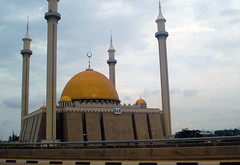
Mesquita Nacional em Abuja, NigériaImage by Moises.on via Flickr
Source: African Activist

The Pew Forum on Religion and Public Life just released an extensive study on Islam and Christianity in Sub-Saharan Africa. It is almost impossible to discuss the advancement of lesbian, gay, bisexual, transgender and intersex (LGBTI) rights in Africa without a careful and sensitive awareness of Africa's religious context.

Christianity and Islam is practiced at a much higher rate in Africa than in Europe or the United States and coexists with traditional African beliefs and practices.

The Executive Summary opens with the following paragraph:
The vast majority of people in many sub-Saharan African nations are deeply committed to the practices and major tenets of one or the other of the world's two largest religions, Christianity and Islam. Large majorities say they belong to one of these faiths, and, in sharp contrast with Europe and the United States, very few people are religiously unaffiliated. Despite the dominance of Christianity and Islam, traditional African religious beliefs and practices have not disappeared. Rather, they coexist with Islam and Christianity. Whether or not this entails some theological tension, it is a reality in people's lives: Large numbers of Africans actively participate in Christianity or Islam yet also believe in witchcraft, evil spirits, sacrifices to ancestors, traditional religious healers, reincarnation and other elements of traditional African religions.
A large number of the Christians and Muslims surveyed take the Bible or Koran literally, word for word.

In the chapter, Commitment to Christianity and Islam, research indicates that large majorities in every country express belief in the core tenets of Christianity or Islam and took more literalistic approaches to the Bible and the Koran.
In addition, large numbers of Christians - including at least half in every country surveyed and nearly nine-in-ten people in Nigeria and Liberia - say they believe the Bible is the word of God and should be taken literally, word for word. Most Muslims adopt a similar view of the Koran, including roughly nine-in-ten or more Muslims in Nigeria, Cameroon and Ghana.

Pakistan: Call to recognise transsexuals as distinct gender

Source: The News

Transvestites (eunuchs) should be allowed to identify themselves as a distinct gender as per the apex court’s ruling and they should be included in government support program so as to help them develop skills and become respectable and contributing members of society.

These views were expressed by speakers at the launching ceremony of a report on transvestites in Sindh compiled by journalist-cum-activist Akhter Hussain Baloch at Karachi Press Club on Sunday.

The participants expressed their concern that despite the Supreme Court orders that transvestites be issued CNICs and be hired in government jobs, the community continues to face neglect on the part of the state and society. It was observed that the demand by trans-gender group for a share from officially collected Zakat was fair and just. The participants recommended that measures be taken to ensure that transvestites could draw benefit from essential services in health and education sector.

The report, titled: “Third gender - a scoping study of the socio-cultural complex around the trans-gender communities of Sindh”, is prepared by the Society for Development and Human Rights in collaboration with ActionAid Pakistan.

The participants were of the view that transvestites happen to be the most neglected and excluded group of the country. Though Pakistani society was shy of talking about them, they had come out of the shadows following Supreme Court’s landmark judgment which ruled that transvestites were entitled to inheritance and other rights.

It was informed that following Supreme Court orders, a census of transvestites in Pakistan was carried out by the Social Welfare Department. But, ironically, the process did not deliver as the department came up with only about 1,500 registrations in Punjab and about 800 in Sindh. However, the participants observed that there were over 16,000 transvestites in Karachi alone and 0.4 million throughout Pakistan.

The speakers included Khizar Habib, Aziz Sanghur, Abu Rashid, Anis Mansoori and Javed Iqbal Burki. They said that the transvestites needed to be distinguished from sex workers, adding: “We must not discriminate against the people because of their sexual preferences”.

Akhtar Hussain Baloch, the author of the report, said that he has attempted to provide a rare insight into the social and cultural life of this group.

He said that the report provides cases of violent treatment meted out to transvestites by the police and other state agencies. The report comprises interviews of the victims / survivors, police officials involved, community elders, neighbours of the transvestites and lawyers.

According to him, the poor people of this group have often been deprived of their properties and resources, while the law remained heavily tilted in favour of the oppressors. The research work has also explored the lifestyle of the group e.g. their celebrations, dance, music, relationships i.e. marriages and other forms of co-habitation.
Reblog this post [with Zemanta]

Alan Johnson fibs on asylum claim refusal numbers

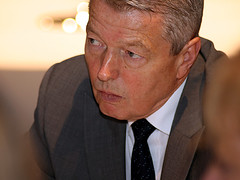
Alan Johnson in BirminghamImage by Downing Street via Flickr
Source: Channel Four News

By Alice Tarleton
The claim

“The Liberal Democrats… would allow asylum seekers to work, which would be a fundamental mistake given that 83 per cent of asylum seekers are found not to have a genuine claim.”
Alan Johnson, home secretary, BBC Politics Show, 25 April 2010

The background

The idea that hordes of “bogus asylum seekers” are trying to get into the UK has generated many a tabloid headline over the past decade.

The government draws a line between refugees and those coming here for economic purposes by preventing asylum applicants from working in all but exceptional circumstances.

But the Lib Dems want to reduce spending on benefits by letting asylum seekers find paid work after two months, regardless of whether their case has been approved.

This would, Johnson said, be a “fundamental mistake” – given that 83 per cent of asylum seekers turn out not to have a genuine reason for seeking sanctuary in the UK.

That’s a strikingly high figure – but is it correct?


The analysis

Tuesday, 27 April 2010

Labour is shunning gay Iraqis, asylum seekers

David-MilibandImage by Labservative via Flickr
By Paul Canning (for pinknews.co.uk)

As he launched Labour's international LGBT manifesto last Wednesday, foreign secretary David Miliband made one howler, echoed by another in the manifesto's text.

He said: "Under Labour the UK will continue to be a beacon of hope for LGBT people."

This delusion sounded a lot like Home Office minister Phil Woolas' article last year, when he wrote that he was proud of the attendees of the London Pride march who'd found sanctuary in the UK – never mind that his office would have refused them and fought tooth-and-nail to remove them.

The pair should form a double act.

An Amnesty International report released today said that gays in Iraq have no protection from the state and are allegedly even being targeted by some security forces. Yet Miliband's 'beacon' government would tell those seeking our sanctuary they could safely return and be "discreet".

Recent research from the UK Lesbian and Gay Immigration Group on 50 refused asylum cases found that many were told to go home and not act gay.

Laugh? Cry? There is no "discreet" in Iraq – they will come and they will find you and they will torture you and display your body. For women "discreet" means you must marry and suffer rape for the rest of your life.

Furthermore, Labour's gay group LGBT Labour has nothing to say on asylum, despite the group passing a resolution at its AGM last year that it would "explore with the Home Office and Borders and Immigration agency" such items as no longer telling people to "go home and be discreet".

Labour's gay manifesto has nothing to say on the matter, presumably because the "explorations" came to nowt.

Elsewhere, the document says that the UK has "campaigned in the UN for the decriminalisation of homosexuality".

Now this has been part of a shopping list of Labour's great deeds for LGBT for some time. Previously, LGBT Labour's website claimed that the party "launched" the campaign but this has now mysteriously disappeared.

It certainly didn't lead. The origins of the UN resolution lie in the work of Louis George Tin, the French International Day Against Homophobia (IDAHO) founder who launched a worldwide campaign to end the criminalisation of same-sex relationships in 2006. He worked with then French foreign and human rights minister Rama Yade to get it to the UN. The British tagged on later. Google it.

I've exchanged emails with Louis George on the Labour claim. Shall we just say he's "bemused"?

It's also de rigeur here for them to say "only Labour" will continue to support UN work. I guess it was written before the rise of the LibDems who appear to be a good decade ahead of Labour on LGBT issues.

Having knocked it there's one good thing to say about Labour's gay manifesto. It does promise to "always raise matters of LGBT rights in countries where there is systematic violence or harassment", naming Russia, Uganda, Iran and Jamaica.

Of course we won't offer asylum or accept refugees but this is progress. It's certainly progress on Miliband's own Foreign Office human rights report, issued in February, which barely mentions LGBT issues anywhere outside Europe. It also somehow misses their sterling work in the Commonwealth, but, in future, sez the manifesto, they'll be a "relentless champion".

One country is missing in that list: Iraq.

Let's be clear, Labour created this modern-day pogrom. Saddam wasn't systematically hunting people down because they were lesbian, gay or transgender. That started after the invasion.

Since then, none of the governments responsible have done anything about it bar a few diplomatic words. Right now there is a pogrom going on in southern Iraq, the area formerly controlled by Britain: the legacy of the Labour government's rule there.

Perhaps I shouldn't pick out just Labour LGBT for pretending that this isn't happening, hoping the stench in the corner will be quietly ignored. The Labour government may be legally responsible but they're not the only ones ignoring it (so, given realpolitik, Labour LGBT's hope may be quite justified). The LGBT 'community' internationally has a case to answer.

Neither is it the responsibility of LGBT alone to help rescue Iraqi gays, but for those who claim to care about our brothers and sisters in other countries (including those who seek votes on that basis) it is shameful how they are turning their backs on Iraqis.

They are focusing, like the American Jews of the 1930s and 40s, solely on our own selfish interests.

LGBT Ugandans have been discussing what to do should the 'kill-the-gays' bill pass, where to flee. Some Americans have talked about pressuring the US State Department to help rescue them.

And the UK? How would we help those from our former colony, to whom we bequeathed sodomy laws? Referring back to that list of countries this manifesto says are experiencing "systematic violence or harassment", how has the Labour government helped fleeing Jamaicans? Or Iranians?

Jewish people know all about rescue. We could learn something from their history. They have a litany called an Al Chet which they use during Yom Kippur. Rabbi Joseph Soloveitchik wrote this one about how Jews escaping Germany weren't helped by fellow Jews who looked firstly after their own interests:

"Al chet shechatanu lefanecha bera’inu tzoras nafshoseihem shel acheinu bais yisroel shehischananu eileinu v’lo shamanu" [for the sin that we have sinned before you by seeing the suffering of our Jewish brethren who called to us and we did not listen].

They are calling, and we need to start listening.
Reblog this post [with Zemanta]

Amnesty damns UK government on asylum returns to Iraq, Iraqi security forces on targeting gays

By Paul Canning

In a new report on deaths of civilians in Iraq, Amnesty International has hit out at European governments which continue to return asylum seekers to that country and said that Iraqi security forces are 'encouraging' the targeting of gays for murder.

They have called on the international community to:
  • End all forcible returns to any part of Iraq; any return of rejected asylum-seekers should only take place when the security situation in the whole country has stabilised.
  • Provide financial, technical and in-kind assistance to refugee-hosting states in the region, UNHCR and other organisations providing assistance to refugees from Iraq.
  • Share the responsibility for resettling refugees from Iraq currently in the region, giving priority to the most vulnerable cases.
Forcibly returning people to Iraq – including to the most dangerous parts of the country – is in direct violation of guidelines set out by UNHCR, the UN refugee agency. A number of members of the EU do not return asylum seekers to Iraq, including France, but the UK has attempted several times to return Iraqis.

The agency says that improvement in the situation in Iraq is not yet sufficient enough to promote or encourage massive returns and it recommended that refugees already benefiting from international protection should retain their status. It singled out central governorates of Baghdad, Diyala, Kirkuk, Ninewa and Salah Al-Din as unsafe.

In October The Guardian reported that following a policy change to remove to Iraq's Central province "allegations of assault, racist taunts and operational chaos have emerged from Iraqi asylum seekers the Home Office attempted to deport to Baghdad."
The commander of Baghdad airport was reportedly so infuriated by the unexpected arrival of the chartered plane on Thursday that he threatened to set fire to the aircraft if it did not leave within two hours. Details of the operation – involving as many as 100 private guards and about 40 failed Iraqi asylum seekers – suggest the secret expulsions degenerated into a humiliating retreat.
Kawa Ali Azad, who arrived in the UK in 2002, said:
"They slapped me on the mouth and handcuffed me. I still have the bruise. I was also spat at. When the plane stopped in Italy, we had to swap aircraft. I heard them talking to Italian security and they said we were a group of terrorists being transported. They put a jacket over my head and I received kicks."
Amnesty International spoke to several Iraqis who were forcibly returned by the Netherlands government on 30 March 2010. Among the 35 refugees was a 22-year-old Shi'a Turkoman man from Tal Afar, a city north of Mosul, where hundreds of civilians have been killed in sectarian or other politically motivated violence in recent years, and where the violence continues unabated. As of mid-April, he remained stranded in Baghdad. Denmark, Norway and Sweden have also removed Iraqi asylum seekers.

In February 2010 Iraqi Vice-President Tariq al-Hashemi urged European governments not to deport Iraqi asylum-seekers to Iraq until security and economic conditions had improved.

In its section on attacks on gay men, which reiterates much of the evidence from the Human Rights Watch report "They Want Us Exterminated" released last August, Amnesty says that "members of the security forces and possibly other authorities appear in some cases to have encouraged the targeting of people suspected of same-sex relationships, in blatant violation of the law and international human rights standards."

This is the first time either a government or a major Human Rights organisation has cited Iraqi government collusion, although it has been reported by Iraqis for some time. "Members of the gay community under threat of attack or murder," it says "cannot expect any assistance from the authorities, even when urgent protection is needed."

Ali Hili, the head of London-based Iraqi LGBT, who welcomed the report, told PinkNews.co.uk that:
"We continue to receive reports of killings and now have over 738 documented.

"Within the last fortnight two young gay men were taken by men in police uniforms and their graffitied bodies displayed in one of Baghdad's main squares.
Hili said that British government was "failing Iraqi lesbians and gays".
"We have and will continue to try to get people to safety but the British government must do more. It is wrong to tell Iraqi asylum seekers that it is safe to return if only they are 'discreet', which they have done." 

Amnesty International: Iraq: Civilians under fire


Reblog this post [with Zemanta]

South Africa: I'm not a fake woman, says intersex Jennifer

The Coat of arms of South AfricaImage via Wikipedia
Source: The Times

By Taschica Pillay

A Glenwood woman is fighting for a South African identity document and also to be recognised as a female South African.

Jennifer Kisten, 42, who is intersex or transgender, wants to be accepted and recognised as a woman.

Kisten, who returned to South Africa six months ago after spending 20 years in the Netherlands, has been battling to get a new ID number, change her name from Gordon to Jennifer, and be classified as female.

"I have spent R80000 over the past six years in legal fees trying to get an ID book. I have all the documents to prove that I am a woman. While in Holland, I had genital correction done in 2001," she said.

Kisten was born with male genitalia and later discovered she had female organs.

"I had female organs in me. My ovaries were removed a long time ago. I am totally female. I have a perfectly normal relationship with my boyfriend, Liaan Myburgh."

She said the Department of Home Affairs didn't acknowledge her as a female.

"They lost my files. Now they say they are going to speed up the process to have it ready. I want to be able to open a bank account and register with SARS.

"In the Netherlands, I am classified as a female. I have all the Dutch documents proving I am female. Why am I being discriminated against here? This is my country and I should not be treated like this."

Kisten, who was adopted as a baby, ran away from her Chatsworth home at the age of 16 after allegations of sexual abuse. "I lived in Johannesburg before moving to the Netherlands, where they are more tolerant of people like me. People in SA still call me a fake woman."

She said she would be focusing on transgender, intersex and gay and lesbian people in South Africa and their rights.

"I want people to come out and live their lives, because many intersex people lock themselves up because society does not accept them. People need to be tolerant of people like me. People should not be disrespectful of us."
Reblog this post [with Zemanta]

Protest at British Embassy in Washington for Kiana Firouz

Kiana in a scene from the film 'Cul de Sac'
By Paul Canning

An Iranian solidarity group is to protest this Saturday, 1 May, outside the British Embassy in Washington DC against the UK's continuing removals of asylum seekers to Iran. It is calling for four deportation orders to be lifted, including that of Kiana Firouz, the lesbian Iranian actress.

The protest by Mission Free Iran focuses on women which Britain wants removed.

Firouz's claim was turned down by the UK Border Agency and she has lost an appeal. The actress is to be appear in the film 'Cul de sac', released next month, and says "the movie contains sexual scenes which itself would be subject to death punishment if I return to Iran."

More than 11,000 people have viewed the trailer for the video. An international petition for Firouz has collected 3000 signatures in a week.

As well international campaigners are asking for calls to UK embassies around the world to protest removals of Iranian asylum seekers.

Jamaica: 'Taboo Yardies' to hit the streets in November

Source: Gleaner

By Howard Campbell

A Jamaican film-maker's documentary about the country's indifference toward homosexuals is tentatively scheduled for a November release.

Taboo Yardies is the title of Selena Blake's project which looks at the intolerance of Jamaicans toward persons with an alternative lifestyle. The project is being produced by Blake's Maynov Productions.

"Hopefully, the film should be completed within the next two months. I think the buzz surrounding this project is human rights because it's never been told in this manner before," she said.

The Old Harbour-born Blake interviewed several persons in the Caribbean gay community in New York City, and travelled to Jamaica late last year for similar discussions with prime minister Bruce Golding, psychologist, Aggrey Irons, journalist, Beverley Anderson Manley, and the Jamaica Forum of Lesbians, All-Sexuals and Gays.

Significant assignment

The Golding assignment was significant. In a 2008 interview on the British Broadcasting Corporation television programme Hard Talk, the prime minister said there was no space for homosexuals in his administration.

Blake, 47, said it was difficult getting archival material in Jamaica.

"We knew it would be challenging trying to get footage from sources that are homo-intolerant but we managed to overcome the road blocks," she said.

Jamaicans have long shunned homosexuality, mainly on religious grounds. In recent years, many dancehall artistes have been targeted by gay advocates in Europe and North America for their anti-gay songs.

Taboo Yardies is the second film by Blake, a former model who has lived in New York City for more than 30 years. Her 2005 debut, Queensbridge: The Other Side, dealt with deteriorating conditions at the Long Island housing project of the same name where she once lived.

The Queensbridge scheme was built in 1939 and was once home to World War II veterans. NBA star Ron Artest and rapper Marley Marl grew up there.

That documentary got strong reviews including a thumbs-up from the New York Times. Blake hopes Taboo Yardies will also strike an emotional chord.

"I hope it will become a vehicle that will spur an open and honest conversation where homo-intolerance is concerned," she said. "I'm sure there are bigger issues facing Jamaica than same-sex relationships."


Reblog this post [with Zemanta]

Monday, 26 April 2010

Iraqi LGBT: Ali Hili campaign update


First campaign coverage in Middle East, first direct comment by government on case

Labour's election web campaign supremo asks Johnson to act

1000 sign petition in fortnight, hundreds of letters to Johnson

A major middle east news source has written about the campaign for Ali Hili and Iraqi LGBT, the first major news outlet for the region to cover the campaign.

The Media Line also secured the first direct comment on Hili's case from the UK government. They said that it is being dealt with by UK Border Agency (UKBA) Case Resolution Directorate and “the reason it hasn’t been prioritised is because it doesn’t fall into one of the priority categories listed on our website.”

When applying for his case to be prioritised, Hili's solicitor Barry O'Leary explained that he needed to travel to fulfill speaking engagements which would directly aid lesbians, gays, bisexual and transgender people (LGBT) suffering terror in Iraq through publicising their cause. "It’s disrupting everything for us and throwing the group’s work down the drain," said Hili.

Six months later, and interpreting those "priority categories", the UKBA told O'Leary that:

  • the assistance which Hili has given to the Foreign Office (and mentioned in their 2009 Human Rights Report) "does not count"
  • the fatwa (death threat against him) does not mean that Hilli "falls within the classification of clear and immediate vulnerability"
  • that the delay in deciding Hilli's asylum case (since July 2007) "is not in itself an exceptional circumstance"
  • his case is not "compelling"
The UKBA explanation is in contradiction to the response given to MP Clare Short, prompted to write by a constituent. She was told by Gail Adams, West Midlands Regional Director of the UKBA that "information contained in applications to the UKBA is treated as being strictly confidential and is not normally disclosed to third parties."

Iraqi LGBT have been informed that a number of MPs have asked Johnson to act, including the head of Labour's web campaign for the general election Kerry McCarthy, Labour MP for Bristol East.

Campaigners are determined to get the British Home Secretary, Alan Johnson, to intervene and order Hili's case prioritised - as he is able to do. 
  • They would like it to become an issue in the UK election. 
  • They say that the lack of resolution and consequent inability to travel and meet politicians and journalists in places such as Washington DC, Brussels and Madrid directly affects LGBT who are suffering a pogrom which continues in the country.
  • Iraqi LGBT say they will be releasing a video next month which addresses the ongoing campaign against LGBT, particularly in Iraq's south, a region formally under the control of the British. They say that in recent weeks there have been a number of murders of young gays.
Within a fortnight of the launch of the campaign, over 1000 people have signed an international petition. Over 250 mainly Americans have used change.org to send a message demanding intervention from the UK Home Secretary. Campaigners say they are aware of over 100 other letters going to both Alan Johnson and Gordon Brown.

The author Stella Duffy posted a link to the campaign on her Facebook page.

Besides The Media Line, a number of other blogs and websites covering Iraq have featured the case and support has come from many Iraqis.

Further coverage of Hili's case and the plight of LGBT in Iraq has come from a wide variety of media around the world.

LGBT in Haiti, Three Months After the Quake


By Cary Alan Johnson, IGLHRC Executive Director

In the fall of 2009, I traveled to Haiti to get a better understanding of emerging LGBT communities, the impact of HIV on men who have sex with men (MSM), and how LGBT were responding to the HIV crisis. At the time, I met some talented, committed individuals, who were mainly working in the context of the HIV prevention, treatment and care sector, but were also steadily carving out a space for the promotion and protection of a broad set of human rights for LGBT people.

It has only been three months since the devastating 7.0 magnitude earthquake of January 12, 2010, and I have returned to Haiti, along with Marcelo Ferreyra, IGLHRC’s Latin America and Caribbean coordinator, and researcher Samara Fox. This week we will be interviewing LGBT Haitians, relief workers, and human rights activists to learn more about how the earthquake and the recovery efforts are impacting LGBT lives.

Our findings will help us understand the specific difficulties that LGBT people face in the wake of massive disasters and upheaval so we can make our partnerships as useful as possible when working with organizations such as SEROvie and its members in Haiti, and LGBT communities elsewhere in the wake of catastrophes.


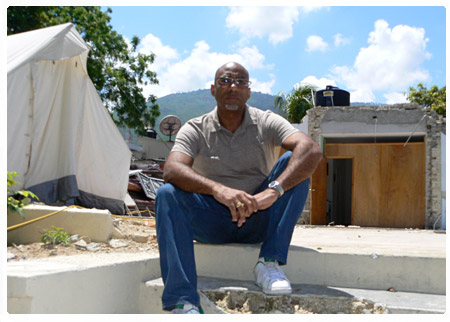
Cary Alan Johnson, IGLHRC at the SEROvie offices

Stepping into the courtyard of the offices of SEROvie, the only organization in Haiti working exclusively with gay and bisexual men and transgender women, is a shocking experience. The bright, spacious office that I had visited only 7 months ago has been reduced to its foundations. The one room left standing is the office of Program Director Reginald DuPont, a composed young man with a reassuring voice, who oversees SEROvie’s counseling and outreach programs. Fourteen SEROvie members were killed on the day of the earthquake; seven in the collapse of the office. Reginald pulled many of the dead and dying from the rubble himself.

Mithly, Morocco’s first magazine for gays

Source: afrik.com

By Djamel Belayachi

Launched on April 1, Mithly (gay, in Arabic) is the first openly gay Moroccan magazine. The publication, edited in Arabic, seeks to give a voice to "lesbians, gays, bisexuals and transsexuals, to express themselves." And this does not necessarily go down well with everyone.

"A first in the Arab world!" Exclaims the pan-Arab daily Alarab online. Launched on April 1 by the president of Kif Kif, a Moroccan LGBT (Lesbian, Gay, Bisexual and Transgender rights) organization.

It is the first gay magazine in Morocco. A publication that aims to give a voice to "lesbians, gays, bisexuals and transsexuals, to express themselves despite the fact that the authorities pretend that they do not exist," says the magazine’s blurb. The magazine is also available on the Internet.

Arab Homosexuals come from me of the "most politically and socially unstable areas in the world," says the magazine’s editorial, adding that the homophobia of which they fall victim tois as a result of "ignorance and misunderstanding."

Mithly’s editorial team is based in Madrid, Spain, given that homosexuality in Morocco is considered as an offense and punishable by up to three years imprisonment and a heavy fine. But despite this risk, officials of the magazine could not resist the temptation to distribute the first edition in Morocco.

Nearly 200 copies were printed and distributed under the counter in Rabat. For the time being, no legal action nor fatwa have been brought against them the moment, albeit a condemnation from the Islamist Justice and Development party’s newspaper, Attajdid.

"Homosexuality is against the future of humanity", Mustapha Khalfi, editor of the publication told Le Soir Belgique. According to him, the Moroccan authorities "should ban this publication that hurts the Islamic values of the Moroccan society." Cohabitation may be difficult.

Reblog this post [with Zemanta]

Yemen: Pro-gay article sparks smear campaign, death threats

Source: The Media Line

Written by Rachelle Kliger

A Yemeni filmmaker is facing a smear campaign from conservative and religious groups in his home country after publishing an article in a local magazine promoting gay rights.

The Paris-based author, Hamid Aqabi, wrote that homosexuality was “part and parcel of our society.” He called on the parliament to extend more rights to gay people and went as far as to suggest that the Yemeni government should consider allowing gay marriages, just like in the West.

The article tackled several thorny issues and appeared in A-Thaqafiyya, a cultural magazine funded by the government and issued by the Al-Jumhouriyya institution.

Like in most of the Arab world, in Yemen homosexuality is controversial and rarely discussed topic.

"Yemen is the same as other Arabic societies – homosexuality is practiced in private,” Ali Hilli, the pen-name of a London-based gay rights activist and director of Iraqi LGBT told The Media Line.

“Freedom of speech is very important and should not be subject to prison sentences. Threats or intimidation are a very dangerous weapon against human rights activists and journalists in the Middle East and governments should tackle this issue,” he said.

As to Aqabi’s suggestion to introduce gay marriages, Hilli said it was “not very rational” to bring this up for discussion in a society like Yemen.

“In Yemen there is no gay community, because according to Islamic Sharia it’s prohibited,” Mohammed Al-Qadhi, a Sanaa-based journalist and analyst told The Media Line. “Yemen isn’t the United States. It’s a very conservative society and no one will admit that they’re gay.”

Al-Qadhi called Aqabi’s article “very rare.”

Sunday, 25 April 2010

South Africans to protest lack of LGBT protections in USA + Uganda

Source: LezGetReal

By Melanie Nathan

A protest march will take place in Pretoria on Freedom Day, April 27, to demand equality for lesbians and gays in both the U.S. and Uganda.  Organized by Up & Out, the University of Pretoria’s gay organization, the protesters will march from the Ugandan Embassy to the U.S. Embassy.   The U.S. has been slammed by the organization for its continued refusal to grant same-sex couples federal marriage rights and benefits. “How can a supposed first world nation decide to do such things?” asked Up & Out in a statement.

Uganda is also under immense international pressure over its proposed Anti Homosexuality Bill which, if   passed by the country’s parliament, would impose the death penalty on people found guilty of repeated “homosexual offenses”.

“We as the Lesbian, Gay, Bisexual, Transgendered, Inter-sexed, Asexual (LGBTIA) youth and champions are devastated at the ongoing government tyranny in Uganda. It is inhumane and totally uncalled for,” said Up & Out.  No right minded individual should even be able to comprehend the preposterous notion of giving someone the death penalty on grounds of their sexual orientation. To add to the injustice, if you are related to or even know of an LGBTIA individual in Uganda, you will either be arrested or fined for not bringing these individuals to the attention of the authorities.”

The protest march will kick off at 10am, on Tuesday 27 April, with protesters urged to meet at the OUT offices at 1081, Pretorius Street, Hatfield (two houses down from the corner of Pretorius and Hilda streets).

The group will then gather outside the nearby Ugandan Embassy in Church Street before marching toward the US embassy in Pretorius Street. Participants are urged to bring placards, banners and pickets.
Reblog this post [with Zemanta]

Australia: LGBT refugees increasingly being accepted

Source: Sydney Star Observer

By Ani Lamont

The plight of gay and lesbian refugees is increasingly being understood by the Refugee Review Tribunal, but sensitive questioning still remains a foreign concept.

A recent Tribunal decision to accept an Indian man’s application for refugee status on the grounds of homosexuality has been welcomed as an “enlightened” case by Gay and Lesbian Immigration Task Force solicitor Lachlan Riches.

The case involved a man from New Delhi who applied for asylum after being outed by an employee from his factory. He was subsequently physically attacked by both town locals and his father and brother whose abuse was so violent that he required medical attention.

It is not the first gay refugee case but, according to Riches, the findings indicate a more understanding approach being taken by the Tribunal.

Unlike previous cases brought before the Tribunal, the applicant was not told that it would be safe for him to return to his country of origin and continue life as a gay man with provisos.

European Court of Human Rights to consider Italy's 'intercept the boats' policy

l'immigrato solo in giro per l'ItaliaImage by Add rien via Flickr
Source: Radio Netherland

By Linawati Sidarto

“It’s the first time that the procedure which countries like Italy and Spain, and sometimes Greece, apply comes before the ECHR,” said Thomas Spijkerboer, migration law professor at Amsterdam’s Vrije Universiteit. “The stakes are high. This is an incredibly important case.”

Since May 2009, Italy has made it a procedure to intercept in international waters boats filled with migrants, coming mostly from African countries, who aim to reach Italian shores. These migrants are then brought to Libya.

The United Nations Refugee Agency UNHCR said that in two months since Italy introduced its “new push-back policy,” at least 900 people trying to reach Italy by sea have been sent to other countries, mainly to Libya.

A law suit was filed in July last year by 24 asylum seekers originating from Somalia and Eritrea, who were among those intercepted and shipped to Libya. Rome-based lawyer Anton Giulio Lana, who represents the plaintiffs, said Italy is violating three articles in the European Convention of Human Rights: article 3 on the prohibition of torture and inhuman or degrading treatment, article 4 of protocol 4 prohibiting collective expulsions, and article 13 on the right to proper legal remedy.

One of the 24 plaintiffs has since passed away. “One of them died in his last attempt to reach the Italian coasts in November 2009,” Lana said.

The lawyer keeps in contact with his clients by phone or email, which is no easy feat given their uncertain living conditions. “Some of them are in temporary detention centres, and others are in prison in Tripoli.”

Italy’s policy has sparked sharp criticism from organisations such as UNHCR, Amnesty International and Human Rights Watch, all of which have expressed their support for the plaintiffs to the Strasbourg Court.

Lana stressed that the condition in Libyan detention centres is a grave concern. “Camps are often overcrowded, have sanitary problems, acts of violence or sexual abuses against women are regularly carried out, as well as acts of torture or ill-treatment.”

The UNHCR stated that based on its “assessment of the situation in Eritrea and our interviews with the (expelled) people themselves, it is clear that a significant number from this group are in need of international protection.”

Spijkerboer said that during the time Italy allowed migrants to land on its soil, about half of them applied for asylum, and from that group roughly half of the people are granted asylum. “A good working presumption is that a quarter of the people who are (now) returned are refugees.”

“European countries often claim that of all these migrants, a few out of every hundred might be refugees. But according to their own decision making behaviour, that’s a serious underestimation of the scope of the problem,” he said.

The ECHR has given Italy a deadline of April 12th to give its statement to the Court, and the plaintiffs in turn will have a month to reply to the statement. After that, Lana said, the Court will make its decision. It is not unusual for the ECHR to take up to five years to conclude a case, though both Lana and Spijkerboer said that until now the Court has dealt with the case “in a speedy manner.”

The Italian state’s representative for this case, Nicola Lettieri, has not responded to inquiries about the lawsuit.

The outcome of the lawsuit, Spijkerboer said, would decide “whether European countries are allowed to intercept migrant boats and return them to countries of departure without any human rights guarantees.”

If the plaintiffs are victorious, Spijkerboer expects that similar suits will be filed at Strasbourg, for example against Spain. He explained that Spain executes a different variation of Italy’s policy: Spanish vessels try to intercept migrants in West African territorial waters, often carrying a West African official on board.
Reblog this post [with Zemanta]

Saturday, 24 April 2010

Homophobia Threatens HIV/AIDS Work in Africa

Source: Amfar

In February, peer educators at an HIV clinic in Kenya that serves men who have sex with men (MSM) were savagely beaten by an anti-gay mob that doused some of the men with kerosene and tried to set them on fire. In Malawi, a leader of a grassroots group working to stop HIV/AIDS among MSM went to his local police station to file a report after a break-in at his office—and was arrested for distributing HIV prevention materials the police deemed “pornographic.” And in Uganda, the country’s legislature is seriously considering anti-gay laws that would make consensual sex among HIV-positive adults punishable by death.

Homophobia, of course, is present in every country. But a wave of homophobic rhetoric and violence in some African countries is undermining efforts to combat high rates of HIV/AIDS among MSM. Human rights activists, AIDS advocates, and grassroots MSM organizations—including a number of groups funded by amfAR’s MSM Initiative—say that the progress that had been made over the past several years in reaching African MSM is being threatened by a new climate of fear and repression that is sweeping parts of the continent.

Uganda: “We’ll be forced underground”

Same-sex sexual behavior has long been outlawed in Uganda, but the country’s war on homosexuality began to escalate in the spring of 2009, when several evangelical clergymen from the U.S. visited to give a series of talks opposing the “gay agenda.” Amidst the ensuing anti-gay fervor, in October MP David Bahati introduced new anti-homosexuality legislation in Parliament.

The proposed law would impose the death penalty for “aggravated homosexuality,” which includes any same-sex sexual activity by HIV-positive people. It mandates up to life in prison for anyone convicted of homosexuality or attempted homosexuality. It would also imprison anyone who knows of homosexual conduct and fails to report it—effectively criminalizing the efforts of anyone providing HIV/AIDS services to members of the LGBT community.

Pepe Julian Onziema is the HIV/AIDS program coordinator at Sexual Minorities Uganda (SMUG), which received a community award from amfAR’s MSM Initiative for advocacy and outreach aimed at curbing the spread of HIV among MSM. Over the past several months, Onziema explained, SMUG’s vocal opposition to the bill has made it the target of sensational media coverage and has raised fears that anyone associated with the organization will be subject to violence or arrest.

Pakistan: How gay is being ‘gay’ in city?

The skyline of KarachiImage via Wikipedia
Source: Daily Times

By Andaleeb Rizvi

As Karachi continues to resonate with sparring political parties, sanctimonious religious outfits and bloodcurdling acts of terrorism in the post-Zia Pakistan, there is only one place where those who are ‘different’ could really be their own selves and get some respite without being judged by all and sundry. This place is a private party for those who are attracted to their own sex, but the guests may attend by invitation only.

While most men and women from the gay community in the country are afraid to talk to even their close ones about their private lives, three brave souls were more than happy to converse with Daily Times about their feelings and activities. Imran, who is quite open about his sexual orientation among his close friends, said, “I go to a party almost every other weekend to relax and chill. It is the only opportunity for me to be myself. Otherwise, I have to pretend being straight to the extent where I start feeling like a hypocrite who is trying to act like a homophobic.”

With the growing segregation in our society, it is very easy for men and women to socialise with people belonging to their own sex than with the opposite since, according to the infamous Hudood Ordinance, it is not only questionable but even punishable in certain circumstances to be discovered mingling with the opposite gender.

“I can tell my parents that I am going to a male friend’s house and plan to spend the night there. I am never questioned on that. However, if I were to say I was going to a female friend’s house, there would be dozens of questions about that,” said Burhan who is also entirely comfortable with who he is. Unlike some parties that are strictly for homosexuals, most of them allow everyone irrespective of their sexual preference. Nevertheless, in order to protect their guests, one cannot attend these parties without an invitation. Saira, a teenager who prefers women, said people believe there are more homosexual men than women in our country, but they’re wrong since gay women do not get too many opportunities as the gay men do.

Imran said, “Straight parties, especially the ones thrown by notable icons, end up mostly in brawls because the ambience of these parties is filled with jealousy and covetousness. But you will always find the environment at our parties serene.” Responding to a question, he said straight men tend to come to the parties at times for the purposes of diversion or a change of atmosphere, and some even find being around men more comfortable than women. Burhan said, “People from all age groups and economic backgrounds having different sexual preferences attend these parties. Gays, lesbians, bisexuals, transsexuals, straight... everyone attends these parties.”

When asked if such parties take place in posh localities of the city, he refused to give a definite answer and said, “Such activities take place in many parts of the city, but I am not going to disclose any of the locations because miscreants could harm our community if anyone of them were to find out about any of the venues.”

Saira said straight men prefer to avoid homosexual men, which is why they are relatively safer; however, if these men discover about gay women gathering at a place, they would not think twice before crashing the party. When asked if she was aware of ‘swinging’, she said, “Of course, I am. It is very common at our parties. Sometimes, people come with their partners and ‘swing’ them without wrangling with anyone. Our parties are pretty peaceful as compared to parties thrown by and for ‘normal’ people.” When asked why she could not refer to herself as ‘normal’, Saira sheepishly replied that our society continues to make people like her feel embarrassed about their sexuality by portraying them as evil. “At least we’re better than the terrorists,” she added with a grin.

It is pertinent to mention here that a little over five months ago, an international broadcasting organisation had reported about a very small gay parade in the city. However, the event was overlooked by the local media.
Reblog this post [with Zemanta]

Related Posts with Thumbnails