Wednesday, 30 September 2009

US immigration equality: Shirley Tan & Family Advocate in DC

Source: Immigration Equality

At the White House after West Wing meeting

At the White House after West Wing meeting

This week Shirley Tan, her partner Jay Mercado, and sons Jashley and Jorienne pressed Congress and the White House for equal immigration rights for gay and lesbian binational families.

The Tan-Mercado family met with several members of Congress, the staff of numerous additional Congressional offices, and, in a West Wing meeting, White House staffers to press for new cosponsors for the Uniting American Families Act and the House Reuniting Families Act, as well as for inclusion of lesbian and gay binational families in comprehensive immigration reform.

Members and hill staff commended the family on – and thanked them for – their advocacy. They made it clear that they will not soon forget the family’s story or the plight of tens of thousands of other families like them. Supportive members told the family that they will continue to prioritize ending discrimination against LGBT immigrant families.

With Senator Dianne Feinstein


With Methodist Bishop Minerva Carcano.  The United Methodist Church has endorsed UAFA and the Reuniting Families Act.
With Methodist Bishop Minerva Carcano. The United Methodist Church has endorsed UAFA and the Reuniting Families Act.


With Congressman Jared Polis (D-CO)


With Congresswoman Tammy Baldwin (D-WI)


With Congressman Joseph Cao (R-LA)


With Congresswoman Jackie Speier (D-CA)

.
With Congressman Mike Honda (D-CA)
Reblog this post [with Zemanta]

Tuesday, 29 September 2009

Italian gay men to seek asylum in Spain

Source: typicallyspanish.com

Gay men from Italy who are members of the association Arcigay say they are to ask for asylum in Spain because of the ‘increasing homophobia’ in their country.

They are to present their request for asylum before the Spanish Consulate in Milan, and have called a national demonstration in Rome on October 10.

‘We want to live in a civilized country’ they say, highlighting recent attacks on people attending gay venues in Italy.

Aceh government rejects Shariah bylaw

Flag of Aceh.Image via Wikipedia
Source: fridae

The Aceh provincial government says it will not sign the controversial bylaw; Indonesia's Home Minister Mardiyanto: The new bylaw would be “detrimental” to the Acehnese and would “frighten” visitors and investors.

The Aceh provincial government says it will not sign the controversial Shariah (Islamic) bylaw (qanun) allowing adulterers to be stoned to death and homosexuals whipped, the Jakarta Post reported.

The report last Friday quoted Hamid Zein, the head of the legal bureau of the Aceh governor's office, as saying on Thursday that the administration has firmly rejected the bylaw passed by the legislative council on Sep 14.

"As long as the executive and legislative bodies do not settle differences in the application of [capital punishment by] stoning, the Aceh government will not sign the bylaw," Hamid said.

Aceh, an autonomous province and the country’s only province with special provisions allowing it to have Islamic Sharia-based laws.

Signaling the first time the central government had intervened in the issuance of rules and legislation by the Aceh administration and council, Indonesia’s Home Minister Mardiyanto said the government would file a review to the Supreme Court, and the laws are "detrimental" to the Acehnese and would "frighten" visitors and investors, as well as possibly not respecting the [national] constitution.

Under the controversial regulation, men and women found guilty of adultery could be stoned to death publicly, while individuals engaging in premarital sex or homosexual sex may get 100 lashes, fined or jailed. The bylaw, which is applicable to Muslims and non-Muslims, will also provide for penalties for all parties proved to have "facilitated" such acts including hotels and entertainment venues.

Aceh's Sharia laws already prohibit the sale or consumption of alcohol, gambling or meeting a person of the opposite sex - who is not a spouse or family member - in a private place.

According to media reports, the local law (qanun) will punish homosexuality and lesbianism with 100 lashes of the whip, 1 kilogram of gold, or 100 months in prison.

When asked, Toni Almuna, an activist working with civil society groups in Aceh told Fridae: "The type of punishment (lashes, fine or imprisonment) is to be decided by the judge, so for example if someone is proven to commit adultery, the judge will decide which punishment he/she deserves. If he/she is sentenced to pay fine (gold) it will be paid to the government."

The bylaw is being seen as a last-ditch move by conservative Islamic lawmakers to push through the new laws before a new council takes over in early October. The new council is said to be dominated by supporters of the current government under Irwandy Yusuf, the Aceh Party, mostly comprising former members of the Free Aceh Movement (GAM), whose leadership is renowned for not supporting Sharia law in Aceh.

Reblog this post [with Zemanta]

Immigration roadshows give demos to public in bizarre PR blitz

A pair of standard law enforcement handcuffsImage via Wikipedia
Source: The Guardian

By Jamie Doward

UK Border Agency handcuffs pensioners and fingerprints children at country fairs to 'dispel myths'

At the end of a week in which the government's most senior lawyer, the attorney general Baroness Scotland, was embarrassed by revelations that her Tongan housekeeper was working illegally in the UK, confidence in the country's immigration system could be at rock bottom.

So some may find it reassuring to learn that the government agency charged with protecting the UK's borders has embarked on an extraordinary PR blitz to give the public a taste of what can happen to those who fall foul of fortress Britain.

A series of UK Border Agency roadshows at country fairs around southern England have seen children fingerprinted, pensioners handcuffed and families locked into immigration service "cell vans" as part of a drive to dispel what it says are "myths that surround immigration issues".

The initiative, featured in Interact, the newsletter for UKBA stakeholders, describes events at the Kent and New Forest and Hampshire county shows in which members of the public were briefly locked in "cell vans", placed in handcuffs and dressed up as "arrest officers" by UKBA staff keen to show they mean business. Children made "fingerprint paintings".

The newsletter concedes that "immigration staff knew they would have to overcome initial hesitation from the public" to being confronted by "fully-kitted arrest team officers".

However it concludes the roadshows were a "great opportunity to explain the importance of our work". According to the UKBA, at the end of the shows, 239 visitors had improved their opinion of the work of the service, while 13 said it was the same.

But last night migrant support groups questioned the rationale behind the PR campaign. "We appreciate UK immigration officers do a hard job in difficult circumstances," said a spokesman for Refugee Action. "But we remain to be convinced the way to dispel myths about immigration is to dress members of the immigration service up like extras from The Sweeney whilst running around fingerprinting children, handcuffing pensioners and locking families in arrest vans."
Reblog this post [with Zemanta]

Violence and anti-gay attitudes tarnish Jamaican beauty

JamaicaImage by jikamajoja via Flickr
Source: WorldFocus

By Micah Fink of the Pulitzer Center on Crisis Reporting

Jamaica, to me, is a land of deep contradictions.

On one hand, it’s a lovely, lush tropical country, blessed with sandy beaches, fantastic flowering shrubs, ripe mango and coconut trees, and inhabited by a strong, proud people who clearly share a basic sense of personal dignity and a deep-seated hospitality towards strangers. I found this to be true regardless of whom I was speaking with, be they rich or poor, educated or illiterate, straight or gay.

At the same time, I also encountered an intensity of violence and hatred lurking close to the social surface that shocked me. I was amazed at how easily people expressed their disregard for the human rights of gay people. Or how the same individual could argue that most violence against gays is carried out by other homosexuals while also acknowledging how “understandable” it is that gay people would be beaten by a mob, perhaps even killed, if they “flaunt” their sexual identity in a public space.

I was also surprised by the homophobic venom expressed, openly and on-camera, by the political leaders we met. Perhaps it was to be expected from Representative Ernest Smith, an outspoken opponent of gay rights, but I felt side-swiped to hear similar views expressed by the Reverend Bishop Herro Blair, who is Jamaica’s Political Ombudsman and widely credited with reducing political violence in Jamaica’s inner cities. And I was stunned when their most inflammatory remarks were repeated by leading public health officials, teen-aged school children, and, sometimes, even by members of Jamaica’s gay community.

The ideology of homophobia is as deep as it is pernicious in Jamaica.

It is widely held that homosexuality is a mortal sin, which the Bible (and by extension God) has ruled should be punished by death. And if that wasn’t inflammatory enough, there is a wide-spread perception that gayness is transmitted by homosexual contact (gays are made, not born) and that gay men and women are out actively raping young Jamaican children to “recruit” them into a new generation of homosexuals. Many people also seem to believe in the existence of an “international gay lobby” that is conspiring to undermine and destroy the nation’s moral values and political sovereignty.

In the context of HIV and AIDS, of course, these attitudes are deadly. So it wasn’t surprising for me to meet a young gay man who rejected every safe sex message ever created. “It’s not AIDS that is killing us,” he told me. “If it were, I would use a condom. But it’s people, not AIDS, that is killing us. AIDS has nothing to do with it.”

Jamaica, it seems, needs to be reminded of another old biblical adage, expressed succinctly in Galatians: “You shall reap what you sow.”
Reblog this post [with Zemanta]

Monday, 28 September 2009

Being Gay, Muslim and Indonesian

"Free Sex go to Hell"..?Image by squid697 via Flickr
Source: Jakarta Globe

By Hera Diani

Despite living under the same roof for years, Fachri (not his real name) thought his father had no clue that he was gay. But around five years ago, when he borrowed his father’s Koran to research a project, he was surprised to find certain verses underlined in pencil.

They were about God’s wrath toward people who committed acts of sexual deviance during the time of Prophet Luth (or Lot), the Islamic equivalent of the Sodom and Gomorrah text in the Bible.

Growing up in a religious family that adheres to Islamic teachings, it was not the first time Fachri had come across the verses. It was sort of touching, he said, how his father seemed to want to know him better, although he wished it was not through the religious text he despised.

“The text was one of the reasons why I decided to renounce my religion. I have lost faith in any kind of religion because it excludes us, condemns us,” said the 31-year-old advertising executive. “It creates an absolute border, whereas a human being is a complex thing.

“Why should I embrace religion when it doesn’t accept us? Why should I adhere to Islam, or any religion for that matter, when there is no space for me?”

In Indonesia, where religion plays a dominant role in society and where 90 percent of the population is Muslim, homosexuality is not punishable by law but condemnation of homosexuality has been voiced by many religious leaders, not only Islamic.

Aceh, which adheres to Islamic Shariah law, recently issued a controversial bylaw mandating adulterers to be stoned to death and homosexuality and premarital sex to be punished by 100 lashes of a rattan cane.

In the remainder of the secular country, society in general is conservative, which means that being gay risks at least mockery and losing face with family and friends. Although gay-bashing is a rare extreme here, gay people continue to experience bias and prejudice.

Facing condemnation from religious leaders, Fachri chose to renounce his faith. But many other gay people embrace their profoundly held religious beliefs regardless of what the teachings say about their sexuality.

Adhe Oktav said that being a lesbian did not prevent her from praying five times a day, fasting and carrying out her obligations as a Muslim.

“I was raised with religious values and continue to adhere to them now. It’s my way of being grateful to God,” she said.

“It is my personal relationship with God, regardless what people say. I never asked to be born, let alone be a lesbian. I don’t see myself as committing a sin regarding my sexual preference. Even if I am, let God be the judge of that.”

Dody (not his real name) said the condemnation of homosexuality was caused by a too literal reading of Islamic lessons. “I believe that religious teaching should be seen in context. I don’t think that homosexuality is a sin,” he said. “I think God created gay people with a purpose — it’s not a disease or a sin. Like everything in nature, there is always an anomaly.”

But not all gay people are like Adhe and Dody, who embrace their sexuality and their religion together. Many of them willingly embrace their religion, but the perception of homosexuality as a sin causes a confusion of guilt and conflict between society, their families and themselves.

Farid, who only wanted to be identified by his first name, said that a part of his religiosity was compensation for him being gay, which he sees as a sin.

“I still carry out my obligations according to Islamic teachings, and it’s up to God whether He will accept them or not. I pray that He will,” he said.

He believes his sexuality is a disease.

“I would like to get married to a woman and have kids someday, but at the moment I’m still not able to do that,” he said, adding that he still dates men and is sexually active, and feels extremely remorseful about that.

“I pray to God that someday He’ll cure me and make me straight,” he said, sighing.

The seemingly taboo mix of religion and sexuality makes some gay people, like openly gay columnist Samuel Mulia, 46, opt for celibacy. He believes that homosexuality itself is not condemned, but that it is the sexual act that is disapproved of by God.

Samuel said he used to resent religion, but then he lost a kidney to disease, which made him start to think about God and religion. He became a born-again Christian.

“I began to think that God loves me, regardless of my sexuality. I then started to go to church and study the Bible, and came to the conclusion that it’s not the sexuality that is sinful, but the sexual intercourse. So five years ago, I decided to practice celibacy,” said Samuel, whose urban culture commentary appears every Sunday in Kompas newspaper.

While his Facebook status updates are full of sexual innuendo, Samuel said it is only a social experiment to gauge people’s reactions.

“I used to be very promiscuous but I’ve been celibate for five years and I’ve never been happier,” he said. “I think that’s what God wants and I adhere to that because I don’t want to go to hell.”

Some gay people criticize Samuel for denying his human needs.

“It’s our sexuality that makes us different,” said Budi (not his real name). “We are called gay because of our sexual preference. Denying or repressing it won’t do any good.”

Meanwhile, moderate Muslim scholars have said that Islam recognizes homosexuality and that condemnation of homosexuality is based on narrow-minded interpretations of Islamic teachings.

Siti Musdah Mulia, an expert on Islamic jurisprudence and a recipient of this year’s Yap Thiam Hien human rights award, said that homosexuality derived from God and should be considered natural.

“People are equal in the eyes of God regardless of their gender, ethnicity, wealth, social status or sexual orientation. People are valued based on their piety,” said the activist, who co-founded the Indonesian Conference on Religions and Peace.

What is considered sinful is if people commit sexual violence, pedophilia or other crimes, she said. As premarital sex is considered sinful in Islam, she urged that same-sex marriages be acknowledged.

But she acknowledged that society still strongly rejected homosexuality, making the recognition of same-sex marriage unlikely. “Nevertheless, gay people should not feel guilty either. Just leave it all to God, it’s His prerogative to judge.”

Although he has renounced religion, Fachri agrees with Musdah that God alone can judge, especially after encountering the Islamic spirituality known as Sufism.

“I read books about Sufism, which said that the Koran consists of a high level of literature that it is open to interpretation. There are layers of understanding the text in the Koran, and the highest understanding is owned by God, it’s not in the capacity of mankind,” he said.

“The Sufic teachings soothe me. Maybe there is an interpretation that we don’t know. Who are we to condemn other people?”
Reblog this post [with Zemanta]

Sunday, 27 September 2009

Mehdi N. Is Granted Official Status as a Refugee in Germany

BERLIN - JUNE 25:  People gather for a candlel...Image by Getty Images via Daylife
Source: IRGR

Mehdi N., a 30-year-old gay Iranian, left his country for Germany in 2007 because of his well-founded fear of persecution due to his sexual orientation.

Iranian Railroad for Queer Refugees (IRQR) was informed about Mehdi's case in 2007 when he reached IRQR via email and explained his life-threatening situation. We at IRQR contacted the German authorities and Mehdi's solicitor in order to fight for Mehdi's official refugee status, but unfortunately Germany threatened to deport Mehdi back to Iran in March 2009. We initiated a campaign to stop his deportation, and with your support, we won this hard-fought battle. You can read more about Mehdi's situation here (http://www.irqr.net/English/199.htm) and here ( http://www.irqr.net/English/199.htm )

Arsham Parsi, Executive Director of IRQR, traveled to Germany to help resolve Mehdi's difficult situation. He was able to find an excellent supporter in Germany who agreed to pay all legal fees in order to mount the final appeal of the deportation order against Mehdi. IRQR was also able to contact LSVD on Mehdi's behalf in order to help him further in Germany.

Finally, today, Mehdi is officially recognized as a refugee in Germany. "I cannot believe it. Somebody must kidding me! I cannot believe that my limbo situation is over now, and that I have the right to live in Germany as a human being," Mehdi said in a telephone conversation with IRQR, just after his refugee status was confirmed.

We at IRQR thank everyone who sent letters on Mehdi's behalf to the German authorities. Your letters not only gave Mehdi hope in his fight against deportation to Iran - which may have resulted in physical harm to him at his return - but they also helped to achieve the stunning reversal of the German authorities in granting Mehdi his official refugee status.

IRQR is working on about 250 Iranian queer asylum cases worldwide. Without your support, our ability to act effectively on their behalf is tightly restricted.

To make a donation in support of our work, please check http://www.irqr.net/donation.htm.

To became member of Refugee Sponsorship Plan, Please check http://www.irqr.net/RSP
Reblog this post [with Zemanta]

Congresswoman Blasts U.N. Leader for Anti-Gay Comments

{{w|Ileana Ros-Lehtinen}}, member of the Unite...Image via Wikipedia
Source: FoxNews

A Florida congresswoman on Tuesday blasted the new president of the United Nations General Assembly for recent remarks that seemed to favor the criminalization of homosexuality.

"The anti-gay bigotry spewed by this Qaddafi shill demonstrates once again that the UN has been hijacked by advocates of hate and intolerance," Rep. Ileana Ros-Lehtinen, the ranking Republican on the House Foreign Affairs Committee, said.

Ros-Lehtinen was referring to remarks made by Ali Abdessalam Treki, who is a former foreign minister of Libya. Treki said in a news conference last week that the issue of homosexuality was "very sensitive, very touchy," but then added that "as a Muslim, I myself am not in favor of that. ... It is not accepted in the majority of the world."

The United Nations voted last year to urge the decriminalization of homosexuality in countries around the world.

Ros-Lehtinen warned that the United States was being asked to contribute aid to "the U.N.'s anti-freedom agenda," noting Treki's comments and similar comments made by Iran's leader, denying even the presence of gays.

"Congress must demand better by enacting pending legislation that would leverage our contributions to the UN to produce sweeping, meaningful reform of that body," Ros-Lehtinen said.

Reblog this post [with Zemanta]

Saturday, 26 September 2009

Twilight life of Malaysia's Muslim transsexuals

Transsexual EyesImage by Dude Crush via Flickr
Source: France24


With her tight jeans, elaborate make-up and flowing hair, Tasha looks for all the world like a striking young woman. But her all-important Malaysian ID card declares she is a Muslim man.

"In Islam, there are only men and women, there are no transsexuals, and this is an Islamic country so that makes life very difficult for us," says the 28-year-old who has been cross-dressing since she was a child.

Like many transsexuals in Malaysia, a conservative and mostly Muslim country, the clash between ID card and appearance means Tasha is shunned by employers, and forced to make her living as a sex worker.

"It's a hard life, people don't like us, they're always making fun of us," she says as she prepares for another night in the grimy alleyways of Chow Kit, the red light district of the capital Kuala Lumpur.

Tasha endures drunken clients, violent pimps, and aggressive competition from other transsexual prostitutes, but what really frightens her are the raids mounted by police and religious authorities.

Enforcement officials from the Islamic Affairs Department (JAWI) -- notorious for swooping on nightclubs and motels in search of Muslims drinking or having extramarital sex -- regularly descend on the streets of Chow Kit.

Sex workers are sent scattering on their high heels, and those who are caught and hauled off face jail or intensive "counselling" sessions like a two-week interrogation Tasha once endured.

"They asked me why I didn't want to be a man, how I became like this and why I behave like this. But it didn't change my mind!" she says as she layers on make-up before hitting the streets where she has worked since she was 15.

Tasha puts on a brave face, but the the pain is clear when she relates how she has struggled for acceptance from her family, her religion and her country.

Although she is on the margins of society, she continues to perform the Muslim prayers, fasts during the holy month of Ramadan, and respected her mother's wish that she not undergo sex-change surgery.

"Of course I still believe I'm a Muslim, it's just that the religion cannot accept us transsexuals," she says.

"Why can't Islam accept us? We are human beings as well. I am also one of God's creations."

It was not always this way for transsexuals in Malaysia, where they are known as "mak nyah".

"Until the early 1980s transsexuals were usually accepted in Malaysia, they could go for a sex change and amend their identity card," says Teh Yik Koon from the National Defence University who has written a book on mak nyahs.

"At that time quite a few had sex changes, some became happily married and even adopted children."

But in 1983 a "fatwa", or Islamic ruling, that prohibited gender-reassignment surgery as well as cross-dressing was imposed on all Malaysian Muslims, who make up 60 percent of the multicultural population.

"So now they're not accepted, there's no such thing as transsexuals according to Islam in Malaysia," says Teh, who estimates there are in fact at least 20,000 in the country.

"The biggest dilemma for a Muslim transsexual is the ID card, because it states they are a Muslim man but when you look at them they look like a woman," she says.

Some do manage to find regular work, typically as hairdressers, make-up artists, and boutique sales assistants, but advocates say that at least 70 percent resort to prostitution.

"At 15 I ran away from home and to Chow Kit. I cried at first, but luckily I had other transsexuals who helped me find a place to stay," says Tasha.

On a good night she can earn 500 ringgit (142 dollars), a huge sum by Malaysian standards, but since the economic downturn she now gets only two or three clients a night who may pay as little 50 ringgit a time.

Now that her mother has died, she plans to go to Thailand later this year and have sex-change and breast augmentation surgery.

"If you want to become pretty quickly, then you can't be afraid," she says. "Only then will I feel like a complete woman."

Transsexuals do not need to be selling their bodies in order to attract attention from authorities. Last year, Islamic religious police arrested 16 for taking part in a beauty pageant at a beachside resort.

Influential Islamic cleric Harussani Zakaria, who helped establish the 1983 fatwa, defended the strict approach and said that transsexuals should use their "willpower" and adopt a traditional lifestyle.

"Of course they won't get a job if they turn up wearing a woman's dress. All religions are opposed to this," he said.

"You cannot be transsexual, you are either a woman or a man. Why do they want to go against Allah?" he asked. "If God has created you as a boy, then act like a boy."

Reblog this post [with Zemanta]

Friday, 25 September 2009

Gay rights way to fight AIDS in Malawi - official

None - This image is in the public domain and ...Image via Wikipedia
Source: Reuters

By Mabvuto Banda; Editing by Janet Lawrence

LILONGWE - Malawi must recognise the rights of its gay population to be able to step up its fight against AIDS, a senior government official said on Tuesday.

In a first public government comment on homosexuality in the conservative African country, Mary Shawa, secretary for nutrition, HIV and AIDS in the president's office, said Malawi would not be able to fight the virus without giving gays access to HIV and AIDS services.

"There is a need to incorporate a human rights approach in the delivery of HIV and AIDS services to such risk groups like men who have sexual intercourse with men if we have to fight AIDS," she said, opening a two-day conference on HIV/AIDS.

The Centre for the Development of People (CEDEP), an organisation working with homosexuals, said the HIV prevalence rate was at 25 percent among the country's gays.

"The voices and the rights of these people are critical in the fight against AIDS," said Gift Trapensi, head of the CEDEP.

AIDS has killed more than 800,000 people in Malawi since the first case was reported in 1985 and left more than one million orphans.

Preventative campaigns have helped reduce the overall prevalence rate to 12 percent from 14 percent, and reduced the number of people dying from HIV related illnesses by 70 percent.

Three years ago the Anglican Church sent pro-gay rights Bishop Nick Henderson to head a diocese in rural Malawi. The congregation did not accept him and protests led to the death of a church member.
Reblog this post [with Zemanta]

GayRussia and GayBelarus to host largest Ever Gay Human Rights Conference in Belarus

Source: GayRussia.Ru

MINSK, September 25, 2009 – Almost 100 participants are expected to take part in a gay human rights conference in the Belarus capital tomorrow (September 25).

Over 30 NGOs and LGBT groups have registered to speak at the one-day event. And this has caused a problem for the organisers in finding a room large enough.

“It is challenging, but not impossible, to organize a human rights conference in Belarus,” one of the organisers commented. “But, when it turns to be a LGBT rights conference, then, no one is ready to rent you a place anymore.”

For months, the organisers attempted to book different venues. But their requests were always turned down. Finally, they managed to find a venue, but are not yet disclosing where – even to the delegates.

Sergey Androsenko, a conference co-organiser and leader of the local advocacy group GayBelarus, said that many do not really know what are the demands and the challenges face by the LGBT community.

“We cannot let them think any longer that gays are boys dressed like girls just because they saw one singer in woman’s clothes on TV. We have to be visible, so that people hear us and see us as we are really.”

Thirty years ago, Harvey Milk expressed the same view:“We are coming out to fight the lies”.

Tomorrow’s event has been made possible as a joint project, funded and supported by the LGBT Human Rights Project GayRussia.Ru.

It will be held under the patronage of the IDAHO Committee – the Committee of the International Day Against Homophobia.

This is not the first event held by the IDAHO in Eastern Europe. In May 2006, the IDAHO Committee supported the First Moscow Pride Festival, an event that marked a breakthrough after 12 years of silence of the LGBT community in Russia.

Louis-Georges Tin, the President of the IDAHO Committee sees in the conference as “a step that will help local activists to raise awareness for their struggle”.

“It is our duty to help and support activists especially when they ask for our help. It is a unique chance for LGBT activists to discuss and express their demands,” said Mr Tin.

The conference will show reports from different activists and the plan is to strengthen discussion between the LGBT movements and other Human Rights NGOs. This is why the subject of the conference is LGBT Movement and NGOs: Prospect for Cooperation to Overcome Homophobia in Belarus.

The conference is also supported by Hamburg Pride and the Swedish Embassy.

Attending will be mainly Belarus people, but activists from Russia, Germany, France, Switzerland and Sweden are travelling to Minsk to show their support – and share their experiences.

“We are here to facilitate the dialogue between human rights groups and the LGBT movement,” said Alekseev of GayRussia and chief organiser of the Moscow Pride. “We are happy to bring our support and knowledge in organizing such large scale event.

“In less than a year during which we were actively working with our Belarusian colleagues, we have helped them to get more visibility at the international level,” Mr Alekseev added.

Russian and Belarusian LGBT movements ‘twined’ last November and associated their efforts in their joint struggle. The conference is one more step after the first Slavic Pride that they organised last May in Moscow – and the next one that is planned in Minsk in 2010.

The Embassies of three European Union countries – Sweden, Hungary and France – as well as the European Commission’s delegation in Minsk have said they will participate.

The presence of the EU diplomacy is seen as key by the organisers. “Firstly, we want them to monitor any attempt to disrupt the event, and secondly, we want to ensure that LGBT rights will not be forgotten in the human rights dialogue that the EU holds with Belarus,” said Mr Androsenko.

“The LGBT movement in Belarus is just being built. We want to show that we exist and we want to have our place in the human rights discussions in the country.

“For too long, we have been left aside. This is now going to be past,” he added.


Reblog this post [with Zemanta]

Thursday, 24 September 2009

South Africa: "Is there another word that you can use instead of lesbian?"

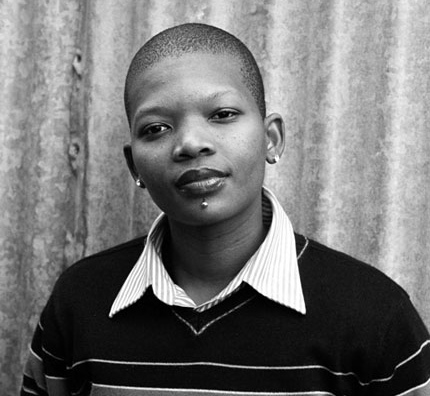
faces01

Source: Africa is a country

That’s the Judge, Ratha Mokgoathleng, unable to contain his homophobia, speaking earlier to the prosecutor in the case of the murderers of Eudy Simelane, a lesbian woman brutally raped and murdered in a township outside Johannesburg, as reported by “The New York Times.” Yesterday one of the killers was jailed for life.

In March, a new study by anti-poverty group Action Aid warned that South African lesbians were suffering rapes by men trying to “cure” their homosexuality. South Africa is one of the world’s most violent societies with fresh crime statistics released on Tuesday showing a rise of sexual offences by 10.4 percent with 27,750 rapes committed in six months.

To contextualize the outcome of the case, my friend, Dan Moshenberg, forwarded me links to the case.

The facts according to Johannesburg’s “Mail and Guardian“:

“A man was jailed for life on Tuesday for the murder and gang rape of Eudy Simelane, a lesbian South African international footballer. Themba Mvubu (24) from KwaThema, was found guilty of murdering, robbing and being an accessory to the rape of 31-year-old Eudy Simelane. Activists at the magistrate’s court in Delmas, Mpumalanga, hailed the judgement as “extremely important” in drawing attention to cases of murder and so-called “corrective rape” against lesbians in South Africa. Simelane was one of the first women to live openly as a lesbian in KwaThema township, near Johannesburg. A keen footballer since childhood, she played for the South African women’s team and worked as a coach and referee. She hoped to serve as a line official in the Soccer World Cup in South Africa. But in April last year she was accosted while leaving a pub and robbed of her cellphone, trainers and cash. She died from wounds to the abdomen after being gang-raped and stabbed 12 times. Her naked body was dragged towards a stream and dumped.”

Writing on the blog BlackLooks, Sokari Ekine, at Black Looks, according to Dan, notes the missing element:

“… In summing up the case the judge only managed to concede that [Eudy Simelane's] fame as a footballer may have contributed to her rape and murder – but still failed to acknowledge her rape and murder as hate crimes. It’s a relief for everyone – family and friends of Eudy to have finally received justice. The campaign around Eudy’s case has been central to raising awarness of hate crimes against lesbians in South Africa and for that we must acknowledge the work of The Lesbian and Gay Equality Project and it’s director, Phumi Mtetwa who worked tirelessly to make sure the case was given the highest possible profile. Recognition must also go to all the friends and supporters who attended the court hearings despite the lack of funds to transport and accommodate them during the endless postponements and delays. I wonder whether people reading about the case realise how difficult and what a strain it has been for everyone involved to keep up the pressure. The battle for this one case, to get justice for Eudy Simelane, has been one but the struggle against hate crimes and for justice in a climate of increased lesbiaphobia and homophobia is only just beginning.”

* The image, above, is unrelated to the case and is from photographer Zanele Muholi’s series “Faces,” images of South African lesbians.

Reblog this post [with Zemanta]

IGLHRC - UN, CEDAW Silent on LBT Women in Concluding Observations

IMG_0907CWGL at the 53rd Session of the Commis...Image by CWGL via Flickr
Source: International Gay & Lesbian Human Rights Commission

IGLHRC is disappointed that the Committee on the Elimination of all Forms of Discrimination Against Women (CEDAW Committee) failed to reference issues relating to sexual orientation or gender identity in its Concluding Observations for the 44th session. The countries reviewed in the 44th session were Azerbaijan, Bhutan, Denmark, Guinea Bissau, Lao People's Democratic Republic, Japan, Liberia, Spain, Switzerland, Timor Leste, and Tuvalu.

The Committee's silence is especially striking in the cases of Azerbaijan, Japan, and Switzerland. Shadow reports focusing exclusively on the human rights violations of lesbian, bisexual, and transgender (LBT) women were submitted by NGOs from these countries, and activists traveled to New York to attend the CEDAW session and speak at NGO meetings on the violations faced by LBT women.

CEDAW's Concluding Observations constitute the Committee's final recommendations to governments about how to further equality for all women. Where women as a group face discrimination or violence, the situation is often even worse for LBT women. Devaluing women on the basis of sexual orientation and gender identity devalues all women, just as adverse treatment of women as a group is particularly detrimental to women who are LBT.

The CEDAW Committee, as well as other human rights treaty bodies including the Human Rights Committee, the Committee on Economic, Social, and Cultural Rights (CESCR), the Committee Against Torture (CAT), and the Committee on the Rights of the Child (CRC), has recognized sexual orientation as a prohibited basis for discrimination. On at least one occasion the CEDAW Committee has also recommended legislation that protects people from discrimination on the basis of gender identity. Other treaty bodies including CESR and CATR have explicitly included gender identity among the prohibited grounds for discrimination.

The following comparisons reiterate some of the concerns that could have been included within the framework of the Concluding Observations. Although the groups’ recommendations were ultimately omitted from the session’s Concluding Observations, they still provide a useful blueprint for governments to act as they fulfill their obligations under CEDAW.

All the shadow reports and Concluding Observations from CEDAW’s 44th Session can be downloaded here.

Azerbaijan:

The Gender and Development Social Union’s shadow report explicitly highlighted a number of areas where LBT women are particularly at risk in Azerbaijan:
  • Prejudice in media and society, including hate speech and hate crimes,
  • Domestic violence and forced marriage
  • Discrimination in employment, health care, and the legal system.
The shadow report specifically recommended that Azerbaijan amend legislation to address family violence against LBT people, prohibit discrimination on the basis of sexual orientation and gender identity, promote education and tolerance, and adopt mechanisms to recognize transgender people in the legal and medical fields.

Azerbaijan should take LBT people into consideration as they implement these recommendations and recognize how LBT people are especially disadvantaged by these forms of inequality identified by the Committee:
  • Stereotypical attitudes toward women and portrayals in the media,
  • Domestic violence and violence against women, and
  • Discrimination in education, employment, and health care.

Japan:

GayJapanNews’ shadow report explicitly highlighted a number of areas where LBT women are particularly at risk in Japan:
  • Barriers to changing legal gender that limit access to health care,
  • information, and venues for expression,
  • Discrimination in health care, education, employment, housing, social security, and asylum,
  • Cultural expectations and pressure to marry, and
  • Domestic violence and violence against women.
The shadow report specifically recommended that Japan adopt anti-discrimination legislation and establish an independent national institution to protect the human rights of LBT people.

Japan should take LBT people into consideration as they implement these recommendations and recognize how LBT people are especially disadvantaged by these forms of inequality identified by the Committee:
  • Unequal provisions for inheritance, custody, adoption, and family law,
  • Discrimination,
  • Stereotypical attitudes toward women and portrayals in the media, and
  • Domestic violence and violence against women.

Switzerland:

The shadow report by Fondation Agnodice, Lesbenorganisation Schweiz LOS, Lestime, Homosexuelle Arbeitsgruppen Zurich HAZ, and WyberNet explicitly highlighted a number of areas where LBT women are particularly at risk in Switzerland:
  • Discrimination,
  • Disparities in health and well-being,
  • Barriers to changing legal gender and name across cantons, and
  • Lack of recognition in family law.
The shadow reports specifically recommended that Switzerland adopt federal legislation prohibiting discrimination on the grounds of sexual orientation and gender identity, permit LBT couples and individuals to adopt, receive fertility treatment, and undergo artificial insemination, include LBT people in data collection, medical training, outreach and prevention programs, and improvements in care, and allowing transgender people to change their legal name and gender without preconditions.

Switzerland should take LBT people into consideration as they implement these recommendations, and to recognize how LBT people are especially disadvantaged by these forms of inequality identified by the Committee:
  • Employment and economic disempowerment,
  • Stereotypes,
  • Domestic violence and violence against women,
  • Lack of protections for rural women, and
  • Lack of protections for women in de facto relationships if these dissolve.

Moving Forward on LBT Issues:

Given the considerable overlap between the problems raised by LBT groups and those acknowledged by the Committee, there is a clear justification for LBT inclusion in these reports. The Committee might consider, at minimum, highlighting the risks that LBT people face by including them in their concern for and recommendations on “vulnerable groups of women” (CEDAW, 44th Sess., Concluding Observations: Azerbaijan paras. 35-38; Japan paras. 53-54; Switzerland paras. 43-44).

In the Concluding Observations of the 44th session of CEDAW, there was no discussion of a host of other unique problems faced by individuals who are LBT–invisibility and marginalization in law and society, discrimination and violence on the basis of sexual orientation and gender identity, and stark disparities in physical and psychological well-being–which merit swift and specific attention.

The concerns of LBT people are unique enough to merit explicit consideration, but they are also inextricably related to the issues being raised by a broader community of women. Given the similarities between the issues that different groups of women face, the concerns of LBT women can–and should–be incorporated into the framework of recommendations by the Committee.

The 45th CEDAW session will be held January 2010 in Geneva, Switzerland. The Committee will review the human rights records of Botswana, Egypt, Malawi, Netherlands, Panama, United Arab Emirates, Ukraine and Uzbekistan. Civil society groups from those countries are encouraged to submit shadow reports on LBT issues.

~~~~~~~~~

For more information see IGLHRC’s July 2009 publication, Equal and Indivisible: Crafting Inclusive Shadow Reports for CEDAW — a handbook for activists who want to write shadow/alternative reports for CEDAW incorporating human rights issues related to sexual orientation, gender identity and gender expression. Download the handbook here.
Reblog this post [with Zemanta]

Wednesday, 23 September 2009

The Secret Life of Kosovo’s Gay Community

Source: balkaninsight.com

By Shega A'Mula

As Albania prepares to legalise gay marriage, Kosovo’s government says such a move is not even on the radar.

Arian is an attractive young man who lives in Prishtina. His phone rings during our coffee break and he insists he must take it, since it is his partner. However, most do not know that his partner is a man.

“Sorry, he gets mad when I don’t pick up, you know the way relationships go,” he says.

Young men and woman constantly stroll down the streets hand in hand, share intimate dinners in the city’s many restaurants, and openly flirt in the bars and cafes. But when Arian goes out for a drink with his boyfriend they appear just friends - homosexuality remains a taboo in Kosovo.

“Our religion outlaws homosexuality, and extremists beat gays. I’ve been physically and emotionally abused so I keep the fact that I am gay to myself,” Arian says.

With the Albanian government’s latest proposal for legalising same-sex marriages, and gay pride cancelled in Belgrade this weekend, gay rights have become a hot topic across the Balkans. But the debate has been strangely muted in Kosovo.

And the government has no plans to open up the issue. Government spokesperson Memli Krasniqi told Balkan Insight that this issue doesn’t fall into the government’s current or even future priorities.

“This issue is not relevant in Kosovo’s social context. It does not exist as a primary, secondary or tertiary issue to focus on. It is not in the government’s margins of importance, unless we consider looking at the law on marriage,” he said.

As far as gay rights are concerned, Krasniqi said that “the government supports the law against discrimination, which includes discrimination against them”.

However, Arber Nuhiu from the human rights organisation Elysium, which protects the rights of Lesbian, Gay, Bisexual and Transgender individuals, told Balkan Insight that despite the law against discrimination, many gay men and lesbians face abuse and prejudice.

“The constitution, thankfully, has a law against discrimination on the grounds of sexual orientation, but the government does not directly support or fund this cause. They haven’t financially supported our organisation at all,” he said.

Sabrie Kamberi, an official from Kosovo Police’s information office, told Balkan Insight that there have been cases involving physical abuse reported to them.

“Every so often we have cases of violence against homosexual individuals. But we do assure them that they are offered the same protection as any other citizen, and we support the rights that they have,” she said.

The fear of violence and discrimination that the gay community lives with, the vast majority of the LGBT community interviewed by Balkan Insight said they chose not to disclose their sexual orientation.

The only time they revealed their sexual orientation was at private parties, organised by close friends or the Elysium organisation.

“I can reveal that I am gay only at parties organised by Elysium or behind closed doors atother private gatherings and parties,” admitted Arian.

Nuhiu stated that Elysium is the only organisation in the country that directly provides support to lesbians and gay men.

“We organise small parties, and we have a drop-in centre…where gay people can feel free to talk about their problems and be open about their feelings,” he said, adding that there were no gay bars or clubs anywhere in the country.

“Elysium is an environment where they can connect, make friends and sometimes begin a relationship,” he added.

Nuhiu admits that very few women come to the drop-in centre, something he blames on the inequality between genders in the Kosovo.

“Lesbians are more hidden because of double discrimination. Society already discriminates against them because of their gender, let alone their sexual orientation,” he said.

Vlora, a young bisexual from Prishtina, has experienced this double discrimination. Vlora is currently dating a man she says she cares about, but she admits that if she could, she would be with a woman.

“I feel like society forces me to date men, even though I get butterflies in my stomach when an attractive women passes by, I can’t help it,” she said.

When Vlora has told people about her sexual orientation, they have often used it against her.
“People think I just want to be interesting and seem sexier to men if I’m with a woman, or they think I’m into threesomes and all I want to do is experiment,” she explained.

She has accepted that prejudice means cannot live an open lesbian life in Pristina.

“I imagine falling in love with a girl, but when I know that I can’t hold her hand or kiss her and say ‘this is my girl!’, I try to avoid it,” she said, adding that although she considers herself a lesbian, she is forced to be a bisexual in order to date men, and be perceived as normal.

“I have many friends I’ve met at Elysium, but not one of them is openly gay. I don’t know one person who admits that they are gay to anyone other than their close friends,” she said.

It seems that much work remains to be done before people in this marginalised community feel comfortable revealing their true identity.

The names used in this story have been changed to protect the identity of those interviewed.
Reblog this post [with Zemanta]

Pakistan’s lone gay writer rests pen, says sorry

Karachi Gymkhana Ground, overlooking downtown ...Image via Wikipedia
Source: LBGTI Bangladesh

Islamabad – Gay community in India may be celebrating the Delhi High Court’s landmark ruling that decriminalized homosexuality, the lone Pakistani who blogs about gay travails has decided to stop writing.
“Not in Pakistan. I cannot. Sorry,” Jalaluddin, who blogs at Tuzk-e-Jalali, wrote in his latest and perhaps last post on June 28. “I guess all of you guys will have to get used to the fact that I will, from now on, be blogging very irregularly, as in once a quarter or something.” Jalal describes himself as a “20-something sarcastic, psychotic, socialist, homosexual blogger from Karachi” who was educated as an engineer, but works as a banker and dreams of being a traveler and writer.
“For all the actions where I have come out of the closet to my family and friends does not mean that I am ready to do it officially. So, for now, I am going to have the following goals in life, I want to learn how to speak French and Farsi (Persian) and I want to learn horse riding, sword fighting, archery and shooting,” he wrote. “One of the reasons for not blogging for the past three months would be the fear elicited by the fact that my blog has been quoted. The closet door is being banged at very hard. I would have to request you people to at least not try to knock on the closet door,” he wrote.
You can have a look at his works here:
aool.blogspot.com
Reblog this post [with Zemanta]

Tuesday, 22 September 2009

The complexities of human sexuality, and Islamic laws and regulations in Iran

Shouting slogansImage by marjoleincc via Flickr

Source: iranian.com

By: Azad Moradian, The Chicago School of Professional Psychology

Abstract

In the following paper, the complexities of human sexuality are explored as it occurs within the present day Iran. Attention is given to the Islamic laws currently demanded and practiced in Iran, as well as issues such as the existence of Lesbian,Gay, Bisexual, and Transgenders (LGBT) and gender identity within the culture. 
Historical and cultural relevance is given to each issue examined while remaining sensitive to the present day laws and regulations in Iran.

Interpersonal relationships in Iran

Currently under Iran's theocratic Islamic Government, based on Islamic law (Shari'ah), all interpersonal relationships are clearly expressed. As a rule the relationship between the sexes are narrowly restricted to lawful (Hallal) or illegal (Haram) categories. A relationship is considered to be legal only between a brother and sister, a parent and his or her children, and an uncle or aunt with his or her sibling’s children. Every other relationship, be they sexual on non sexual, outside of these narrow boundaries is forbidden and illegal.

A sexual relationship is only permitted within a heterosexual marriage. Homosexuality is completely forbidden (Duran, Khalid 1993), and the proximity of persons of opposite sex outside of marriage is authorized only within the limits set under Islamic law.


All sexual relations that occur outside of a traditional, heterosexual marriage (i.e. sodomy or adultery) are illegal and no legal distinction is made between consensual or non-consensual sexual activity.

As a result, Lesbian, Gay, Bisexual, and Transgender (LGBT) rights described under the Universal Declaration of Human Rights (UN, 1948). "Sexual rights are universal human rights based on the inherent freedom, dignity, and equality of all human beings...Was states that sexual health is the result of an environment that recognizes, respects and exercises the rights of sexual freedom." (Britton Patti PhD 2005).

In Iran since the Islamic Revolution of 1979 have come under overt governmental persecution. International human rights groups have reported public floggings and executions of lesbian, gay and bisexual individuals. (Wikipedia.org).

In contrast, under the rule of the last monarch of the Pahlavi Dynasty, homosexuality was tolerated even to the point of allowing news coverage of a same-sex wedding. However, homosexuality was still taboo in the society. A homosexual individual could not depend on the support and guidance of his or her family or friends and public agencies geared toward assisting youth or people who were confused or questioning their sexuality were non-existent.

Societal views toward homosexuality have not changed. Many LGBT people are pressured by their family and society to conform to a heterosexual lifestyle, which in some cases even leads to forced marriage. Unmarried men and women who have reached a certain age are considered "suspect" and will often be asked to explain their situation (Safra Project-Iran 2004).

The official view of the Iranian Islamic government is that everyone should be heterosexual and that homosexuality is, "a violation of the supreme will of God"(wikipedia.org), and punishable by death even homosexual relations that occur between consenting adults in private do not escape punishment. Homosexual conduct is proven by the testimony of four male witnesses who is present during the events is not required by Islamic law. The punishment for female homosexuality involving persons, who are mature, of sound mind, and consenting, is 100 lashes.

If the act is repeated three times and punishment is enforced each time, the death sentence will apply on the fourth occasion. (Articles 127, 129, 130) The ways of proving lesbianism in court are the same as for male homosexuality. (Article 128)(Kar Mehrangiz 2008)

According to Iranian Islamic president, Mr. Ahmadinejad : "In Iran we don't have homosexuals like in your country.” "In Iran we do not have this phenomenon, I don't know who has told you that we have it," Ahmadinejad said to the Columbia University audience. (NEW YORK -AFP2007 )

The restrictions imposed by the Islamic government are in opposition to the long history of Iran. The most stories and poetry of classical Persian literature are explicitly illustrates the existence of homosexuality among Iranians. The most classical Persian literature is replete with homoerotic allusions, as well as explicit references to beautiful young boys and to the practice of pederasty. (Babayan K, Afsaneh N 2008)

A significant amount of major traditional and well known Persian literature explicitly illustrates the existence of homosexuality among Iranians.

Some examples

In some poems, Sa'di's beloved is a young man, not a beautiful woman. In this he followed the conventions of traditional Persian poetry. In the Gulistan Story 18, he states: 
When I was young, my intimacy with a young man and my friendship for him were such that his beauty was the Qiblah of my eye and the chief joy of my life union with him':
 Perhaps an angel in heaven but no mortal
Can be on earth equal in beauty of form to him.
I swear by the amity, after which companionship is illicit 
No human sperm will ever become a man like him. (Shaikh Saa'di 1258 ACE)


Transexuality

After the establishment of the Islamic regime, Ayatollah Khomeini gave a fatwa that allows sex change operations in Iran. Therefore some homosexual men undergo sex change operations to avoid harsh penalties including imprisonment, execution or both. Transexualism is still a taboo topic within Iranian society and no laws exist to protect post-operative transsexuals from discrimination and transsexuals still report societal intolerance.

Sexual orientation and gender identity

Due to the restrictions imposed by the current regime in Iran, social gatherings in which unrelated men and women are present are illegal especially if the women are not completely covered from head to toe. In addition, dancing and music are strictly forbidden.

Even though heterosexuality is the only tolerated sexual orientation, having a heterosexual relationship other than a legal marriage is just as strictly forbidden as homosexual relationships.
Some Iranian women often runaways, have been cross-dressing as a man in order to avoid being the victim of sexual harassment, rape and to access economic opportunities, which are often only given to men. Women dressing as men or barbers cutting the hair of women short are both illegal.

Islamic tradition does not allow cross-dressing. A man should only dress in male clothes. Men who cross-dress as women or are deemed to be too effeminate will also face harassment or criminal charges. The one exception is for transsexualism. There has been a rash of public executions in Iran that have involved youth or were related to sexuality and gender identity.


Gay Iranian couples are often afraid to be seen together in public, and report that LGBT people were widely stereotyped as being sex-obsessed child molesters, rapists, and diseased ridden degenerates.


Under Iran's current fundamentalist rule, a homosexual may be harassed, arrested and punished with the most extreme measures possible. (Paula E. Drew, 2004)

Girls, Virginity, Stoning

The most traditional Iranian culture demands that a bride be a virgin for her first marriage. A girl who loses her virginity before official marriage are agreed upon is not considered as having behaved immorally, women can ruin the family honor by not maintaining their virginity prior to marriage, or by involving themselves in extramarital affairs.

Iranian women can be punished by stoning to death, if they have extramarital intercourse or fornication (zena). Although the penalties for non-marital sex included in the current Islamic criminal code also apply to men (if the female partner is not married), they incur little or no social disgrace for illegitimate sex. If caught in such relationships, men can often escape punishment by producing evidence of temporary marriage to their partner.


Stoning is a pre-Islamic punishment. It was once practiced in many parts of the world, but in recent years has been almost entirely abandoned except in a few Islamic countries principally Afghanistan, Pakistan, Bangladesh, Iran and Saudi Arabia Stoning is a part of torturing before death, for the execution, the condemned person is wrapped head to foot in white shrouds and buried in a pit. A woman is buried up to her armpits, while a man is buried up to his waist. A truckload of rocks is brought to the site and court-appointed officials or in some cases ordinary citizens approved by the authorities carry out the stoning.

Victims are guaranteed a slow, torturous death because the stones are deliberately chosen to be large enough to cause pain, but not so large as to kill the victim immediately. If the condemned person somehow manages to survive the stoning, he or she will be imprisoned for as long as 16 years but will not be executed.

Honor-Killing, and human sexuality in Iran

Honor killing, means honor murders of persons, mostly women who are perceived as having brought dishonor to their family, and their society are often identified with Islam, although the other religion has a common believe in this regard. The most Islamic countries officially or unofficially are agreed with the concept of honor killing. In Iran , south of Iraq, and Afghanistan honor killing are legal or slightly punished. Sexual intercourse with person who is married to someone else can carry a harsh penalty according to the Islamic criminal code. (Kar Mehrangiz 2008)

A woman can be targeted by (individuals within) her family for a variety of reasons, including: refusing to enter into an arranged marriage, being the victim of a sexual assault, seeking a divorce even from an abuse husband or (allegedly) committing adultery. The mere perception that a woman has behaved in a way that "dishonors" her family is sufficient to trigger an attack on her life.

In the Islamic Republic of Iran, according to addendum 2 to article 295 and article 226 of ‎the Islamic penal code, if someone murders another on the assumption that the victim ‎was “vajeb al-ghatl” [literally, "necessary to be killed" ], he will not be tried for first-‎degree murder.

Based on these laws, judges convict murderers who have committed ‎honor killings on the assumption that the murdered woman has committed adultery not to ‎death or life imprisonment, but rather to pay the “dia” [blood money]. As such, legal ‎incentives, protected by judges in the area of implementation, are given to men who are ‎accused of killing women. This must be noted as the most important factor behind the ‎rise in the number of honor killings in Iran. ‎((Kar Mehrangiz 2008))

Polygamy and Temporary Marriage

In Iran, a man can have more than one wife. Although the Shi-e marriage law, now dominant in Iran, allows a man to simultaneously have up to four wives. A man (married or not), and an unmarried woman (virgin, divorced, or widowed) can enter a temporary marriage contract (sigheh) in which both parties agree on the period of the relationship and the amount of compensation to be paid to the woman. This arrangement requires no witnesses, and no registration is needed.

This form of temporary marriage, according to its proponents, is a measure for curbing free sex and controlling prostitution. A man can have as many sigheh wives as he can afford, but the woman can be involved in no more than one such temporary relationship at any given time and cannot enter another contract before a waiting period (edda) of three months or two menstrual cycles elapse. Sigheh has been very unpopular, particularly among the educated middle-class families and among women who tend to associate it with legalized prostitution.


References

1 . Afary Janet, Anderson Kevin B., Foucault and the Iranian Revolution: Gender and the Seductions of Islamism, University Of Chicago Press; annotated edition edition (June 20, 2005)

2. Babayan Kathryn, Afsaneh Najmabadi, and other, 2008 ,Islamicate Sexualities..., , Harvard CMES, page 200

3. Britton Patti PhD, The Art of Sex Coaching: Expanding Your Practice, 2005, W.W. Norton& Company, New Yourk, Page 61

4. Duran, Khalid. Homosexuality in Islam, Swidler, Anne (ed.) "Homosexuality and World Religions" (1993). Trinity Press International, Valley Forge, Pennsylvania.

5. Kar Mehrangiz, Honor killing, 2004,www.roozonline.com/english/archives/2008/02/.html

6. Paula E. Drew, Ph.D ,Iran, Jomhoori-Islam-Iran, www2.hu-berlin.de/sexology/IES/iran.html

7. Safra Project, Resource Project for LBTQ Muslim women, Country Information Report, Iran, 2004, P.O. Box 35929, London, N17 OWB, England, UK, www.safraproject.org

8. The universal Declaration of Human Rights, United Nation High Commissary for Human Rights, 1948, http://www.un.org/Overview/rights.html

9. 'No homosexuals in Iran': Ahmadinejad , September 24,2007- AFP http://afp.google.com/article/ALeqM5hATGOzv6YSmgeM...

10. (Shaykh Moslahaldin Sa'di , The Gulistan , Chapter V , On Love and Youth, Written 1258 A.C.E.)


10. (Shaykh Moslahaldin Sa'di , The Gulistan , Chapter V , On Love and Youth, Written 1258 A.C.E.)
Reblog this post [with Zemanta]

Film explores being gay in Tunisia


Source: Behind the mask

By Jerina Messie(BTM French reporter/translator)

A film, set to be released on the 7 April 2010, has brought the topic of homosexuality back in the agenda in Tunisia.

The first feature film by Tunisia’s Mehdi ben Attia titled “Le Fil”, tackles the issue of homosexuality between men within a male chauvinistic society where men are supposed to be men and ancient traditions still rule.

Entirely shot in Tunisia, “Le Fil” was presented under the Tunisian National Selection, during the Festival du Film Francophone d’Angouleme (South West of France), on 26 to the 30 August 2009.

The film is about Malik, a young man from a rich Tunisian family who has spent many years overseas. As the only son, the death of his father brings him back in his home country. During his years overseas, he discovered his sexual orientation.

Now that he is back home, living with his mother, he wants to “get out of the closet” and tell her that he loves men. But unable to do so, he lies and just gets himself into deeper and deeper water until he falls in love with Bilal.

With his young lover, everything becomes possible; Malik breaks taboos, comes clean about his homosexuality and in the heat of Tunisian summer finds the happiness he has always desired.

The rest of the film contains all the ingredients that go with the discovery of ones homosexuality, attraction, love and revelations and what subsequently follow, arguments, social hypocrisies and lies.

Critics paid tribute to the performance of the main characters, the absence of modesty in sex scenes, which they said are very realistic and filmed with sensuality and concluded that it is a good story well put together and filmed.

However, they deplored the fact that like in many gay films homosexuality is presented as an “issue” affecting only middle and upper class people and is reduced to a complex relationship with one of the two parents or even both.
Reblog this post [with Zemanta]

Monday, 21 September 2009

South Africa: Zuma's new God squad wants liberal laws to go

ANC logoImage via Wikipedia
Source: Mail & Guardian

By MANDY ROSSOUW

The National Interfaith Leadership Council, formed by Rhema church leader Ray McCauley and closely associated with President Jacob Zuma, flew its conservative colours this week, saying that it wants to revisit laws legalising abortion and same-sex marriages.

Last week the council (NILC) entered the debate about the ­Judicial Service Commission’s decision to drop its investigation into Western Cape Judge President John ­Hlophe. It attacked the challenge to the JSC by Freedom Under Law, chaired by former Constitutional Court judge Johann Kriegler, and Archbishop Desmond Tutu’s support for it, saying it could “only serve to further erode the integrity of the judiciary and undermine the confidence of the people in it”.

“For us, the ruling signified closure on this sad chapter and paved the way for the judiciary to heal and move forward,” the NILC said.

Nthabiseng Khunou, an ANC MP and member of the NILC secretariat, told the Mail & Guardian that the council would “play a role” in revisiting legislation legalising abortion and gay marriage.

Khunou, a pastor, said the laws were very unpopular in South Africa’s churches: “I know most churches want them abolished, so the reason for NILC is to give a voice to people who don’t have it.”

Khunou revealed that the NILC had recently discussed the possibility that South Africa might legalise prostitution, “saying: why has the church been so quiet about it? We must play our role here.”

Interviewed this week McCauley, the council’s national convener, denied any formal links between the organisation and the ANC.

But at least four members of the 20-odd group of religious leaders are ANC MPs, including heavyweights such as ANC chief whip Mathole Motshekga and former Western Cape premier Ebrahim Rasool.

McCauley insisted the group was open to other political parties. But no religious leaders who support opposition parties have joined.

“The NILC does not consult with the ANC, although there are people there who are part of the ANC,” he said.

Motshekga said the ANC insisted that the party accorded the NILC no special treatment.

“We’re on record as supporting [the] council and noted what it said about Judge Hlophe, but it is not for us to approve or disapprove.”

McCauley was not speaking for the ANC, but for his own constituency.

The M&G can also reveal that the NILC uses the ANC parliamentary caucus’s communication facilities to communicate with the media. The two NILC press statements were sent from the ANC’s offices in Parliament.

Motshekga claimed to be unaware of this, while McCauley said the statements “should not have been sent from the ANC”. Khunou said ANC MPs are free to use party email facilities for any purpose they saw fit.

Other ANC sources point to the close relationship between Motshekga and McCauley through which the idea for a new religious formation was hatched.

McCauley controversially gave Zuma an exclusive platform to speak in his Johannesburg church during the ANC’s election campaign this year.

Vusi Mona, at that time the Rhema spokesperson, defended the church’s decision to invite Zuma to address the congregation, and not leaders from other parties. Mona quit Rhema shortly after the elections to join Zuma’s presidential communications team.

Self-confessed frand convict Carl ­Niehaus was also a Rhema spokesperson before his stint as ANC spindoctor during the election campaign.

In August the NILC met Zuma and pledged its support in helping the government deal with service ­delivery protests.

Other religious leaders have been caught off guard by the decision to launch the NILC. McCauley is a leader of the National Religious Leaders’ Forum (NRLF), which includes representatives of all the major faiths practised in South Africa.

He did not attend an NRLF meeting on Wednesday.

The general secretary of the South African Council of Churches, Eddie Makue, said the purpose of the NILC was unclear to the religious fraternity. The SACC is set to meet NILC leaders before the end of September to clarify matters, he said. He added that the Dutch Reformed Church, formerly linked to the apartheid government, was also considering joining the NILC.

Makue said the SACC decided in 1995 to embark on “critical engagement” with the government: “We took the view that governments come and go, but the church will always remain.”
Reblog this post [with Zemanta]

Africa: Preventing blackmail and extortion against gays

Source: Global Voices

by Haute Haiku

Blackmail and extortion has proven to be a lucrative business towards gay people in Africa. Internet scams have become rampant as more gays are trying to come to terms with their sexuality.

The “unfamiliar gays” or the “newly coming out” are the target for this activity as they are lured into what is referred to as a “honey trap.” This is when unsuspecting persons are lured into dark alleys or traps with promises of sex or sexual favors, but actually meet with wicked characters who threaten, blackmail and sometimes assault.

This always starts with visits to the internet in search of love on dating websites, without suspecting that the alluring profiles on most of the sites are fake.

Easy Track Ghana suspects that the majority of these profiles are fake:

On international gay chat sites, there are a disproportionate number of young men from Ghana professing to search for true love. Many people get excited when first reading all the lovely gay profiles professing a search for romantic love. Well, none of it is true! Let us be direct and say that 98% of these guys online do not rank above a 3 on the Kinsey Scale of Human Sexuality. Only a small 2% of the guys on these gay chat sites are ‘gay' in the sense you think of it in the West.

A page on Squidoo has:

If you look at the online dating sites, you will notice that many of the guys from Ghana claim to be as young as 18. Many of these people are not actually gay. The ones that are, may not be genuinely looking for what they claim. The pictures are often fake and their profiles may well be copied from other peoples.

Due to the governments’ inability to counter assault and blackmail towards people of different sexual orientation, some bloggers have taken matters into their own hands to protect their own by shining a spotlight on the fakers.

An online movement against scammers

A blog called Fakers2Go deals solely with the extortionists who trap their unsuspecting victims in houses and then show up with the police or gang who strip the victim naked.

The blackmailers work in groups; with the police and cyber café owners whose main aim is to squeeze the slightest cash from foreigners and the rich just because they can:

In Ghana, On-line criminals are targeting men who have sex with men (MSMs). They aim to extort money through kidnapping, violence and use of Ghana's archaic colonial law.

As homosexuality is illegal in Ghana, MSM's have no protection under the law and reporting a crime can lead to the victim being criminalised.

Furthermore, the police often work with the criminals to extort money and therefore cannot be trusted.

Easy Track Ghana writes:

Just remember, this is a business here. At many Internet cafes there will be 3 or 4 African boys working together, each having multiple chats with foreigners. This is the reason the chat and profiles all sound so similar. Some people are illiterate and hire typists who move from computer to computer answering chat messages. They work together to help each other formulate responses to questions in chats and email. They cut-and-paste sweet love.
Even more shocking though, there are some Internet cafes that are *completely* devoted to this type of activity. It is truly a business, with finders fees paid for arranging a meeting with a foreigner, and 11 and 12 year old year-old boys watching pornography en masse and learning how to chat ‘gay'. On the Internet, anybody can be anything, so you really do not know who you are chatting with.

Gay Ghana warns visitors to Ghana:

Dating sites are the most frequently used ways to meet a (potential) lover or gay guide in a foreign country. At sites like Outpersonals or Gaydar you will find that Ghana is the country in Africa with the most registered hopefuls. No other country in Africa has so many boys and men looking for a partner on Outpersonals with picture (often naked) than Ghana. Does this mean Ghana is the Gay paradise in Africa? No…! It may mean that there are plenty young men desperate enough to seek greener pastures elsewhere, whilst developed enough to have access to the internet and a digital camera.

GALCK, a Kenyan website, has a post titled, “Have you ever been blackmailed?” where they try to tally the amount of money Kenyan gays have been dishing out to the fakers in return for their silence. Gays are vulnerable and scared of the stigma from workmates, neighbors, friends because they know that their are life would be in danger and profession would wither under the glare of a homophobic community.

GALCK claims that blackmailers ask for as much as KSH 2,000,000 (approx $25,000) and as little as KSH 500 ($6)…

Have you ever been blackmailed because of your sexual orientation, or know someone who has? GALCK would like to establish the true cost of being Gay in Kenya. Blackmail and extortion are the twin crimes that afflict the LGBTI community in Kenya today, but majority of the cases are never reported. By compiling this report we shall be able to establish the extent and total cost of what we have paid to “keep the silence.”

From the stories we have gathered so far, our people have paid from Kshs. 500 to Kshs. 2,000 000. The latter having paid only a month ago. Let us join and compile this report - we shall not use real names, unless you want us to. You may also write your story down, and email it to info@galck.org, if you do not want to come in person. Call us on +254-20-2426060 to arrange an interview.

Some basic safety advice

How do you identify the fakers on the net? Most write with horrible grammar. It is reported that most are illiterate and rely on typists who are hired to do the dirty work. Over-disclosure: they profess their love to you and narrate their background, a family member who needs a hair or nail transplant. At the first meeting, they ask for money even before you know them:

Any person who comes at you with instant love is a faker or a scammer. The instant love they feel for you is love for the opportunity that you present and the money you have. The scams sound sincere, but all involve you sending money. Even if you are a poor person in your country, you are a very rich person by comparison to most of your African chat buddies. This disparity in wealth profoundly affects any relationship you develop.

Safety Tips from Fakers2Go:

How not to get beaten up and robbed
Take great care when meeting people on line. Below are some of the things scammers have said to people when arranging to meet them:

  1. Bring your phone (because they want to steal it)
  2. Dress sexy / wear your good clothes, etc (because they will strip you naked and sell your clothes)
  3. Come alone (so that there is no one to help you)
  4. Come to Tema!

Sometimes they might text you a sexy message and ask you to respond. If you text back something sexual they can use that as evidence against you with the police. Yahoo chats and your online photos can also be used as evidence.

GALCK says that the first question a blackmailer asks any unfamiliar gay is whether they’ve heard of GALCK, if response is yes, they leave in a huff:

Secondly spread this information around to your networks. In fact every time you meet a new person, ask him or her if she/he knows about GALCK. This has two advantages, one - if your friend does not know about GALCK, s/he gets to know about our activities which s/he may find helpful some day. Secondly, GALCK is now the code word to ward off blackmailers. Indeed I have been told, the first question blackmailers ask their potential victims nowadays is if they know of GALCK. Do yourself and your friends a service, lets all spread the word, and especially the GALCK contacts so that our people can not just feel but actually be protected at all times.

In addition to having a recreational center library, movie sessions, forums and discussions on men who have sex with men (MSM) and gay pride events (CSWs), they have people who defend the gays and they stress that every lesbian, gay, bisexual, transgendered or any queer identified persons should have their phone number saved on their phones….

Here is what to do when confronted with challenging circumstances.
First of all, we should all save this number in our phones - 020-2426060. This is the GALCK number, GALCK will always rush to your defence when confronted by difficult legal situations regarding your sexuality. And this includes even when you have been caught in the ‘very act’ - especially if you have been caught in the act. So comrades, shed off the fear!

Related Posts with Thumbnails