Thursday, 31 December 2009

Iran: 2010 New Year Resolution


Dear Friends,

In these last few days of 2009, I write to thank you all for what you have done for us here at Iranian Railroad for Queer Refugees (IRQR). I want to thank you for your support, your generosity, your activism, your spirit – and for your courage, which is the fuel of change.

 IRQR is working on about 250 Iranian refugee cases now. In the last twelve months 36 of our asylum applicants have been recognized as refugees, with 43 of them resettled in Canada, the United States, Germany and the Netherlands. We received 32 new cases in 2009.

This leaves about 200 refugees who are in a limbo situation – desperate today for aid in finding safe haven, legal support, or resettlement assistance.

In 2009, the Iranian Railroad for Queer Refugee (IRQR) received its Canadian Federal Corporation status. We celebrated this important step because it helps us to expand the cause for Iranian human rights and to support those who escape Iran on the basis of their sexual orientation and gender identity.

In the past year, we helped vulnerable persons obtain their refugee status: Hassan got his status after a 20-year wait in the United States. We lobbied the German government who stopped Mehdi N.’s deportation and granted him refugee status. Pegah received a letter from the British home office that her asylum application had been accepted and that she would remain in England. There are other moving examples that you can find on our website.

With our recent incorporation and strong track record, our New Year’s Resolution is to expand our services - to help those who are waiting so long for their asylum, to help ensure their safety after escaping Iran, and to lobby European governments to review their outdated and often false reports on Iranian queer human rights – governments that must conduct new investigations through their embassies in Iran in order to help Iranian queer asylum seekers. Our executive director has a meeting with the office of the German Minister of Foreign Affairs in early January 2010 to ignite new progress in these reviews and updates from there.

We want your own New Year’s Resolutions to include your continuing involvement in our struggle and activism. You can support us much more easily than you think. By donating the equivalent of less than $1 per day, you can obtain full membership with IRQR – indeed, for less than your morning coffee.  Your support is easier to give than you think. In 2009, for example, a number of friends of Iranian queer joined our Refugee Sponsorship Plan to help some refugees with their basic needs. Also we were able to assist our refugees with more than $4000 in donations which we received from our worldwide friends.  This figure though invaluable is one we need to triple in order to make significant headway into resolving more quickly the awful situations so many Iranian queers endure.

We ask you to please make your New Year Resolution now by subscribing to our $1 per day support here


There is another option for you to donate $10 per month and support the Iranian queer cause, if you are otherwise unable to join the $1 per day support program. We appreciate all of your support - even if you just write a note of support to asylum-granting governments for us.


Happy New Year and we wish you all the best in 2010!


Arsham Parsi
Executive Director
Iranian Railroad for Queer Refugees - IRQR

Monday, 28 December 2009

Government is exploiting weak asylum-seekers, says Archbishop of York


Source: The Times

By Ruth Gledhill and Richard Ford

The Archbishop of York has criticised policy on asylum-seekers, warning that cuts in financial support will leave many of them destitute this Christmas.

In an article in today’s Times, John Sentamu accuses the Government of exploiting the weak by making it more difficult for asylum-seekers to make a repeat claim to stay in Britain.

He also condemns the reduction in benefits given to single asylum-seekers to £5 a day. He said that this “meagre” sum was the same amount he received when he arrived in Britain in 1974 after fleeing from Idi Amin’s Uganda.

The Government reduced the benefit for single asylum-seekers over 25 from £42.16 a week to £35.15 in October, bringing it in line with the amount given to under-25s. The allowance will be credited to a card rather than given in cash, restricting where and when it can be spent.

“It won’t be possible to carry money over from one week to the next, or even buy clothes in charity shops,” Dr Sentamu said. “These new arrangements will make it even more difficult for people already struggling to find enough to pay for food and other essentials. There must be a better way.”

New rules mean that people who claimed asylum before March 2007 and have been refused can no longer make second asylum applications by post. They must apply in person in Liverpool or at reporting centres. The Government says that the intention is to deter people from making repeated claims, but Dr Sentamu said that it imposed an unnecessary burden on some people.

Phil Woolas, the Immigration Minister, said yesterday that asylum-seekers typically lived in UK Border Agency accommodation and so had no housing costs or water, gas or electricity bills. “In view of the difficult economic climate, support rates were reviewed this year to ensure that essential living needs of asylum-seekers could be met within budgetary constraints,” he said.

Sir Andrew Green, of MigrationWatch, said: “The Archbishop is surely right to call for compassion and there may be areas where this is needed, but the queues of asylum-seekers at Calais suggest that we are already regarded as a favoured destination.”

~~~~~~

No room at the inn? We can still be hospitable

Source: The Times

By John Sentamu

There is a grace said in Yorkshire after dinner that could well be spoken in homes up and down the land this Christmas:

“Thank you Lord for what we’ve had/ It could ha’ been better, but times is bad.”

We are in a time of recession, and for many homes in Britain this means hard times now and hard times to come. There is one group of vulnerable people who possibly do not get as much sympathetic coverage as others, and I hope that, with me, you will spare a thought for them this Christmas.

Asylum seekers who find themselves destitute and struggling to survive with little or no means of support are our society’s “living ghosts”.

Parallels can be drawn between those seeking sanctuary today, who often have to endure successive trials and indignities, and Mary and Joseph. They were displaced within their country for the Roman census, only to then become refugees with their newborn son, Jesus, seeking protection in Egypt from Herod’s tyranny. In each case we see displaced people struggling to relate to complex obstacles and bureaucracies.

In the run-up to an election, political parties compete with each other to show who can be toughest on immigration. The destitution experienced by some asylum seekers will easily be overlooked. “No room at the inn” will be all too real for those awaiting removal at the UK Border Agency’s detention centres, including families with young children. I am thankful that in 1974, when I fled Idi Amin’s terror in Uganda, there was room in this country’s inn for my wife Margaret and I.

But I have a lot of time for the innkeeper. He was under tremendous pressure. Bethlehem was heaving with people, and it wasn’t his fault that there were no rooms left. What he did was generous and compassionate within the bounds of what was possible.

According to Luke, the Roman census required everyone to travel to their town of birth, and Joseph, as head of his family, had to bring his heavily pregnant wife with him, despite the inconvenience, to the city of David. Rules were rules, and someone in Mary’s condition was not exempt from this edict.

It has been my privilege to be engaged recently in discussions at the Home Office between the Still Human Still Here coalition and staff from the UK Border Agency. I have to say that those from the agency whom I have met, have been, in many ways, remarkably like the innkeeper of Bethlehem. They have been working under pressure. They have had a problem with numbers: too many people, too many applicants, and a limited capacity. Nonetheless, they declare themselves determined to act with compassion and genuinely to seek the protection of the vulnerable. For that I thank God. It is all too easy, under pressure, to put up the barriers and think only of ourselves, our own stresses and strains, and to forget the stranger at the gates.

Lately, however, I am disappointed to have to say that there have been two very discouraging developments.

Back in October, new arrangements were announced for asylum seekers whose first applications were made before March 5, 2007, and have since been refused. These individuals now have to travel in person to the UKBA office in Liverpool if they wish to make a further submission. There is no funding available to cover their travel costs, and in many cases the bill is picked up by local churches and other charities.

While this may not pose particular problems for healthy single people, there are others for whom this is an unnecessary burden. They may not have to travel to Liverpool by donkey, but the demand must seem as unreasonable as that which forced Joseph to bundle the heavily pregnant Mary so unceremoniously from one end of the country to the other.

Surely there must be scope for a little compassion here? Could not special arrangements be made for those who are, like Mary, visibly pregnant? Or for unaccompanied asylum-seeking children? Or, indeed, families with young children? Or for those who, for one reason or another, are not able-bodied? In the name of God, why not? It is argued that this will deter those who do not have serious protection needs from making further submissions, but I seriously doubt it will. If a person wants to stay in the UK, he or she will push his or her case as far as possible, and will not be deterred. But the strong should not exploit the desperation of the weak.

My second serious concern is both with the quantity and the manner of financial support now being offered to these very vulnerable people. Before October, single asylum seekers over the age of 25 were receiving benefits of £42.16 a week:

30 per cent less than a single person over the age of 25 resident in the UK. But in October this was cut to £35.15 a week, leaving asylum seekers only £5 a day to live on. That was the same amount of money I received from Ridley Hall theological college when I arrived here to study in 1974. The cost of living then was low.

Unlike other UK residents, asylum seekers are not permitted to work. Previously, payments were made in vouchers that people could exchange for cash at local voluntary groups, which were often run by churches. The UKBA is now bringing in a scheme that credits this meagre allowance to a card that will restrict where and when it can be spent.

It won’t be possible to carry money over from one week to the next, or even buy clothing in charity shops. Those living far from the shops cannot use their cards on the buses, so they have to walk. These new arrangements will make it even more difficult for people already struggling to find enough to pay for food and other essentials. There must be a better way.

The Christmas Gospel clearly spells out for us the message of peace and goodwill to men and women everywhere. At York Minster tomorrow, I shall be celebrating this message with two or three thousand others.

More than 2,000 years on, people are still on the move, pushed from pillar to post, facing destitution and uncertainty. Let us show, like the innkeeper, compassion and hospitality this Christmas.


John Sentamu is Archbishop of York

Saturday, 26 December 2009

Statement by Homosexual Students at Iran’s Universities


Frieda Afary, the Iranian-American translator who runs the excellent blog "Iranian Progressives in Translation," at my request has just translated and posted the full text of the statement earlier this month by the new underground coalition of queer students at Iranian universities. It is below (for more on this campus queer organizing work in Iran, click on my article for which she gives the url.)
— Doug Ireland

Translator’s note: The formation of the new organization, “Homosexual Students at Iran’s Universities” is a courageous act. Below are large excerpts from a statement which this organization issued on the occasion of Students’ Day. For more information about queer organizing in Iran, please see “Twelve Men Face Execution for Sodomy in Iran” by Doug Ireland, published in Gay City News

Please also contact Hossein Alizadeh, Middle East and North Africa Program Coordinator at International Gay and Lesbian Human Rights Commission.

~~~~~~~~~~

Statement by Homosexual Students at Iran’s Universities
Source: http://www.schrr.net/spip.php?article7232
Translated by Frieda Afary

December 6, 2009

This year’s commemoration of December 7, significantly differs in nature from previous years. This December 7 is being shaped anew, not as necessitated by the calendar, but as necessitated by conditions that have set the stage for protest movements.

We cannot stop still or go backward. We cannot commemorate this event in a routine way. Just as we gave new political meaning to Qods Day, and appropriated November 3, so our preservation of December 7 as a commemoration which belongs to the student movement, denudes this day of its official title in order to make it an event once again. [Qods day refers to September 18, a day designated by Ayatollah Khomeini as Jerusalem Day. November 3, refers to the anniversary of the take over of the U.S. Embassy in Tehran. This year, the Green Movement transformed both events into protests against the government and in defense of democracy and human rights –tr].

After five decades, the rise of a revolution, and the emergence of a people’s movement, December 7, the symbol of protest against a regime backed by the July 1953 coup, now confronts the June 12, 2009 coup [The July 1953 CIA-sponsored coup deposed the democratically elected government of prime minister Mohammad Mosaddeq, and returned Shah Mohammad Reza Pahlavi to power—tr] This year, the distinguishing factor is that the forces of the people are intertwined in the context of these [December 7] protests. Students are no longer starry-eyed in their socio-political struggle. Prior to the people’s protest against dictatorship and lawlessness under the Islamic Republic, students might have felt isolated in their opposition to dictatorship. Now, however, the student movement takes place in the context of a society which demands an end to dictatorship, and is untainted by superficiality and narrow-mindedness.

Due to the depth of social perception in the student body, and an extensive grasp of human rights and civil rights, student demands are now linked to women’s demands on the one hand and workers’ demands on the other. This dual link has been achieved not only on the basis of theoretical knowledge but also on the basis of practical experience.

On the other hand, the student movement includes the demands of homosexuals. These demands represent a transgression of deeply rooted cultural boundaries which impede social tolerance.

The presence of minorities within the student body, limits the possibility of monopolization. . . . Students who may have different names, are part of the people. Their multiple presence on a variety of fronts continues to shake the weak foundation of the regime and challenges its security. The student movement is not green throughout. It also includes other colors. However, the breadth of the instinctual drive for equality among the people of the Green Movement, has compelled other colors to accommodate to it. We hope that the social right to self-determination of a people who wish to live within the framework of human rights and not any type of ideological dictatorship, will be placed in the hands of the people themselves. The students will not monopolize December 7.


Similar to years prior to the June 12 election, students constitute the largest number of those murdered, arrested and tortured . . . December 7, 2009 is equated with December 7, 1953 in order to transcend it and move from protesting the coup to determining the fate of democracy in Iran. In order to create a society in which everyone is free to move safely in her/his direction, we need to be together. On December 7, let us comprehend that freedom for the majority can only exist when minorities are safe. Let us be together.

Homosexual Students at Iran’s Universities, publish their third statement on the occasion of a December 7 commemoration which might signify the last gasps of a coup-backed government.

Considering that a significant number of university students are also queers, and considering that the active part of the queer community in Iran consists of university students and university graduates, it is not too late to correct the intolerant and inappropriate drafts of the constitution, in order to guarantee that the perspectives of the representatives of the Green Movement do not fall short of the perspectives of the rank and file of the people’s movement.[The authors of this statement do not cite the specific drafts to which they refer. A draft presented by the “Lawyers of the Iranian People’s Green Movement” does recognize the rights of people regardless of gender, religion, nationality and race, but makes no mention of sexual orientation—tr. The Persian text can be viewed online at http://greenlawyers.wordpress.com/2009/11/08/constitution-1/ A brief summary in English is available at http://persian2english.wordpress.com/2009/10/23/unity-proposal-for-democratization-of-iran-]

Another milestone achieved by this year’s December 7 commemoration was the student body’s deep comprehension of the concept of human rights. It is crucial to remind the readers that the student movement and the women’s movement have captivated a larger portion of Iranian society because these movements are more tolerant and think more deeply.

At a time when two human rights organizations in Iran --which consist of students-- have been courageous and forthright in taking up the rights of minorities and especially sexual minorities who have been excluded from civil rights protection, the representatives of the Green Movement who are devising the outlines of the new constitution, avoid mentioning the rights of minorities. If we do not pay attention, the first opportunity for correcting the defects of the constitution will lead not to reform but to a future imprisoned by prejudice and exclusion.

On the eve of December 7, and at a time when the Green Movement of the people has come to signify fresh air for a repressed society, students who give their all to this movement, do so to make sure that the passion for life is not crushed under the boots of dictatorship.

Homosexual Students at Iran’s Universities who have not been promised any share of political power or fame, would like to send a message to the Green Movement in the spirit of solidarity and kinship. The demands of the people, rooted only in the necessity to abide by human rights and civil rights, are greater than all the demands which the leaders of the Green Movement utter in honor of the [1979 –tr] revolution.

Mr. Karroubi and Mr. Mousavi, Mrs. Rahnavard, students and families, on this December 7, keep the Green Movement dynamic by making a statement about the human rights demands of all the people of Iran. The movement needs more than the blood of the youth to survive. The movement needs a timely declaration of its exact, explicit, and human rights-based demands, in order to defend your lives and your social rights. Let us all be together.

Homosexual Students at Iran’s Universities
For Freedom and Equality
December 2009

Ugandan president committed to blocking anti-gay bill: officials


Human Rights Day protest against Uganda's Anti-Homosexuality Bill - Ugandan Embassy, London, 10 December 2009. L-R: Michael Senyonjo, Richard S, Topher Campbell, Peter Tatchell, Godwyns Onwuchekwa, Rev Rowland Jide Macaulay. Credit Brett Lock of OutRage!

 
Source: DC Agenda

U.S. officials have received assurances from the Ugandan president that he would work to block a harshly anti-gay bill from becoming law in his country and would veto the legislation should it come to his desk, according to the State Department.

Jon Tollefson, a State Department spokesperson, told DC Agenda that Ugandan President Yoweri Museveni has pledged on several occasions to the top U.S. diplomat engaged in Africa that he would stop progress on the anti-gay bill.

Assistant Secretary of State for African Affairs Johnnie Carson received this assurance from Museveni on Oct. 24 during an in-person meeting with the president in Uganda and again during a phone conversation with Museveni on Dec. 4, Tollefson said.

Homosexual acts are already illegal in Uganda, but the anti-gay legislation — a bill sponsored by a member of the president’s party — would, among other things, institute the death penalty for repeat offenders of the homosexual acts ban and those who have homosexual sex while HIV positive.

Additionally, the bill would criminalize the formation of LGBT organizations and the publication or broadcast of pro-gay materials in Uganda.

The legislation is moving forward in the Ugandan parliament, and this week lawmakers were slated to have a second reading of the bill, according to the Times of London. Mark Bromley, chair of the Council for Global Equality, said the bill is expected to come up again in January for a final reading.

Tollefson said during the Oct. 24 meeting that Carson met with Museveni and other high-ranking Ugandan officials to express concern about the legislation and conveyed that its passage would be “a big step backwards in human rights” that “could really have the potential to harm the reputation of Uganda.”

“And the president understood the concerns and said that he would do what he could to make sure the bill was not passed,” Tollefson said. “He would not sign the bill. … He made a commitment to the secretary that he would work to make sure it wasn’t signed into law.”

Tollefson said when the bill started moving forward and gaining international attention, Carson on Dec. 4 contacted Museveni by phone to reiterate U.S. concerns, and the president again expressed his commitment to stop the bill from becoming law.

“So that being said, the assistant secretary is expecting the president to live up to that commitment and … he expects President Museveni to live up to his reputation as a leader in the HIV/AIDS struggle in Africa,” Tollefson said. “It’s a significant human rights issue. I know it also gets in the way of treatment and prevention and education on the HIV/AIDS front.”

Asked whether it’s the understanding of U.S. officials that Museveni would veto the legislation should it come to his desk, Tollefson replied, “Right, that’s a commitment that he’s made. He made that personally to the assistant secretary on that first meeting that he had on Oct. 24 and again on a call on Dec. 4, and so we’re going to continue to expect that.”

Tollefson said the United States wants Museveni to go beyond his private commitment to blocking the bill from becoming law and to make a public statement against the legislation.

“He has not done that, and we’ve asked him to come out and say how — be a leader in this, just as he’s a leader in HIV/AIDS,” Tollefson said.

On Friday at the State Department, Carson briefed non-governmental organizations on the commitment Museveni made to the United States and explained the work U.S. officials have done to prevent the measure from becoming law.

Tollefson said about 20 NGOs were represented at the briefing, including groups focused on African development, LGBT issues and confronting the HIV/AIDS pandemic. Among the groups that were invited to the briefing, which was closed to the public, were the Human Rights Campaign, the International Gay & Lesbian Human Rights Commission, Human Rights First and Human Rights Watch.

Bromley was among those in attendance at the briefing. He confirmed for DC Agenda that he was told Carson had received assurances from the Ugandan president that he would work to stop the bill from becoming law.

But Bromley said he isn’t sure whether the president would terminate the bill by vetoing it or via some other method.

“I’m not incredibly sure that veto is the right word because I’m still trying to clarify whether the president actually has the authority to veto under the parliamentary system, but basically he assured Assistant Secretary Carson in October and then again in December that he would keep the bill from going forward,” Bromley said.

Noting that the bill came from a member of the president’s party and his party “dominates the politics” in Uganda, Bromley said pressure from the president would “certainly slow the bill.”

“But Secretary Carson made it clear that on two occasions, President Museveni has said he would stop the bill from going forward and he said that he’s continuing to write to him and sending messages that the U.S. expects him to honor his word,” Bromley said.

Tollefson also detailed work the State Department has done to help block the legislation from going forward and said Carson has made clear to Museveni that — in addition to rejecting the measure — the United States expects full decriminalization of homosexuality in Uganda.

“He made very clear that we will not accept simply the removal of the death penalty or some of the harsher aspects of the law,” Tollefson said. “We expect full decriminalization of sexual acts between adults. There’s no hedging on that.”

Noting that supporters of the legislation in Uganda have been saying religious leaders are in favor of the bill, Tollefson said the State Department has delivered to the country statements from U.S. religious leaders denouncing the legislation. A statement from Rick Warren, pastor of the Saddleback Church in California, was among the statements from religious leaders sent to Uganda in opposition to the bill. Warren recently spoke out against the bill.

Tollefson said the State Department also believes the legislation could have a detrimental effect on the region around Uganda and noted that movement on anti-gay legislation in Uganda and other countries will be recorded in the State Department’s annual human rights report.

“It won’t just be focused on Uganda, we’re not going to make a lot of effort to remove this from Uganda while remaining silent on neighboring countries that have similar legislation even if they’re already on the books,” he said.

Asked whether restricting funds under the President’s Emergency Plan for AIDS Relief could be a way to deter Uganda from passing the bill, Tollefson said that question came up during the Friday briefing, but U.S. officials are reluctant to pursue that option.

PEPFAR, a multi-billion dollar initiative started by President George W. Bush, provides treatment for those living with HIV/AIDS in developing countries.

“Public funds to start retroviral treatment is not a one-day commitment, it’s a lifetime commitment, and we haven’t had that discussion and we don’t want to have that discussion,” Tollefson said. “And, of course, no one would want to see that happen, so it’s not something that we want to consider.”

Bromley said he’s impressed with the State Department’s level of commitment to stopping the anti-gay legislation from being passed.

“I’m very pleased that the State Department has been so forceful and is now publicly challenging President Museveni to honor his word and commitment,” Bromley said. “I’m pleased that they are responding as assertively as they are and that they are now doing so in a public fashion.”


Wednesday, 23 December 2009

Algerian trans asylum seeker needs help

The flag of Algeria.
Source: GAAI

Urgent Call for DONATION to Save life of Randa the Algerian Trans founder and leader of the AbuNawas (LGBT Activist Group in Algeria) who escaped in April to Lebanon with the help of Meem. Now she is in jail in Lebanon, she risk to be expelled to Algeria. If that happens it could mean a death sentence. Meem needs donations for the fees of the Lawyer. Please help save her life

Report from Yahia Zaidi

Dear friends,

In April 2009, we have helped an Algerian transsexual woman who has survived many death threats get a visa to come to Beirut. It had become dangerous for her to live in Algeria, and she landed in Beirut hoping to apply for Asylum to another country from here so she can continue her trans operations and live her life without fear.

At the time, we had welcomed her into our community, expecting her to stay with us for a few months, maybe more, while we provided the financial and emotional support she needed.The past few weeks have been especially difficult as she was arrested at the General Security (GS) while applying for a work permit, because of a case of mistaken identity. When that happened, we immediately contacted a lawyer with whom we are still working very closely to get our friend out of prison.

The military tribunal cleared her name within 24 hours, nevertheless, the GS are still detaining her for further investigations with regards to her residency/work permit.Currently detained at the GS, it has become clear to us that there is a need that we, as a community, come together in order to support one of our own who is in a crisis situation.

Some of us have written her letters, some have visited her bringing along bags of fruits & vegetables, a bit of cash and words of comfort, some have snuggled her hormones in little bottles, along with chocolate and books, to her jail cell, some have gotten together to organize fundraisers, etc.As amazing and meaningful as these acts of support and friendship have been and as much as they are needed at the moment, we are still quite far from being able to cover the expenses that are at hand.

The lawyer has informed us that the expenses of this case (including minimal lawyer fees and work permit costs) will range somewhere between 2000 USD – 3000 USD and will be urgently needed the day our friend is given a residency permit which will (hopefully) be very soon.

We are relying entirely on donations and the smallest contributions go a long way. We are a community of hundreds, if not thousands of people, and if each one of us managed to donate at least 10 USD and suggested that their friends do the same, we can put together a support fund in a matter of days. If for any reasons you cannot donate at the moment, there's still a lot of actions that you can do to be more involved with this case.

For your contributions and donations, please send an email to lynn@meemgroup.org or yahia.zaidi@gmail.com It's at times like these that we must stick close together as community and show that we care for each and every one of us, especially when that "one of us" is going through difficulties.

Thank you for your support!

Please help Her

Yahia Zaidi

~~~~~~

Algerian gays celebrate anniversary in seclusion    


Source: Behind the mask

October 23, 2008

By Abeli Zahabu

ALGERIA – 23 October 2008: The tenth of this month marked the second anniversary of Abu Nawas which aims to fortify solidarity and provide support to the gay community in Algeria.

On that special day this month, the Abu Nawas members intended to use the day to celebrate across ensuring belonging to the Arabic and Muslim world despite the sexual orientation which is largely despised in that environment.

“On 10 October the Muslim world celebrated the birth of Selim I, the first Khalife of the Ottoman Empire and who happened to be gay himself and to love boys. We want to take part into this celebration to show in our unique way that we are still and we’ll remain Arab and Muslim and while being gay”, Karim Randa, co-founder of Abu Nawas, explained.

This only Algerian lesbian, gay, bisexual, transgender and intersex (LGBTI) organisation had planned a petition to be signed by all LGBTI individuals and to be sent to the Algerian government to demand the recognition of gay rights, but couldn’t be forwarded because Algeria is fraught of homophobia and very restrictive laws are enacted towards homosexuality.

However, Abu Nawas decided to repeat the symbolic and silent candle light vigil it had on its first anniversary in 2007.

Said Randa: “Our objective at this second anniversary is to raise awareness among Algerian LGBT that we are a community and that we are not fighting each one his/her own battle. It is also an opportunity to tell the world that we exist and we are here to stay.’

This message of mutual support and solidarity in such hostile environment towards Algerian LGBTI people is all Abu Nawas members needed in this time of tribulation and fear.

“For an Algerian LGBT individual that I am, the candle light vigil is very significant. It symbolises continuity and hope in our fight for the recognition of our rights. Even though it won’t bring an immediate change, the lighting of candles shows that we exist and we still hope for a better world”, Nabil Ali-Toudert, another Abu Nawas member, who found refuge in South Africa, confided.

LGBTI members have several reasons to fear for their life in Algeria just like in most African countries. Not only the constitutions and penal codes prohibit and punish homosexuality, but LGBTI individuals and organisations have to fear the mob mentality.

“Had the public knew about our celebration or who was behind it, we would have been molested”, Randa cautioned.

He concluded that the Algerian society is so homophobic to such an extent that they cannot make public activities.
Reblog this post [with Zemanta]

Tuesday, 22 December 2009

Anti-gay hate crimes surge in Honduras


Source: Miami Herald

By Frances Robles

The recent killing of gay activist Walter Tróchez in Honduras shows a troubling increase in hate crimes in the past six months in the Central American nation that has been marred by a political crisis.

Walter Tróchez spent a lot time at Honduras police stations and morgues: he was the HIV-positive gay activist who got the call every time a transgender sex worker was murdered on the streets of Honduras.

His phone rang often. Human rights advocates say up to 18 gay and transgender men have been killed nationwide -- as many as the five prior years -- in the nearly six months since a political crisis rocked the nation. Activists say the spike illustrates a breakdown in the rule of law in a country already known for hate crimes.

Tróchez is now among the victims. Last week, just days after he escaped a six-hour kidnapping ordeal, an unknown assailant fired at him from a moving vehicle, silencing one of Honduras' most prominent voices in the gay community. Tróchez had also become a leader in the ``Resistance Movement'' that demands the return of ousted president Manuel ``Mel'' Zelaya, raising questions about whether his murder was related to hate -- or politics.

The next day, the headless and castrated body of a transvestite was found on the highway near San Pedro Sula.

``Walter was afraid,'' said Reina Rivera, director of the Center for the Investigation and Promotion of Human Rights, known by its acronym in Spanish, CIPRODEH. ``He was a leader in the Resistance, but we thought he was in a precarious situation because he was also HIV-positive and gay in a patriarchal, machista and homophobic society.''

VIOLENCE RESEARCH


Prior to Tróchez's murder, CIPRODEH enlisted New York attorney David Brown to research the issue of violence against the LGBT community. Brown documented 171 acts of violence since 2004, including rapes, stabbings, beatings and murders. Brown tallies another 10 murders since Zelaya's June ouster, but activists in Tegucigalpa say they count 18. Brown said his number is lower because he only counts incidents that were clearly hate crimes.

A May 2009 Human Rights Watch report said there were 17 murders of transgender people -- many of them prostitutes -- from 2004 to 2008.

``Since the coup, there's been a noticeable uptick in violence,'' Brown said. ``There is a social breakdown and a breakdown in law enforcement. You walk into government offices and you get the sense that nobody is doing anything.''

Honduras is currently ruled by an interim government that took power after the military ousted the president at gunpoint. The former president is at the Brazilian Embassy in Tegucigalpa, and much of the de facto government's attention the past few months has been focused on remaining in power.

A new administration takes over Jan. 27.

``It's not necessarily that people from the government are committing these crimes,'' Brown said, ``but it's clear that it's open season on this community.''

The Human Rights Watch report suggests authorities are responsible for much of the violence. The report quoted several transgender sex workers saying they had been raped and even stabbed by police officers who demanded sexual favors.

The report cites an ambiguous Honduran law that allows police to pick up people for ``immoral behavior'' as a root of the problem.

``This is the same speech as always,'' said Honduran National Police spokesman Orlin Cerrato. ``There is a tendency by people that have that orientation or belong to the Resistance to blame everything on the police. We don't accuse anyone until we have evidence. It's irresponsible.''

Cerrato said Tróchez's murder is under investigation and discounted reports that his Dec. 5 kidnapping might have been committed by undercover officers.

In his complaint to human rights groups, Tróchez said his kidnappers whizzed past police road blocks unfettered, suggesting the vehicle was an unmarked police car.

``That's what they want the international community to believe,'' Cerrato said. ``There is a great distance between what they say and the truth.''

A spokesman for the Honduran Attorney General's office said no one there would be available for comment -- everyone working the Tróchez case left for vacation Wednesday and will be out until January.

Activists are not surprised: of the 171 cases Brown documented, there have been arrests in only three.

``I have filed reports many times,'' transgender sex worker Cynthia Nicole told Human Rights Watch last year. ``They put them away and archive them. . . . Our human rights abuses are not a priority for them.''

In January, a few weeks after her testimony, she was shot and killed.

``Everybody that I know is getting killed,'' said Juliana Cano Nieto, a researcher for Human Rights Watch's LGBT rights program. ``The political unrest in Honduras has made it harder for transgender people. People don't understand and don't like transgender people, so they kill them. And they kill them because the government does not speak out against it.''

Tróchez was not transgender or a sex worker, but he visited them in jail, in the hospital and arranged for their funerals. He distributed condoms and offered anti-violence workshops.

A ZELAYA SUPPORTER

He parlayed that activism to the anti-coup movement, incorporating a historically shunned community alongside labor unions, teachers and peasants, Rivera said.

In July, he was one of roughly 1,000 Zelaya supporters who protested in front of Honduras' United Nations offices calling for the deposed leader's return.

``They took him away from power because they were scared that Mel was a friend of all people,'' Tróchez told The Miami Herald that day. ```He cared about the people that everyone else wants to forget -- the people who live on the margins, [blacks], the homosexual community.''

While other marchers shouted their rhetoric, he spoke calmly as people stopped to hug and kiss him.

``We're suppose to be living in a civil society, not a military state,'' Tróchez said.

After years of separation from his family, he had recently reconciled with his father, a Lousiana house painter who admits he first rejected his son for his sexual orientation. Now, the elder Tróchez said, he feels only pride and a thirst for justice.

``I said to him, `Why are you staying there?' '' Ricardo Tróchez said. ``Walter said: `I know they are going to kill me, but I have to stay. I am defending people's rights.' ''

Miami Herald reporter Laura Figueroa contributed to this report.
Reblog this post [with Zemanta]

Saturday, 19 December 2009

Gay Life in Cuba - Not much has changed since Reinaldo Arenas’ time

Source: LGBT Cuba News Today (via In These Times)
A contestant in the first-ever Mr. Gay Havana contest

EDITOR’S NOTE: The following posts are from the blog LGBT Cuba News Today. In These Times offers this selection in lieu of the article that was to have been written by Mario José Delgado Gonzáles (ultramarino321@yahoo.com), who was jailed in August for trying to organize a Mr. Gay Havana contest. Delgado is the vice president of the Reinaldo Arenas LGBT Memorial Foundation, a group named for the Cuban poet and author of Before Night Falls.

JUNE 3, 2009

Several young homosexuals arrested in May are sentenced to prison

Several young gay people, arrested on May 15 on the Island hours before the official celebrations of the Day Against Homophobia, were sentenced to two to four years of prison, according to a press release from the Reinaldo Arenas LGBT Memorial Foundation and the Cuban LGBT Committee for Human Rights.

The organizations didn’t specify the exact number of those sentenced.

The young people were part of a group of 58 homosexuals detained in a raid called “Operacion Pio” (Operation Tweet), who were forced to sign off on charges against them, fined and sent back to their provinces of origin.

JUNE 4, 2009

Havana

“I don’t want faggots walking around Havana—sooner or later I’m going to throw you all in jail after I exhaust all the warnings I’m going to give you,” said Police Capt. Ángel of the Reina district, between San Nicolás and Rayo Streets, after he arrested 58 young people for homosexuality, according to José Luis, an HIV+ transvestite who was arrested four blocks from his home for being homosexual.

“When I got to the station and asked why I’d been detained, an officer tried to hit me—I’m not sure how I avoided it. During the day, I have no complaints, but at night it’s impossible for a transvestite to walk the streets. We live in a great state of fear on the streets. They come and detain you, just like that. And if you complain or defend yourself, it’s worse because they beat you.

“I was on the P7 bus when suddenly it was stopped. The police blocked the transit bus and one of the officers came on the bus looking for homosexuals. He made me and two others get off. I was dressed as a woman. In the Reina district, the police are very violent and aggressive; it’s directed by Capt. Ángel. He hurled insults, told us to shut up and hit us. The Captain said that if we wanted to walk around on the streets, Mariela Castro [Raúl Castro’s daughter, who runs the CENESEX, Cuba’s National Sex Education Center, and has started an anti-homophobia campaign] would have to buy us our own island.” …

JUNE 23, 2009

Havana

Thirty homosexuals are arrested around the Capitol Building.

Thirty homosexuals were arrested Saturday, June 13, when the National Police from the Dragones station parked two Hyundai vans downstairs at the Capitol Building, according to Amaury Cabodevilla Torriente, a blogger and member of the Center for Human and Sexual Rights (formerly Cuban Committee for LGBT Human Rights), an organization focused on monitoring police activities against gays.

JULY 7, 2009

Seven young men are arrested in Playa del Chivo

Seven gay youths were arrested this Sunday in Playa del Chivo, outside Havana, for gathering in a public bathing area.

Ignoring the the petition filed with the Ministry of Justice by the board of directors of the Reinaldo Arenas LGBT Memorial Foundation asking for a stop to the police persecution and arrests currently going on in the capital’s homosexual community, seven young gays were arrested at Playa del Chivo for insisting on swimming in the public beach, said Rene Alonso, 18, who was fined 30 pesos after the raid.

“We resisted being displaced; we didn’t want to be forced out of the beach. They don’t have a right to kick us out just because we’re homosexuals. It’s sad but true. The rest of the boys ran when they saw the squad cars.”

SEPTEMBER 1, 2009

Organization asks for help to produce gay event in Havana

After suffering persecution, arrest of its members and confiscation of computers, the board of directors of the Reinaldo Arenas LGBT Memorial Foundation asked for support from international LGBT organizations to produce Havana’s first Mr. Gay contest. Recently, the members of the organizing committee of the contest were seized, beaten, arrested, and had their equipment confiscated by members of state security and the National Revolutionary Police. It happened as organizers met to go over the final details of the contest at the home of Mario José Delgado Gonzáles, a sociology student and the foundation’s vice president. The repressive actions resulted in the arrest of Delgado Gonzáles and Belkis, also a university student and committee member, with the goal of having the contest canceled. Mrs. Gonzáles, mother of Mario José, did not know of her son’s whereabouts for 12 days. In fact, he had been detained by state security and was imprisoned at Villa Marista.

SEPTEMBER 2, 2009

Amidst Repression, Cuba Celebrates Mr. Gay Havana

After a 50 year wait, the Cuban queer community finally celebrated Mr. Gay Havana.

Cuban government security forces and police tried to shut down the cultural event. The repressive state forces beat organizers, arrested activists, confiscated materials and, finally, banned the foundation’s vice president, Mario Jose Delgado Gonzalez, from continuing his university studies in sociology. Delgado Gonzales had been jailed for more than a week without charges after a raid on his home during an organizing meeting. [He has since been released from jail, but is still banned from the university.]

In the days prior to the Mr. Gay Havana event, the leadership, members and supporters of the foundation underwent state persecution, interrogations and intimidation with the explicit purpose of terrorizing them and breaking up the organization. In spite of these repressive actions, the contest took place August 29, at 2 p.m., on Chivo Beach, on the other side of the Havana tunnel, usually one of the places of greatest police persecution and hounding of queers in the capital.

The winners of the Mr. Gay Havana contest are:

THIRD PLACE: Rafael Chávez González, 21 years old, medical student.

SECOND PLACE: Roger de Cruz Caballero, 19 years old, library science student.

FIRST PLACE: Asley Sarriá Arrondo, 21 years old, dancer and culinary student.

Next year, the foundation and the Mr. Gay organizing committee seek support to bring this cultural event to the interior of the country and in this way conduct a nationwide Mr. Gay Cuba contest.

SEPTEMBER 10, 2009

Mr. Gay Havana, a medical student, detained for questioning

Rafael Chávez González, third place winner of the Mr. Gay Havana contest, was detained last Thursday and interrogated by members of State Security for participating in the illegal beauty contest, Mr. Gay Havana, which took place August 29, in Playa del Chivo.

“They told me the Cuban LGBT Foundation was an organization seeking to destroy the revolution, that the Mr. Gay contest was a distraction, one of the many fallacies of capitalism, that it was not a serious contest in any part of the world, and that they didn’t understand how a medical student, educated by the revolution, could take part in an event against the revolution.

“They told me the best thing I could do was to make a public statement saying everything was fraudulent, that what happened in Playa del Chivo was an event organized by homosexual anti-revolutionaries in Florida, and that they could prove that Efren Martinez, the homosexual counter-revolutionary monkey, was behind it all so as to draw attention to alleged human rights violations in Havana.

“They barely let me talk. It was impossible to make them see that the event was a completely cultural thing, that we weren’t being used by anybody, that we’d been told many times by the organizers that it was possible that there would be repercussions because of the event … we heard about what had happened at the home of the foundation’s vice president, how the police beat them and confiscated the electronic equipment in the home, which made some of those who were there flee in fear.

“They insulted me when I told them the contest had been open and held with transparency, that it was the spectators who chose the winners, and how I saw for myself how the foundation formatted the only memory stick they had so they could offer it as a prize—a memory stick the government sells for 30 to 40 CUCs [Cuban convertible currency, roughly equivalent to the U.S. dollar], which would have been impossible for a student from a typical family to buy.

“That’s when they asked me if I was interested in continuing my medical studies. They said all Cuban doctors have to be committed to the revolution and they need to have an unbreakable revolutionary conscience. They said they’d never allow a Cuban medical student to support the counter-revolution being orchestrated in Florida.

“I just hope they don’t ban me from studying medicine just because I took part in a beauty contest.”

Friday, 18 December 2009

Rwandan Parliament to Vote on Criminalizing Homosexuality this Week

Flag of RwandaImage via Wikipedia

Source: IGLHRC

On December 16, 2009, the lower house of the Rwandan Parliament will hold its final debate on a draft revision of the penal code that will, for the first time, make homosexuality a crime in Rwanda. A vote on this draft code will occur before the end of the week. The International Gay and Lesbian Human Rights Commission (IGLHRC) has learned that the proposed Article 217 of the draft Penal Code Act will criminalize "[a]ny person who practices, encourages or sensitizes people of the same sex, to sexual relation or any sexual practice." If the Chamber of Deputies approves, the draft code will go before the Rwandan Senate most likely in early 2010.

Article 217 violates Rwandans' basic human rights and is contradictory to the Rwandan Constitution as well as various regional and international conventions. IGLHRC, the Coalition of African Lesbians (CAL), and Rwanda's Horizon Community Association (HOCA) will shortly issue a call to action to demand that the Rwandan Parliament withdraw this article. We urge the international community to act against this proposed law and support the equality, dignity, and privacy of lesbian, gay, bisexual, and transgender (LGBT) people in Rwanda.

This draft provision targeting LGBT people closely follows the introduction of a similar measure in neighboring Uganda, where the nation's parliament is currently debating an Anti-Homosexuality Bill. The proposed Ugandan law would prohibit all LGBT activism and organizing, would further criminalize consensual same-sex conduct between adults, which is already illegal in Uganda, and in some cases apply the death penalty.
Reblog this post [with Zemanta]

Thursday, 17 December 2009

Hillary Clinton talks about Uganda in human rights speech

clinton georgetwon

Source: LGBT POV

Four days after President Obama delivered his well-received Nobel Peace Prize acceptance speech in Oslo, Secretary of State Hillary Clinton delivered remarks Monday at Georgetown University on the Human Rights Agenda for the 21st Century worthy of her inspiration - Eleanor Roosevelt, facilitator of the UN’s Universal Declaration of Human Rights.

In this speech, Clinton not only discussed the situation in Uganda – where it is now reported that the death penalty for homosexuals remains in the Anti Homosexuality Bill 2009 – but she also talked about how the State Department has “elevated” its dialogue about LGBT rights. Remembering what then-First Lady Clinton said in Beijing in 1995, “human rights are women’s rights, and women’s rights are human rights” – one might argue that in this speech Clinton says LGBT rights are human rights and human rights are LGBT rights.

Here’s an example. This question was the first one asked by a student skipping a final exam to hear Clinton speak:

QUESTION: Hello, Secretary Clinton. Thank you so much for speaking to us today. You spoke about the situation in Uganda. Could you please talk to us a little bit more about how the United States can protect the rights of LGBT people in areas where those rights are not respected?

SECRETARY CLINTON: Yes. And first let me say that over this past year, we have elevated into our human rights dialogues and our public statements a very clear message about protecting the rights of the LGBT community worldwide. And we are particularly concerned about some of the specific cases that have come to our attention around the world. There have been organized efforts to kill and maim gays and lesbians in some countries that we have spoken out about, and also conveyed our very strong concerns about to their governments – not that they were governmentally implemented or even that the government was aware of them, but that the governments need to pay much greater attention to the kinds of abuses that we’ve seen in Iraq, for example.

We are deeply concerned about some of the stories coming out of Iran. In large measure, in reaction, we think, to the response to the elections back in June, there have been abuses committed within the detention facilities and elsewhere that we are deeply concerned about. And then the example that I used of a piece of legislation in Uganda which would not only criminalize homosexuality but attach the death penalty to it. We have expressed our concerns directly, indirectly, and we will continue to do so. The bill has not gone through the Ugandan legislature, but it has a lot of public support by various groups, including religious leaders in Uganda. And we view it as a very serious potential violation of human rights.

So it is clear that across the world this is a new frontier in the minds of many people about how we protect the LGBT community, but it is at the top of our list because we see many instances where there is a very serious assault on the physical safety and an increasing effort to marginalize people. And we think it’s important for the United States to stand against that and to enlist others to join us in doing so.

But the other seriously significant aspect to her Georgetown speech was how she held the US accountable, as well as other nations:

First, a commitment to human rights starts with universal standards and with holding everyone accountable to those standards, including ourselves.

[snip]

By holding ourselves accountable, we reinforce our moral authority to demand that all governments adhere to obligations under international law; among them, not to torture, arbitrarily detain and persecute dissenters, or engage in political killings. Our government and the international community must counter the pretensions of those who deny or abdicate their responsibilities and hold violators to account.

[snip]

In the end, this isn’t just about what we do; it is about who we are. And we cannot be the people we are – people who believe in human rights – if we opt out of this fight. Believing in human rights means committing ourselves to action, and when we sign up for the promise of rights that apply everywhere, to everyone, that rights will be able to protect and enable human dignity, we also sign up for the hard work of making that promise a reality.

Here is Clinton’s full speech, as posted on the State Department’s website.

Wednesday, 16 December 2009

From Teheran to Riyadh, this is how we are discriminated against


Source: ResetDOC

A conversation with Hossein Alizadeh

Turkey and the Lebanon are the countries most tolerant of gays; Iran and Saudi Arabia are the most homophobic. The picture painted by Hossein Alizadeh, a young Iranian who is the spokesman for the International Gay and Lesbian Human Rights Commission (IGLHTC) with headquarters in New York, is that of a patchy Middle East, where on the one hand embryonic gay movements appear while on the other sentences against sodomy are ferociously applied.

An interview by Ernesto Pagano.

Tell us about this organisation. When was it founded and what are its objectives?

The International Gay and Lesbian Human Rights Commission was founded in 1990. Its mission is the emancipation of human rights for everyone, in all countries, to put an end to sexual discrimination, gender identity or restrictions to the expression of one’s sexuality.

What are the most important problems faced by homosexuals in the Middle East?

Sexuality in general and homosexuality in particular are considered taboo by people and by the media. Many are only informed about homosexuality on the basis of what they have been taught by their religious leaders, who often speak of it as a sin, as well as gossip on the streets labelling gays as perverts. General ignorance has been exacerbated by laws on sodomy, whether based on Shari’a, as in Iran and in Saudi Arabia, or inherited colonial laws as in the Lebanon. The combination of disinformation and strict laws against homosexuality have made LGBT people (lesbian, gay, bisexual and transgender, editor’s note) extremely vulnerable in the Middle East.

Can one consider Beirut as a sort of refuge for homosexuals in the Middle East?

Historically the Lebanon has been one of the cultural centres for Arab countries. Its heterogeneous society has allowed the growth of a LGBT movement in loco. This works as an example and a model for the rest of the region. On the other hand political barriers do not permit gays and lesbians to travel to the Lebanon from other countries in the region. Furthermore, the Lebanese government is very sensitive as far as non-Lebanese Arab immigrants are concerned and makes it very difficult for them to settle in this country. There are also language differences that make the integration of between Arabs and non-Arabs more difficult, such as between Turks and Iranians.

Are there any other gay organisations appearing directly in the Middle East apart from the Lebanese one?

There are various LGBT groups in Turkey. In the Palestinian Territories there are two gay and lesbian organisations. There are also various activists in other countries such as Iraq, Iran, Morocco and the Sudan, who run their organisations from outside the region, in exile.

Do you remember any important episodes of homophobia in the region?

One of the most crude episodes perhaps is one that took place in the spring of 2009, when a few hundred homosexuals were raped and tortured by Shiite militias in Iraq. The manner in which homosexuals are treated by the Iranian authorities is also a dark chapter in the history of this movement.

How do homosexuals live their relationships in a country such as Iran?

There are many small secret clubs forming an underground network of gays and lesbians linking people and allowing them to meet and get to know each other. Unfortunately there is always a fear that government elements might infiltrate the organisation and in some cases there have been police roundups that have led to arrests, brutal torture and persecutions.

Are conditions for homosexuals improving in spite of repression?

The battle continues but I do not think the situation is improving. As long as there is ignorance, homophobia will prevail unconditionally. I am convinced that the role played by local activists is extremely important in establishing a dialogue with public opinion and in making the falseness of these prejudices understood.

Is it just a question of prejudice or are there links between Islam and homophobia?

Like many other religions, Islam is interpreted so as to only allow a binary vision of sexuality. Many religious leaders, using a literalist interpretation of religion, have brutally attacked homosexuality. Luckily, in recent times a movement of erudite preachers, both Sunni and Shiite, has encouraged a reanalysis of this issue with a more tolerant approach to sexuality in general and homosexuality in particular.

In his book Desiring Arabs, Joseph Massad criticises movements such as the IGLHRC because they impose the “homosexual” category there where it did not previously exist.

It is true that the concept of homosexuality as we know and understand it in the West is a strictly western experience. It is however certainly not true that people with desires for their same sex did not exist in other cultures before contact with the west. The truth is that Arab Islamic society has never accepted an open dialogue on sexuality. The idea of being gay and having a different identity has never been developed among Muslims. This does not mean that homosexuality has been exported from the West, just as it does not means that human rights are valid only for the West and not for Muslims.

Translated by Francesca Simmons

Reblog this post [with Zemanta]

UNHCR: Not safe to send Iraqis back to central areas

BAGHDAD, IRAQ - JANUARY4:  A group of Iraqis a...Image by Getty Images via Daylife

Source: AlertNet

By Stephanie Nebehay

European countries should stop forcibly returning Iraqis to Iraq's central provinces until security improves, the United Nations refugee agency said on Friday.

Britain, Denmark, the Netherlands, Norway and Sweden have repatriated hundreds of Iraqis to dangerous areas, despite the U.N. High Commissioner for Refugees' advice last April that they still need protection, it said.

"It is just too dangerous to forcibly return people to Iraq," UNHCR spokesman Andrej Mahecic told a news briefing. "We have seen a number of European countries doing this."

Those deported include asylum seekers whose claims have been rejected, and convicted criminals, according to the spokesman.

Baghdad is still wracked by periodic bombings and a series of car bombs killed 112 people in the capital on Tuesday, according to police.

"Despite the efforts of the authorities, the security situation remains precarious," Mahecic said.

"Countries need to refrain from forcibly returning Iraqis originating from the region of central Iraq back to those governorates deemed to be unsafe, namely Baghdad, Nineveh, Salahuddin, Diyala and Kirkuk," he said.

For Iraqi asylum-seekers from the three semi-autonomous northern provinces, the southern provinces and the western province of Anbar, UNHCR recommends their cases be reviewed on an individual basis.

Sectarian carnage and conflict since the U.S.-led invasion in March 2003 created a massive refugee crisis. An estimated 2 million Iraqis fled, mainly to Syria and Jordan.

"There is concern in some Middle East countries that these people should be returning to Iraq," William Lacy Swing, director-general of the International Organisation for Migration (IOM), told reporters in Geneva on Thursday.

"The problem is when will they be able to? In the meantime, should they be given an opportunity to resettle somewhere else?"

Some 56,218 Iraqis have been resettled voluntarily in 10 Western countries since Oct. 2006 under an IOM programme.

Nearly 38,000 of them went to the United States, according to the IOM. Canada and Australia have taken in the second and third highest numbers of resettled Iraqis.
Reblog this post [with Zemanta]

Tuesday, 15 December 2009

GLBTIQ Issues Make Inroads at Commonwealth Summit


Source: IGLHRC

For the first time at a Commonwealth Heads of Government Meeting, at CHOGM in Trinidad & Tobago, there was significant representation of GLBTQ (gay/lesbian/bisexual/transgender/queer) activists among civil society participants, and a concerted effort to highlight issues of sexual citizenship and rights. A delegation of GLBTQ activists from Africa, Asia and the Caribbean participated actively in the thematic assembly discussions and drafting process in the November 22-25, 2009 Commonwealth People's Forum (CPF), a gathering of civil society organizations that meets in advance of, and sends a statement to, the Commonwealth Heads of Government Meeting. Working in partnership with gender, disabilities and other human rights advocates, they achieved visibility for a number of key concerns, and won inclusion of these issues in the broad civil society agenda for the Commonwealth.

The issues cut a wide swath: repealing laws criminalizing non-normative sexualities and gender expression; preventing and prosecuting bias-related murders and violence, including punitive rape of Lesbians; ending discrimination in accessing health services; creating safety in the school system from violence and bullying; addressing the need for support and resources for parents; and developing training and sensitization for a range of public servants and service providers. Both scheduled speakers and participants from the floor made moving contributions related to human rights violations on grounds of sexual orientation and gender identity in Commonwealth member countries. Especially powerful speeches came from Ashily Dior, a Transgender activist from Trinidad; Canadian Stephen Lewis, co-director of AIDS Free World and former UN Special Envoy on HIV in Africa; and Robert Carr, director of the Caribbean Vulnerable Communities Coalition. Together, contributors raised a comprehensive range of concerns in several of the assemblies, particularly those focused on Gender; Health, HIV and AIDS; and Human Rights.

The final Port of Spain Civil Society Statement to the Commonwealth Heads of Government Meeting includes language calling on "Commonwealth Member States and Institutions" to "recognize and protect the human rights of all individuals without discrimination on the grounds of…sexual orientation, gender identity and/or expression"; to "repeal legislation that leads to discrimination, such as the criminalisation of same sex sexual relationships"; and for "the Commonwealth Foundation to facilitate a technical review of such of laws". Further, it issues a call for "Commonwealth Member States to ensure universal access to basic" health "services for marginalised and vulnerable groups", including "sexual and gender minorities", and to "work to actively remove and prevent the establishment of legislation which undermines evidence-based effective HIV prevention, treatment and care available to marginalised and vulnerable groups, such as sexual minorities". Its Gender section includes a distinct item on "Transgenders, Gays and Lesbians" ("We call on Commonwealth Member States to include gender and sexuality as a specific theme on sexualities, sexual and gender minorities, related violence and discrimination, making them no longer invisible") and echoes the recognition in the human rights section "that gender equity implies equality for all and therefore issues related to non-normative sexualities, such as sexual and gender minorities".

The Statement also makes reference to proposed "Anti-Homosexuality" legislation introduced in the Parliament of Uganda, home of current CHOGM Chair President Yoweri Museveni. The legislation would require reporting of homosexuals, provide a sentence of life imprisonment for homosexual touching or sex, and the death penalty for "aggravated homosexuality", if the offender is HIV-positive. In remarks in more than one CPF assembly and in a special press conference, Lewis, Carr and a representative of the Caribbean HIV & AIDS Alliance, spoke out forcefully against the legislation, asking Museveni to take a clear position on it, and calling on others to condemn it. The Trinidad & Tobago Coalition Advocating for Inclusion of Sexual Orientation joined these voices, asking its own Prime Minister Patrick Manning, who will assume the chairmanship of CHOGM, and other CARICOM leaders, to do the same.

Eighty-six countries in the world currently have legislation criminalizing same-sex conduct between consenting adults as well as other non normative sexual and gender behaviours and identities; half of them are Commonwealth member states. Criminal provisions in these countries may target same sex sexual conduct, men who have sex with men specifically, or more generally any sexual behaviour considered "unnatural". Some countries criminalize other non normative behaviours, such as cross-dressing, or utilize criminal provisions on indecency or debauchery, among others, to target individuals on their real or perceived sexual orientation, gender identity and gender expression. These criminal provisions not only constitute a violation of civil and political rights in and of themselves because they violate key provisions established by international human rights law; they also have significant human rights implications, representing a serious risk for the exercise of other fundamental rights, such as the right to association, the right to assembly, and the right to expression, the right to health, the principle of non discrimination, to mention a few. Furthermore, the mere existence of these laws is in many countries is an avenue for other human rights violations by state and non-state actors.

We acknowledge and welcome the civil society consensus on the above mentioned issues, and call on Commonwealth member states, the Commonwealth Secretariat and the Commonwealth Foundation to implement the recommendations of the Commonwealth People's Forum.

You can access the Port of Spain Civil Society Statement to the Commonwealth Heads of Government Meeting 25 November at: http://www.commonwealthfoundation.com/governancedemocracy/CPF2009/NewPublicationsCPF/

* Alternative Law Forum (ALF) - India

* Center for Popular Education and Human Rights Ghana (CEPEHRG) - Ghana

* Coalition Advocating for Inclusion of Sexual Orientation (CAISO) - Trinidad & Tobago

* Gay and Lesbian coalition of Kenya (GALCK) - Kenya

* GrenCHAP – Grenada

* Jamaica Forum for Lesbians All-Sexuals and Gays – (J-FLAG) - Jamaica

* Knowledge and Rights with Young People through Safer Spaces (KRYSS) - Malaysia

* Lesbians and Gays Bisexuals Botswana (LEGABIBO) - Botswana

* People Like Us (PLU) - Singapore

* Society Against Sexual Orientation Discrimination (SASOD) – Guyana

* The Independent Project (TIP) - Nigeria

* United and Strong - St Lucia

* United Belize Advocacy Movement (UNIBAM) - Belize

* United Gays and Lesbians against AIDS Barbados (UGLAAB) – Barbados

* Global Rights

* International Gay and Lesbian Human Rights Commission (IGLHRC)

The HIV and AIDS and Law Reform Briefing - CHOGM2009
Speakers: Stephen Lewis, Director Aids Free World, Robert Carr, Director Caribbean Vulnerable Communities Coalition (CVC), and Basil Williams, Director, Alliance Caribbean.


Reblog this post [with Zemanta]

Audio: Interview with Neil Grungras of LGBT asylum advocates ORAM


Source: Out in the Bay

We've heard about horrific anti-gay violence in Jamaica, the Middle East and other parts of the world. Now hear how those who've fled their homelands fare as refugees, usually with no resources and in neighboring countries just as homophobic.

Longtime immigration lawyer Neil Grungras founded the Organization for Refuge, Asylum and Migration (ORAMinternational.org) to help them out. He's Eric Jansen's expert guest on this episode of Out in the Bay.


Monday, 14 December 2009

Pakistan: Situation of homosexuals in urban centres, particularly in Islamabad, Karachi and Lahore

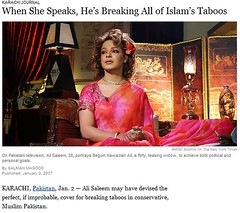
When She Speaks, He’s Breaking All of Islam’s ...Image by JAMALadi via Flickr

Source: Immigration and Refugee Board of Canada (via UNHCR)

Evidence of open and active gay communities in urban centres of Pakistan, including Islamabad, Karachi and Lahore, could not be found among the sources consulted by the Research Directorate. Specific information relating to the situation of homosexuals in urban centres was scarce among the sources consulted by the Research Directorate. A 3 April 2009 article in The Independent, which discusses Chay, Pakistan's first magazine about sexuality, notes that in Lahore and Karachi, the "gay scene is largely underground" (The Independent 3 Apr. 2009). This information could not be corroborated among the sources consulted by the Research Directorate.

Though not specific to urban centres, the following information may be of interest. A 6 February 2008 International Gay and Lesbian Human Rights Commission (IGLHRC) report, submitted to the United Nations (UN) Human Rights Council for its 2008 Universal Periodic Review, indicates that

[t]here is no known grassroots activism among lesbians, gays, bisexuals, transsexuals and transgender (zenana) communities in Pakistan. This lack of activism, the silences around sexualit(ies), and deeply closeted status of most gays and lesbians in Pakistan (many of whom lead double lives to avoid revealing their sexual orientation) makes it difficult to accurately assess their living conditions and human rights situation. Anecdotal information from Pakistani gay people who have left the country describes fear, secrecy, isolation, suicides, forced marriage, family and community pressure to conform to heterosexual norms.

This Response was prepared after researching publicly accessible information currently available to the Research Directorate within time constraints. This Response is not, and does not purport to be, conclusive as to the merit of any particular claim for refugee protection. Please find below the list of sources consulted in researching this Information Request.

References

The Independent [London]. 3 April 2009. "Let's Talk About Sex, and Rights, Pakistan." [Accessed 10 Nov. 2009]

(pdf) International Gay and Lesbian Human Rights Commission (IGLHRC). 6 February 2008. "Human Rights and Transgender People in Pakistan." [Accessed 5 Nov. 2009]

Additional Sources Consulted

Oral sources: Al-Fatiha, Asian Human Rights Commission (AHRC), Imaan, Pakistan Society, AIDS Prevention Association of Pakistan (APAP), Sathi Foundation and a social anthropologist did not provide information within the time constraints of this Response.

Internet sites, including: 365 Gay.com, The Advocate, Al-Fatiha Foundation, Asian Human Rights Commission (AHRC), Asylum Aid, Australia Refugee Review Tribunal (RRT), British Broadcasting Corporation (BBC), European Country of Origin Information Network (ecoi.net), Freedom House, GlobalGays.com, Human Rights Watch (HRW), Imaan, International Gay and Lesbian Travel Association, New Internationalist, Pink News, Social Science Research Network (SSRN), SodomyLaws.org, South Asia Human Rights Documentation Centre (SAHRDC), United Kingdom (UK) Border Agency, United Nations (UN) Integrated Regional Information Networks (IRIN).

Reblog this post [with Zemanta]

Related Posts with Thumbnails